
You're sitting at the kitchen table in Panther Creek, trying to discuss custody, the house, retirement accounts, and a possible business valuation without turning every sentence into a fight. You don't want a Montgomery County courtroom deciding the details of your family's future, but you also don't want to sign an agreement that protects the peace for a week and creates problems for years.
That's the central question behind divorce mediation vs collaborative divorce in The Woodlands. Both are settlement-first options. Neither works by magic. Mediation relies on a neutral facilitator and direct negotiation, while collaborative divorce creates a coordinated professional team around both spouses. The right choice depends on conflict, disclosure, assets, children, and whether both people will stay committed when negotiations become uncomfortable.
Two Paths to a Divorce in The Woodlands
A representative couple in The Woodlands may begin with the same goal: keep the divorce private, protect the children, and avoid handing every major decision to a judge. They may live in Panther Creek, share a home, and have children whose school, activities, and routines are rooted in Montgomery County. Yet the process that fits them can change dramatically depending on how they handle information and disagreement.
Mediation usually places both spouses with one neutral mediator. The mediator manages communication, identifies unresolved issues, and carries proposals between the parties. The mediator doesn't represent either spouse and can't give either person personal legal advice. Each spouse may have a separate attorney to prepare the case, advise privately, and review the settlement.
Collaborative divorce uses a different structure. Each spouse retains a collaborative lawyer, and the parties sign a participation agreement promising to negotiate outside litigation. The process can also include jointly selected financial, parenting, or communications professionals. The collaborative lawyers work toward a complete settlement, but they generally can't continue representing the parties if the process ends and someone files or proceeds in court.
| Factor | Mediation | Collaborative divorce |
|---|---|---|
| Core structure | One neutral facilitator, with separate lawyers optional | Two collaborative lawyers and, when needed, jointly used professionals |
| Best starting point | A case where both spouses can exchange information and bargain | A case needing organized, multidisciplinary problem-solving |
| Court involvement | Court mediation may be ordered or chosen by agreement | Voluntary settlement process under a written participation agreement |
| Main vulnerability | One spouse may dominate, delay, or withhold information | The process can collapse if one spouse exits or refuses good-faith participation |
| Main advantage | Flexible, efficient negotiation with fewer required professionals | More structured support for complicated finances, parenting, or emotional dynamics |
Mediation has a long history as a mainstream alternative to litigation. A large multi-jurisdiction review found settlement rates typically ranging from 50% to 85%, with many studies clustering in the middle to upper part of that range, and it found that mediated agreements tended to have stronger compliance than litigated outcomes. The same review associated mediation with more shared parenting or joint custody outcomes than litigation, a meaningful consideration for parents trying to preserve their relationship with their children. The review of divorce mediation research provides that historical context.
The practical decision: Choose the process that matches your spouse's actual behavior, not the process that sounds most peaceful in a brochure.
Collaborative divorce can be valuable when both spouses want a negotiated result but need more structure than a single neutral can provide. It's not automatically gentler, cheaper, or safer. For a family in The Woodlands, the question is whether the additional team and commitment will solve the case's problems or create another layer of cost and risk.
How Each Process Works in Texas
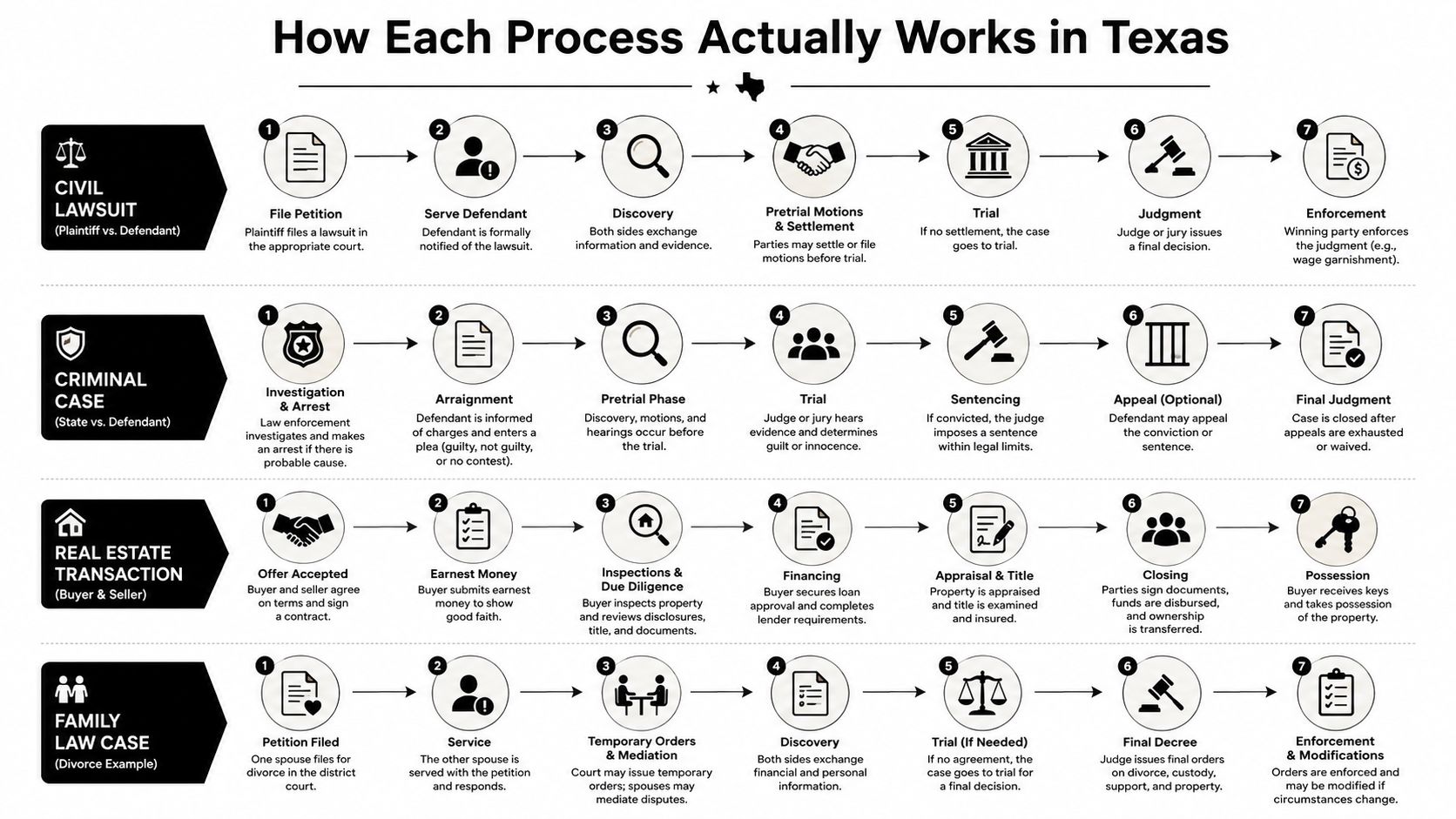
A spouse who says, “I don't want this to destroy us,” still needs a process that can withstand the other spouse's conduct. In Montgomery County, the choice turns on more than whether both sides prefer settlement. It turns on whether the case involves a high-conflict relationship, a privately held business, executive compensation, or financial information that requires coordinated professional review.
Mediation follows a flexible negotiation model
Mediation commonly unfolds through five stages:
Preparation. Each spouse gathers financial records, identifies parenting concerns, and reviews settlement positions with separate counsel. A mediator can organize the discussion, but does not protect either spouse's legal interests.
Orientation. The mediator explains confidentiality, communication rules, and the issues requiring decisions. The spouses may meet together or work in separate rooms while the mediator moves between them.
Negotiation. The mediator helps the spouses evaluate tradeoffs involving property, parenting time, support, retirement accounts, and other divorce terms. The mediator may explain process options, but cannot decide who is right or direct either spouse to accept an agreement.
Drafting. If the parties reach terms, they are placed in a written mediated settlement agreement. Texas Family Code Section 6.602 addresses mediation in a divorce. An agreement becomes binding when it prominently states that it is not revocable and is signed by the parties and any attorneys present. Texas Family Code Section 6.602 provides the statutory reference.
Finalization. The attorneys prepare the final divorce documents for court approval. Unresolved issues remain for another negotiation, hearing, or trial process.
The court may order mediation on its own motion, or the parties may agree in writing to mediate. That flexibility makes mediation in The Woodlands useful when the spouses want to test settlement without adopting a larger professional structure. It also gives a prepared spouse room to address disputed records before committing to final terms.
Collaborative divorce creates a formal settlement team
Collaborative divorce begins with a written participation agreement. The agreement identifies each spouse's collaborative lawyer and confirms that the parties are choosing voluntary settlement rather than asking the court to decide disputed issues. The Texas Collaborative Family Law Act requires the agreement to be written and to identify the collaborative lawyers. The Texas statutes on collaborative family law set out that framework.
Each spouse has separate counsel. The parties exchange information fully and candidly, often with jointly selected professionals when the facts require them. A financial professional may examine business records or compensation. A parenting professional may help develop workable arrangements. A communication professional may address conflict that prevents productive meetings. The team exists to solve those problems together instead of building separate litigation positions.
The spouses also agree to suspend court proceedings while negotiations continue. If the process fails, the collaborative lawyers must withdraw, and the spouses generally need new litigation counsel before taking the dispute to court. That withdrawal rule is part of the design, so a spouse who may abandon settlement should not enter the process casually.
Texas Family Code Chapter 15 supplies the statutory framework, while the Texas Bar's overview of collaborative family law explains how collaborative practice differs from mediation. A Divorce Lawyer in The Woodlands, TX can help assess the facts before either spouse signs a participation agreement.
Cost, Timeline, and What Happens If It Falls Apart
Mediation appears cheaper upfront, but a failed mediation can cost more than a collaborative divorce that reaches agreement. The right comparison depends on the work your case requires, the professionals involved, and the consequences if settlement ends.
Collaborative divorce research has reported resolution without litigation at roughly 85% to 86%. One International Academy of Collaborative Professionals result reported 86% resolution, while a Florida analysis reported 85% full resolution across nearly 300 cases from 2014 through mid-2024. Those findings are summarized in the collaborative divorce study summary, which also reported that about 60% of collaborative cases finished within six months or less.
Cost remains difficult to compare because attorney involvement and case complexity vary. The same study summary estimated average collaborative costs around $25,000, compared with about $7,500 for mediation. Those figures are not a quote for your case. They show the structural difference between hiring one neutral facilitator and coordinating two attorneys with additional professionals.
Mediation vs Collaborative Divorce at a Glance
| Factor | Mediation | Collaborative Divorce |
|---|---|---|
| Cost structure | One neutral mediator, plus each spouse's attorney if retained | Two attorneys, with neutral professionals added when useful |
| Timeline | Often more efficient when the issues are defined and both parties can negotiate | Can move efficiently with good-faith participation, but team coordination takes planning |
| Confidentiality | Settlement discussions generally occur outside the public trial process | Negotiations also occur in a settlement-focused setting under the participation agreement |
| Team size | Usually one neutral, with separate attorneys advising the spouses | Two collaborative lawyers and potentially financial or family professionals |
| Failure consequence | The same attorneys can generally continue if the matter proceeds | Collaborative attorneys must withdraw if the process collapses |
| Best financial fit | Straightforward property and parenting disputes | Complicated finances where professional coordination adds real value |
A performance review found a grand effect size of 0.36 across five studies, reflecting small-to-moderate but consistent mediation benefits involving process satisfaction, outcome satisfaction, emotional satisfaction, spousal relationship quality, and understanding of children's needs. The mediation outcome research supports mediation when efficiency and direct settlement are the priority.
Protect your downside: Before signing a collaborative participation agreement, ask how your legal budget and timeline change if your spouse quits the process.
Montgomery County families must also plan for court scheduling, temporary parenting needs, and unresolved disputes that may require formal action. Mediation still requires preparation, complete financial information, and a workable negotiation plan. It gives prepared parties a way to resolve issues without asking a judge to decide every contested point. Review this comparison of mediation and trial divorce in Texas before choosing the settlement process that fits your risks.
Which Path Fits Your Family Situation

The right process depends on the obstacle blocking agreement. A couple in Alden Bridge with modest property, predictable income, and reliable communication faces a different decision from spouses dealing with a private company, changing executive compensation, or a serious power imbalance. Texas law permits negotiated settlement, but the process must match the family's ability to exchange information and negotiate fairly.
Parenting-focused and financially straightforward
Two parents in Alden Bridge may mainly disagree about school-week schedules, holidays, transportation, and child expenses. If both can speak openly, share records, and negotiate without intimidation, mediation is usually the better fit.
Mediation keeps the work focused on a parenting plan and a manageable property list. It avoids adding professionals and meetings when the dispute does not require them. That efficiency disappears if one parent withholds basic financial information or uses parenting discussions to control the other parent.
For this family, prepare before the first session. Gather income records, account information, proposed schedules, and a clear list of unresolved issues. A mediator can help structure negotiation, but cannot investigate missing assets or advise either spouse about what Texas law requires.
A private business or executive compensation
A dual-income family in Sterling Ridge may own part of a private company, hold restricted compensation, or depend on bonuses and equity that change over time. Dividing checking accounts will not resolve questions about ownership, valuation, tax treatment, or future income.
Collaborative divorce fits when both spouses will disclose records and work with a neutral financial professional. That professional can organize business information, identify valuation questions, and help the spouses compare settlement options. The team gives the family a structured way to address financial issues before every disagreement becomes a courtroom dispute.
Mediation remains workable when each spouse has independent legal advice and the records are already available. I would favor mediation if the valuation is clear or the financial disagreement is narrow. I would favor collaborative divorce when the family needs organized financial problem-solving and both spouses will provide complete information.
High conflict and financially opaque behavior
A spouse who controls the accounts, refuses to produce records, or repeatedly changes the story about income creates a poor fit for collaborative divorce. The process depends on voluntary participation, disclosure, and continued engagement. Someone who performs cooperation while hiding information can use that structure against the other spouse.
Mediation has a similar weakness when the parties cannot bargain on reasonably equal footing. A neutral mediator manages the discussion, but does not investigate assets or represent the spouse with less information. Formal discovery, court orders, or litigation protections may provide a safer and more reliable response.
Collaborative results can be strong when both parties participate in good faith. As noted earlier, the reported study found that many cases reached agreement, while some reconciled and others ended before full settlement. The point is not that collaborative divorce guarantees success. It is that the process depends on honest disclosure and sustained participation, as described in the collaborative divorce study summary.
Emotionally complex families
Some families are stuck on grief, fear, communication, or parenting decisions that trigger old conflicts rather than on arithmetic alone. If children need a carefully designed transition plan, a collaborative team may provide more support than mediation by itself.
That structure can help parents address communication routines, decision-making, school issues, and changing household expectations. It can also fail quickly when one spouse will not participate truthfully or treats every professional as an opponent.
Mediation suits cooperative couples with complete information and a defined dispute. Collaborative divorce serves families that need structured financial, parenting, and communication support, provided both spouses will honor the process. Safety concerns, coercion, serious concealment, or deliberate delay call for court intervention instead.
Questions to Ask Before You Sign Anything
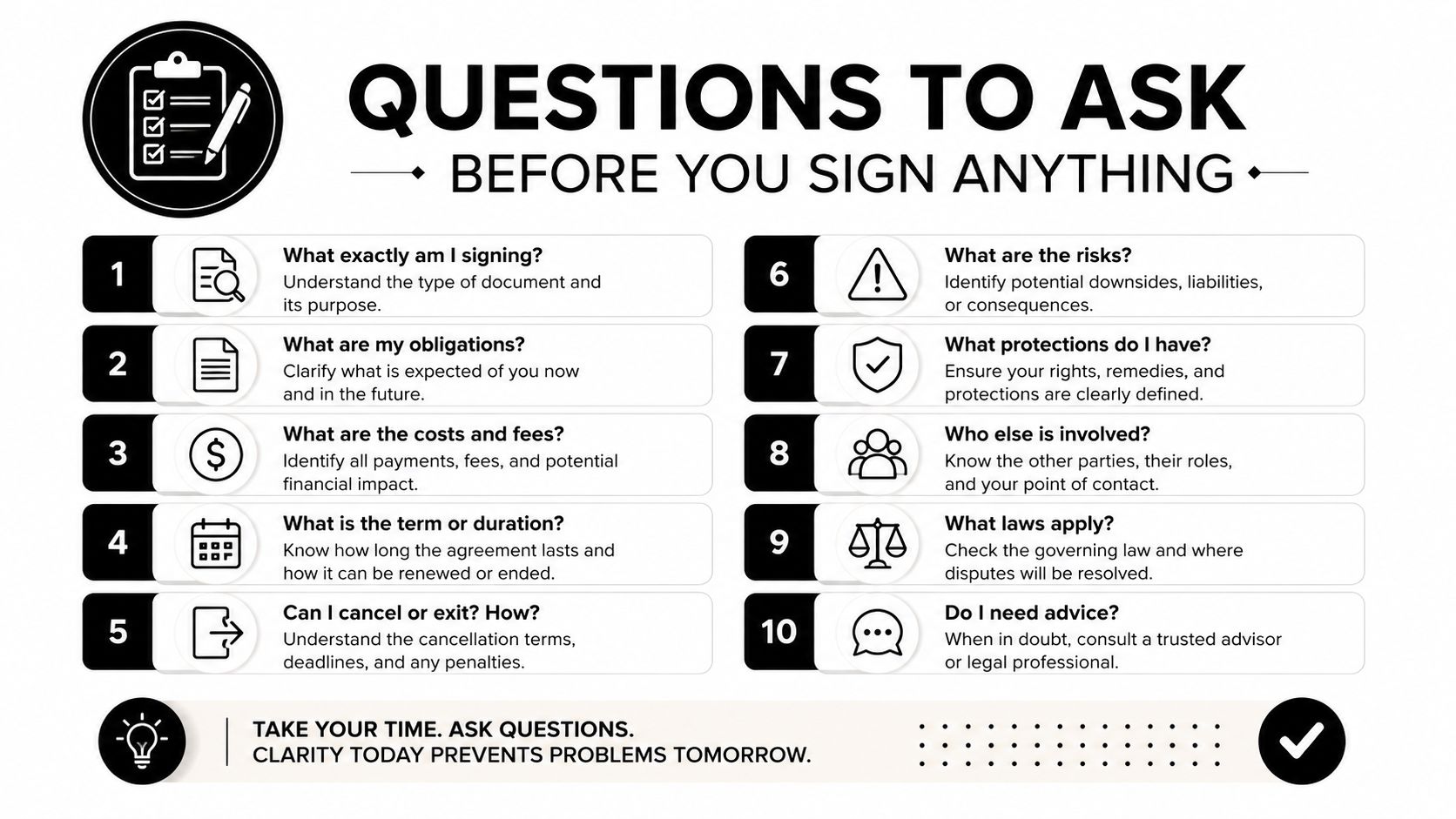
Don't choose a process because your spouse says it will be cheaper or because a website calls it peaceful. Ask questions that reveal how the process will handle your actual risks.
Questions for a mediator
Bring these questions to the first meeting:
- Training and role: What mediation training do you have, and how do you keep your role neutral when one spouse has more legal or financial knowledge?
- Legal boundaries: What can you explain about the process, and what questions must each spouse take to an independent attorney?
- Fees: Are fees hourly, session-based, or structured another way? How are cancellations, additional sessions, document drafting, and follow-up handled?
- Scheduling: How quickly can the first session occur, and how will urgent parenting or financial issues be handled while the divorce is pending?
- Impasse: What do you do when negotiations stall? Will you identify the unresolved issue, suggest another session, or end the mediation?
- Safety: How do you screen for family violence, coercion, intimidation, or a serious power imbalance? Can the spouses work separately if necessary?
A mediator's job is to facilitate negotiation, not to protect one spouse's legal position. Each party should understand the proposed agreement before signing, especially because a properly executed mediated settlement agreement can become binding under Texas Family Code §6.602.
Questions for collaborative lawyers
Ask each prospective collaborative lawyer:
- Relevant experience: How have you handled private businesses, executive compensation, retirement assets, or complicated parenting disputes in Montgomery County?
- Professional team: Which neutral professionals might the case require, and what specific problem would each person solve?
- Disclosure: What records must both spouses provide, and what happens if the information is incomplete?
- Withdrawal: If the process ends, what steps follow after mandatory attorney withdrawal, and how should the family protect the transition?
- Continuity: Who prepares the final documents, and how will the agreed terms be carried into the final decree?
- Conflict assessment: What facts would make you recommend mediation, litigation, or temporary court orders instead?
The questions to ask a divorce lawyer in Texas can help you organize the first consultation.
Documents to gather
Collect what you can before choosing either path:
- Income records: Recent pay stubs, compensation statements, and records showing bonuses or equity.
- Tax information: Three years of tax returns, including schedules and business-related filings.
- Property records: Deeds, mortgage statements, vehicle information, account statements, and insurance records.
- Retirement information: Current retirement and investment statements, beneficiary information, and loan records.
- Business materials: Ownership documents, financial statements, valuation materials, and records showing distributions.
- Parenting outline: A proposed school-week schedule, holidays, transportation plan, healthcare responsibilities, and communication preferences.
This article is general information, not legal advice. Texas law restricts who may provide legal advice, and your facts should be reviewed by a qualified Texas family lawyer before you sign a participation agreement or mediated settlement agreement.
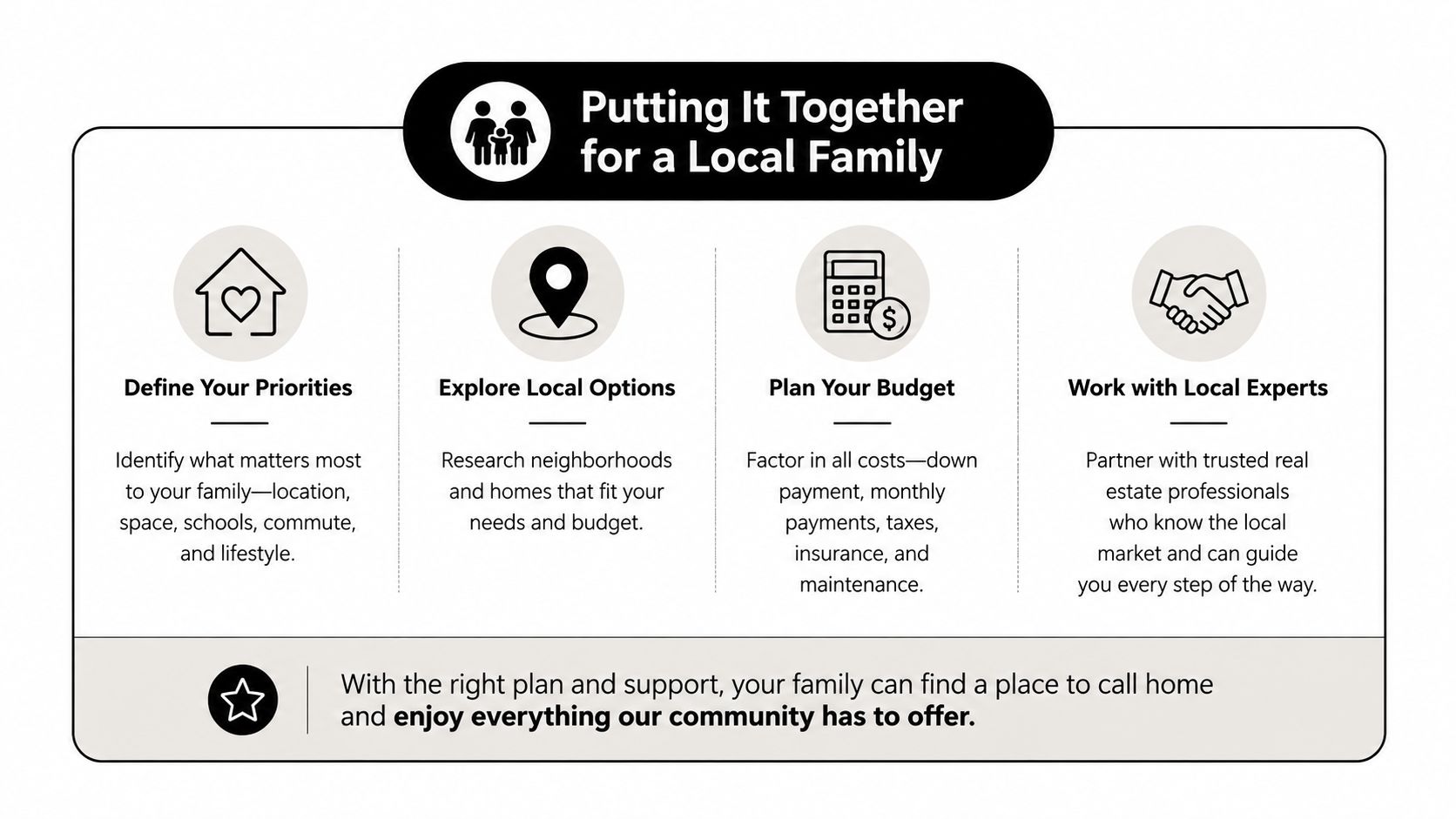
Putting It Together for a Local Family
Consider a family in Creekside with two children, a jointly owned service business, and a disagreement about the children's weekday schedule. The parents aren't comfortable with each other, but both still exchange records and want to avoid a public courtroom battle. One parent needs temporary parenting terms while the business information is organized.
The first decision is conflict. If neither spouse is using money or parenting time as pressure, settlement remains possible. The second is complexity. The business may require a neutral financial professional, but that doesn't automatically require collaborative divorce. If the business records are complete and each spouse has independent legal advice, mediation may provide the cleaner route.
If the financial picture is incomplete or the parents need deeper support around communication, collaborative divorce may justify its added structure. If one spouse refuses disclosure, the family may need court involvement, discovery, or an interim parenting order instead of pretending that a settlement process can fix a trust problem.
What to do next
- Assess conduct: Decide whether both spouses are exchanging information and negotiating in good faith.
- List complexity: Identify businesses, executive compensation, retirement assets, real estate, and child-related disputes.
- Gather records: Assemble tax returns, income documents, account statements, business materials, and a parenting outline.
- Get individual advice: Speak with a Texas family lawyer before signing mediation or collaborative paperwork.
- Choose the process: Use mediation for a cooperative, defined dispute, and consider collaborative divorce when a committed professional team adds needed value.
- Plan for failure: Ask what happens if the other spouse stops participating, hides information, or refuses to settle.
This is general information, not legal advice, and it doesn't create an attorney-client relationship. A case-specific review is the responsible next step when your children, property, or long-term financial stability are involved.
The Law Office of Bryan Fagan helps clients evaluate mediation, collaborative divorce, and litigation options for family-law disputes in The Woodlands and Montgomery County. Visit The Law Office of Bryan Fagan to schedule a consultation and discuss which path fits your conflict level, finances, and parenting priorities.