 Skip to content
You're probably here because a parent's health is changing fast, the house is paid down, and nobody wants to make a wrong move that costs the family everything. In The Woodlands and across Montgomery County, that fear is rational. Medicaid rules in Texas are tight, the paperwork is unforgiving, and a delay of a few months can change the whole outcome.
A Medicaid planning attorney in The Woodlands, TX doesn't just fill out forms. The job is to line up income, assets, deeds, trusts, and timing so a family can qualify for long-term care without needlessly burning through savings or forcing a spouse out of the home. That matters more here than in many places because local families often hold substantial home equity, retirement accounts, and business interests.
Texas is still an income-cap state, and for 2026 a single applicant for Nursing Home Medicaid generally has to stay below $2,982 per month in income and $2,000 in countable assets, while a couple applying together faces a $5,964 income limit and a $3,000 asset limit (Texas Medicaid eligibility overview). Texas also uses a 60-month look-back period for long-term care transfers, so gifts and transfers inside that window can create penalties (Texas Medicaid eligibility overview). Families in The Woodlands need to understand that before they move money, sign deeds, or “help out” a child.
What Medicaid Planning Really Means for The Woodlands Families
A Sterling Ridge couple in their 70s usually doesn't call me because they want to game the system. They call because the husband's dementia is getting worse, the wife is still healthy, and they're staring at a home they've built equity in for years. The question is blunt. How do they keep the house, keep enough income for the spouse still at home, and still qualify for care when the time comes?
Medicaid planning means doing the legal and financial work before someone applies for long-term care Medicaid so the family can qualify without spending every dollar or losing the family home. In Texas, that planning usually starts with two different tracks. One is institutional Medicaid, which helps cover nursing home care. The other is home and community-based services, which can support care at home for eligible people through waiver programs.
The Woodlands makes this more urgent than a lot of Texas markets. Montgomery County had 620,443 residents in the 2020 Census, and 12.4% of them were age 65 and older (Montgomery County demographic profile). Texas as a whole had 3,583,905 residents age 65 and older, or about 12.1% of the state population (Texas demographic profile). That senior share keeps demand high for elder-law planning in fast-growing suburbs.
A real Medicaid planning attorney handles legal structuring, trust drafting, applications, appeals, and fair hearings. A financial planner can help you organize money. A paralegal can assemble papers. But only a licensed Texas lawyer can give advice on how to move assets, protect a spouse, and avoid a look-back penalty under state law.
Practical rule: if the family's main asset is the home, the planning question is not “Can we keep everything?” It's “Do we keep the house for the spouse, or do we protect more for the kids and accept a different trade-off?”
That's the choice Montgomery County families need to make early, while there are still options.
Texas Income and Asset Rules You Need to Know for 2026
Texas Medicaid planning starts with math, not emotion. For a single applicant, the default resource cap is $2,000, and for a married couple applying together it's $3,000 in countable assets under the 2026 framework (Texas Medicaid eligibility overview). That is why a Cochran's Crossing home with a modest property tax bill can still be a planning problem. The taxes may be manageable, but the equity, retirement accounts, and titled assets may not be.
What counts and what doesn't
Caseworkers look at countable assets differently than families do. A primary residence may be exempt in many situations, one vehicle is often exempt, prepaid burial arrangements can be exempt, and certain retirement accounts depend on how they're structured and paid out. That's the core problem in The Woodlands. A family can feel “asset rich” but still be trapped by an eligibility rule that treats only some assets as countable.
Texas also protects the spouse still at home through spousal impoverishment rules, including the Community Spouse Resource Allowance and the Monthly Maintenance Needs Allowance. Those rules matter because the healthy spouse should not be forced into poverty just to cover care for the spouse who needs Medicaid. If the couple is also dealing with a property division issue, Property Division Lawyer in The Woodlands is the kind of practice area that often overlaps with those asset questions in a divorce context.
Bottom line: if the house is the main asset, don't assume “we're under the tax appraisal value, so we're fine.” Medicaid doesn't care about sentiment. It cares about title, equity, exemptions, and whether the asset is countable.
The healthy spouse can also receive income through the monthly allowance rules when the applicant's income is too high. That's where families get tripped up. They think income just “belongs” to whoever earns it. Medicaid doesn't work that way.
| 2026 Texas Medicaid Eligibility Snapshot | Single Applicant | Couple (Community Spouse at Home) |
|---|---|---|
| Monthly income limit | $2,982 | $5,964 |
| Countable asset limit | $2,000 | $3,000 |
| Look-back period | 60 months | 60 months |
| Core planning issue | Qualify without spending everything | Protect spouse while qualifying |
If you're also sorting out retirement, wills, or beneficiary designations, an Estate Planning Attorney in The Woodlands is often part of the same conversation, because the documents have to work together.
The 60-Month Look-Back and How the Penalty Is Calculated
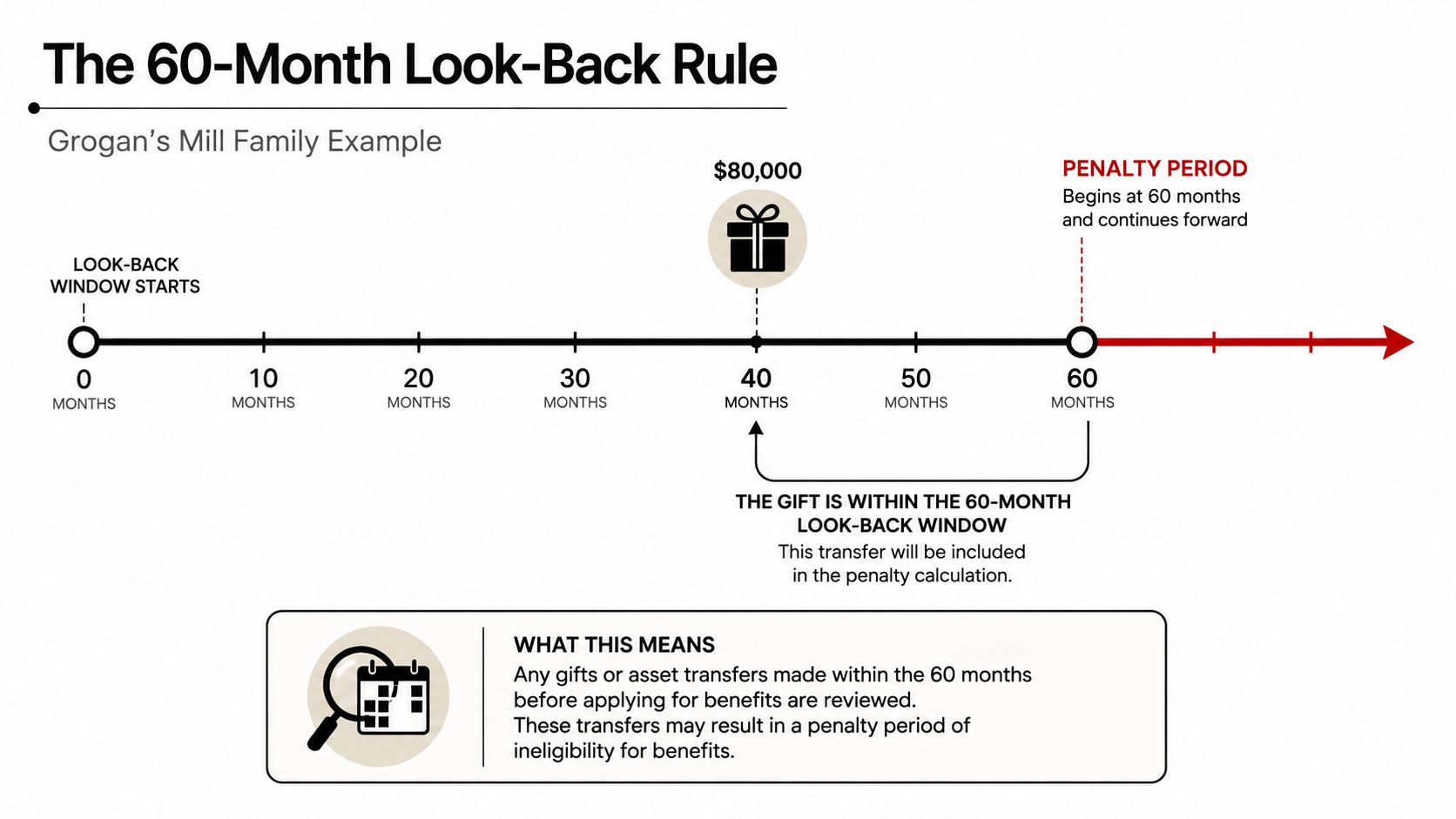
A Grogan's Mill family can do almost everything right and still lose eligibility because of one transfer. A mother gives $80,000 to her daughter 40 months before applying, calling it family help. Medicaid treats that as a transfer for less than fair market value inside the look-back period, and the issue becomes a penalty calculation.
Texas reviews uncompensated transfers made by the applicant or spouse during the 60 months before application and divides the total by the state's divisor to set the ineligibility period. For case actions disposed on or after Sept. 1, 2023, Texas uses a divisor of $242.13 per day (Texas HHSC uncompensated transfers handbook). That means even a smaller transfer can create real delay. At that divisor, roughly one month of ineligibility comes from about $7,339 of uncompensated transfers.
The exceptions are narrow. Transfers to a spouse, to a disabled child, or in certain other protected situations can avoid a penalty. Transfers below fair market value into trusts or to children usually do not. Families need to treat informal gifts, title changes, and “just helping out” payments as transfer risks until they are reviewed.
A short video walkthrough can help families understand the timing problem:
The penalty clock starts with the medical effective date if the other eligibility rules are met. Application timing changes when the penalty begins, so filing early or late can change the result. Texas also says the penalty begins the first day of the month of the medical effective date when the other requirements are satisfied (Texas HHSC uncompensated transfers handbook).
Do this first: collect every transfer record before anyone signs a Medicaid application. The state does not fill in missing facts in your favor.
Homeowners often ask about deed planning before they touch anything else. A Lady Bird deed in The Woodlands can affect how title and eligibility interact, so it belongs in the conversation early, not after the application is already filed.
Common Strategies Used by a Medicaid Planning Attorney
A Woodlands family usually needs more than one move. The right plan depends on whether the goal is Medicaid eligibility now, or preserving assets for a healthy spouse and the next generation. Timing controls the result.
Income planning and spousal protection
If the applicant's gross monthly income is over the Texas cap, a Qualified Income Trust, often called a Miller Trust, can route the excess income through the trust instead of blocking eligibility. The trustee then pays the Medicaid share of cost and keeps the income in the right place.
The spouse at home also needs attention. The Community Spouse Resource Allowance and the monthly income allowance rules can protect the healthy spouse from being left short on the mortgage, taxes, and basic living costs. If the home spouse cannot keep the household running, the plan has failed even if Medicaid approval comes through.
Trusts and transfer tools
An Irrevocable Trust can be part of the answer, but only if it is funded early enough. For families who need a closer look at that tool, an Irrevocable Trust Attorney in The Woodlands TX can explain whether the timing works for the facts on the table. The five-year look-back still applies, and funding a Medicaid Asset Protection Trust too late usually puts the transfer inside the penalty window. Gifts and title changes can create the same problem.
This matters in high-equity homes. A spouse may want to protect the house without triggering a denial or a penalty, but the deed has to match the Medicaid strategy. Families in a High-Net-Worth Divorce in The Woodlands face another layer of risk, because title changes, division orders, and support terms can affect eligibility and recovery rights. Those issues need to be coordinated before anyone signs papers.
Contracts and financing devices
Annuities, promissory notes, and personal care contracts can help in the right case. HHSC will still review them closely to see whether they were set up for value or dressed up as transfers. If the paperwork does not look commercial, the agency can treat it as uncompensated.
The lawyer's job is simple here. Match the tool to the facts, then reject the tools that will wreck the application.
| Medicaid Planning Strategies | What Each Tool Does | Look-Back Risk | Best Timing |
|---|---|---|---|
| Qualified Income Trust | Channels excess income so the applicant can qualify | Low when properly funded | When income is over the cap |
| Spousal allowances | Protects the spouse at home | Low if documented correctly | Before filing |
| Irrevocable trust | Moves assets out of the applicant's name | High if funded too late | Years before need |
| Annuity or note | Converts assets into structured payments | Medium to high if badly drafted | Before application, with legal review |
If the Medicaid plan has to fit with the rest of the estate plan, a Property Division Lawyer in The Woodlands and an estate planning lawyer should be looking at the same documents. The trust, will, and beneficiary designations cannot fight each other.
Documents to Gather and a Realistic Planning Timeline
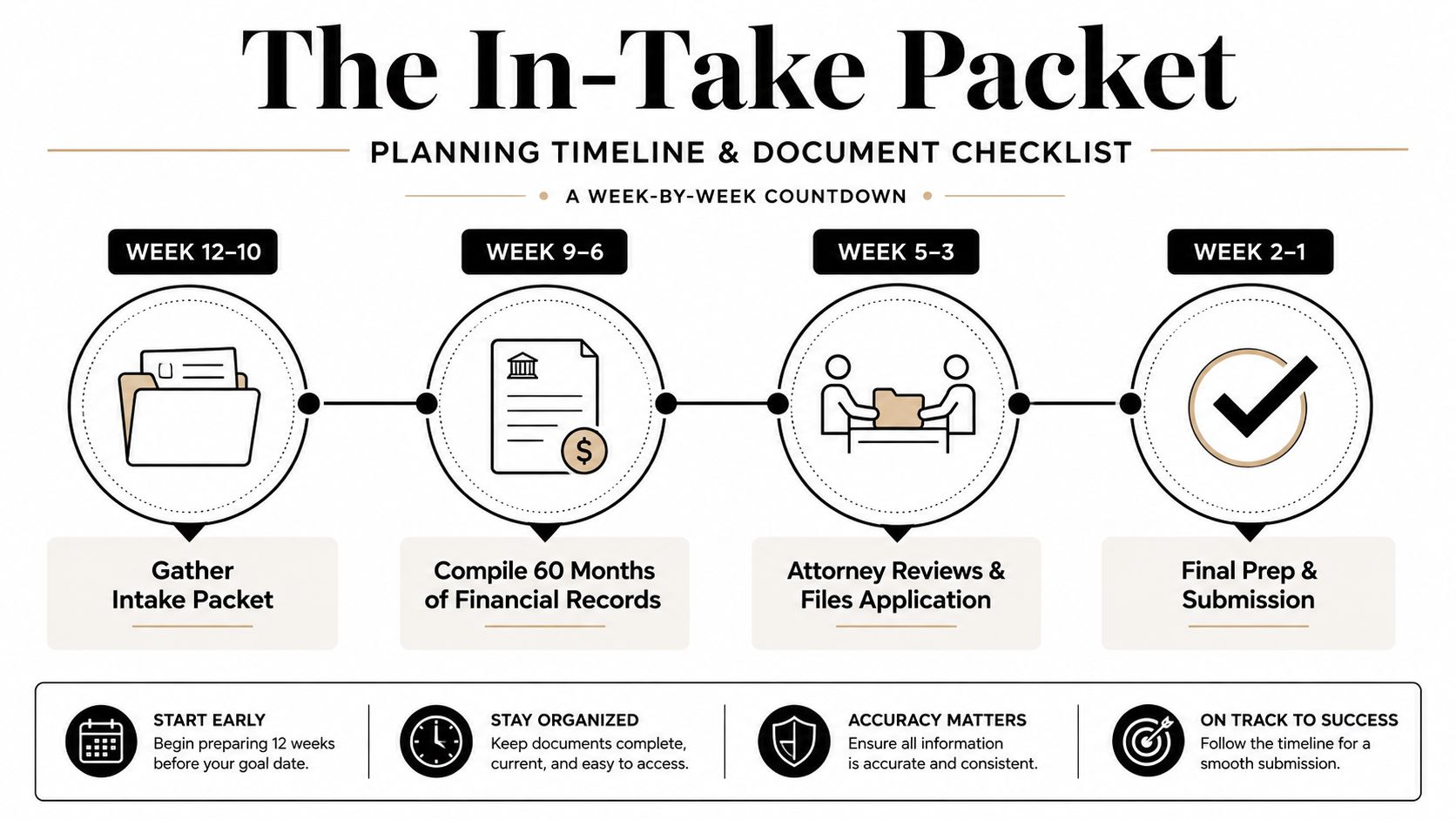
If a family waits until the nursing facility hands them a Medicaid packet, they're already behind. The intake packet should include 60 months of bank, brokerage, and retirement statements, all life insurance policies, deeds and mortgage payoff information for any The Woodlands home, vehicle titles, the last two years of tax returns, Social Security award letters, and any prior divorce decree or prenuptial agreement.
What the timeline usually looks like
A crisis case means the person is already in a facility and the family needs a fast filing. In Texas, that often takes 45 to 90 days to approval, depending on how complete the records are and how messy the finances are. A proactive case starts 12 to 36 months ahead and gives the attorney room to use trust funding, deed work, and other restructuring tools. A long-term plan starts 3 to 5 years ahead and is where the family can use caregiver agreements and asset reorganization with far less risk.
The cost follows the complexity. Texas flat fees often run $3,500 to $7,500 for crisis planning and $7,500 to $15,000 for proactive irrevocable trust drafting. Those numbers are not cheap, but they're usually a lot less expensive than a bad spend-down or a long penalty period.
File early, not perfect: a clean application with missing details is still better than a perfect plan that starts after the transfer window has already closed.
The paperwork also tells the story of the family. Divorce decrees, trust records, and tax returns often show whether an asset is separate, community, exempt, or already tied up in another court case. If the records are scattered, the Medicaid application will be slower and riskier.
How Medicaid Planning Intersects With Divorce and Probate in Montgomery County
A family can be dealing with divorce papers, a Medicaid application, and a probate case at the same time. Montgomery County courts do not pause for that mess. If a case is already moving in the 410th or 418th District Court, the asset picture can change fast. For Medicaid, only the applicant's separate income and assets count. A badly drafted QDRO can push retirement funds into the wrong name at exactly the wrong time.
That is why divorce and Medicaid planning have to be handled together. If retirement money is divided in a way that leaves the wrong spouse with countable assets, the Medicaid filing gets harder, not easier. Probate can create the same problem, because the timing of a court case affects when assets move and who has control over them. If you need a refresher on that court timeline, review How Long Does Probate Take in Texas.
Probate is not a side issue
When the Medicaid applicant dies, Texas estate recovery can seek reimbursement from the probate estate. Under Texas rules, the claim is generally presented within 70 days after the program gets actual notice of death for a Medicaid recipient age 55 or older who received covered long-term care services (Texas MERP guide). Texas also allows recovery after death for certain covered services, and the state may file against the estate with limited exceptions and hardship defenses (Texas estate recovery rule summary). Recent Texas coverage also noted a rule change announced in late August 2026, so families need current advice, not a stale FAQ.
A creditor's claim filed in Montgomery County Probate Court can override a Will that leaves everything to the children. That is the part many families miss. They assume the Will controls everything. It does not. State recovery claims can reduce what is left after Medicaid benefits have been used.
Don't assume the homestead is untouchable. Homestead rules, probate claims, and estate recovery can collide, especially when the home is the main asset left.
The right sequence matters. Divorce counsel, probate counsel, and a Medicaid planning attorney should talk before anything is filed. Once the wrong paper reaches the courthouse, cleanup gets expensive.
Choosing the Right Medicaid Planning Attorney in The Woodlands TX
Start with the obvious question. Does the lawyer practice Medicaid planning, or are they just an estate planner who dabbles in it? You want a Texas-licensed attorney with no active grievances through the State Bar of Texas, and you want to know how many Texas Medicaid applications they've filed in the last 12 months.
Ask whether they handle both institutional Medicaid and waiver programs like STAR+PLUS and HCS. Ask for a sample timeline, a flat-fee quote versus hourly billing, and confirmation that the same attorney will draft any Irrevocable Trust or Qualified Income Trust. If they can't explain the strategy in plain English, keep looking.
Local knowledge matters more than people admit. A lawyer who works Montgomery County cases knows how HHSC investigators look at bank statements, annuities, and transfers. They also know how local facilities in Shenandoah, Conroe, and the Grogan's Mill area usually submit the MEPD form.
If divorce or probate is already active, the attorney should coordinate with the other lawyers, not ignore them. Ask for two recent client references from the 77380, 77381, or 77382 ZIP codes. And if you want one shop that already handles family-law and probate overlap, The Law Office of Bryan Fagan is one local option that works in those related court systems alongside this kind of planning.
| Vetting Checklist for a Woodlands Medicaid Planning Attorney | What a Qualified Answer Looks Like |
|---|---|
| Do you actually handle Medicaid planning? | Clear examples of Texas Medicaid filings and strategy |
| Are you Texas licensed and in good standing? | Verifiable licensure and no active grievances |
| Do you handle both institutional and waiver cases? | Yes, with specific program knowledge |
| Will you give a written fee quote? | Flat fee or hourly scope in writing |
| Who drafts the trust? | The supervising attorney, not an unknown staff member |
| Do you coordinate with divorce or probate counsel? | Yes, when other cases are active |
| Can you explain timing and look-back risk? | A direct answer, not a sales pitch |
If you're staring at a nursing home bill, a divorce decree, or a probate file, don't wait for the paperwork to sort itself out. Get the records together, ask the hard questions, and make the plan before the next transfer or court deadline changes your options.
The Law Office of Bryan Fagan helps families in The Woodlands and Montgomery County with probate matters, divorce-related asset issues, and the kind of court coordination that often comes up in Medicaid planning. If you need a direct conversation about timing, assets, or how a pending case could affect long-term care planning, visit The Law Office of Bryan Fagan and schedule a consultation.
