
If you're in The Woodlands and you've just been served papers, or a caseworker is asking questions you don't know how to answer, parental rights termination can feel like the ground shifting under your feet. A termination case is not the same thing as a custody fight, and it's not a routine parenting dispute. In Texas, it can permanently end the legal parent-child relationship, so the details matter from the very first hearing.
Families in Panther Creek, Alden Bridge, Sterling Ridge, and Creekside often start with the same confusion. One parent thinks a signed paper will settle everything, another hears that CPS “has a case,” and a grandparent wants to know whether there's any way to keep the child connected to the family. Texas law is stricter than many expect, and Montgomery County courts apply those statewide rules to local cases.
This guide is written for people trying to understand parental rights termination The Woodlands TX in plain English. It focuses on the part most guides skip, the fact that a statutory ground alone does not win termination unless the court also makes a separate best-interest finding under the higher clear and convincing evidence standard. This is not legal advice, but it should help you ask better questions and spot the issues that matter most.
What Parental Rights Termination Means for The Woodlands Families
A mother in Creekside gets a call that CPS has filed something serious. A father in Alden Bridge believes signing a paper will end the case and keep things quiet. A grandmother in Sterling Ridge worries that a courtroom order could cut off a child from both parents and change the family structure forever. Those are different situations, but they all lead to the same hard question, what does termination do?
Termination is not just a stronger custody order. It is a court action that can permanently sever the legal parent-child relationship, which is why Texas treats it as one of the most serious outcomes in family law. That's also why people in The Woodlands often feel blindsided when they learn the court is looking at more than just conflict between adults, it's looking at whether the law allows the relationship itself to be ended.
Why this matters before you sign or agree to anything
In a custody case, a judge may change who has decision-making authority or where a child lives. In a termination case, the court is deciding whether the parent-child legal bond should remain at all. That difference matters in Montgomery County because a parent can't undo termination with a later conversation, a private agreement, or a handwritten promise.
Texas has also seen a meaningful filing pattern in recent years. The Texas Judiciary's 2024 Annual Statistical Report shows that new filings for termination of parental rights cases fell 12% in 2024 compared with 2023, and adoption filings fell 11% in the same period, which reflects how closely these proceedings move together in child welfare practice (Texas Judiciary 2024 Annual Statistical Report).
A local resource like Montgomery County Family Courts: A Local Guide can help you understand how family law cases proceed in Montgomery County courts serving The Woodlands, but it won't replace a careful look at the actual pleadings and orders in your case.
Practical rule: if a parent is talking about “giving up rights,” assume the court still has to approve everything before the legal relationship changes.
How Texas Law Defines Termination Under the Family Code
Texas does not treat termination as a private family decision. Chapter 161 of the Texas Family Code controls both voluntary and involuntary termination, and the law is explicit that only a court order can terminate parental rights. A signed relinquishment, waiver, or informal agreement might be part of the process, but it does not itself permanently end the relationship (Texas State Law Library guide to termination of parental rights).
Termination is not the same as changing custody
Think of custody like changing who holds the keys to a house. Termination is more like the law removing the family relationship itself. The court is not just deciding where a child sleeps on school nights. It is deciding whether the parent still has legal rights and duties at all.
That distinction matters in Montgomery County because many parents first hear about termination in the middle of another family dispute. A parent might lose possession time, temporary decision-making authority, or conservatorship and assume the next step is automatic termination. It isn't. Texas law still requires judicial approval, and the moving party must ask for the correct relief.
Section 161.206 of the Family Code also has practical consequences that people miss. If the court terminates the parent-child relationship, the order divests the parent and child of legal rights and duties toward each other, but the child generally retains the right to inherit from and through the parent unless the court orders otherwise. The same statute preserves certain grandparent access rights under Chapter 153 (Texas Family Code Section 161.206).
Why a signature alone is not enough
A signed paper can show intent, but it doesn't replace the judge. That's true in voluntary cases and in contested cases. For parents in The Woodlands, that means the court still has to review the legal basis for termination, the child's circumstances, and whether the outcome fits Texas law.
A signed relinquishment can start the process. It cannot end it by itself.
If a Montgomery County case is being discussed casually as if the paperwork has already settled everything, that's a warning sign to slow down and read the Family Code carefully. A signed waiver is not the finish line.
Legal Grounds and the Two Part Test Texas Courts Require
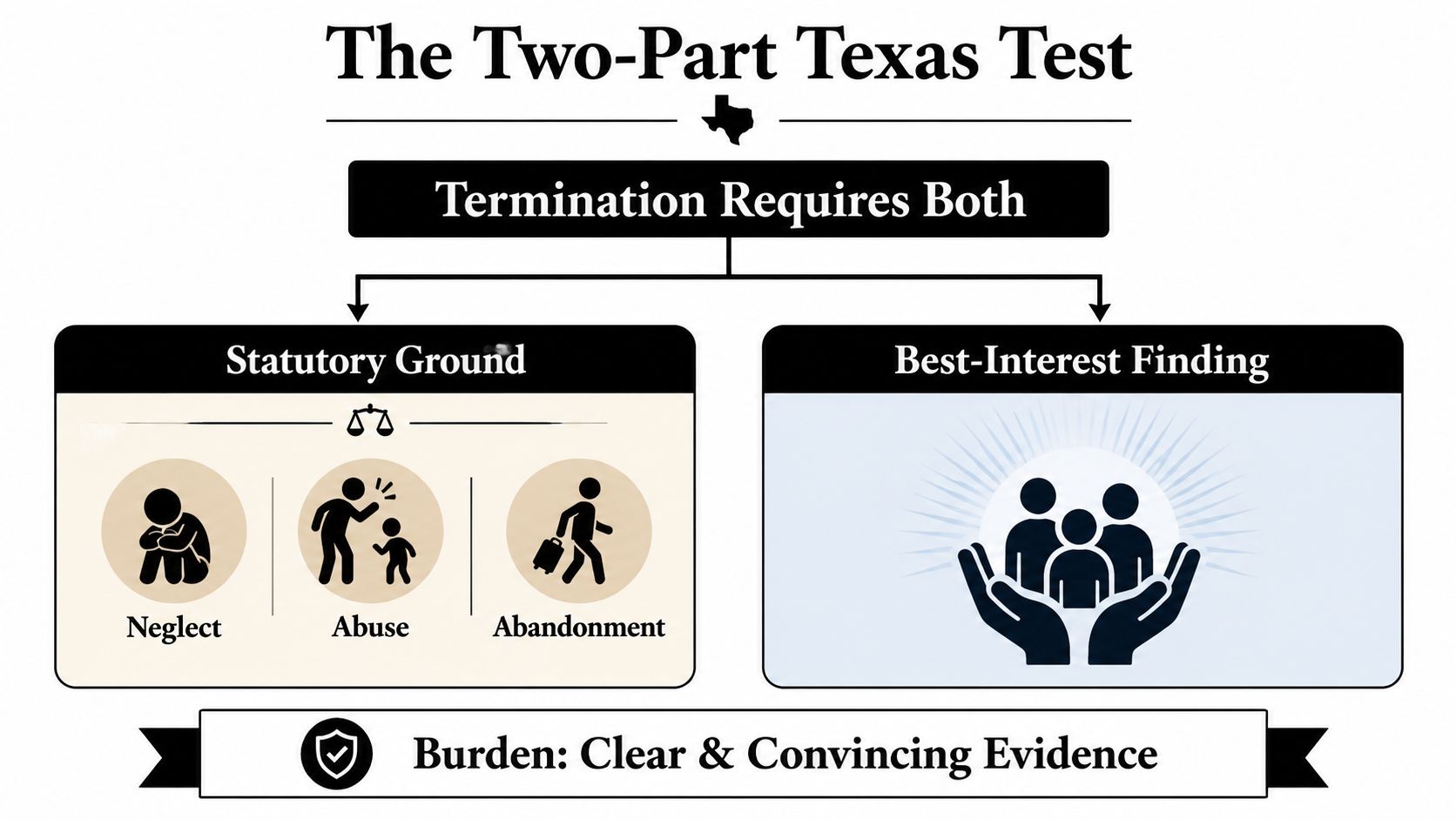
A parent in The Woodlands can lose a termination case on one issue and win on another. Texas courts do not stop at a single accusation. The party asking for termination must prove a statutory ground and must also prove that termination is in the child's best interest. Both findings must be supported by clear and convincing evidence, a higher standard than the usual civil burden (Child Welfare Information Gateway, Texas involuntary grounds).
What a statutory ground actually means
A statutory ground is a reason the court is allowed to use under the law to terminate rights. Federal guidance on involuntary termination grounds in Texas lists abandonment, endangerment, failure to support for one year, and certain serious convictions. In plain English, the court is asking whether the parent's conduct fits one of the legally recognized reasons.
That does not make every allegation enough. A claim that a parent was “not around enough” is not the same thing as proof of abandonment. A complaint that a home was chaotic is not automatically endangerment. The evidence has to show what happened, and family court usually looks for records, timelines, service histories, and concrete facts rather than conclusions.
Why the best-interest finding is separate
TexasLawHelp explains that the court still has to decide whether ending the parent-child relationship serves the child's best interest (TexasLawHelp on terminating parental rights in Texas). That separate finding is where many cases turn.
A statutory ground can be proven, yet the court can still refuse termination if the best-interest proof is weak. The judge may look at service efforts, the child's stability, safety risks, and whether the evidence shows that termination helps the child. Two cases with similar facts can still end differently because the best-interest question is its own step, not a side issue.
For Montgomery County parents, the paper trail often matters more than the emotion in the room. Service plans, visitation logs, safety reports, support records, school information, and medical records can carry more weight than angry texts or secondhand stories. A lawyer who handles CPS Defense Attorney in The Woodlands matters can help sort out which facts matter in a CPS-driven termination case.
How a Termination Case Moves Through Montgomery County Courts
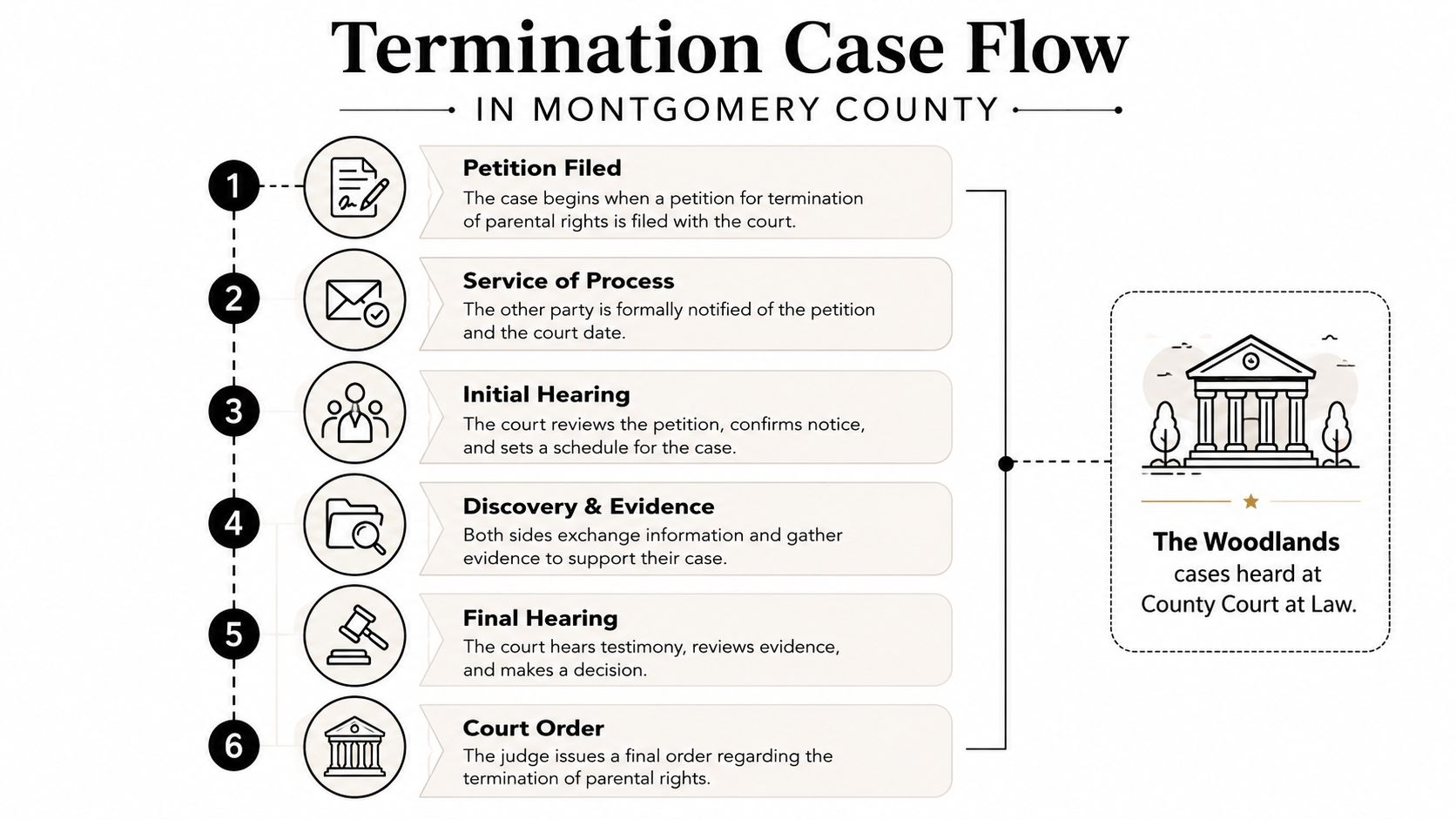
Termination cases in The Woodlands usually begin in the Montgomery County court system, and the process is more structured than expected. Someone files a petition, the other side gets served, the court sets hearings, and the parties exchange evidence before any final decision. The Texas Family Code governs the case, and the process can move quickly once CPS or another party asks for permanent relief (Texas Judiciary 2024 Annual Statistical Report).
What usually happens first
The petition has to say what the party wants and why. In a Montgomery County case, that means the request isn't vague, it has to identify the legal basis for termination and ask the court to sign a final order. If CPS is involved, the court may also set early hearings tied to safety and placement.
Service of process matters because the other parent has to know the case exists and has a chance to respond. If someone has been telling you, “They can just do this without me,” that's usually wrong. The court process exists precisely because termination is so serious.
The filing trend in Texas helps set expectations, but it doesn't tell you how your case will go. The statewide numbers show fewer termination filings and fewer adoption filings in 2024 than the year before, which is useful context, but local outcomes still depend on the facts, the evidence, and the hearing record (Texas Judiciary 2024 Annual Statistical Report).
What to bring to court
Parents should keep copies of pleadings, service plans, school notices, medical records, and any written contact with CPS or the other side. If a case is tied to a removal, this internal resource can help you understand how that hearing stage works in Montgomery County, CPS removal hearing in The Woodlands.
The practical mistake people make is waiting until the final hearing to organize evidence. By then, the record is already taking shape. In a termination case, the court is reading the history, not just the last conversation.
If the paperwork says one thing and your daily reality says another, gather the records that prove the difference.
Contest and Defense Options When Termination Is Sought
A termination petition can look overwhelming at first glance, especially when it is backed by CPS allegations or a family conflict that has already been going on for months. The court still expects proof on both parts of the case. A parent can contest the statutory ground, challenge the best-interest evidence, or show that the petitioner has not met the clear and convincing standard required in Texas. That distinction gives the defense real work to do, because a filing is only an accusation until the evidence is tested in court.

Common defense points parents raise
A parent may argue that the conduct alleged in the petition does not match the specific legal ground the other side selected. Another may point to progress, such as regular visitation, completed counseling, drug testing results, parenting classes, or more stable housing. Parents also challenge endangerment claims by showing the record is thin, the facts are incomplete, or the alleged risk is being stretched beyond what the evidence really shows.
Sufficiency problems matter in these cases. Texas appellate materials continue to show disputes and reversals tied to endangerment evidence, which is a reminder that judges need proof, not just concern or accusation. For a parent in The Woodlands, that means the case is not decided by labels alone. It is decided by what the documents, testimony, and hearing record prove.
A simple example helps. A father in The Woodlands gets served after a CPS investigation and assumes the petition has already decided the outcome because the allegations sound broad. He gathers his service-plan records, proof of completed counseling, and a log of consistent visits. That evidence does not promise a win, but it can change how the judge views the facts and whether the alleged ground is really supported.
If CPS is part of the case, How to Fight CPS in Montgomery County can help frame the issues before the final hearing. The goal is not to argue loudly. It is to build a record that answers each legal point with documents, witnesses, and specific facts.
Why the best-interest fight still matters
A statutory ground is only part of the case. Parents can still attack the best-interest proof by showing the evidence is thin, one-sided, or based on old events that do not reflect the child's current situation. That often means focusing on stability, the parent-child bond, the child's needs, and whether the petitioner has real evidence that termination would help the child, not just allegations that sound serious.
That is the part many families miss in Montgomery County. A court can hear a strong accusation and still ask whether the proof supports a permanent order. Parents who understand that point can focus their defense on the weakest links in the other side's evidence, especially where the best-interest record depends on assumptions more than facts.
Alternatives to Termination Families Should Consider
Not every difficult family case needs the permanent step of termination. In The Woodlands and across Montgomery County, families often need a solution that protects a child's safety without severing the legal relationship forever. That may mean changing conservatorship, adjusting possession, or building a reunification path rather than asking for permanent termination.
The statute matters here too. Under Section 161.206, a termination order ends legal rights and duties between parent and child, but the child generally keeps inheritance rights unless the court orders otherwise, and certain grandparent access rights can remain under Chapter 153 (Texas Family Code Section 161.206). That's one reason families should think carefully before treating termination as a casual fix.
| Alternatives to Termination Compared | Legal Effect | When It Fits |
|---|---|---|
| Sole managing conservatorship | One parent gets decision-making authority, but the legal parent-child relationship remains intact | When the child needs stability, but complete severance is unnecessary |
| Joint managing conservatorship with limits | Parents share rights, with court-ordered limits on possession or decision-making | When both parents can still participate safely in the child's life |
| Possession modification | Changes visitation or access without ending rights | When the main issue is schedule, conflict, or safety supervision |
| Family reunification services | Focuses on correcting conditions that caused court involvement | When a parent can safely work toward reunification |
| Adoption planning | Creates a new legal parent-child structure through a separate process | When another adult will assume full legal responsibility |
The main trade-off is simple. Termination gives finality, but it also removes the legal relationship. Other options can create safety and stability without permanently ending rights. For grandparents who are trying to preserve a child's family connection while protecting the child, this local discussion about grandparent custody when a parent is unfit in Montgomery County may be a useful next read.
Your Next Steps in The Woodlands and When to Get Legal Help
If you're dealing with parental rights termination in The Woodlands, slow down and read every paper before you sign it. Look for the exact Family Code sections cited in the petition, compare those claims to the facts you can prove, and keep your notes organized by date. Montgomery County cases move faster when people ignore the paperwork and slower when the evidence is clear.
What to do next
- Save every document: Keep petitions, notices, service plans, text messages, and letters together in one folder.
- Write a timeline: List dates for visits, support, services, hearings, and CPS contact.
- Check the legal basis: Look for the statutory ground and the best-interest language, not just a general accusation.
- Gather proof: Collect school records, medical records, photos, receipts, and service-completion records.
- Get advice early: Talk with a family law attorney before you sign anything or miss a hearing.
A second local scenario comes up often. A mother in Montgomery County thought her case was already over because the other side kept saying termination was “inevitable.” A consultation helped her see that the petition still had to prove the ground and the best-interest finding, and that her records gave her something concrete to work with. She didn't need hype, she needed a plan.
This is not legal advice, and it can't replace advice on your exact case. If your family is dealing with CPS, custody pressure, or a possible termination petition, the safest move is to get the documents reviewed before the next deadline.
The Law Office of Bryan Fagan helps families in The Woodlands and Montgomery County handle termination, CPS, custody, and related family law issues with a focus on the actual court process and the evidence that matters. If you're facing a petition or trying to understand your options under the Texas Family Code, visit The Law Office of Bryan Fagan to schedule a consultation and get clear guidance for your next step.