
You're caring for your grandchild more days than the parent is. The phone calls are getting harder. The child is tired, the home situation keeps sliding, and you're no longer talking about “helping out.” You're talking about whether a parent can safely make decisions at all.
That's the moment many families in The Woodlands and Montgomery County reach the same hard conclusion. Grandparent custody when parent unfit in Montgomery County is possible, but only when the facts are strong enough to overcome Texas's strong presumption that parents should raise their own children. If you're considering filing, you need a plan, not just a reason. The court wants proof of harm, proof of instability, or proof that you've already been doing the parenting long enough that changing course would hurt the child.
The law is narrow on purpose. Maryland's public materials explain that third parties must overcome a strong presumption favoring parents, and Texas uses similarly restrictive standing and conservatorship rules that keep the bar high. That matters because judges are not asking whether you'd be a loving caregiver. They're asking whether the parent's care is so deficient that the court should step in.
When Grandparents Must Step In
A lot of grandparents wait too long because they do not want to make things legal. By the time they call a lawyer, they have already been handling school drop-off, doctor visits, bedtime, and weekend emergencies for months. That is not a weakness. In many Montgomery County cases, it is the clearest proof that the grandparent has already become the child's day-to-day caregiver. Texas law does not give grandparents an automatic right to custody, but it does recognize that some children need protection when a parent cannot provide it.
The first question is direct. Is this a temporary family problem, or is the parent unfit? If the facts point to substance abuse, neglect, abandonment, severe instability, or a condition that keeps the parent from caregiving, the case may justify court action. If you are in that position, start by reading the firm's overview of Grandparents' Rights in The Woodlands and grandparents rights in Montgomery County, Texas so you understand how Montgomery County family courts handle these cases.
What the court is really looking at
Judges do not award custody because a grandparent is kinder, calmer, or more stable than the parent. They look for proof that the parent's situation is hurting the child or will hurt the child if nothing changes. Texas courts require a real showing of danger or unfitness before they let a nonparent step into a custody fight, and that is the hurdle you have to clear first. If you cannot explain the harm in concrete terms, the case is too thin.
Montgomery County judges also care about who has been caring for the child day to day. A grandparent who has already stepped in as the stable caregiver stands in a very different position from a grandparent who only sees the child on holidays. That fact can affect temporary orders, the evidence the court expects to see, and whether a judge takes the request for conservatorship seriously.
The emotional part is obvious. The legal part is harder. You need records, dates, witnesses, and a clear picture of what the child has lived through.
Establishing Legal Standing Under Texas Law
Before a judge ever weighs whether you should get custody, you need standing, which is the legal right to file. Texas Family Code § 102.003(a)(9) gives a nonparent a path to file when the person had actual care, control, and possession of the child for at least six months, ending not more than 90 days before filing. That is not weekend babysitting. That means the child was really living under your care in a meaningful, continuing way.
The other path is danger. Texas courts also recognize standing when the child's current circumstances would significantly impair the child's physical health or emotional development. For visitation, Texas Family Code § 153.432 requires a grandparent to prove that denial of access would substantially impair the child's well-being, and at least one parent must still have parental rights intact. Those are separate routes with different goals, and mixing them up wastes time.

Which standing path fits your facts
If the child has been living with you, your path is usually the six-month caregiving route. If the parent still has the child but the home is unsafe, the danger-based route may fit better. Either way, the court wants a real factual record, not family frustration.
A practical comparison helps:
| Situation | Most likely issue | What you need to prove |
|---|---|---|
| Child lives with you most of the time | Actual care, control, and possession | Six months of real caregiving, with dates and proof |
| Parent's home is unsafe | Significant impairment | Harm to physical health or emotional development |
| You only want contact, not custody | Visitation | Denial of access would substantially impair well-being |
If you're asking whether a custody filing is even possible, review the rules in Texas Family Code § 102.003(a)(9) and § 153.432 before you spend money on a petition. The Montgomery County court will not fix a standing problem for you later. It will dismiss a weak case early.
Start with documents, not emotion. If you can't prove the child was actually in your care or prove a real risk, you're not ready to file.
If your fact pattern fits a custody rather than visitation case, Child Custody Lawyer in The Woodlands, TX is the right kind of resource to look at because it focuses on conservatorship, not just access.
Understanding Your Legal Options
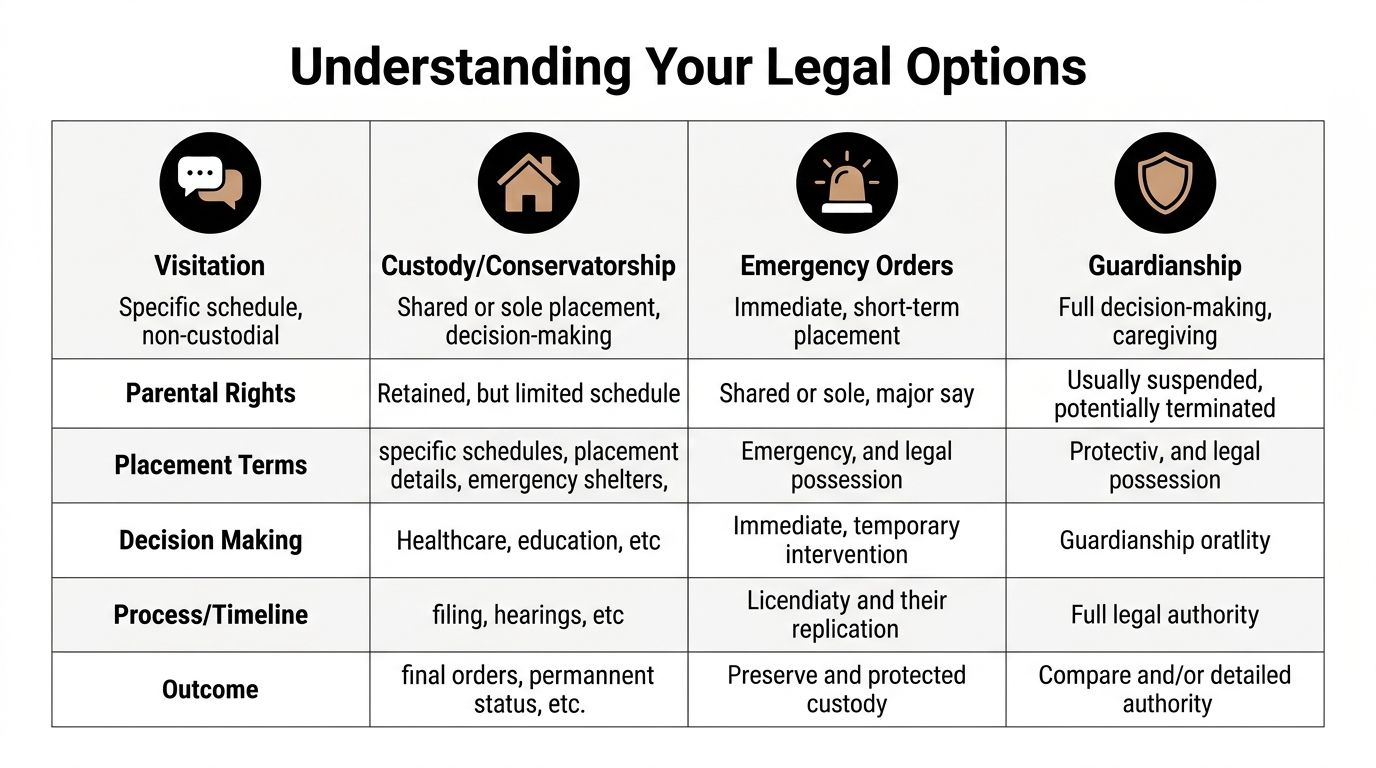
Grandparents often use the wrong word for the relief they want. That causes bad strategy. Visitation, custody, conservatorship, emergency orders, and guardianship are not interchangeable, and each one carries a different legal burden.
Visitation, custody, emergency orders, and guardianship
Visitation under Texas Family Code § 153.432 is for a grandparent who wants access, not decision-making authority. It's a narrower claim, and the legal test is tough. You must prove that cutting off access would substantially impair the child's well-being, not just that the child enjoys seeing you.
Custody, which Texas usually calls conservatorship, gives you authority over the child's care, residence, and major decisions. That is a much bigger remedy, so the court requires a stronger showing. The parental presumption has to be overcome first, and then the judge can reach best interests.
Emergency orders are different. They're for immediate protection when the child needs short-term relief before the court can hear the full case. They can stabilize a child's living situation, but they are not the final answer.
Guardianship under the Texas Estates Code comes up in a different setting, often when parents are deceased or permanently unable to care for the child. It isn't the same as a custody fight between living parents and a grandparent.
The right remedy depends on urgency
If the child is safe but being cut off from you, visitation may be the better fight. If the parent's home is unstable and the child needs a stable residence, conservatorship is the critical issue. If there's immediate danger, ask about temporary orders right away.
The wrong filing can hurt you. A visitation petition won't solve an unsafe-home case, and a custody petition without standing gets tossed before you ever reach the merits. That's why the remedy has to match the facts.
I'll be direct. If your concern is serious enough that you're considering court, then stop describing the situation as a family disagreement. Start sorting it into legal categories. That clarity saves time, money, and grief.
Building Your Evidence of Parental Unfitness
Cases are won or lost on the evidence presented. Montgomery County judges need concrete, contemporaneous evidence, not family rumors and not your sincere belief that the parent is failing. If you can't show the problem with documents, photos, messages, or witnesses, the case gets much harder.
Texas courts and Maryland guidance both point in the same direction on what matters. Unfitness usually means abuse, neglect, abandonment, substance abuse, or a mental illness that materially impairs caregiving capacity. That's a legal standard, not a personal insult. Your job is to map your proof to one of those categories.
Build proof that matches the harm
Start with records that already exist. School attendance records can show chronic absence. Medical records can show untreated conditions. CPS or dependency findings can show official concern. Text messages and emails can show a parent who isn't involved, won't respond, or is admitting they can't care for the child. Witnesses can fill in the gaps, especially teachers, counselors, and neighbors who saw the child's condition or the parent's conduct firsthand.
A few strong categories matter most:
- Medical or school records showing neglect, missed care, or chronic instability.
- Witness statements from adults who personally observed the parent's inability to care for the child.
- Photographs or videos that show dangerous living conditions while they're still current.
- Financial records if they help show a real inability to provide necessities.
- Law enforcement or CPS reports if there were official responses to the problem.
One mistake ruins many files. People save the text messages but not the dates, or they screenshot a conversation but lose the surrounding context. Preserve digital communications in full when you can. If a record matters, keep the original source and a backup copy.
For a deeper look at organizing proof before you file, the firm's guide on Evidence Needed for Child Custody in Texas is the right place to start. And if an order already exists and the parent keeps ignoring it, Enforcement of Court Orders in The Woodlands becomes relevant because enforcement and custody often overlap in real life.
Bottom line: If the evidence only proves that the parent is frustrating or inconsistent, that's not enough. Show harm, inability, or dangerous conduct.
What to preserve before you file
Keep school notices, discharge papers, drug-test results if you lawfully have them, messages about missed pickups, and photos of the home if you can obtain them without crossing a legal line. Write a dated timeline while events are still fresh. Judges trust records more than memory, especially when the family is fighting.
If there's a paper trail showing the parent's repeated failure to step up, that trail matters more than a dramatic single incident. Courts like patterns because patterns show the child's real life. That's the kind of proof that moves a case in Montgomery County.
Navigating Montgomery County Court Procedures
Montgomery County is not the place to wing it. Family-law filings need to be targeted, served correctly, and backed by a strategy that fits the local court calendar. If you file without understanding the procedure, you can burn weeks before the other side even responds.
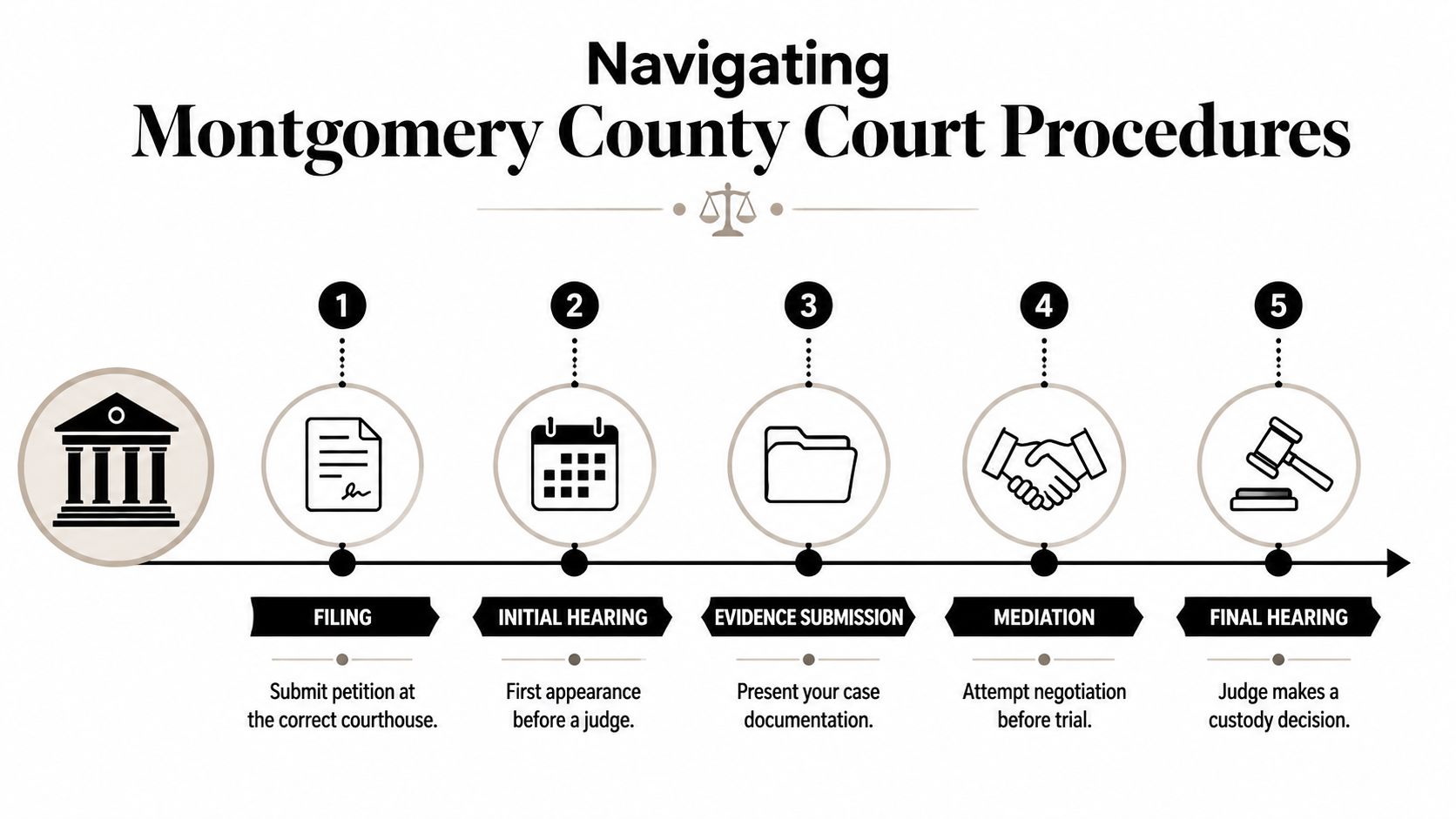
What the process usually looks like
A custody or conservatorship case starts with a petition in the proper Montgomery County courthouse, followed by service on the parent. After that, the court may set temporary orders if the child needs immediate structure while the case moves forward. Discovery follows when the parties exchange documents and information. Mediation often comes before trial, because judges want families to resolve what they can without consuming court time.
A case with conflict can take a while. The timeline is often measured in months, not days, because each hearing, deadline, and continuance changes the pace. Temporary relief matters during that period, especially if the child's safety or schooling is unstable.
Who helps the judge, and why it matters
Montgomery County courts can appoint professionals such as amicus attorneys or guardians ad litem to investigate the child's situation and make recommendations. They are not there to decide the case for the judge, but their work often shapes how the court views the facts. Treat them like decision-makers who need clean records and truthful answers.
For temporary relief hearings, bring the documents that show the child's current situation, not just the history. A parent who appears disorganized at home but has suddenly cleaned up for litigation can still be exposed by school records, missed medical appointments, or a timeline of caregiving by the grandparent. If you need a practical overview of what happens at a temporary hearing, the firm's page on navigating a temporary custody hearing in Montgomery County, Texas is worth reviewing.
I'm opinionated on this point. Most grandparents lose momentum because they treat the court process like a single hearing. It isn't. It's a sequence. Win the paperwork, win the temporary hearing, keep the evidence flowing, and stay disciplined through mediation.
A Real Montgomery County Grandparent Custody Case
A Woodlands grandmother calls after school keeps sending home notes about missed pickups. Her eight-year-old granddaughter starts staying with her more and more, first for weekends, then for whole weeks. The child's mother is battling opioid addiction, has failed multiple drug tests, and has already drawn CPS attention.
The grandparents do the right thing early. They keep the child in a stable home, save the school notes, document the missed appointments, and track every time the mother disappears or shows up impaired. After six months of continuous care, they have the standing they need under Texas law. The filing isn't based on anger. It's based on a real caregiving history and a record of parental failure.
At the temporary orders hearing, the judge sees a child who finally has routine, medical care, and school attendance. The mother gets a chance to respond, but the evidence is stacked against her because it's current and specific. The court enters a temporary structure that keeps the child stable while the case continues.
The strongest custody cases don't start with a dramatic story. They start with boring proof, collected every day.
Later, the case moves through mediation. The grandparents are not trying to erase the mother from the child's life, so they push for supervised visitation instead of a total shutdown. That's a smart move. It protects the child and leaves room for the parent to work toward recovery.
In the end, the court awards the grandparents managing conservatorship. The mother keeps supervised access. That outcome reflects what Montgomery County judges do when the proof is strong, the child has been living safely with the grandparents, and the parent's conduct has made ordinary reunification unsafe.
Your Next Steps and Resources
If you're serious about filing, the next 30 days matter. Don't wait for the situation to get “bad enough.” By then, records may be gone, school problems may have worsened, and your caregiving history may become harder to prove.
What to do next
- Write a dated timeline of when the child started living with you and what the parent did or didn't do.
- Save records now. School notices, medical papers, messages, photos, and names of witnesses all belong in one file.
- Talk to a Montgomery County family law attorney before you file so you don't choose the wrong remedy.
- Decide what relief you need, visitation, conservatorship, temporary orders, or something else.
- Keep communication calm and documented if you can safely do so.
If the parent is still reachable and it's safe, keep messages short and factual. Don't argue in long texts. Courts like parents and grandparents who act like adults, especially when children are involved.
Local legal aid, family-court self-help resources, and kinship caregiver support can help with forms and emotional support, but they won't replace case-specific advice. Timing matters. If the child is unsafe or the caregiving pattern is still developing, waiting can weaken the case.
This is not legal advice, and it's not a substitute for a consultation about your specific facts.
If you're trying to protect a grandchild in The Woodlands or elsewhere in Montgomery County, The Law Office of Bryan Fagan can review your facts, explain your custody or visitation options, and help you decide whether filing makes sense now. Visit The Law Office of Bryan Fagan to schedule a consultation and talk through your next move with a family law attorney who knows Montgomery County courts.