
A divorce can turn a strong Woodlands company into a pressure test. The phones still ring, payroll still hits, vendors still expect payment, and now one spouse is asking how much the other spouse's share is worth, and how it's going to be paid. In Montgomery County, that usually becomes a family business buyout, not because that's the easiest answer, but because it's often the only way to keep the company open while the marriage ends.
Under the Texas Family Code, property acquired during marriage is generally presumed to be community property, while separate property claims depend on proof and tracing. In a business case, that means the court and the lawyers have to answer three questions fast. Is the business part of the marital estate, what is it worth, and how can the buying spouse pay without breaking the company?
What a Family Business Buyout Actually Means in a Texas Divorce
A Woodlands owner usually feels this problem long before the court does. The spouse who runs the company wants to keep working, the other spouse wants a fair payout, and both sides know a forced sale would hurt the business and the family. In Texas, a buyout is the practical middle path, it converts an illiquid ownership interest into a payout while the operating company stays alive.
The legal frame in Montgomery County
Texas courts divide property in a just and right manner, not by a rigid formula. That matters because the court is looking at the whole estate, not just the name on the business card. If the company was formed during marriage, community-property issues usually come first. If part of the business came from premarital funds, gifts, or inheritance, tracing can change the size of the marital slice under the Texas Family Code.
The divorce decree also needs to be drafted so the result can be carried out later. If the settlement says one spouse keeps the company and pays the other spouse over time, that promise has to be written clearly enough to enforce if things go sideways.
Practical rule: if the business is essential to the family's income, the first goal is usually continuity, not liquidation.
For Woodlands and Montgomery County families, a buyout usually means three decisions in sequence. First, identify what part of the business belongs in the marital estate. Second, determine the value with a real valuation process. Third, choose the payment structure that fits cash flow and debt capacity.
You can see how local business-owner divorce issues are handled in more detail in Divorce Involving Business Owners in The Woodlands.
A buyout is often preferred because the alternative is worse. Selling a company can wipe out goodwill, disrupt customers, and force a taxable event at the worst possible time. A buyout keeps the doors open, but only if the numbers and the payment method are grounded in reality.
How the Business Gets Valued When Spouses Cannot Agree
When spouses disagree on value, the case usually turns on the appraisal report. A credible report does not start with a guess. It starts with a credentialed appraiser and a method that can be defended in court, usually one or more of the income approach, market approach, and asset approach. Those methods are the backbone of the valuation process, and the choice matters because each one can produce a different buyout number.

The three methods and why the method changes the fight
The income approach focuses on what the business earns. It's often persuasive for service businesses, medical practices, and owner-driven companies because the cash flow tells the story.
The market approach compares the company to similar businesses, but that can be hard when the business is closely held and local.
The asset approach looks at assets minus liabilities. It can matter when the company owns equipment, inventory, or real estate, or when earnings are inconsistent.
A valuation report should also address goodwill. In divorce, that term matters a lot. If value depends on the operating spouse's personal reputation, relationships, or day-to-day labor, the buyout price can be inflated if the valuation treats that earning power as a transferable business asset. That issue shows up often in Woodlands owner-operated companies.
Courts and negotiators should ask whether the value belongs to the business itself or to the spouse who shows up every day and drives the revenue.
Tracing can also shrink the marital share. Under Texas law, a spouse claiming separate-property status has to prove it by clear and convincing evidence. If the company was funded before marriage, or with traced separate funds, records matter. Bank statements, formation documents, tax returns, and early capitalization records can move the result.
For a more detailed local discussion of valuation issues, use Business Valuation in Divorce in The Woodlands, TX.
A useful way to think about the appraisal is this. A thriving service company may look valuable on paper because of earnings, but if much of that earnings stream depends on one spouse staying in place, the court and the parties need to separate enterprise value from personal labor. That distinction can change the buyout number by a lot, even when nobody changes the underlying facts.
If the decree later needs to be enforced, Enforcement of Court Orders in The Woodlands is the kind of tool clients end up needing when a promised transfer or payment doesn't happen on time. That's why the valuation stage and the enforcement stage are tied together from the start.
Buyout Structures That Actually Work in The Woodlands
No single structure fits every family business. A cash-rich company can sometimes fund a clean buyout. A seasonal business usually can't. A company using debt financing may need a hybrid plan that keeps the owner in control while spreading out the payout. In Montgomery County divorces, that usually means choosing between cash, notes, refinancing, or an asset offset.
| Structure | Best Fit | Key Risk |
|---|---|---|
| Lump-sum cash payout | Strong cash reserves and simple ownership split | Can strain operating cash and trigger a rushed funding decision |
| Structured promissory note | Businesses that need time to pay while staying open | Default risk if revenue dips or payment terms are too tight |
| Commercial refinance | Companies with enough credit and predictable earnings | Adds debt service to an already busy balance sheet |
| Asset offset | Estates with retirement accounts, home equity, or other divisible assets | The spouse keeping the business may still give up valuable property |
What works when the business is not flush with cash
A lump-sum payout is clean, but it's often unrealistic for a cash-poor Woodlands company. If the business has to empty its accounts to fund the buyout, payroll and vendor terms can take the hit. That's why installment structures are common, and why practitioners often use a repayment window of 3 to 10 years when a note is involved, according to the divorce-practitioner survey cited by LIBN in the verified data.
A structured note gives the business room to breathe, but it needs careful drafting. The payment schedule has to match actual cash flow, not hope. If the company is seasonal, the note should reflect that reality. If the company already carries debt, adding more can turn a sensible buyout into a balance-sheet problem.
A refinance can work when the company has enough earnings to support new debt. A lender may look at whether the company can handle the obligations and still operate. That's where a realistic liquidity test matters. An asset offset can also be smart, especially when the marital estate includes retirement accounts or home equity in places like Panther Creek or Alden Bridge. It lets the business owner keep the company intact while the other spouse receives value from elsewhere in the estate.
The best structure is the one the company can actually survive, not the one that looks neat in the first draft.
When the issue is control, asset swaps often beat shared ownership. Shared ownership after divorce sounds efficient, but it can trap both spouses in a bad working arrangement. In practice, most clients want a clean endpoint, and the court usually prefers clarity too.
Financing the Buyout Without Killing the Business
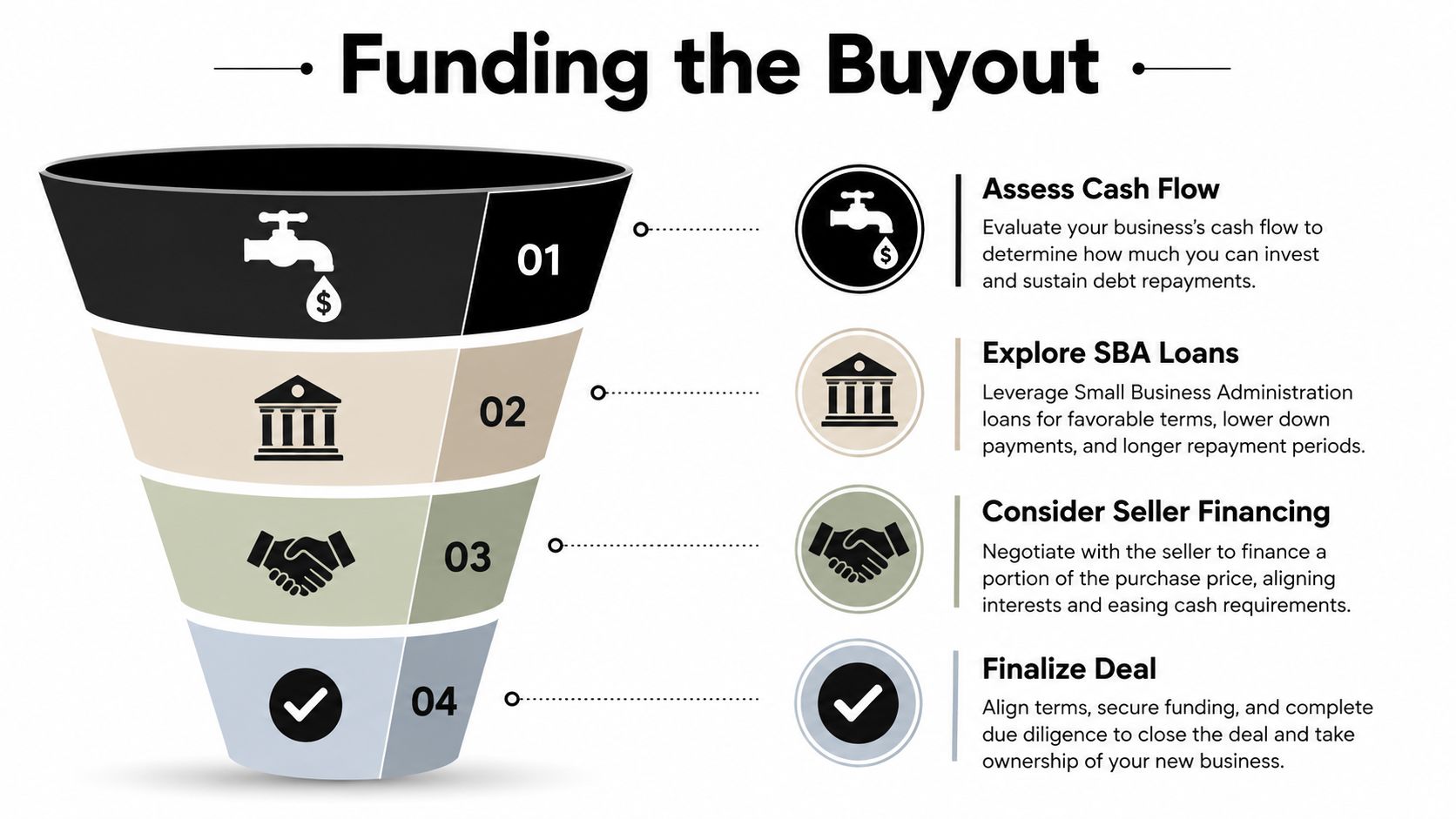
The hardest cases are the ones where the business is good, but the balance sheet is tight. Seasonal revenue, existing loans, or thin reserves make a buyout feel impossible. That's where financing strategy matters more than legal theory.
Testing the company before anyone signs
The first question is whether the business can service both ordinary operations and the buyout debt. Transaction-focused advisory guidance notes that when lenders finance this kind of deal, senior debt is often sized at roughly 2.5x to 3.5x EBITDA. That's not a green light by itself. It just gives a range lenders may consider when deciding whether the company can carry the obligation.
A structured promissory note can be stretched over 5 to 10 years at a market interest rate, according to the same advisory guidance. That can soften the impact, but it does not remove the risk. If the note payments collide with payroll, inventory, or vendor terms, the company starts bleeding where it matters most.
A practical funding review should ask a few blunt questions.
- Cash Flow Reality: Can the business make the payment every month without skipping owner distributions or delaying bills?
- Debt Load: Does the company already have loans or credit lines that make a refinance too heavy?
- Seasonality: Are there months when revenue drops enough that the note would need seasonal flexibility?
- Fallback Assets: Can retirement accounts, equity in the home, or other property be used instead of more operating debt?
A partial sale or asset swap can be better than a pure debt solution. If the estate has enough other assets, it may be smarter to trade value rather than force the company to borrow more. That keeps payroll intact and lowers the chance of a distressed sale.
The biggest warning sign is simple. If the buyout plan forces the owner to choose between paying the spouse and paying the people who keep the business running, the structure is too tight. The right answer is usually a slower payout, more collateral, or a different mix of assets.
The Law Office of Bryan Fagan can help local owners think through divorce, property division, and the settlement language that keeps the company operating while the case is pending. For Woodlands business owners, that kind of planning matters before emotions turn into missed payments.
Evidence to Gather and a Woodlands-Style Scenario
The documents you gather early often decide the case later. A good file gives the appraiser a clean picture, gives counsel a way to trace separate property, and gives the court a reason to trust the buyout number. If the records are messy, the valuation gets messier too.
The documents that matter first
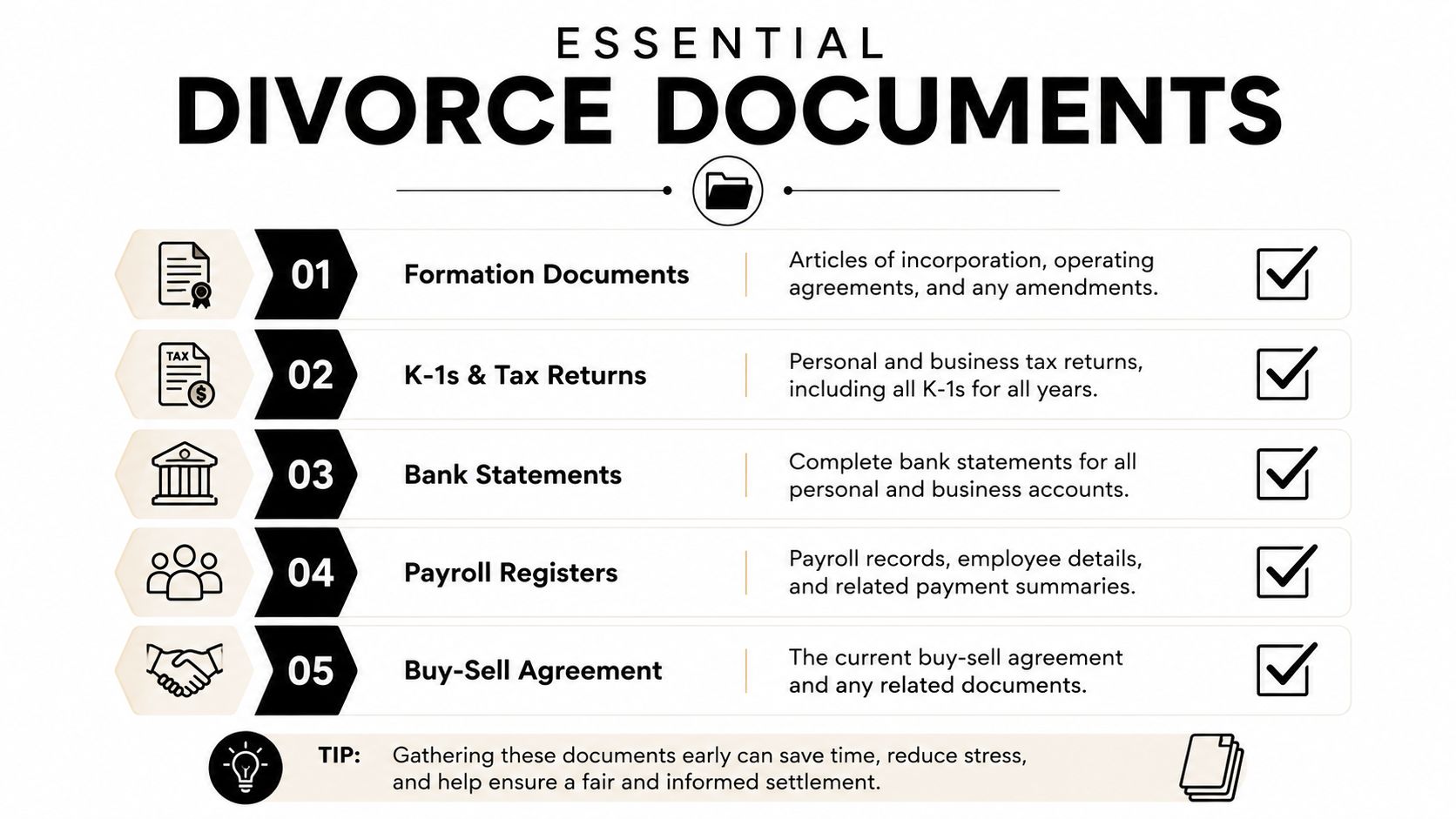
Start with the records that show who owns what, how the company operates, and where the money moved.
- Formation Documents: These show how the entity was created and who holds the ownership interests.
- K-1s and Tax Returns: These help track income, ownership allocations, and the financial history of the company.
- Bank Statements: These show cash flow, distributions, deposits, and transfers that may support tracing.
- Payroll Registers: These help separate owner compensation from business profit.
- Buy-Sell Agreement: This can control transfer rights, pricing, and buyout mechanics if the company already has one.
You should also pull any premarital or postnuptial agreement, loan documents, and records showing whether separate funds were used to start or grow the business. Under Texas law, that kind of tracing can be decisive when one spouse claims the company should be treated as separate property.
A Sterling Ridge example
A couple in Sterling Ridge owns an HVAC company. One spouse started the company before marriage with separate funds, then expanded it during the marriage. The other spouse handled bookkeeping and helped the business grow.
The first fight is characterization. The starting point is the community-property presumption, but the premarital contribution and tracing records may prove part of the company belongs outside the community estate. The second fight is value. If the appraiser credits personal goodwill too heavily to the operating spouse, the buyout number may fall. If the appraiser ignores tracing, the non-owning spouse may be overpaid for value that isn't community property.
That's why the evidence and the valuation have to line up. The judge in Montgomery County is far more likely to accept a buyout number when the records support it, the appraisal is credible, and the settlement language matches the actual ownership history.
Drafting the Settlement So the Buyout Is Enforceable
The settlement has to do more than say who gets the company. It has to make the payment real, and it has to survive after the divorce judgment is signed. That means the marital settlement agreement and final decree need careful language about the transfer, the payment schedule, and what happens if someone defaults.

What the paper should actually do
A secured promissory note can make a buyout much safer for the spouse receiving payment. It can be backed by collateral, a personal guaranty, or life insurance when appropriate. The agreement should also say what counts as default, when acceleration kicks in, and what remedies are available if payments stop.
For ownership transfer language, the decree should connect to the Texas Family Code and, where relevant, the Texas Estates Code so the title, transfer, and post-divorce ownership mechanics are coherent. If the business has a buy-sell agreement or succession document, the divorce papers should not fight with it. They need to fit together or the transfer can become a second dispute later.
A well-drafted agreement also helps with timing. The buyout date should line up with the closing of the divorce so the parties know exactly when value is fixed and when payments begin. That reduces arguments about later earnings, later losses, and who gets the benefit of what happened after separation.
If the language is vague, the business owner may win the divorce and lose the fight over enforcement later.
There's also a tax and basis issue hiding in the background. If the agreement is sloppy, the numbers can be hard to allocate cleanly, and that can create problems the first time the owner tries to report the transfer or explain the adjusted basis. Those questions should be handled before anyone signs, not after the decree is entered.
If the business has a buy-sell or succession document already, the local lawyers who drafted it may have built in restrictions on transfer or redemption rules. Business Succession Planning in The Woodlands, TX is often where that review starts, because divorce and ownership transfer need to match the company's governing papers.
Your Next Steps and a Local Consultation
Start by gathering the records a Texas court and a business valuation professional will use. Pull the last three years of business tax returns, recent bank statements, formation documents, payroll records, and any buy-sell or operating agreement. Check whether a premarital or postnuptial agreement exists, and list every account or asset tied to the business.
Then ask the hard question, can the company fund a buyout without starving operations. If the answer is no, the settlement should use time, collateral, or different assets. In a Woodlands divorce, that often means deciding whether the owner can pay with cash flow, a promissory note, or an offset from other marital property while still keeping payroll, vendors, and debt service current.
Seasonality and cash flow change the answer fast. A business that looks healthy on paper may be tight between billing cycles, tied up in receivables, or carrying debt that leaves little room for a lump-sum payout. The practical goal is a division that gives the nonowner spouse fair value without putting the company in a position where the buyout itself becomes the reason the business slips.
The Law Office of Bryan Fagan helps Woodlands and Montgomery County families handle divorce, property division, and business ownership disputes with local court experience and practical settlement drafting. If you're facing divorce with a family business buyout, visit The Law Office of Bryan Fagan to schedule a consultation and talk through the next step for your company.