 Skip to content

Your divorce decree says your former spouse must pay you, but the payment hasn't arrived. You know they own property in Montgomery County, or you've heard they're buying a home in The Woodlands. Recording something against that property sounds more useful than sending another unanswered message.
A Montgomery County abstract of judgment to enforce a decree can be a useful collection step, but it isn't a complete enforcement remedy. Before requesting one, identify exactly what your decree awards, whether the obligation is presently enforceable, and whether the debtor owns property a judgment lien can legally reach.
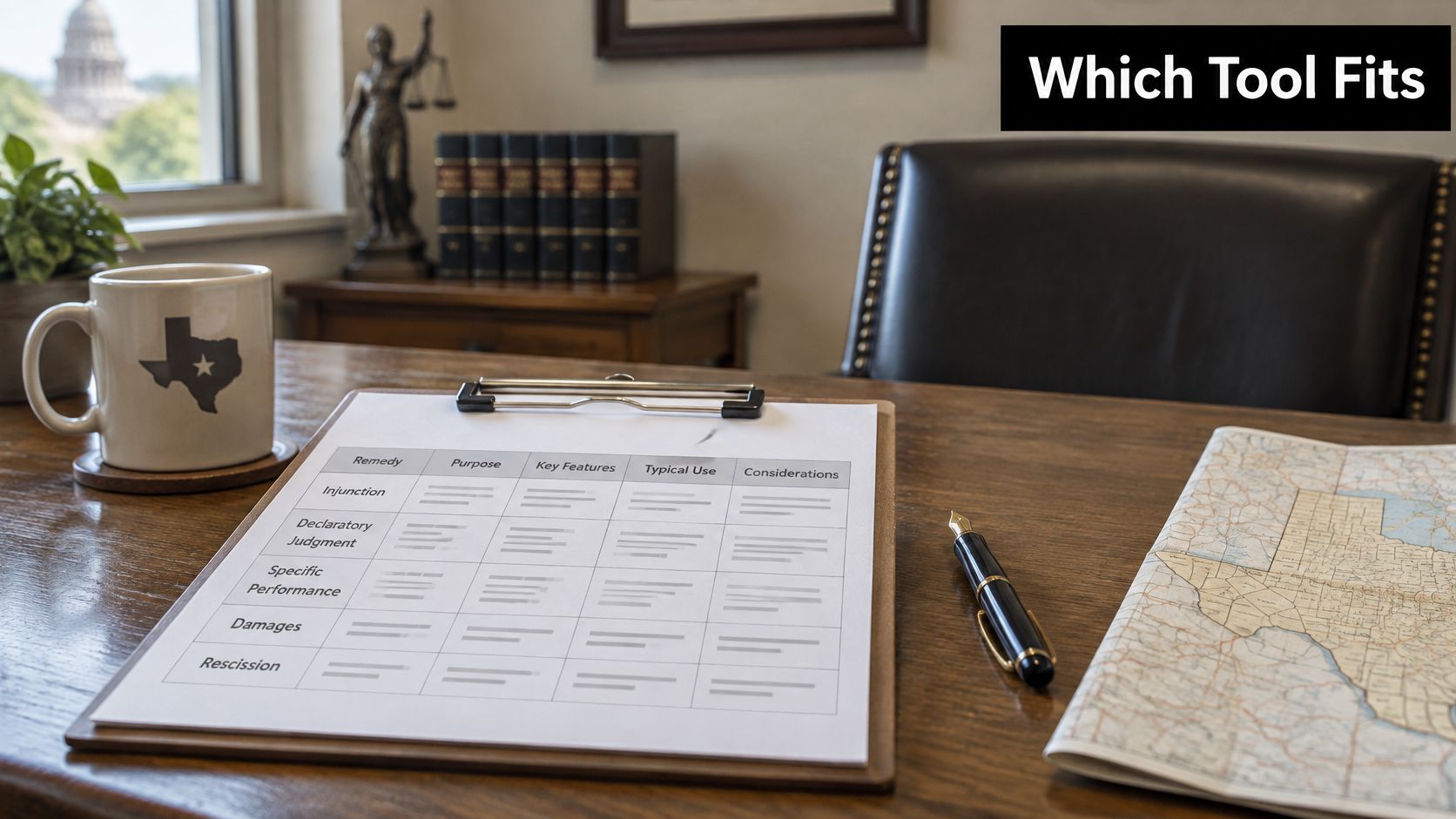
Which Enforcement Tool Fits Your Decree
Enforcement remedies for an unpaid decree in Montgomery County
| Remedy | What It Does | Best When |
|---|---|---|
| Abstract of judgment | Creates a lien on nonexempt Montgomery County real estate once properly recorded and indexed | An unpaid money award exists and the debtor owns or may buy local land |
| Motion for enforcement | Asks the court with continuing jurisdiction to order compliance | Custody, visitation, or other non-monetary provisions are being violated |
| Writ of execution | Lets a sheriff or constable seize and sell nonexempt property | An enforceable money judgment is unpaid and identifiable assets exist |
| Garnishment | Reaches eligible funds held by a third party, such as nonexempt bank-account funds; ordinary wages generally aren't available for a property-division debt | You can identify an account containing funds legally subject to garnishment |
| Turnover order | Directs the debtor to turn over identified nonexempt property or funds, subject to legal requirements | The debtor controls assets that aren't readily reached through ordinary execution |
Don't confuse collecting money with compelling compliance. A missed possession exchange calls for a different response than an unpaid property-division award. Child-support collection also has specialized remedies, so ordinary judgment-collection rules shouldn't be applied indiscriminately.
The Texas Family Code's child-support lien filing provision addresses where a support lien notice or abstract may be filed. It isn't a blanket mechanism for enforcing every promise in a divorce decree.
What the Abstract Actually Does
An abstract of judgment summarizes key information about a judgment, including the parties, amount, and rendition date. Proper recording and indexing give it its real-property lien effect.
It doesn't transfer title, sell a house, compel visitation, or force someone to produce records. Nor does the recording clerk decide whether disputed arrears are correct.
Practical rule: Match the remedy to the violated obligation before paying to file anything.
For an uncertain award, the first task may be obtaining a clear, enforceable money judgment. For a definite unpaid award, a judgment-enforcement attorney can assess whether recording should accompany an active collection remedy rather than replace it.
Start with these screening questions:
- Is the award a fixed dollar amount? Identify an actual money obligation, not merely a direction to cooperate.
- Does the debtor own or expect to acquire nonexempt Montgomery County land? Identify a plausible collection target rather than assuming every home qualifies.
A yes to both makes an abstract worth considering as an early tool. Otherwise, evaluate an enforcement motion, execution, eligible garnishment, or turnover relief.
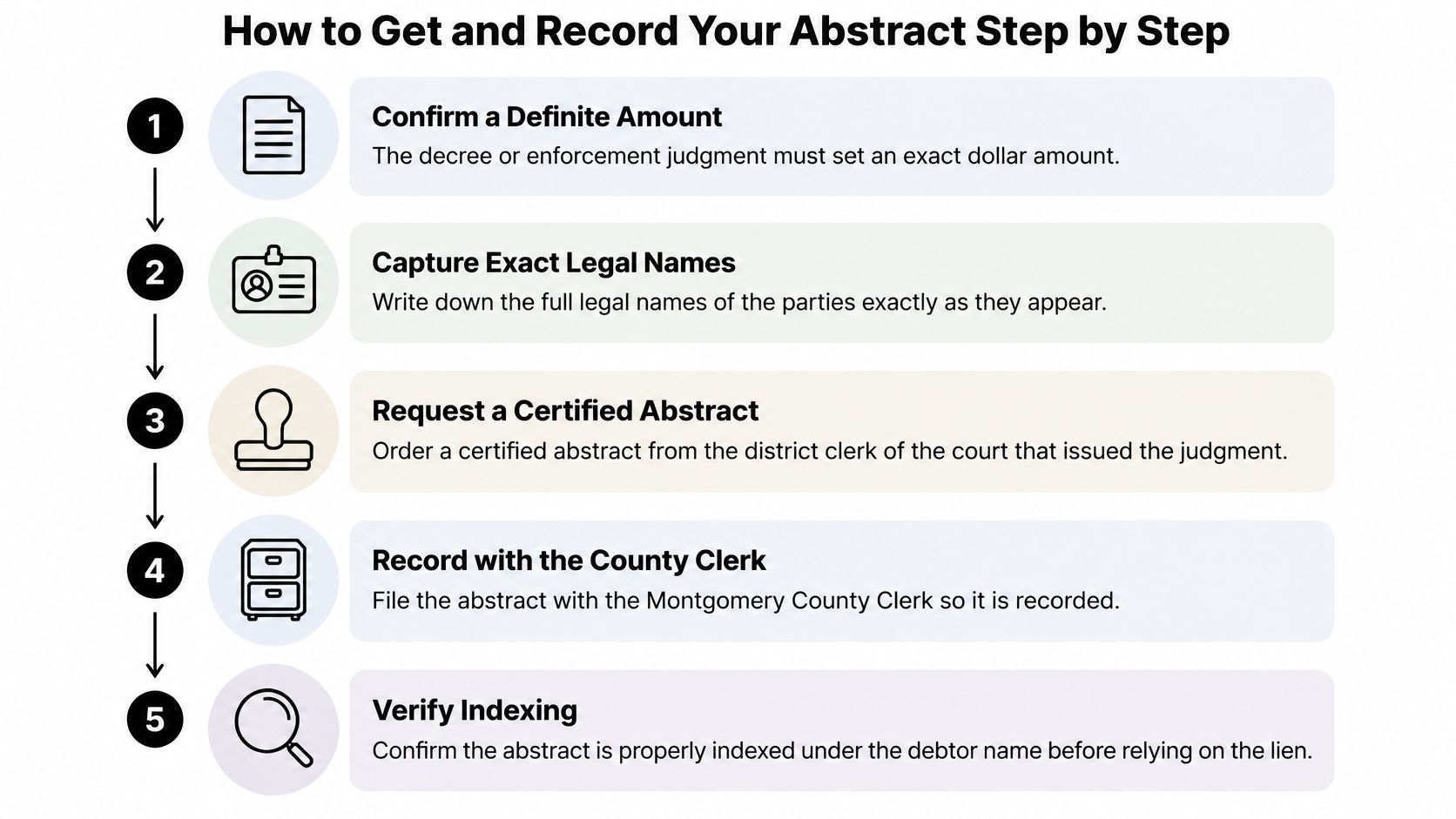
How to Get and Record Your Abstract Step by Step
Prepare the Judgment Information
Confirm the enforceable amount. Read the decree alongside any later enforcement orders and payment records. Write down the parties' exact legal names and distinguish the original award from the remaining unpaid balance.
Identify who will apply. Under Texas Property Code §52.002, the judgment winner, that person's attorney, agent, or assignee may apply for an abstract. Having someone else submit the request doesn't eliminate the need to check its accuracy.
Request the abstract from the issuing court. For a district-court divorce judgment, contact the district clerk associated with the court that rendered it. An abstract may be issued after judgment without first exhausting other collection remedies, although issuance doesn't establish that every proposed enforcement action is presently available.
Review the completed document before recording. Compare the names, judgment information, amount, and creditor mailing address with your records. If someone other than the clerk prepared the abstract, confirm the verification requirement has been satisfied.
The issuing clerk and the recording clerk perform different jobs. Ordering an abstract from the district clerk doesn't mean it has been recorded with the County Clerk.
Complete the Recording and Notice
Confirm and pay the separate charges. Ask the issuing clerk about issuance and the Montgomery County Clerk about recording. Include any requested certified copies or mailing arrangements in your cost check rather than assuming one payment covers everything.
Record the certified abstract in the proper county records. Submit it to the Montgomery County Clerk for recording in the Official Public Records. Confirm that the recorded document is indexed under the debtor's correct legal name, because that's how a title searcher should be able to find it.
Save the recording date and document information. Keep the recorded copy, receipt, and instrument information together with the decree and payment ledger. Have counsel calendar both the lien-duration issue and any judgment-dormancy deadlines instead of treating the recording as permanent protection.
Handle child-support notice separately. For a child-support lien filing, the Texas Family Code notice provision requires providing the obligor a copy within 21 days after filing or delivery, using first-class or certified mail with return receipt requested. Preserve the mailing documentation, address used, and return receipt when applicable.
A finished filing should leave you with more than a submitted envelope or an electronic-payment confirmation. You should have a recording receipt, recorded document, and searchable index entry under the debtor's name.
Before closing the file, compare the recorded image with the document you submitted. If the index entry or recorded document appears wrong, address the problem promptly rather than discovering it during a later sale.
Fees, Recording Charges and Penalties to Expect
Abstract of judgment charges in Montgomery County
The recording amounts and administrative changes below appear in the Montgomery County published fee schedule; confirm the applicable total before filing.
| Charge | Amount | Note |
|---|---|---|
| Abstract issuance, district court | Confirm the authorized issuance charge | Ask the issuing clerk before paying |
| Abstract issuance, county court | Confirm the authorized issuance charge | Ask the issuing clerk before paying |
| Recording charge for an abstract | $8 | Listed recording charge; confirm document-specific treatment |
| Records-archive fee on most recording documents | $10 | Collected since October 1, 2023 |
| Former document-filing or courthouse-security fee | $1, eliminated | Eliminated January 1, 2024; older guides may still include it |
| Creditor mailing address omitted | Greater of $25 or twice the statutory recording fee | Include the address instead of budgeting for a defective submission |
The mailing-address penalty is described in the Texas Office of Court Administration District Clerk Manual: omission can require payment of the greater of $25 or twice the statutory recording fee before recording.
Calculate the Total Without Mixing Clerk Charges
Using the county schedule's listed charges, an $8 recording charge plus a $10 records-archive fee totals $18, if both apply to the document. That's a recording-side example, not a guaranteed all-in filing price.
Add the issuance charge confirmed by the court clerk, plus any certified-copy or mailing costs. Don't confuse an issuance fee with the recording charge just because both offices use the word abstract.
For the address-penalty example, doubling the listed recording charge produces less than the statutory minimum penalty, so the minimum would control on that assumption. The better solution is to correct the address before submission.
Cost check: Ask for the total for your actual document, not just the price of an abstract.
Call the Montgomery County Clerk on the filing day to confirm the current recording total, accepted submission method, and payment requirements. Ask specifically whether the archive charge applies and whether any additional document-specific charges are included.
That short check can prevent a rejected submission, an incorrect payment, or another trip to Conroe. A fee schedule helps you budget; it doesn't replace confirmation from the office accepting the filing.
What an Abstract Can Reach in The Woodlands and Montgomery County
A properly recorded and indexed abstract generally reaches the debtor's nonexempt real property in the recording county, including later-acquired property, under Texas Property Code Chapter 52, which also generally provides a 10-year lien period unless the judgment becomes dormant sooner.
Homestead protection matters. An ordinary judgment abstract doesn't create an enforceable lien against a residence protected by Texas homestead law merely because the creditor records it.
That issue deserves attention whether the address is in Panther Creek, Alden Bridge, Sterling Ridge, Conroe, or Magnolia. A valuable house isn't necessarily an available collection asset.

An Installment Award and a Later Home Purchase
The Texas court-administration manual's discussion of a Supreme Court divorce dispute describes a $500,000 award payable at $10,000 per month, followed by a home purchase approximately six months later and an abstract that created an apparent lien. That payment structure represents 50 scheduled payments, a little over four years, if paid without interruption.
For a local illustration, suppose an ex-spouse with that type of installment obligation buys a home in Panther Creek while the decree debt remains outstanding. Recording may raise a lien issue during a title examination, but the creditor still must address homestead protection and whether the obligation is collectible as asserted.
The Panther Creek location is hypothetical, not the location identified in that court dispute. The useful lesson is that an apparent title encumbrance and a legally enforceable collection right aren't necessarily the same thing.
Check Ownership Before Counting on Equity
Search the County Clerk's Official Public Records under the debtor's legal name, then compare the results with Montgomery Central Appraisal District parcel records. Review deeds, ownership interests, and any indicated homestead exemption.
An appraisal exemption is a warning to investigate, not a final legal ruling on homestead status. Likewise, property titled to a business isn't automatically the individual debtor's property.
A review of Montgomery County real-property records after divorce can help distinguish a title problem from a collection problem. For land in Harris County or another neighboring county, evaluate a separate recording there.
We serve clients in The Woodlands and across Montgomery County. The useful starting point is the property's actual ownership and county location, not just the neighborhood name or mailing address.
Mistakes to Avoid and What to Do Next
The most expensive mistake is treating a recorded abstract as payment. You can complete the paperwork correctly and still have an unpaid decree balance because no money has changed hands.
Decide what happens after recording. If there's no expected sale, refinance, or other transaction involving reachable property, waiting on the lien alone may not meet your financial needs.
An active collection strategy may require identifying eligible bank funds, locating nonexempt assets for execution, or seeking turnover relief. Each option requires its own legal screening, and ordinary wages shouldn't be treated as an available source for collecting a property-division judgment.
Don't Let Paperwork Replace Asset Investigation
A name mismatch can waste the filing. Use the legal name established by the judgment and review relevant name changes with counsel; don't substitute a nickname because that's how you know your former spouse.
If the debtor used a former married name or appears differently in a deed, identify the discrepancy before submitting the abstract. Don't assume the clerk will research the person's identity or fix the document for you.
Don't mistake household wealth for reachable assets. A home may be exempt, jointly owned, heavily encumbered, or titled differently than expected. A property search should answer who owns the interest you hope to reach.
A recording receipt proves that a document was recorded. It doesn't prove that the debtor has collectible equity.
Don't stop at the county line. If your former spouse owns land outside Montgomery County, make a county-by-county filing decision based on the assets. A Montgomery County recording shouldn't be treated as a statewide real-estate filing.
Also keep custody disputes out of the collection paperwork. An abstract won't solve denied visitation, and an enforcement motion shouldn't be drafted as though every missed payment supports the same remedy as a possession-order violation.
For property obligations, review whether you're enforcing a property-division order in The Woodlands or collecting a money judgment already awarded under it. That distinction determines what you should ask the court to do.
What to Do Next
- Confirm the balance still owed. Reconcile payments, credits, and the decree's payment terms before asserting an amount.
- Verify the legal names. Compare the decree, proposed abstract, and available ownership records.
- Check exemption status. Investigate homestead protection and other barriers before counting on a particular property.
- Obtain a certified abstract. Review the creditor's mailing address and all required judgment information before recording.
- Record in each relevant county. Base the filing locations on where the debtor owns or may acquire eligible land.
- Verify the index entry. Search the debtor's name and save the recorded image and receipt.
- Calendar lien and judgment deadlines. Have counsel calculate the applicable dates and review any earlier dormancy concern.
- Preserve child-support notice proof. Keep a copy of the notice, mailing records, and supporting documents.
- Choose the follow-through. Decide whether to monitor property transactions, pursue another collection remedy, or request court enforcement.
Bring the decree, later orders, payment history, and known property information to a legal review. Those documents let counsel assess the obligation and the target asset together, rather than recommending a filing based only on an unpaid balance.
This article provides general information, not legal advice. Your decree's wording, payment history, property ownership, exemptions, and procedural posture control the available remedies and outcome.
The Law Office of Bryan Fagan handles complex divorce and child custody matters and can help assess how decree enforcement fits your broader family-law situation. To review your decree, unpaid balance, and property information before filing an abstract, visit The Law Office of Bryan Fagan or call 281-819-1726 to schedule a consultation for help in The Woodlands and Montgomery County.
