
You filed for divorce in Montgomery County, paid the filing fee at the courthouse in Conroe, and walked out of the clerk's office expecting the next step to be service or a court date. Then you notice a withdrawal from the joint account, a changed parenting schedule, or a message saying your spouse is taking the children out of state. The paperwork may feel quiet, but the legal rules governing both spouses have already become active.
For Montgomery County standing orders in a divorce and what they restrict, the central point is simple: these orders control conduct during the most volatile period of the case. They protect property, financial records, insurance, and children before a judge enters temporary orders custom-made to your family.
The Moment You File in Montgomery County
A Woodlands couple can leave the Montgomery County Courthouse in Conroe believing the difficult part is still ahead. They may not have attended a hearing, met a judge, or even served the other spouse. Yet the standing orders can already control what the filing spouse does next.
Texas Law Help's explanation of standing orders states that standing orders take effect when the petition is filed. In practical terms, the filing spouse becomes bound immediately. The responding spouse becomes bound when served, so the timing of service matters, but it doesn't create permission for the filing spouse to move money or change the children's routine.
That gap before the first temporary orders hearing is where poor decisions happen. A spouse may transfer a vehicle to a sibling, withdraw money from a joint account, cancel insurance, delete financial records, or announce a new parenting schedule without written agreement. The fact that no judge has personally addressed the issue doesn't make the conduct safe.
The practical rule: Filing day is not a waiting period. It is the day you start preserving the financial and parenting status quo.
Montgomery County standing orders operate as immediate restraints tied to the first filing date. A same-day transfer or account change can fall within the restrictions before a temporary hearing occurs. That gives the orders strategic importance. They don't merely list prohibited behavior after a judge has heard both sides. They govern the space between filing, service, mediation, and temporary relief.
If you filed, read the orders before making financial or parenting decisions. If you were served, read them before responding emotionally or changing anything involving the home, accounts, insurance, records, or children.
What Standing Orders Actually Are
Standing orders are automatic court rules used in qualifying Montgomery County family-law cases. They aren't custom instructions drafted after a judge hears your facts. They function more like preset safety settings attached to the case at filing.
Temporary orders are different. A party asks the court for specific relief, the parties may mediate, and a judge or associate judge considers the evidence and enters orders directed to that family. The court may confirm, narrow, or expand the practical arrangements that existed under the standing orders.
Texas Family Code Section 6.502 is relevant because it recognizes temporary orders and injunction-related authority in divorce proceedings. The standing-order packet and the local court's procedures determine the exact terms that apply in a particular case, so you should obtain the document tied to your court rather than rely on a generic internet summary.
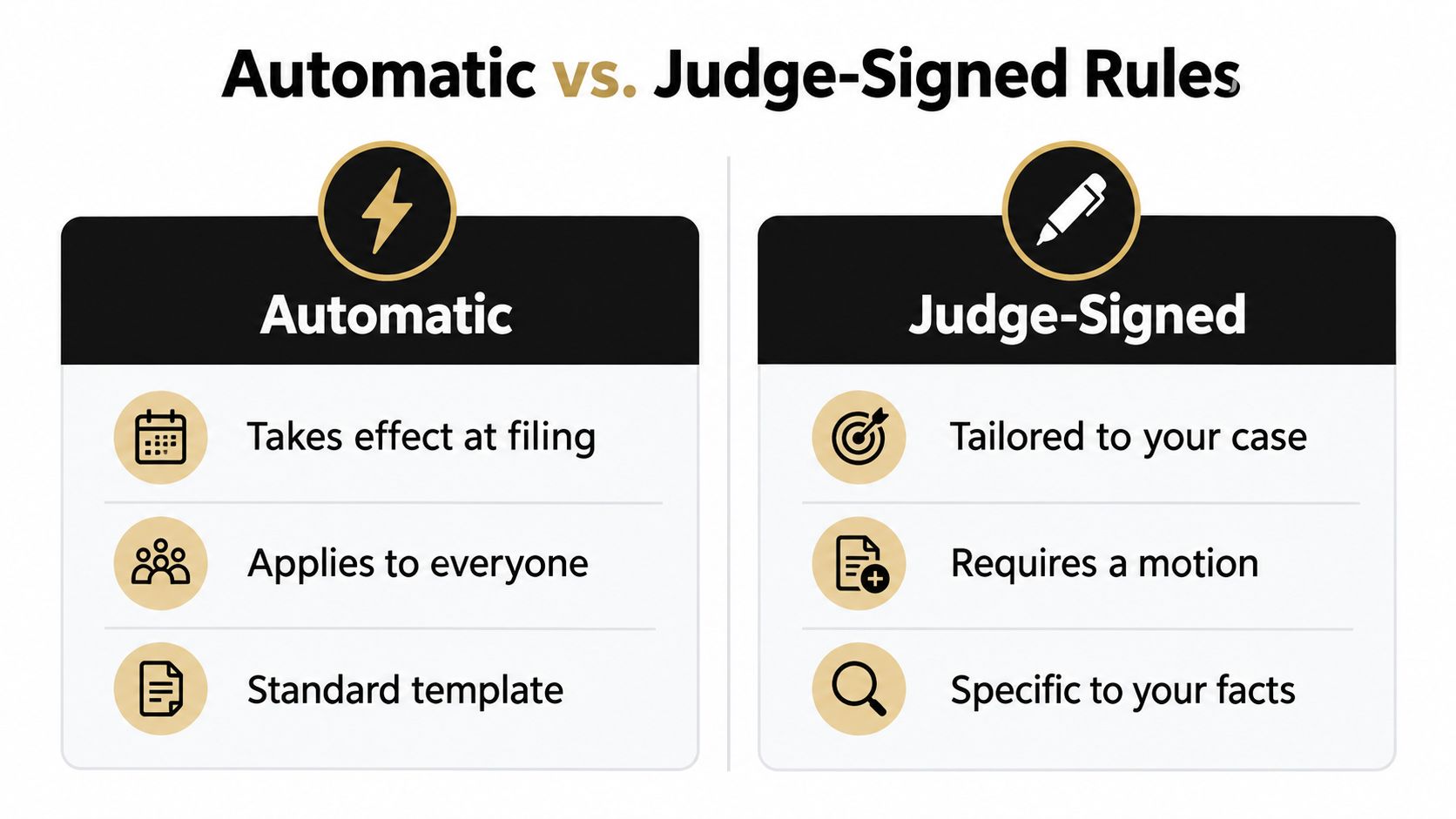
Automatic rules versus judge-signed rules
The distinction matters in daily life:
- Automatic rules: They attach to the case without waiting for an individualized hearing.
- Judge-signed rules: They arise from a motion, hearing, agreement, or specific order addressing your family's facts.
- Standing orders: They preserve property, records, insurance, and parenting conditions while the case develops.
- Temporary orders: They establish more specific financial responsibilities, possession schedules, support terms, and access arrangements.
Standing orders are commonly treated as binding injunctions. A violation can create enforcement and contempt exposure, depending on the wording of the order and the evidence. You shouldn't assume that an order is optional because it came from a standard packet instead of a hearing.
The most useful way to read them is to ask two questions. First, what conduct must stop immediately? Second, what problem requires a separate motion because the standing order doesn't provide enough protection? That distinction keeps you from both violating the rules and waiting passively while an urgent problem grows.
Restrictions That Hit Your Assets and Finances
The financial restrictions are designed to stop either spouse from changing the marital estate before the court can evaluate it. They commonly prohibit selling, transferring, hiding, destroying, or disposing of community property without written agreement or court permission.
A spouse who gives a jointly acquired truck to a sibling is not merely making a personal decision. The same concern arises when someone sells furniture, moves investment funds, empties a safe-deposit box, or withdraws substantial cash. A withdrawal from a joint Woodlands account at an ATM in Shenandoah can become important evidence if the spouse can't explain where the money went and how it was used.
The orders also target unusual debt. Opening new charge cards, co-signing a sibling's loan, drawing heavily against an existing credit line, or financing a vehicle at a Conroe dealership can burden the marital estate. Ordinary household expenses aren't the same as a sudden financial move that changes the parties' positions.
Financial conduct that creates trouble
| Restricted Action | What It Looks Like Locally | Why It Is Prohibited |
|---|---|---|
| Selling or transferring property | Gifting a truck to a sibling or selling household items without agreement | It may remove community property from the estate |
| Draining accounts | Taking unexplained cash from a joint account in Shenandoah | It can create dissipation and make later division harder |
| Creating unusual debt | Opening cards, co-signing loans, or financing a vehicle in Conroe | It may burden the marital estate |
| Changing insurance or beneficiaries | Cancelling coverage or removing a spouse or child as beneficiary | It can leave the family exposed and alter expected benefits |
| Destroying records | Deleting brokerage statements or emptying a safe-deposit box | It impairs discovery and can support enforcement concerns |
Insurance deserves special attention. Standing orders commonly restrict cancelling health, auto, or life insurance and changing beneficiary designations. Do not remove a spouse or child from coverage, cancel a policy, or change a retirement or life-insurance beneficiary because you are angry or trying to gain an advantage.
Document preservation is just as important. Save bank statements, retirement records, tax documents, loan information, emails, and relevant messages. If you delete electronic records or discard statements, the problem isn't limited to the missing information. The deletion itself can become part of the dispute.
Use the financial disclosure form to organize the information your case may require. A Divorce Lawyer in The Woodlands, TX may assist clients in The Woodlands and Montgomery County with divorce representation, but no lawyer can repair every consequence of a rushed transfer or deleted record.
Restrictions That Affect Your Children
Standing orders apply to children before a judge signs a parenting plan for your family. They commonly restrict removing children from Texas, disrupting school or daycare, interfering with possession or access, and taking steps that destabilize the parent-child relationship.
Consider a father in Conroe who plans a two-week Florida trip with the children. If the mother files that morning, the father shouldn't leave the state based only on his travel plans. He needs the other parent's written consent or a court order that permits the trip. A child's passport, school calendar, and travel itinerary may become important if the issue reaches court.

The routine remains important
Parents generally shouldn't:
- Relocate or hide the children: Don't take them out of state or make them unavailable to the other parent.
- Change school or daycare: Don't unenroll a child, change schools, or disrupt daycare without permission or court authority.
- Interfere with access: Don't cancel visits, withhold communication, or create a new schedule unilaterally.
- Pressure the children: Don't discuss allegations, pleadings, or settlement positions with children in a way that pressures them to choose sides.
- Neglect coverage and records: Keep child-related health insurance and preserve school, medical, and parenting information.
The default possession language in the applicable standing-order packet may govern until an agreement or temporary order changes it. Don't assume that the parent who has physical possession on filing day gains permanent control. Likewise, don't treat the standing schedule as permission to ignore a genuine safety emergency. Document the facts and seek prompt legal relief.
A parent who unenrolls a child from school in The Woodlands or changes daycare in Porter may create both practical disruption and evidence of unilateral conduct. The court's concern isn't limited to the location. It includes whether the parent preserved stability and respected the other parent's relationship during the case.
How Montgomery County Family Courts Apply the Orders
A Montgomery County divorce usually moves through several procedural stages. The petition is filed, the standing orders attach according to the applicable court's packet, service or waiver follows, and the parties address temporary arrangements through negotiation, mediation, or a hearing.
The 410th and 418th District Courts are part of the local family-court system, but the exact process depends on the assigned court, the filings, and the relief requested. Local documents matter. A standing-order packet for a specific court can contain terms that a general Texas summary doesn't capture.
The timing sequence matters
The parties may need to complete mediation before a temporary-orders hearing under the local procedure described in Montgomery County materials and commentary. That means you can't treat mediation as an afterthought if you need temporary relief. Prepare the financial and parenting evidence early, because the standing order may preserve the status quo without solving who pays which bills, who lives in the home, or how an unusual work schedule affects possession.
The associate judge may handle early motions or related proceedings, depending on the court's assignment and procedure. The clerk's filing record, citation, waiver, mediated agreement, and temporary-order settings all create a paper trail. Keep copies of everything.
Read the local procedural material and discuss it with counsel through this guide to navigating a temporary orders hearing in a Montgomery County divorce. The court expects a party seeking relief to identify the order, explain the violation or immediate problem, and present organized evidence rather than general accusations.
Timing is leverage. The spouse who preserves records, follows the order, and prepares for mediation usually enters the first meaningful court event with more credibility than the spouse who reacts impulsively.
How to Comply and Ask for Changes
Compliance should become a daily routine. Pull the standing orders on the day you file or receive service, keep a printed copy at home, and store a digital copy where you can reach it before making a financial or parenting decision.
Tell the people who handle practical matters for you. Your banker, employer's benefits contact, and CPA may need to know that you're in a divorce and can't make certain changes without checking the order. That doesn't give them legal instructions, but it can prevent an accidental beneficiary change, policy cancellation, or unusual transfer.
A saveable compliance checklist
- Keep accounts available for reasonable household and child expenses, and document every transaction.
- Maintain insurance and don't change beneficiaries without written agreement or court permission.
- Keep children in their current school or daycare and preserve the existing routine.
- Save financial, medical, school, and electronic records.
- Use written communication for agreements involving money, property, travel, or parenting.
If the standing order doesn't address a serious problem, ask for a specific remedy. A lawyer may file a verified motion, attach financial or custody records, and request a hearing before the court handling temporary relief. Don't create your own exception because you believe the reason is fair.
| Action | Comply | Request Exception or Modification |
|---|---|---|
| Travel with children | Follow the existing restrictions | Seek written consent or court authority before leaving |
| Use marital funds | Limit spending to ordinary needs and document it | Ask the court to address access, support, or extraordinary expenses |
| Handle property | Preserve it and don't transfer it | Request permission for a sale, refinance, or necessary disposition |
| Manage insurance | Keep policies and beneficiaries unchanged | Seek an order addressing coverage or a specific policy issue |
Child-related changes require especially careful preparation. A motion should explain the facts, the proposed arrangement, and why the requested change protects the children's stability and interests.
What Happens When the Other Side Breaks the Rules
The idea that “nothing happens” when a spouse ignores standing orders is dangerous. A party can seek enforcement in Montgomery County family court and ask the court to address conduct that violates the order.
Possible remedies may include a Motion for Enforcement, an Order to Show Cause, contempt findings, compensatory or coercive relief, attorney's fees, court costs, and make-up possession time. The available remedy depends on the order's wording, the type of violation, proper notice, and the evidence presented.
Evidence matters more than outrage
A judge needs proof that connects the conduct to the order. Useful evidence can include:
- Bank records: Statements showing withdrawals, transfers, or unusual charges.
- Text threads: Messages discussing money, travel, access, or threats to change routines.
- Doorbell-camera clips: Recordings showing pickups, removals, or property movement.
- School-attendance logs: Records showing an unexplained change in attendance or enrollment.
- Insurance records: Notices of cancellation, beneficiary changes, or coverage termination.
- Property documents: Titles, receipts, account statements, and transfer records.
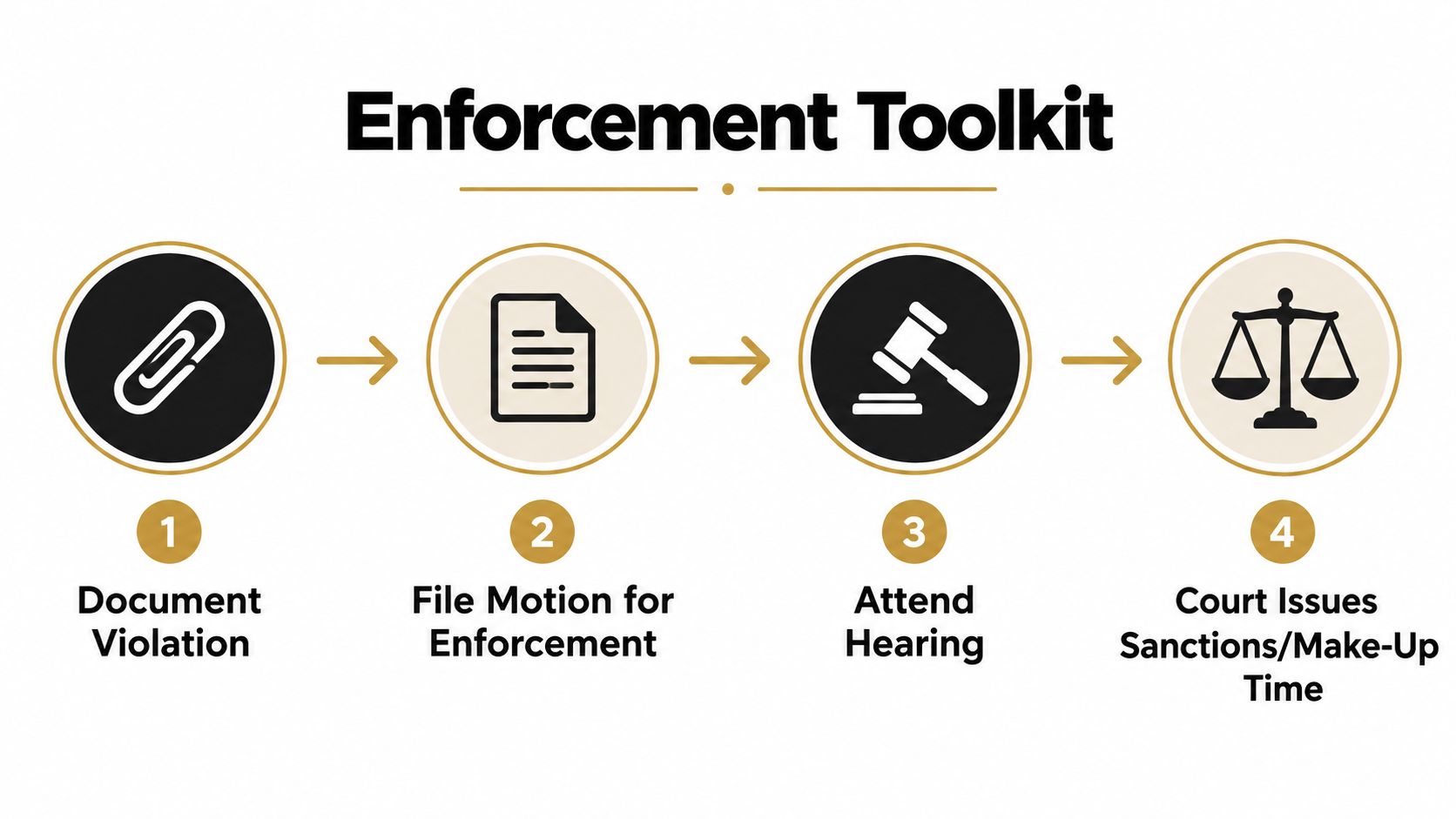
The usual path starts with collecting the evidence and filing the enforcement motion. The court then sets the matter for consideration or hearing, and the moving party must prove the violation under the applicable legal requirements. An associate judge or district judge may hear the matter depending on the assignment and proceeding.
Violations can affect more than the immediate remedy. Repeated disregard for orders may damage credibility and influence later decisions about parenting, property, and temporary relief. Before filing, organize the evidence chronologically and identify exactly what the other spouse did, when it happened, and which provision it violated.
A contempt of court action in a Woodlands divorce is serious. Don't threaten it in a text message, retaliate, or manufacture a violation to create an advantage.
This video provides general background on enforcement concepts, but it doesn't replace advice about your specific standing-order packet.
What to Do Next and How a Local Lawyer Helps
The timing issue is easiest to understand through a practical example. A Woodlands spouse files on Monday and freezes discretionary transfers, saves the account records, keeps the children on their school schedule, and communicates in writing. The other spouse moves money, changes a beneficiary, and announces a Florida trip before the first hearing. The first spouse has preserved evidence and followed the rules. The second has created issues the court may need to address.
Start with this checklist:
- Inventory accounts: List joint and separate bank, retirement, investment, and credit accounts.
- Protect credit information: Review credit reports and watch for unfamiliar applications or balances.
- Gather statements: Collect insurance, retirement, mortgage, tax, and loan records.
- Photograph property: Create a dated record of vehicles, valuables, and household items.
- Preserve parenting records: Save school, daycare, medical, attendance, and exchange information.
- Calendar the temporary-orders window: Track the date of filing, service, mediation, and any temporary-orders setting.
- Preserve communications: Export relevant messages and keep them in a format that shows dates and participants.
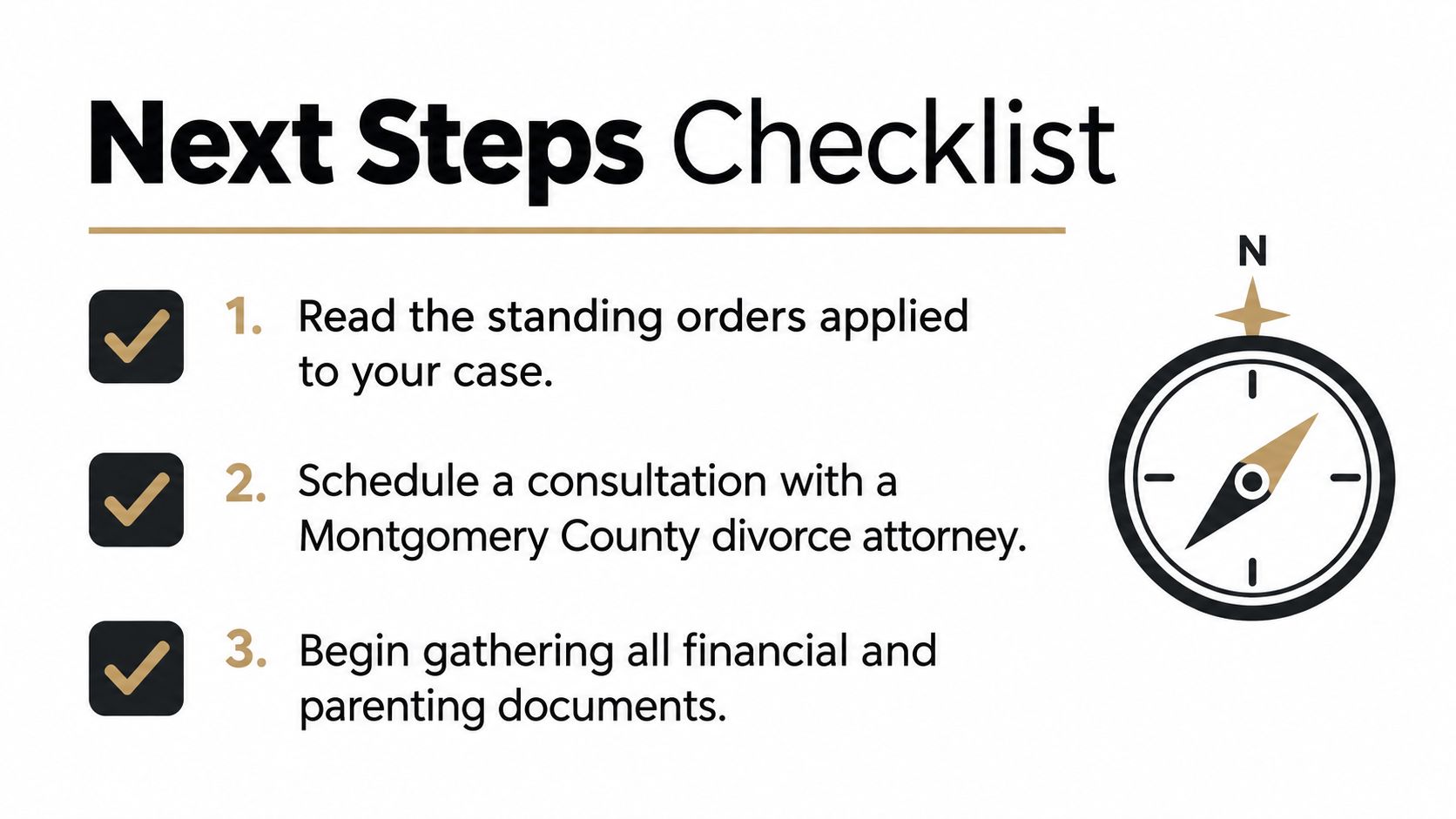
A Montgomery County family lawyer can review the applicable standing orders, prepare or respond to temporary-orders requests, identify early violations, organize financial and parenting evidence, and help protect your position in mediation or later hearings. The Law Office of Bryan Fagan serves families in The Woodlands and surrounding Montgomery County communities in divorce, custody, support, property, and enforcement matters.
This article is general information, not legal advice. Standing orders can differ by court and case, and an urgent safety or financial issue may require immediate legal attention.
If you need help understanding what Montgomery County standing orders restrict, The Law Office of Bryan Fagan can review your filing timeline, financial concerns, and parenting situation. Visit The Law Office of Bryan Fagan to learn more or schedule a consultation about your next step.