 Skip to content

“Just apply for specialty court” is incomplete advice. In Montgomery County, there isn't a single application that opens every treatment-court door, and having an addiction, mental-health diagnosis, or military background doesn't automatically secure admission.
For families in The Woodlands, the distinction matters beyond the criminal case. A treatment schedule can affect school pickups, work hours, and custody exchanges without changing a family-court order. Understanding Montgomery County specialty court programs eligibility starts with identifying the right program, then separating its admission rules from the family's other legal responsibilities.
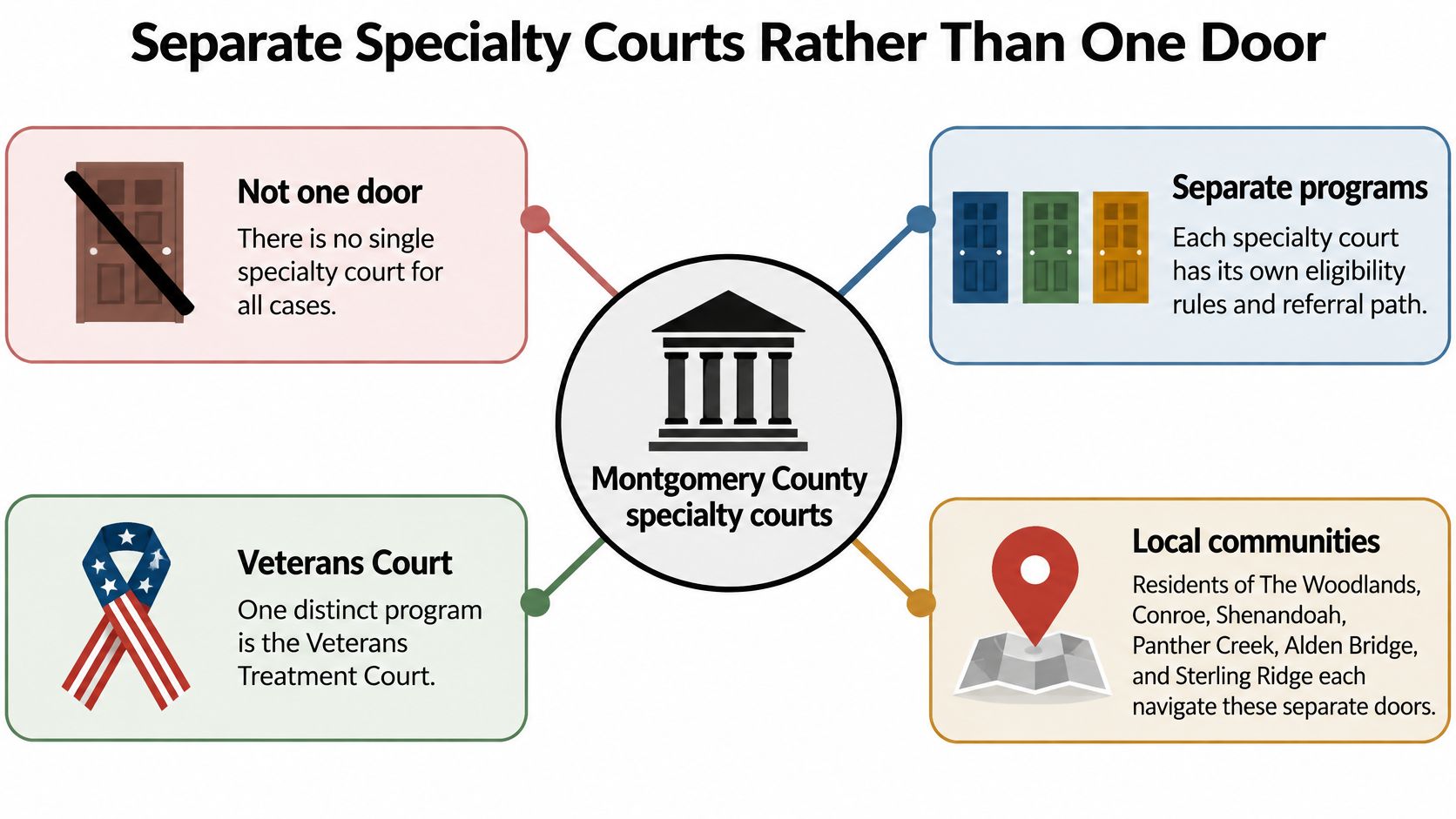
Separate Specialty Courts Rather Than One Door
Treatment-court access isn't automatic, and the local criminal-treatment tracks aren't family-court programs. A parent living in Panther Creek may need treatment and have an active custody case, but those circumstances don't create a combined application or allow either court to decide the other's issues.
Think of a hospital campus with different wings. A patient doesn't enter every unit just because they arrive at the same address. Each unit serves a different population and has its own admission process.
Montgomery County's separate tracks include the CARE drug court, DWI Court, adult Mental Health Treatment Court, Veterans Treatment Court, and juvenile Power Recovery Court. Veterans Treatment Court operates through the 359th District Court. These programs aren't interchangeable routes for anyone who needs support.
Match the case, not just the address
Residents of The Woodlands, Conroe, Shenandoah, Alden Bridge, and Sterling Ridge need to identify the person's age, pending case type, assigned court, and treatment needs. A Montgomery County address alone doesn't establish eligibility.
The Texas Judicial Branch's specialty-courts overview explains that program names, eligibility requirements, and procedures differ by jurisdiction. Texas recognizes specialty courts in criminal cases and, in some settings, child-protection cases, but that doesn't make these local criminal-treatment programs divorce, custody, child-support, or probate courts.
Practical rule: A treatment need identifies a question to investigate, not a guaranteed place in a program.
Someone with overlapping addiction, mental illness, and military service may need screening for the appropriate track. Don't assume that submitting a referral to one program automatically transfers the person to another if admission is denied.
Keep the decisions separate
Referral, legal eligibility, clinical suitability, and final acceptance are different decisions. Written requirements govern the initial review, while assessments and the program's authorized decision-makers determine whether admission can proceed.
The practical decision also includes ongoing treatment duties and the effect on the household calendar. For a parent, the question isn't only whether admission is possible, but how participation will fit alongside existing family-court obligations.
This is general information, not legal advice.
Eligibility by Program for Montgomery County Cases
Montgomery County specialty court eligibility at a glance
| Program | Who it serves | Core eligibility gate | Directory phone |
|---|---|---|---|
| CARE drug court | Adults | Substance-use diagnosis, or a drug, property, or other nonviolent offense in which drug abuse was a motivating factor | 936-538-8113 |
| DWI Court | Adults | Separate DWI track; drug and DWI courts also face statutory limits on certain violent offenses | 936-538-8113 |
| Mental Health Treatment Court | Adults | Mental-health treatment need tied to the criminal case and the program's written criteria | 936-538-8110 |
| Veterans Treatment Court (359th District Court) | Veterans and current Armed Forces, Reserve, National Guard, or State Guard members with a Montgomery County case | Military status is required but not enough; prosecutor consent and a judicial finding are also required | 936-539-7900 |
| Power Recovery Court | Juveniles | Juvenile district-court track, not an adult criminal or family-law docket | 936-538-3700 |
The program classifications and published telephone numbers above come from the Texas Judicial Branch's September 2019 county directory. Treat these as directory contacts, not a promise that the number, coordinator, or admission policy remains unchanged. Confirm the current program before sending sensitive records.
How to read the eligibility gates
Start with the population column. An adult seeking treatment doesn't begin with Power Recovery Court because a family member has heard favorable things about that program. Likewise, an adult mental-health referral isn't interchangeable with a drug-court referral.
Next, examine the connection between the case and the treatment need. For CARE, the screening question concerns substance use and the qualifying offense, not merely whether someone would benefit from counseling. For Mental Health Treatment Court, ask for the actual written admission criteria rather than assuming that any diagnosis qualifies.
CARE and DWI Court share a published contact number, but they're separate tracks. Someone dealing with a first DWI should distinguish the underlying case from possible treatment-court participation; the firm's first-offense DWI information for The Woodlands addresses that separate case context.
The table is a sorting tool, not an admission determination. It helps a family identify whom to contact and what documents to request. It doesn't replace charge-specific screening or the program's current handbook.
The statute matters as much as the program name
The Texas judiciary's specialty-court eligibility guidance distinguishes adult drug courts under Texas Government Code Chapter 123, veterans treatment courts under Chapter 124, mental-health courts under Chapter 125, family drug courts under Chapter 122, and juvenile family drug courts under Chapter 130. That guidance also identifies statutory restrictions involving certain violent offenses for drug and DWI courts.
Those distinctions prevent a common misunderstanding: every specialty-court category Texas recognizes isn't necessarily a locally available Montgomery County program. A statewide reference to family drug courts doesn't establish that a particular local criminal-treatment program can accept a divorce or custody matter.
When calling, describe the pending case accurately. Ask which court controls the referral, which written policy applies, and whether the coordinator can provide the current eligibility materials.
Don't interpret a shared phone number, similar program name, or nearby county's policy as proof of admission rights. The useful answer is the one tied to the person's actual case and the local program's documented rules.
From Referral to Acceptance or a No
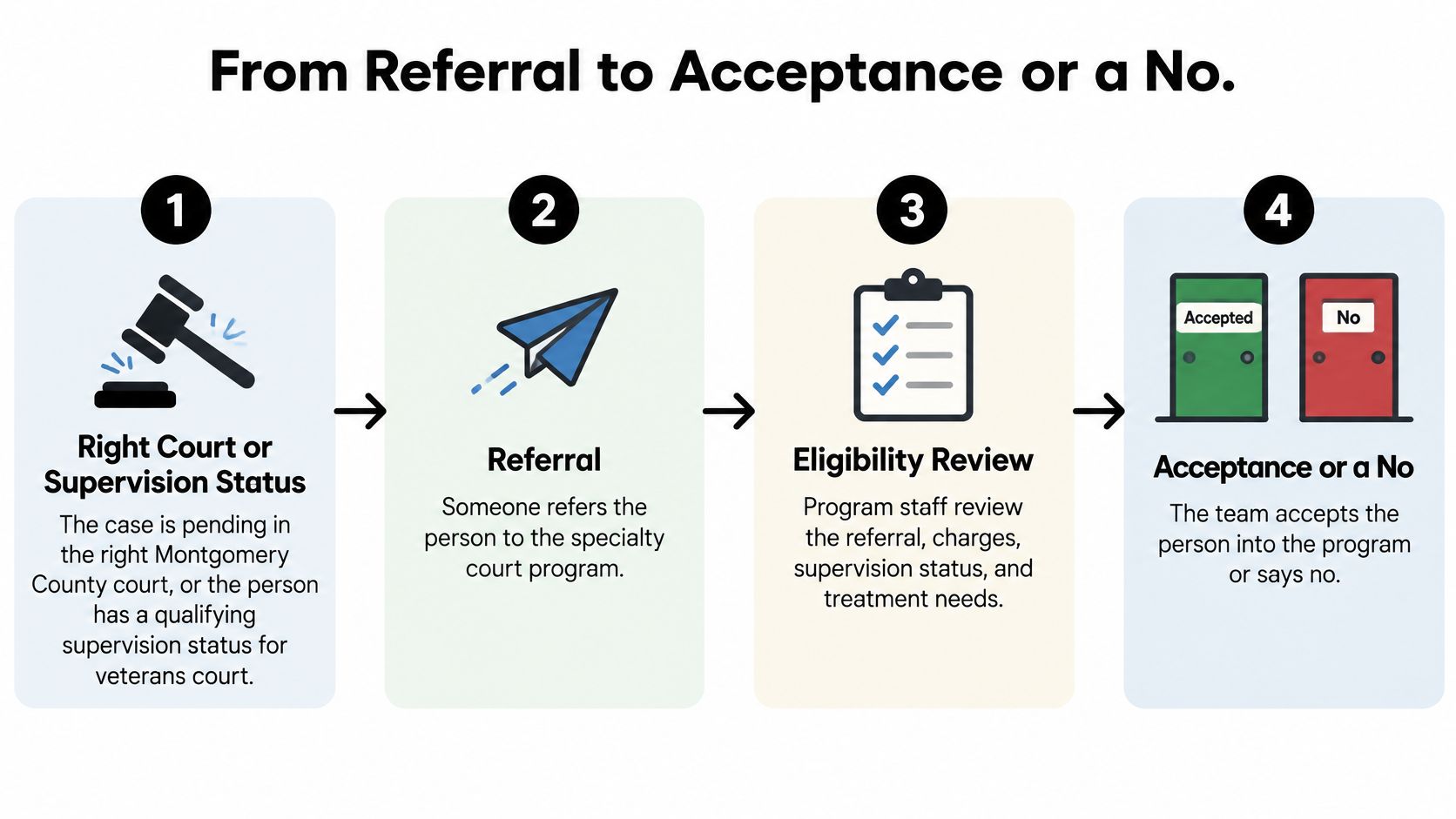
A referral starts a review. It doesn't mean the applicant has been accepted, that a plea agreement exists, or that treatment staff have found the program suitable.
The decision is easier to understand as separate gates, each answering a different question.
Confirm the right court or supervision status. Identify where the criminal case is pending. For veterans court, a qualifying supervision status may also be relevant, so the review shouldn't stop at whether a new charge is awaiting disposition.
Establish the referral route. Ask who must initiate or authorize the referral. Defense counsel, the prosecutor, probation personnel, or the judge may be involved, but families should confirm the local process rather than assume a relative can submit a universal application.
Check the written legal criteria. Staff need the person's age, charge information, jurisdiction, and other admission facts. Any applicable offense restriction must be addressed before someone treats a referral as a likely acceptance.
Complete the required assessments. The Texas specialty-court standards call for trained staff to use validated clinical assessments and risk-and-needs assessments. They also require objective, documented eligibility criteria rather than decisions based solely on perceived motivation, demographic identity, or prior involvement with child or family services.
Document the veterans-specific connection when applicable. Montgomery County's Veterans Treatment Court policy manual describes qualifying service status, a service-connected brain injury, mental illness, mental disorder, or military sexual trauma affecting the charged conduct, a pending misdemeanor or felony or qualifying supervision status, willingness to plead guilty or admit guilt, treatment compliance, and team approval.
Obtain the required consent and acceptance. For veterans court, prosecutorial consent and a judicial eligibility finding are separate from supplying records. The treatment team's approval also matters; an applicant shouldn't mistake a completed packet for final admission.
When a veteran's records are incomplete
A missing formal PTSD diagnosis doesn't necessarily end the evidence inquiry. Potential supporting material includes military and medical records, VA disability determinations, testimony or affidavits, and findings from a state or county veterans office.
The important question is what the accepted evidence establishes about the program's actual criteria. A service record may establish military status without establishing how a qualifying condition affected the charged conduct. A medical record may describe treatment without resolving the required service connection.
Ask counsel which gap needs to be filled before ordering more records. That approach is more useful than collecting a large packet that never addresses the disputed requirement.
Paper eligibility and acceptance aren't the same. Ask which gate remains unresolved and what written criterion controls it.
Charge history, available treatment capacity, and authorized team decisions may still affect the outcome. Discretion doesn't eliminate the requirement for documented standards, and a family's confidence that someone needs help doesn't replace the required legal and clinical findings.
The 12 to 24 Month Duties After Admission
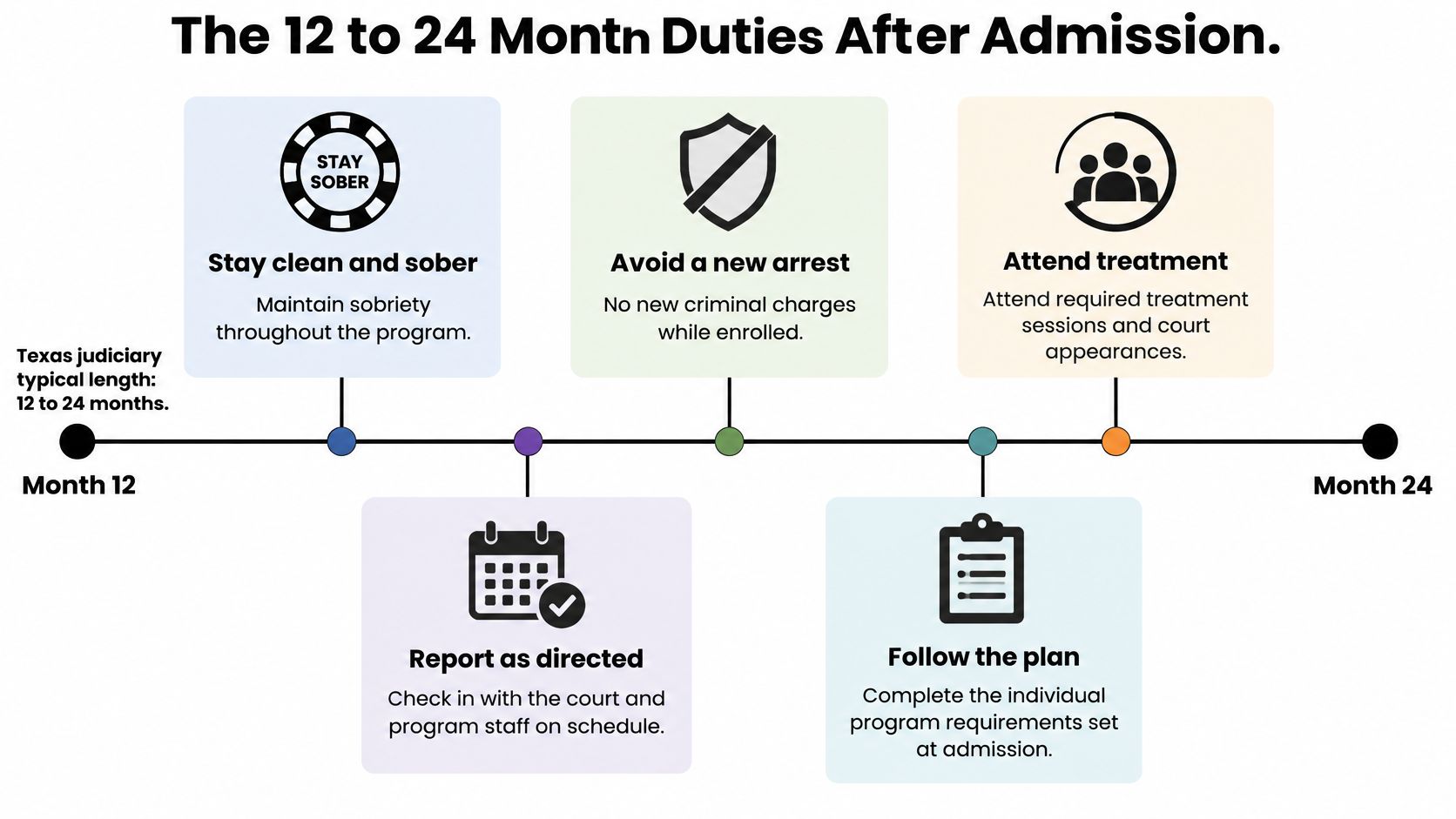
Admission begins a 12 to 24 month obligation. The Texas Judicial Branch's specialty-courts guidance describes typical participation as lasting 12 to 24 months, with sobriety, no rearrest, treatment attendance, and regular court-review hearings among the common requirements.
Those duties sit in the criminal treatment track even when they reshape a household routine. A participant also has to learn the local rules for testing, reporting, and finishing an individual treatment plan. A person who can get to intake may still need steady transportation, childcare, and work coverage for the months that follow.
Build a calendar that can actually work
A workable week in Montgomery County might put treatment in Conroe on a workday, a review hearing on a separate morning, and testing instructions that can require prompt action. A participation plan works like a shift schedule: every commitment needs a time, a backup, and a written rule for changes.
Before agreeing to participate, place the proposed requirements beside work shifts, existing court dates, supervision appointments, and caregiver coverage. Line up a backup driver or caregiver where appropriate, and treat each absence rule as enforceable even when the reason is reasonable.
For someone also under community supervision, compare the program handbook with the applicable Montgomery County community-supervision reporting requirements. Ask whether a treatment appointment satisfies any reporting obligation or whether both remain necessary.
Read the consequences before committing
Missing hearings or breaking program rules can lead to sanctions or removal, potentially returning the matter to the regular criminal docket under the governing terms. The Texas specialty-court standards make the written program framework important to understanding continued participation.
Request the handbook before any plea or admission. For a track that requires admitting guilt, the decision involves more than choosing a convenient treatment provider.
Calendar check: Don't build a participation plan around the hope that work, childcare, and court conflicts will sort themselves out later.
Organized records matter through the final review. Keep attendance confirmations, approved schedule changes, and coordinator instructions together so a misunderstanding stays small and fixable.
Finish the coordinator conversation with these questions:
- Review hearings: How often are reviews scheduled, and how much notice will the participant receive?
- Testing rules: Where does testing occur, how are instructions delivered, and what response is required?
- Missed appointments: What happens after a missed appointment, and whom should the participant notify immediately?
Veterans Court Numbers and What They Leave Out
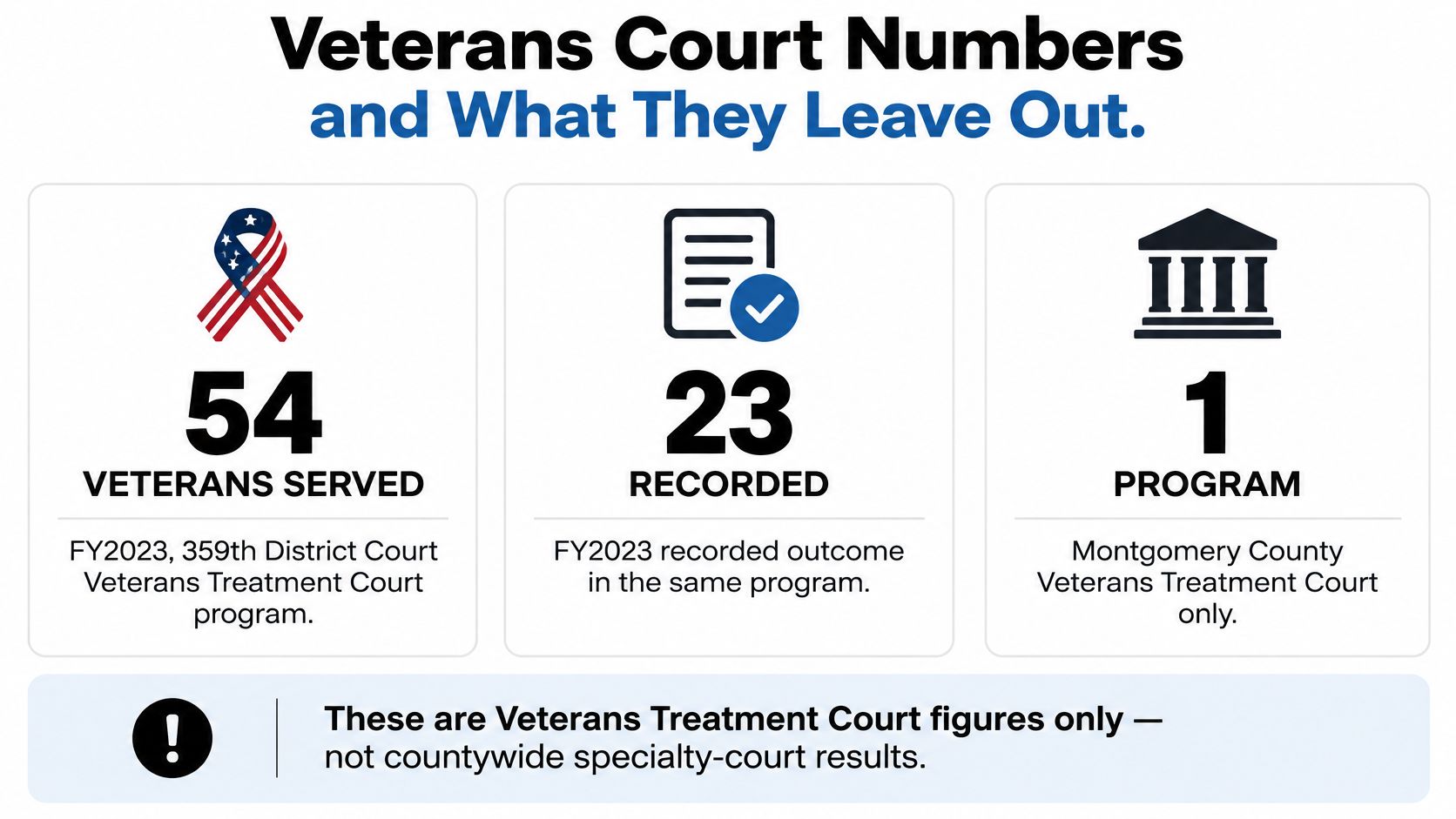
For FY2023, the Texas Veterans Commission's annual report lists 54 veterans served, 23 successful completions, and 0 unsuccessful completions for Montgomery County's Veterans Treatment Court in the 359th District Court, a completion share of roughly 42.6% of those served (23 divided by 54). The same report places Montgomery County among the largest listed county-level veterans-treatment caseloads, with only the North Texas Regional Veterans Court, a multi-county program reporting 162 participants, ahead of it.
That comparison deserves a second look. A regional court spanning several counties measures itself against a different geographic yardstick than a single-county docket.
Published counts like these work like a school's annual report. They record how many students were enrolled and how many graduated, while the question a new applicant cares about is whether the program will take them and whether they will finish. Those are separate gates: the referral, the clinical assessment, prosecutor consent, and the team's decision.
Compare reporting years carefully
Earlier county figures appear in the historical program information associated with the Texas specialty-court registry, which records about $200,000 in reported grant funding for each of the 2021 and 2022 program years.
Montgomery County Veterans Treatment Court reported results
| Year | Veterans served | Successful completions | Unsuccessful completions |
|---|---|---|---|
| FY2023 | 54 | 23 | 0 |
| 2022 | 43 | 10 | 0 |
| 2021 | 40 | 19 | 1 |
Two details matter before reading too much into the zeroes. Participants still enrolled when a reporting year ends count as served rather than as completions, so a low unsuccessful figure partly reflects open cases. Each row also describes that year's group alone, which says little about a new referral's chances of admission or graduation.
What families can't infer
These totals cover Veterans Treatment Court only. They say nothing about CARE, DWI Court, Mental Health Treatment Court, or Power Recovery Court, and folding them into a countywide specialty-court success rate would claim more than the counts support.
They also measure program activity rather than parenting. A completion figure cannot predict a custody ruling, a support modification, or a divorce outcome, because it carries no information about conduct, compliance with family orders, or a child's circumstances.
The more useful habit is to read any outcome number the way an accountant reads a line item: which program, which reporting year, which unit. Ask whether the figure counts admissions, people served, or completed cases, and whether participants were still enrolled when the period closed.
When Treatment Court Dates Hit a Custody Case
A treatment court docket and a custody docket run on parallel tracks, even when they involve the same household. A parent accepted into CARE after a nonviolent drug case owes weekly treatment, testing, and review hearings in Conroe. The custody case keeps its own judge, its own deadlines, and its own hearings, and neither court reschedules around the other automatically.
The collision is practical. A required appointment can land on the same morning as a court-ordered exchange, and someone still has to be at the right place at the right time. If the treatment track requires a guilty plea or an admission, that record may also become something the other parent raises in the family case.
What enrollment does and doesn't show
Texas Family Code section 153.002 makes the child's best interest the primary consideration in conservatorship, possession, and access. Admission to a treatment court answers a criminal-court question. It says nothing by itself about parenting.
A family judge may weigh facts involving stability, substance use, and each parent's ability to meet the child's needs. Participation can be relevant evidence on those points, so the questions that matter are concrete ones: Is the parent attending? Are exchanges reliable? Are the child's needs being met? Enrollment is a status, and status is thinner evidence than conduct.
Two reference points help keep the family side straight. Montgomery County Family Courts: A Local Guide explains the court structure these cases move through, and possession schedule basics covers the exchange times most Woodlands orders follow.
- Preserve the schedule: Keep the current possession order and any later signed changes together.
- Record specific conflicts: Note the appointment, exchange time, notice given, and practical effect on the child.
- Use the right process: Ask a family lawyer how to address an unworkable schedule rather than assuming treatment requirements rewrite it.
Protective orders and probate stay separate
In Montgomery County, a protective-order case is filed through the County Attorney's Office and requires attending at least one preparation appointment and one court appearance. Entering treatment court doesn't waive a protective order or replace that separate process.
A treatment referral is also no permission to disregard existing contact restrictions. Give the lawyers handling each matter the relevant orders so they can spot conflicts before an exchange or appointment creates one.
If a probate matter is open, residents of The Woodlands must file probate at the Montgomery County Clerk's office in Conroe, at 210 W Davis St. That is a different office and a different process from these treatment courts.
The shared household doesn't merge the cases. Keep the criminal-court dates and family-court dates in separate files, even when both appear on the same household calendar.
Confirm the Program Then Talk Through the Family Case
Getting into a program and planning for its effects on your family are two different jobs. The first belongs to the treatment court, where acceptance is really several decisions stacked together: legal eligibility, a clinical assessment, and the program team's sign-off. The second belongs in a conversation with a family lawyer. Handle them in that order, because the admission answer shapes which family-law questions are even worth asking.
Before you call
Program rules and local policies change, so confirm the current version directly with the court or the program coordinator rather than relying on a description you read months ago. A directory listing tells you who a program generally serves. Whether a specific person is admitted comes down to the program's own assessment and the team's decision.
Then prepare for the family-law side:
- Gather the family paperwork: Bring the current parenting order and any upcoming hearing notices.
- Add the proposed treatment schedule: Include any protective orders so the lawyer sees the full set of restrictions at once.
- Name the specific problem: Write down the concrete issue, such as an exchange that collides with a treatment session or a question about who can transport the child.
What the family-law conversation covers
Montgomery County's family courts follow their own procedures for custody, support, and enforcement, and those procedures run on a different track from a treatment program's admission process. A family lawyer can tell you which parts of the treatment schedule a court can work around informally and which parts require a formal modification request. That distinction matters more than the referral itself.
You can discuss your situation confidentially under the attorney-client privilege during our free consultation. Bring questions about the family-law effects of treatment participation without assuming the consultation or a referral guarantees any court outcome.
The Law Office of Bryan Fagan offers free consultations for families in The Woodlands and Montgomery County who need help understanding how treatment-court obligations may affect divorce, custody, or support matters. Call 281-819-1726 or visit The Law Office of Bryan Fagan to use the firm's online contact form and schedule a conversation about the family-law side of your situation.
