 Skip to content
For parents living within 50 miles of each other, the expanded possession schedule became the default for new orders entered on or after September 1, 2025. An older order doesn't automatically change, so a Woodlands parent must understand the language already signed by the court before assuming the schedule has “upgraded.”
You may be reading this after a first court date, with a proposed possession order in one hand and a school calendar in the other. The legal language can feel abstract, but the result is very concrete: who picks up your child, which Thursday includes dinner or an overnight, where holiday exchanges happen, and whether summer means a shorter or longer block of time.
For families in The Woodlands, Alden Bridge, Creekside Park, Sterling Ridge, Panther Creek, Conroe, and the surrounding Montgomery County communities, distance now matters more than many older articles explain. The standard visitation schedule the Woodlands TX parents find online may describe the traditional schedule, while a newer order may use the expanded schedule for parents who live close together.
What Life Looks Like With a Standard Visitation Schedule in The Woodlands
A parent leaves the Montgomery County Courthouse lot off North Thompson after the first Monday docket call. The papers are still warm from the bailiff's hands, and the judge has signed a Standard Possession Order. The parent knows the order is important, but the question is simpler: what happens next Monday, next Thursday, and during the next school break?
Under the traditional in-town framework, the noncustodial parent usually sees the child on the first, third, and fifth weekends of the month. A Thursday evening period during the school term adds a short weekday connection, and summer usually includes a longer possession period. The exact exchange times and holiday language come from the signed order, not from a general internet calendar.
A Thursday might mean picking up a child near Knox Junior High, grabbing dinner near Alden Bridge, and returning the child in time for homework and the next morning's carpool. Another family may coordinate around Panther Cub practice, a Sterling Ridge school event, or traffic between Creekside and the other parent's home. Those details often determine whether a schedule feels workable even when the legal wording looks straightforward.
The calendar becomes the real order
Over the next six months, the parent may move between regular weekends, school-night exchanges, and holiday blocks. Thanksgiving might fall with one household under the holiday section, while Christmas possession is divided into separate blocks. A parent near The Woodlands High School may plan around the morning drop-off, while another may use a neighborhood exchange point that avoids an unnecessary trip through the commercial areas.
The order also affects relatives. Questions about custody and visitation rights for grandparents in Montgomery County are separate from the parent-to-parent possession schedule, as discussed in Grandparents' Rights in The Woodlands, and shouldn't be assumed to arise automatically from a parent's weekend.
The rest of the legal machinery is easier to understand once you connect it to these ordinary moments. The statute supplies a starting calendar, mileage rules adjust the schedule, and the signed decree controls what your family must follow.
How the Texas Standard Possession Order Works
A parent receives a first court date and assumes the judge will create a schedule from scratch. In Montgomery County, the court usually starts with Texas's Standard Possession Order, commonly called standard visitation, then checks whether the child's needs or the parents' circumstances require a different plan.
For children age 3 or older, Texas Family Code § 153.252 creates a presumption that possession under the standard order serves the child's best interest. Family Code § 101.029 defines the term “standard possession order” and connects it to the possession rules in Chapter 153, as explained in Texas's child visitation and possession guidance.
That presumption is a starting point, not a guaranteed calendar. A judge can use the statutory framework, consider the evidence, and order a modified schedule. The child's age, school routine, safety concerns, each parent's residence, and the wording of any existing decree can change the result.
Possession and conservatorship are different
Conservatorship covers parental rights and duties, including decision-making authority. Possession covers the periods when the child is physically with each parent. Parents may be joint managing conservators while one parent has the primary residence and the other follows defined periods of possession.
The traditional closer-distance framework commonly includes:
- First, third, and fifth weekends: The noncustodial parent generally receives these weekends under the applicable local schedule.
- Thursday evening time: A weekday period during the school term provides contact between weekend periods.
- Holiday divisions: The order assigns holidays and portions of school breaks to each parent.
- Summer possession: The traditional closer-distance framework commonly provides 30 days of summer possession.
That traditional calendar matters, but Woodlands parents should not assume it is the only version now available. Beginning September 1, 2025, the default schedule for parents living 50 miles or less apart shifts to an expanded arrangement. The change matters most when an existing order still uses older wording. A new law does not automatically rewrite every signed decree, so read the order before changing exchanges or summer time.
Review this Standard Possession Order in The Woodlands for local context, then compare it with your decree. Start with the signed order, then compare it with the statute. An online calendar cannot override the enforceable language in your court order.
In-Town vs Long-Distance Schedule Compared
Distance changes the shape of possession. A parent who lives in The Woodlands and another who lives in Conroe or Houston may be able to manage a school-night period and regular weekend exchanges. A parent who moves more than 100 miles away usually needs fewer, longer blocks because repeated school-week travel becomes impractical.
For parents living within 100 miles of each other, the traditional framework typically includes the first, third, and fifth weekends, a Thursday evening period commonly described as 6:00 p.m. to 8:00 p.m., and 30 days of summer possession. For parents living more than 100 miles apart, the long-distance structure generally provides one weekend each month, spring break every year, and 42 consecutive days of summer possession instead of the closer-distance summer period. These distinctions are summarized in Texas visitation schedule guidance.
| Schedule Element | Within 100 Miles, Woodlands-area typical | Over 100 Miles, long-distance |
|---|---|---|
| Weekday evenings | Thursday evening time during the school term is commonly included | Fewer midweek visits because of travel |
| Weekends | First, third, and fifth weekends are typically used | Generally one weekend each month |
| Holidays | Holiday periods are divided under the possession order | Spring break every year is generally included, with holiday details controlled by the order |
| Summer | 30 days of summer possession is commonly provided | 42 consecutive days of summer possession is generally provided |
Why mileage must be measured carefully
The relevant distance is between the parents' residences, not just between a neighborhood and a courthouse. A Woodlands parent may face a different calendar after the other parent relocates to Dallas or Austin. The distance can also affect whether Thursday school-term possession makes practical sense, even if a parent technically wants that time.
The Texas Attorney General's parenting-time materials identify a major statutory adjustment for cases filed on or after September 1, 2021, when the 50-mile distance rule became relevant to certain possession provisions. That mileage threshold is especially important for parents comparing an older order with a newer one.
Child support and possession are related family-law issues, but they're not the same proceeding. Parents handling establishment, modification, or enforcement of support may also review information about a Child Support Attorney in The Woodlands, but a possession dispute still requires attention to the custody order's exact terms.
The 2025 Expanded Schedule for Parents Living Close
A parent in The Woodlands may receive a new court order after September 1, 2025 and see a schedule that gives the other parent more time during the school week. That change comes from Texas Family Code § 153.3171, which requires an expanded schedule for parents who live within 50 miles of each other when the statutory conditions apply.
The Texas Attorney General's parenting-time schedule overview explains that standard possession options remain available unless the court finds they do not serve the child's best interest. For a closer look at local procedure, review this guide to an expanded possession order in Montgomery County.
The practical difference is clear. The older pattern commonly used a shorter Thursday period and earlier alternating-weekend return times. The expanded structure generally extends weekend possession until 8:00 p.m. and adds a Thursday overnight, giving the non-primary parent a fuller school-week block.
| Possession Window | Pre-2025 Default | 2025 Expanded Default |
|---|---|---|
| Thursday period | Commonly a shorter evening period ending at 6:00 p.m. or 8:00 p.m., depending on the order | Expanded Thursday period with an overnight under the close-distance structure |
| Alternating weekend end-time | Earlier return time under the older order | Return time generally extends to 8:00 p.m. |
| Local mileage | Traditional provisions applied according to the order and applicable distance rules | Applies to the expanded close-distance structure for parents living within 50 miles |
| Existing orders | Continue according to their signed terms | Don't change automatically merely because the law changed |
New orders and existing decrees are not the same
A new order entered after the effective change may use the expanded schedule when the parents live within 50 miles. An existing decree follows its signed terms. The law does not automatically rewrite it. A parent seeking the newer schedule generally must request a modification and obtain a new order.
Consider a parent in The Woodlands and another in Conroe. Under an expanded schedule, the non-primary parent might pick up the child after school on Thursday, keep the child overnight, and handle school drop-off the next morning. The following weekend may continue until 8:00 p.m. on the return day, depending on the order's selected option and wording. A Woodlands-to-Spring commute may work better with that arrangement than with a dinner-only visit.
For a local explanation of how these changes intersect with court procedure, see Montgomery County Family Courts. Read the decree before assuming expanded possession applies. The case date, order date, parents' addresses, and exact possession provisions determine what schedule controls.
When Montgomery County Courts Deviate From the Standard
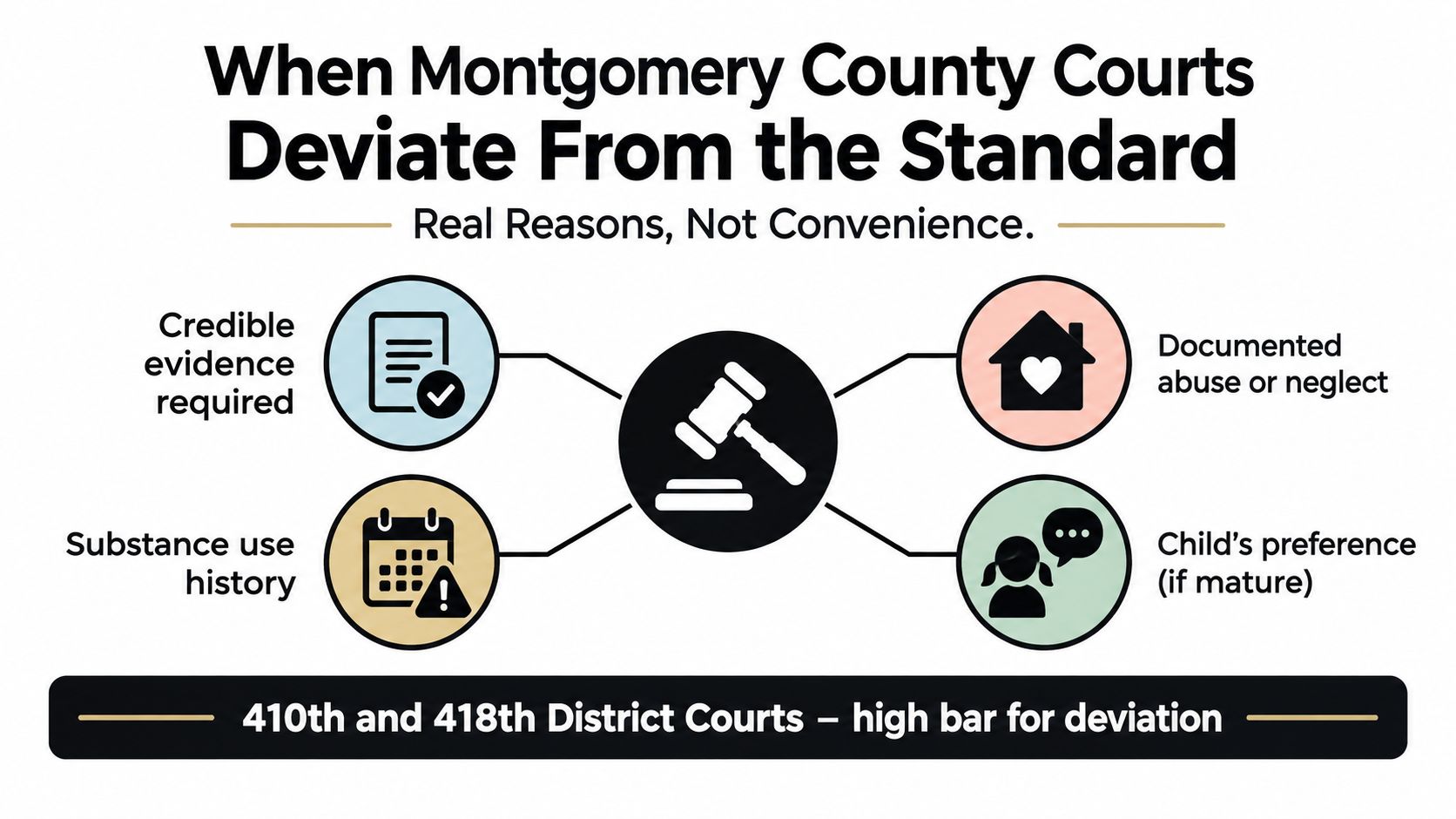
Convenience alone isn't a strong reason to abandon the standard schedule. Parents in The Woodlands sometimes ask for a different calendar because a weekend is inconvenient, a commute is frustrating, or a preferred activity conflicts with possession. Those concerns may support a different exchange time, but they usually don't justify a major departure without evidence tied to the child's best interest.
Family violence is different. Texas Family Code § 153.004 addresses possession and access when credible evidence of family violence exists. A judge may also need to address a child's significant medical or educational needs, documented substance abuse, neglect concerns, a relocation that makes regular exchanges unworkable, or a mature child's expressed preference. A child's preference is a factor, not an automatic decision.
Bring records instead of arguments
The 410th and 418th District Courts need facts they can evaluate. A parent who claims substance abuse should identify admissible records, relevant reports, treatment information, or other evidence. A parent raising special educational needs should organize school records, provider recommendations, and the way the current schedule creates a concrete problem.
A parent working rotating shifts in the oil-and-gas sector may not need a radically different order. The better request may be to exchange Thursday overnight possession for another midweek night that preserves a standard-shaped schedule while matching the parent's actual work rotation.
Practical rule: Ask for the narrowest change that solves the child's problem. A focused request is easier to understand than a demand for an entirely new calendar.
Distance can also justify longer blocks rather than frequent exchanges. A move beyond the local area may make monthly weekends, spring break, and extended summer possession more realistic than repeated school-night travel. The court's task remains the child's best interest, not equal convenience between adults.
If you want a deviation, create a record before the hearing. Keep school communications, medical information, exchange messages, police or protective-order records where relevant, and a clear explanation of how the standard schedule fails this child. Judges rarely depart from the framework based on unsupported accusations.
Modifying or Enforcing Your Schedule Locally
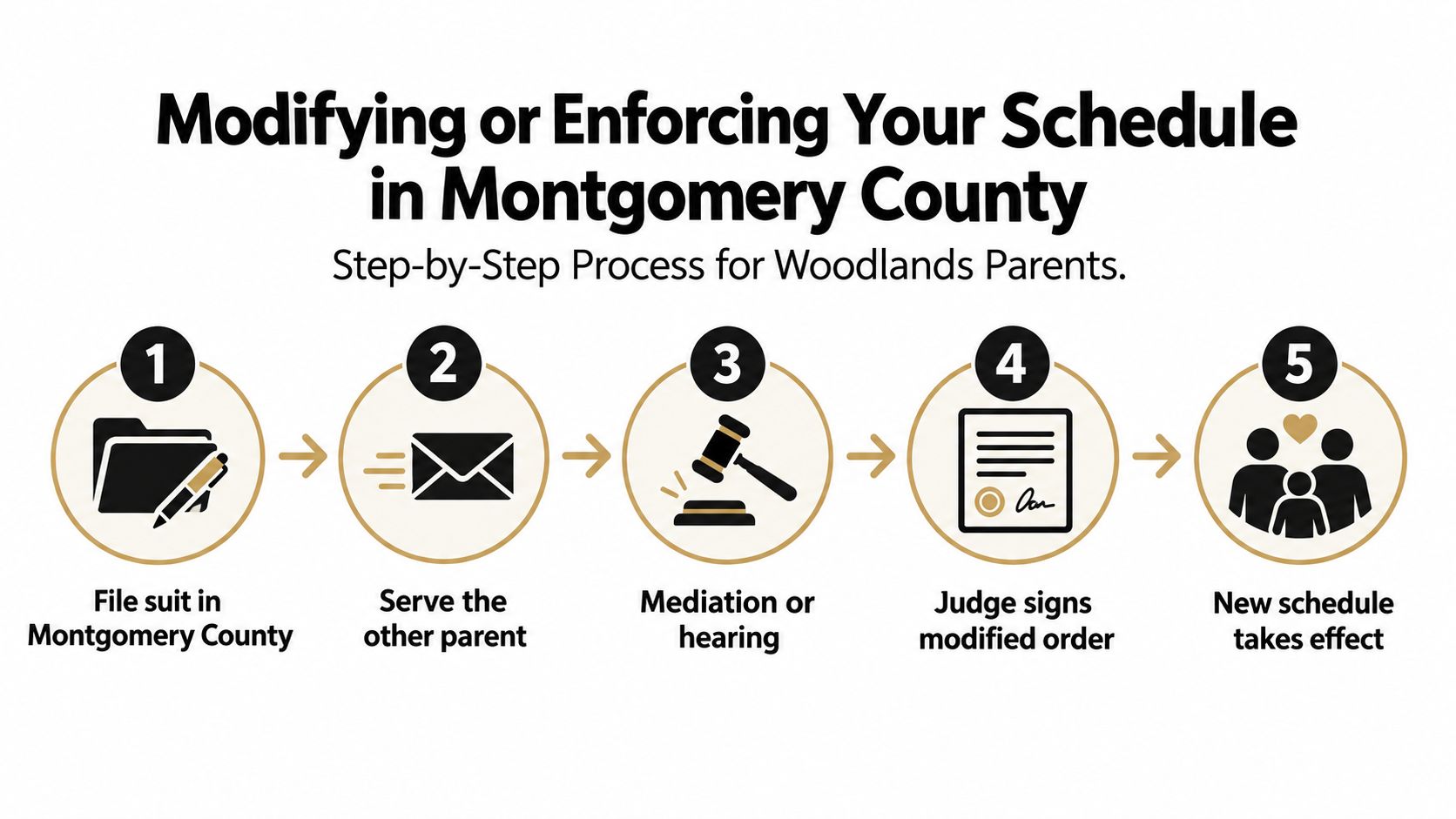
Modification and enforcement solve different problems. Modification asks the court to change an order because circumstances have materially and substantially changed and the requested change serves the child's best interest. Enforcement asks the court to require compliance with the order already in place.
A Woodlands parent seeking modification generally files a Suit to Modify the Parent-Child Relationship in the proper Montgomery County court, serves the other parent, and presents the requested change at mediation or a hearing. Texas Family Code § 156.101 supplies the material-and-substantial-change framework. A new address, school need, work schedule, safety concern, or persistent failure to exercise possession may become relevant, but the facts must be connected to the legal standard.
For enforcement, the parent may file a Motion for Enforcement identifying the violated provision and the dates of noncompliance. Texas Family Code § 157.168 allows the court to order remedies that can include make-up possession. Sanctions can escalate from warnings to contempt and, in appropriate circumstances, possible jail time. Don't treat enforcement as a substitute for rewriting a schedule that no longer works.
Build the proof while the problem is happening
Keep a contemporaneous log. Record the date, the possession period, the exact order language, what happened, the messages exchanged, and anyone who witnessed the exchange. Save texts and emails in their original form, and keep school or activity records that show the practical effect of missed or late possession.
The Montgomery County District Clerk's office on Lee Thompson Lane is part of the local filing process. Filing requirements, fees, service, mediation, and hearing availability depend on the case and the court. Don't assume a filing immediately changes the current schedule. Until a judge signs a modified order, the existing order generally remains the document both parents must follow.
A contested case can take months from filing to hearing, and timing depends on the court, service, pleadings, mediation, and the issues involved. Plan for the process rather than expecting a same-week result. For parents dealing with repeated violations, enforcing a custody order in The Woodlands can provide a starting point for understanding the enforcement path.
The following video offers general background on the process. It doesn't replace advice about your specific decree.
What To Do Next for Your Family
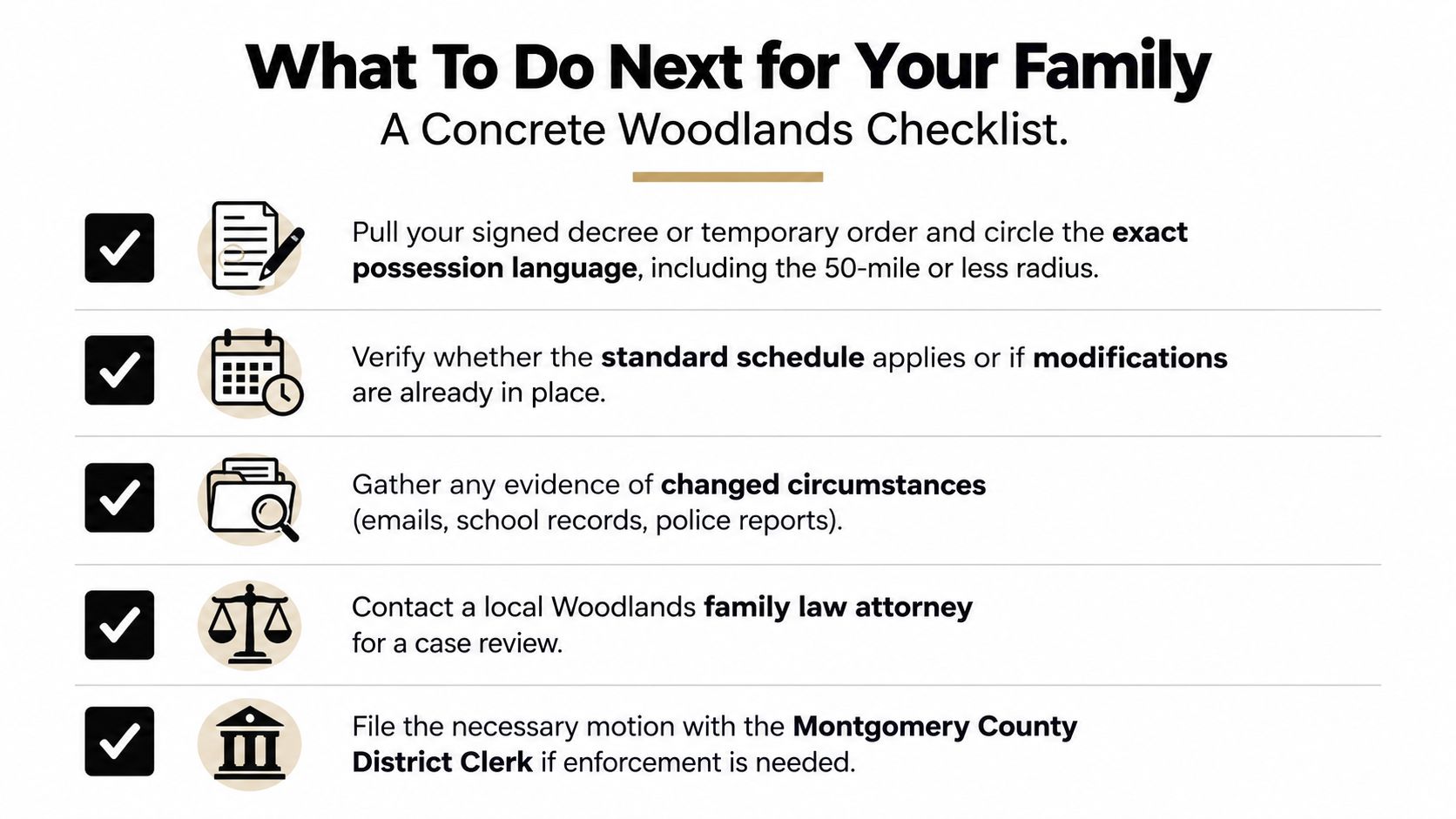
The right first move is not to download a generic calendar. Pull out the signed decree or temporary order and read the possession section word for word. Look for mileage language, expanded beginning or ending times, holiday provisions, summer election deadlines, exchange locations, and any prospective language tied to the child's third birthday.
A practical Woodlands checklist
- Pull the order. Circle the exact possession language and check whether the parents are treated as living within 50 miles for the applicable case.
- Build the calendar. Use the calendar app your family already uses, then add the Woodlands school calendar, school activities, holidays, and transportation obligations.
- Mark exchanges. Identify the location named in the order. If the parents have agreed to another location, preserve that agreement in writing.
- Organize evidence. Save texts, emails, missed-exchange logs, school records, medical records, and receipts that show what is working or failing.
- Choose the legal path. If the order no longer fits, discuss modification. If the other parent violates it, discuss enforcement through the Montgomery County District Clerk.
One local example
A parent in Creekside Park keeps arriving late for exchanges because the order's location no longer fits the child's school route. Instead of relying on angry messages, the parent builds a calendar, records each late pickup with dates and communications, and identifies a practical alternative supported by school logistics. That record can help counsel evaluate whether the issue calls for a written agreement, enforcement, or modification.
Families with younger children should check for future-start language. Texas Family Code § 153.254 allows a court to render a prospective standard possession order taking effect on the child's third birthday, with the order presumptively using the standard framework. A two-year-old's current schedule may therefore change automatically later if the decree says so. Read that provision carefully and ask whether the order contains a staged schedule.
This article is not legal advice. The best response depends on your decree, filing date, mileage, the child's age, and the facts affecting your child's best interest.
The Law Office of Bryan Fagan helps families in The Woodlands and Montgomery County evaluate standard, expanded, modified, and enforced possession schedules. Visit The Law Office of Bryan Fagan to schedule a consultation and discuss what your current order requires.
