 Skip to content

There's no single statewide reporting interval for Montgomery County; your judgment, written conditions, and assigned officer's instructions control your schedule, and check-ins are often, but not always, monthly. Advice to show up once a month leaves out the separate duties that can come with community supervision.
For someone working in The Woodlands, attending treatment in Conroe, or arranging transportation to New Caney, the problem isn't just remembering an appointment. It's keeping the office visit, payments, testing, treatment, and required updates from falling out of step.
What Community Supervision Reporting Means Here
The assumption that everyone reports the same way each month can lead you astray. A coworker's routine isn't permission to follow that routine yourself, even if you live nearby or report to the same department.
Community supervision, often called probation, allows a person to remain in the community under written court conditions. Reporting gives the assigned officer a way to check whether that person is meeting those conditions.
Start with your own papers
Keep these documents together:
- Judgment: The court's written decision and obligations.
- Conditions of Community Supervision: The requirements that apply to your case.
- Officer's instructions: Directions about appointments, communication, documents, and other reporting tasks.
Read them together rather than choosing whichever instruction seems easiest. If something appears inconsistent, ask for clarification and keep the answer.
Someone whose supervision follows a DWI case can also discuss the underlying paperwork with a Montgomery County DWI attorney. Don't assume that an explanation about another person's case answers a question about yours.
Keep separate court obligations visible
A parent in The Woodlands, Conroe, or another Montgomery County community may also have a child-support or custody order. Put those commitments on the calendar too, without treating them as substitutes for supervision duties.
Practical rule: Bring the actual order when asking what you must do. A remembered summary can leave out the detail that matters.
This is general information, not legal advice. It doesn't replace your written order or a lawyer's advice about your case. Use the duty chart to identify the paperwork connected to each requirement.
Reporting Duties and the Proof Each One Needs
Montgomery County Reporting Duties at a Glance
| Duty | When it is due | Proof to have ready | What sets the rule |
|---|---|---|---|
| In-person or directed check-in | Often monthly, but only as the order and officer direct | Identification and any papers the officer requested | Written conditions and officer instructions |
| Address, phone, or job change | As the conditions require, not on a guessed interval | Updated details in the form the officer accepts | Judgment and Conditions of Community Supervision |
| Counseling or ordered program | Begin by the 60th day after supervision is granted | Provider name, address, phone, and attendance record | Chapter 42A, Texas Code of Criminal Procedure |
| Fee, fine, or restitution payment | On the schedule in the judgment; receipts may be reviewed at the next report | Payment receipt or mailed-payment record | Judgment and Montgomery County Adult Probation practice |
| Drug or alcohol testing | When the officer or order directs a test | Test appearance or result paperwork you are given | Supervision conditions |
| Community service | Hours and deadlines written in the order | Signed hour log | Supervision conditions |
| Travel limits or electronic monitoring | Whenever the restriction applies | Permission record or device-compliance notes | Supervision conditions |
Montgomery County Adult Probation's FAQ explains that an assigned officer monitors court-ordered conditions, with check-ins often monthly and other possible requirements including testing, employment, community service, travel restrictions, and electronic home monitoring. Often monthly describes a pattern, not a countywide promise.
Match the duty before gathering the proof
Begin with the check-in row. Write the actual appointment, location, and reporting method on your calendar, then attach any request for documents to that entry. Someone in The Woodlands may have a different reporting arrangement from someone in Conroe or New Caney.
Next, find the notice rules for changes. Don't save a new address, phone number, or employer's details for your next appointment unless your instructions allow that timing. Use the communication method your officer accepts.
For counseling, distinguish enrollment, starting attendance, and continued attendance. An intake confirmation may show that you contacted a provider, while an attendance record shows participation. Keep both when they're available.
Payment records need their own attention. Identify what each payment covers, and keep the receipt with the matching obligation. Sending money doesn't necessarily give you a document showing how it was credited.
Treat the remaining rows as separate tasks
Testing isn't automatically completed by attending the office appointment. Community service needs a usable record of hours, not just your recollection of working them. Travel permission and electronic-monitoring instructions also require attention whenever those conditions apply.
Mark only the rows that appear in your order. Don't add someone else's conditions to your own list, and don't omit a requirement because it's absent from this general chart.
Use the chart in a practical sequence:
- Compare: Match each applicable row to the wording in your conditions.
- Identify: List what must happen before your next reporting date.
- Pack: Gather the proof that corresponds to those tasks.
The purpose is to arrive with records that answer the officer's questions, not a stack of unrelated paperwork.
Deadlines Set by Texas Law
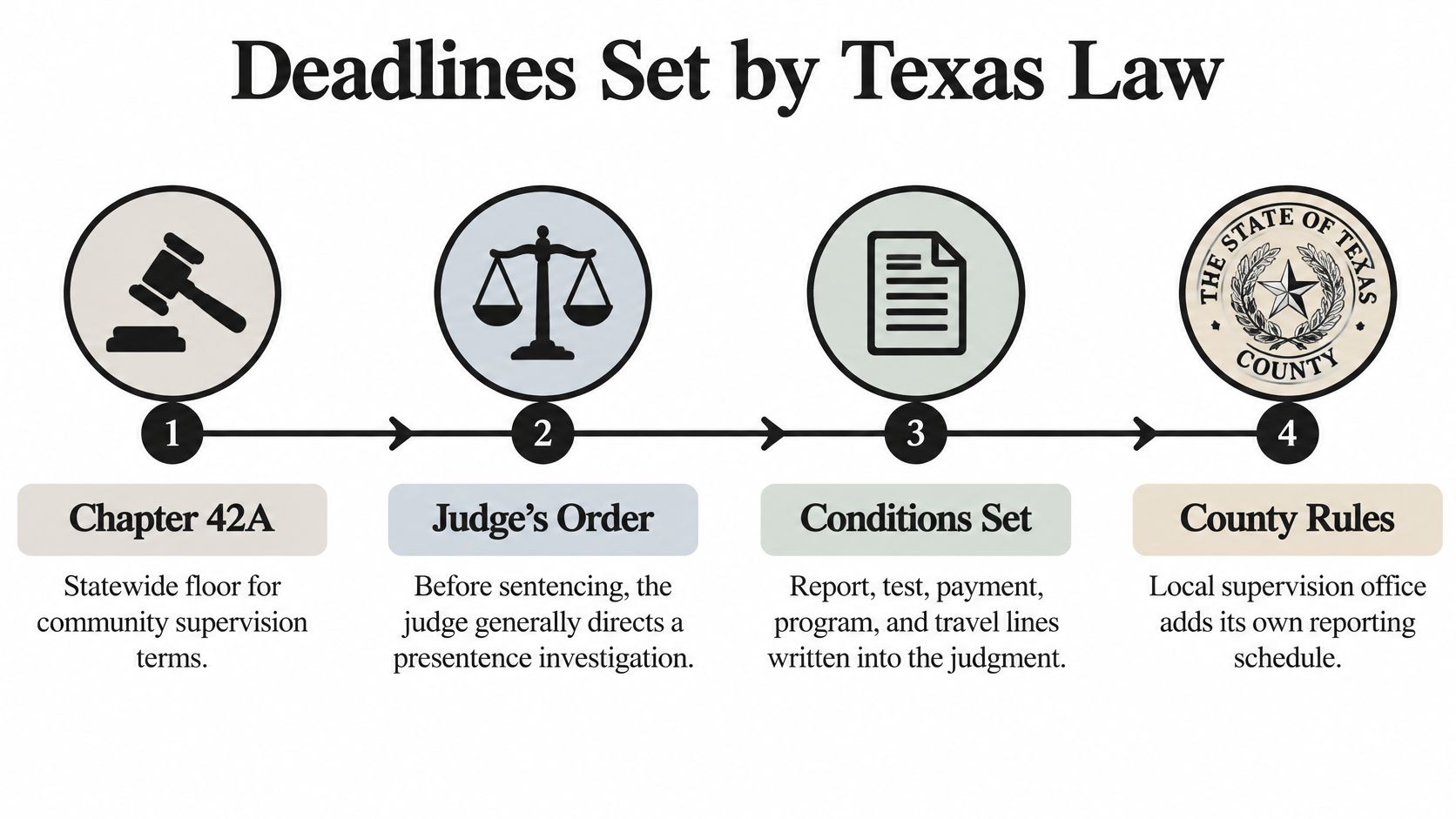
Texas community supervision requirements start with Chapter 42A of the Texas Code of Criminal Procedure, which includes a conditional 30-day postsentence-report deadline for the officer and a 60th-day program-start requirement for a person ordered into counseling or another program. These are different obligations assigned to different people.
The officer's report is not your check-in deadline
Before sentencing, the judge generally directs a supervision officer to prepare a written presentence report. It addresses the offense circumstances, victim restitution, and the person's criminal and social history, along with a proposed supervision plan identifying available programs and sanctions.
When a presentence report isn't required in a felony case, the judge may order a postsentence report. If ordered, the officer must deliver it to the court clerk no later than the statutory deadline after sentence is pronounced or deferred-adjudication supervision is granted.
That administrative deadline doesn't tell you when to attend your next appointment. Don't use it to calculate a reporting date or delay contacting your assigned officer.
The layers of authority fit together this way.
Your program obligation needs its own calendar entry
For ordered counseling or another program, the law requires more than selecting a provider. You must begin attendance, give the officer the provider's name, address, and telephone number, and report attendance.
Think of Chapter 42A as a building code and your Montgomery County order as the plan for your particular building. The code supplies the legal framework; the plan identifies the requirements you need to carry out. Neither a generic calendar nor a coworker's experience replaces that plan.
A provider's waiting list can create a practical problem. Preserve the intake request, the provider's response, and any available start-date information, then seek direction promptly. Don't assume that an unsuccessful attempt to schedule attendance automatically changes the requirement.
A request for clarification is useful evidence of communication. It isn't the same thing as permission to change a deadline.
A child-support amount set under the Texas Family Code remains a separate court obligation. A supervision fee schedule doesn't erase that support order, so keep both visible when planning payments.
If a program is ordered, mark the statutory start deadline on your calendar and ask the officer what proof of the start date is accepted. Also calendar the practical work needed beforehand, such as intake, transportation, and getting the provider's contact information.
When a Woodlands Workday Collides With Report Day
Say a warehouse worker living in The Woodlands receives instructions to report in person on a Tuesday morning. His ordered counseling group meets at the same hour, and his employer expects him back afterward.
He considers attending counseling first and reporting later at whichever county office is open. That feels like a reasonable way to complete everything, but it assumes he can change both the appointment and the location himself.
The conflict starts with the documents in his hand.

An open office isn't an approved substitute
Montgomery County Adult Probation's department page identifies reporting locations in Conroe, The Woodlands, and New Caney, with different operating schedules, including limited Tuesday-through-Friday hours in New Caney. That location information doesn't establish permission for him to report at any office he chooses.
The readily available FAQ material addresses payment receipts rather than setting out a general missed-reporting procedure, guaranteed rescheduling process, or remote-reporting option. He shouldn't fill that gap with a guess.
Instead, he contacts his assigned officer using the instructed method. He identifies the appointment conflict, attaches the counseling schedule if appropriate, and asks whether the reporting appointment can move.
He also requests an attendance note from the program. He saves the message he sent and the officer's answer, rather than relying on his phone's call history to explain the whole exchange.
A request still needs an answer
If he hasn't received a response, he shouldn't treat silence as approval. He should continue seeking direction through the authorized contact method and consult counsel if the conflict remains unresolved.
His work schedule matters to the explanation, but it doesn't tell him which court requirement he may rearrange. The same is true of transportation trouble: documenting the problem helps explain it, without automatically excusing an absence.
Keep the appointment instructions beside the program schedule while reviewing the conflict.
For this worker, the useful outcome is a clear instruction he can follow and preserve. A clash among work, treatment, and office hours is a paperwork problem to raise before the appointment, not after someone records a missed report.
The Folder to Bring to Every Check-In
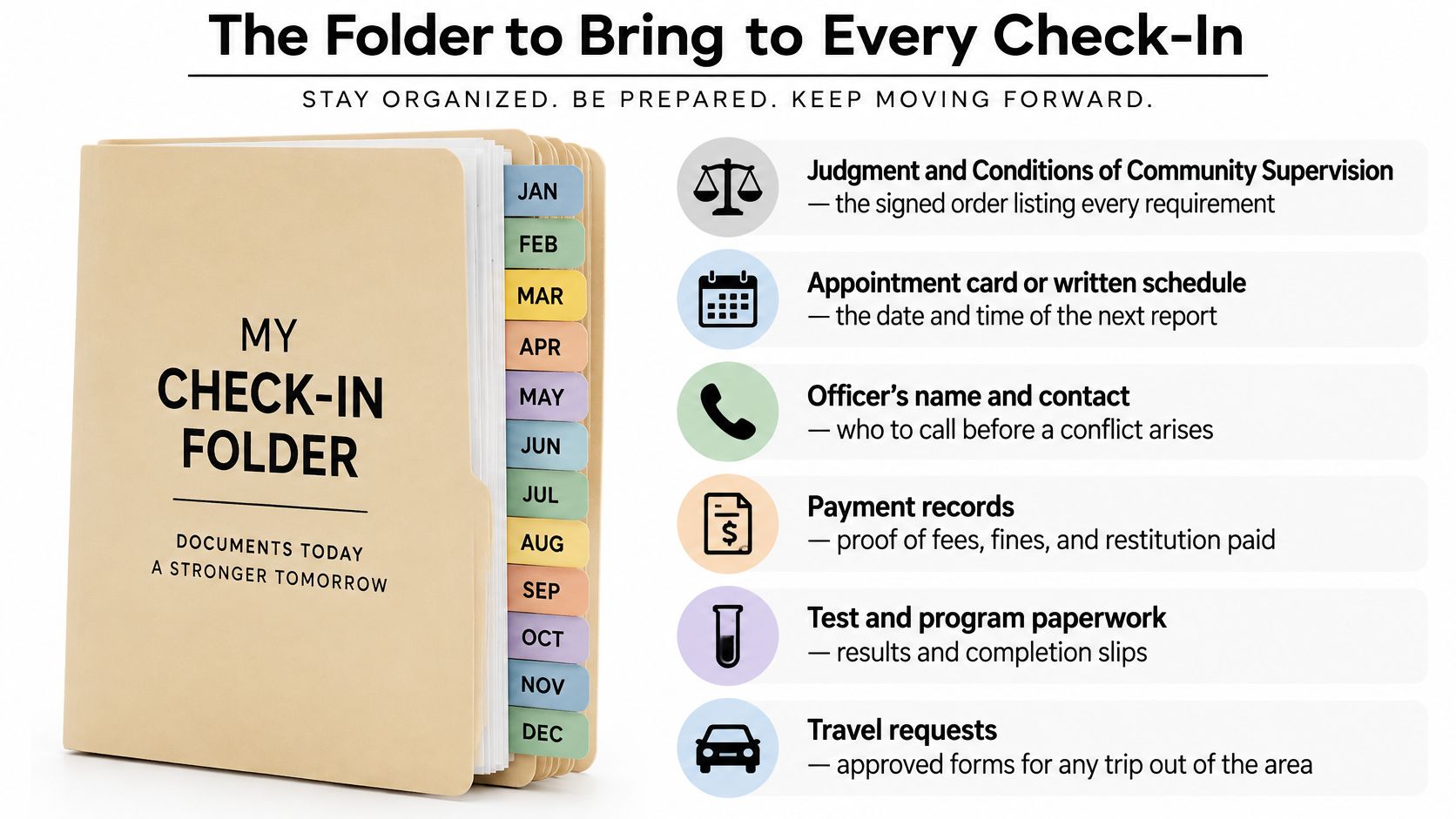
Use a physical folder with monthly dividers or a phone album organized by month. Keep permanent reference papers at the front and the current reporting packet behind them.
The goal isn't to collect everything indiscriminately. It's to make each required activity easy to verify without searching through messages, loose receipts, and screenshots at the appointment.
Keep the standing instructions together
Put the judgment and Conditions of Community Supervision in the reference section. Add the appointment card or written schedule, the officer's name, and the instructions for contacting that officer.
If you use your phone, download readable copies rather than relying entirely on access to an email account. Keep paper originals secure, and bring originals when specifically instructed.
Build the monthly packet around the duties that apply:
- Payments: Fee, fine, and restitution receipts, including mailed-payment records.
- Testing: Appearance slips or result paperwork you're allowed to keep.
- Community service: Signed hour logs and service sign-in sheets.
- Employment: Employer letters or verification requested under your conditions.
- Programs: Enrollment information with the provider's name, address, and phone, plus attendance logs.
- Updates and permissions: Copies of change notices, officer replies, and approved travel records.
A simple folder can make those categories easier to locate.
Label records so they explain themselves
Use month, duty, and date in a filename or on a divider. A label such as “March payment receipt” is more useful than “document,” especially when another March record concerns testing.
Photograph the entire page, including the date, identifying details, and signature when present. Check that the image is readable before putting away the original.
Before you leave: A receipt in the car or an unreadable photograph won't help you answer a question at the reporting desk.
Reporting appointments can include review of both personal contact and financial compliance. Have the packet ready rather than trying to reconstruct a payment history during the conversation.
For a parent paying child support under a Texas Family Code order, use a separate divider for support receipts. Don't combine them with supervision fees in a way that suggests a payment satisfied both duties.
As an organizational practice, keep the set for the full supervision term and ask a lawyer before discarding it. That's a recordkeeping recommendation, not a stated legal retention period. Start assembling the next month's packet on the day the current report ends.
Problems That Can Become Compliance Issues
Compliance Problems and the First Response
| Problem | Why it matters | First response |
|---|---|---|
| Missed check-in | The officer tracks whether the directed appointment was kept | Contact the officer promptly, explain the conflict, and keep a copy of that contact |
| Program not started by day 60 | The statute requires a timely start, provider details, and attendance reports | Enroll, send the provider's name, address, and phone, and keep attendance proof |
| Payment questioned at reporting | The appointment may be used to verify financial compliance | Bring receipts rather than relying on memory |
| Unreported move or job change | Required notice is separate from merely appearing | Give the update in the way the officer instructs and save a copy |
| Test, service, or travel duty skipped | These are separate conditions from the office visit | Treat each condition as its own deadline and document it |
Under Article 42A.301 of the Texas Code of Criminal Procedure, a judge or supervision officer may require reporting as directed and compliance with the applicable department's rules. Related conditions may address home or field visits, geographic restrictions, employment, financial support, substance testing, and treatment.
Identify the instruction at issue
The individual judgment, conditions, and department instructions establish the reporting frequency, method, location, documentation, and required notices. When a problem arises, find the exact instruction rather than arguing from what someone else was allowed to do.
The statutory framework connects conditions to public protection, victim protection, punishment, rehabilitation, or reform. A lawyer can compare a disputed instruction with the written order and review the records showing what happened.
An explanation and proof serve different purposes. Saying that you paid describes your position; a receipt helps establish the transaction. Saying that you notified the officer is more useful when you can also produce the message and any reply.
Don't alter a record to make it look more complete. Preserve the original communication, including a response that doesn't say what you hoped it would say.
Know when to seek legal help promptly
A missed check-in or another unmet condition can be recorded as noncompliance and lead the officer to act on the alleged violation. Possible outcomes depend on the order, the person's history, and the judge; they can include tighter conditions or a request for the court to revisit supervision.
Contact a lawyer promptly when:
- A date was missed: Get advice about the actual record and any outstanding instructions.
- A violation report was mentioned: Preserve the notice and relevant supporting documents.
- A new arrest occurred: Don't assume the existing supervision case is unaffected.
- Court dates conflict: Bring both the family-court notice and supervision schedule.
If a new drug allegation is involved, a drug-possession lawyer in The Woodlands can review that allegation alongside the existing supervision paperwork.
This is not legal advice or a script for contesting a violation. The useful first move is to contact the assigned officer as instructed, preserve proof of that contact, and speak with counsel rather than waiting for the problem to resolve itself.
What to Do Before Your Next Report
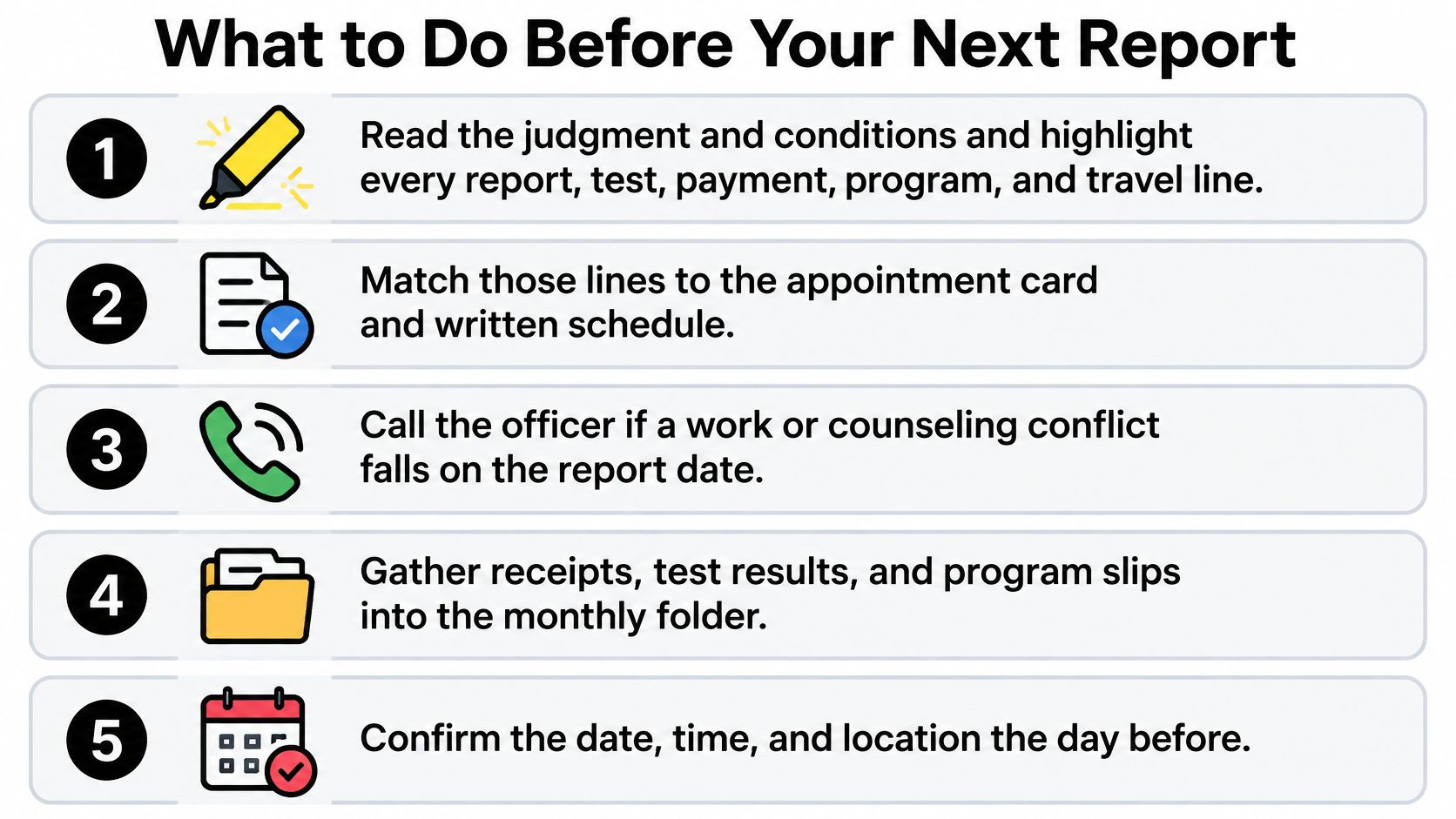
The most useful way to handle Montgomery County community supervision reporting requirements is to turn each written obligation into a task with matching proof. Prepare while you still have time to clarify an instruction or request an adjustment.
What to do next
- Highlight your obligations in the judgment and conditions, including reporting, testing, payments, programs, and travel.
- Match the applicable duties to the chart, leaving out requirements that aren't on your order.
- Confirm the reporting details with your assigned officer, including office, day, method, and requested documents.
- Complete the program-start requirements by the statutory deadline, including sending the provider's name, address, and phone.
- File your proof in the monthly folder, including receipts, logs, and messages.
- Request direction before a conflict involving work, illness, transportation, or treatment, preserving the reply.
- Consult a lawyer about unresolved problems, including a missed report, a mentioned violation, or a conflicting Texas Family Code support or custody obligation.
Keep the checklist alongside your written schedule.
Make the appointment easy to prepare for
Before leaving home, check that the folder contains the requested documents rather than just the usual documents. A new request for employment verification, for example, needs attention even if the rest of your packet looks familiar.
Keep the appointment information accessible during the trip. If transportation fails or illness prevents travel, use the officer's contact instructions promptly and preserve the relevant information. Don't assume a message automatically changes the appointment.
If you're managing custody exchanges or a family-court appearance at the same time, put the actual notices beside the supervision schedule. A lawyer needs those documents to understand the conflict, not just an account that both events happen on the same day.
This article is not legal advice, and your written supervision order controls. Clarification about your own case should come from the assigned officer and counsel, not from another person's reporting routine.
We serve clients in The Woodlands and across Montgomery County. You can schedule a consultation through our website form or by stopping by the Woodlands office; a free consultation is also available by calling (281) 819-1726 or filling out the firm's online contact form.
The Law Office of Bryan Fagan offers consultations for individuals and families in The Woodlands and Montgomery County who need guidance about their legal obligations. If supervision reporting overlaps with a custody, support, or other court matter, bring the relevant orders and appointment notices so you can discuss the specific conflict. Visit The Law Office of Bryan Fagan to arrange a consultation and talk through your next steps.
