 Skip to content
You're driving home after dinner near The Woodlands Waterway when a patrol car pulls you over. You complete field sobriety tests, answer questions, and leave in handcuffs. By morning, you're trying to understand court paperwork, your driver's license, and whether a first DWI can really affect your job and family responsibilities.
It can. A first-offense DWI in The Woodlands isn't a routine traffic ticket. You may be dealing with a criminal case in Montgomery County and a separate license proceeding through the Texas Department of Public Safety. The most urgent deadline may arrive before you ever see a judge.
What a First Offense DWI Means in The Woodlands
A Woodlands Parkway stop can become a criminal case quickly. The officer may claim that your driving, speech, balance, field sobriety performance, or alcohol odor indicated impairment. After an arrest, the state must prove that you operated a motor vehicle in a public place while intoxicated. The charge doesn't become valid merely because you were arrested or because an officer believed you looked impaired.

First offense does not mean low stakes
Texas generally treats a first-offense DWI as a Class B misdemeanor. The baseline punishment range is 72 hours to 180 days in county jail, a criminal fine of up to $2,000, and potential driver-license loss lasting up to one year, according to Texas impaired-driving guidance.
Texas guidance also identifies at least three mandatory jail days for a first conviction. If the case involves an open container, the minimum jail time increases to six days. Those are conviction consequences, not proof that every arrested driver will receive that sentence. Your result depends on the evidence, the charging decision, negotiations, motions, and whether the case goes to trial.
A first arrest can still disrupt transportation immediately. You may need to get to work, take children to school, attend medical appointments, or travel between The Woodlands, Conroe, Magnolia, or other Montgomery County communities. The criminal case and license case can affect those decisions before the criminal court reaches a final outcome.
Practical rule: Treat the arrest as the beginning of two legal problems, not the end of a traffic stop.
What prosecutors must prove
The central questions include whether you were operating the vehicle, whether the operation occurred in a public place, and whether you were intoxicated under Texas law. The prosecution may rely on officer observations, dash-camera footage, body-camera footage, field sobriety tests, breath evidence, blood evidence, or statements attributed to you.
That evidence needs to be tested, not assumed accurate. A stop may involve questionable reasonable suspicion, poorly administered testing, incomplete video, or a chemical result that requires technical review. Calling it a first offense doesn't eliminate those issues.
A local lawyer should also identify which court has the criminal case, which agency handled the arrest, and whether a separate DPS suspension notice was served. Those details determine what must happen next.
Penalties and the BAC 0.15 Enhancement Trap
A first DWI arrest does not always stay a standard Class B misdemeanor. The key question may be the BAC result. At 0.15 or higher, Texas law can place a first DWI in Class A misdemeanor territory, increasing jail exposure, the maximum criminal fine, and the pressure surrounding plea negotiations.
The standard range includes 72 hours to 180 days in county jail, a fine of up to $2,000, and possible license loss lasting up to one year, as described in TXDOT's DWI penalty materials. A first conviction also carries a separate state-imposed financial penalty of $3,000. That amount rises to $6,000 when the BAC is 0.15 or higher, according to this Texas first-DWI penalty overview.
The comparison that matters
| Penalty Category | Standard First DWI, Class B | Enhanced First DWI, BAC 0.15+, Class A |
|---|---|---|
| Jail exposure | 72 hours to 180 days in county jail | Up to one year in county jail |
| Maximum criminal fine | Up to $2,000 | Up to $4,000 |
| State-imposed financial penalty | $3,000 on conviction | $6,000 on conviction |
| License consequences | Suspension can last up to one year | First-offense suspension materials report 90 days to one year |
| Open container | Minimum jail time can increase to six days | The enhancement and open-container issue require separate analysis |
Do not treat the BAC number as a detail to review at the end of the case. It can affect the charge classification, financial exposure, negotiation posture, and available resolutions. The 0.15 threshold can make a first offense a Class A misdemeanor. It does not automatically make the case a felony, but it creates a substantially more serious misdemeanor case. The Texas DWI enhancement discussion explains why that distinction matters.
Other costs follow the criminal sentence
A conviction can create insurance and reinstatement costs after the courtroom portion ends. Practical Texas guidance identifies an SR-22 insurance requirement for two years and a reinstatement fee as potential burdens, alongside the jail, fine, and license consequences.
The Law Office of Bryan Fagan also handles broader local legal matters, including Uncontested Divorce in The Woodlands. That family-law service is separate from DWI defense. A DWI case involves criminal exposure and a possible administrative license action, so the legal strategy must address the BAC evidence, charge level, and driving consequences together.
The Two Parallel Tracks Criminal Case and License Suspension
Your DWI arrest can start a criminal prosecution and an Administrative License Revocation, or ALR, proceeding at the same time. The criminal case is handled through the Montgomery County court system. The ALR matter is an administrative process through DPS concerning your driving privileges.
Those tracks don't rise or fall together. A criminal case may later be reduced or dismissed while the administrative license action continues. Texas implied-consent law means a lawful DWI arrest can create license consequences after a refusal or failed test, and refusal may also be used as evidence in the criminal case. The Texas DWI defense guide describes this two-track risk and the need for an early ALR hearing request.
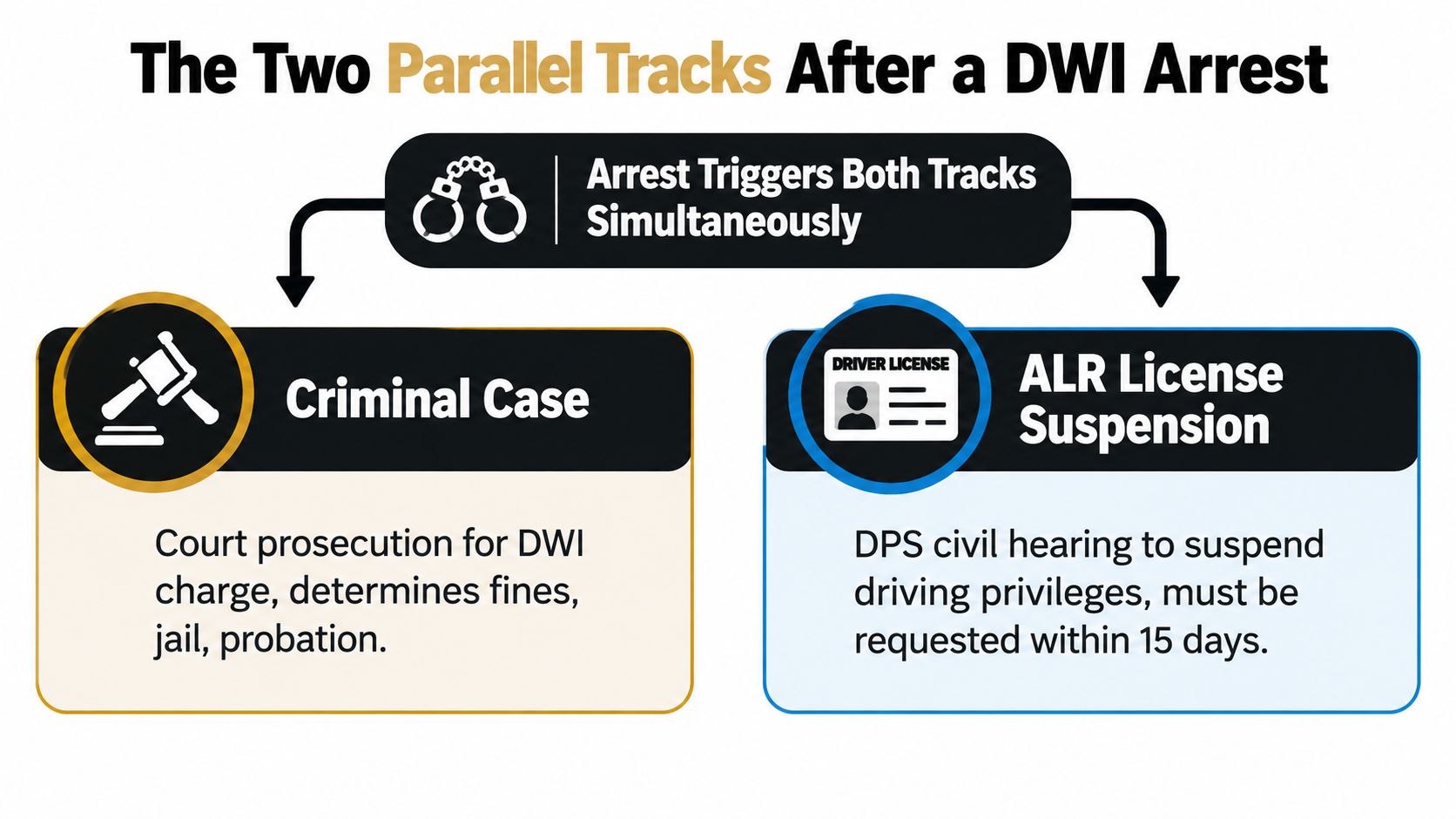
Criminal case versus ALR case
| Criminal track | ALR track |
|---|---|
| Decides whether the DWI charge results in dismissal, reduction, acquittal, or conviction | Decides whether driving privileges should be suspended |
| Proceeds in Montgomery County criminal court | Proceeds through the DPS administrative process |
| Evidence can include officer testimony, video, field sobriety tests, breath, or blood evidence | Focuses on statutory issues surrounding the stop, arrest, test, refusal, and notice |
| Can involve jail, fines, probation, education, or other court conditions | Can cause license suspension even if the criminal case later changes |
For a first offense, Texas materials commonly identify an ALR suspension of 90 days after a failed breath or blood test and 180 days after refusing testing, according to Texas first-offense DWI information from Wilson, Muns, and Anderson. The exact notice and facts matter, but the distinction is important. Refusal doesn't necessarily protect your license.
The critical deadline is rapid. You generally have 15 days to request an ALR hearing after the relevant suspension notice is served. Miss that deadline, and you may lose the chance to contest the suspension before it becomes automatic.
For local representation, a DWI attorney serving Montgomery County can evaluate both tracks instead of treating the criminal charge as the only case. A Divorce Lawyer in The Woodlands, TX handles divorce representation for clients in The Woodlands and Montgomery County, which is a separate legal service from DWI defense.
What to Do in the First 15 Days After Arrest
Your criminal case and your driver's license create separate risks from the moment of arrest. A first-offense DWI can involve a court prosecution while the Texas Department of Public Safety pursues an ALR suspension. The 15-day deadline protects your chance to challenge the license suspension, so treat it as the first task, not paperwork for later.
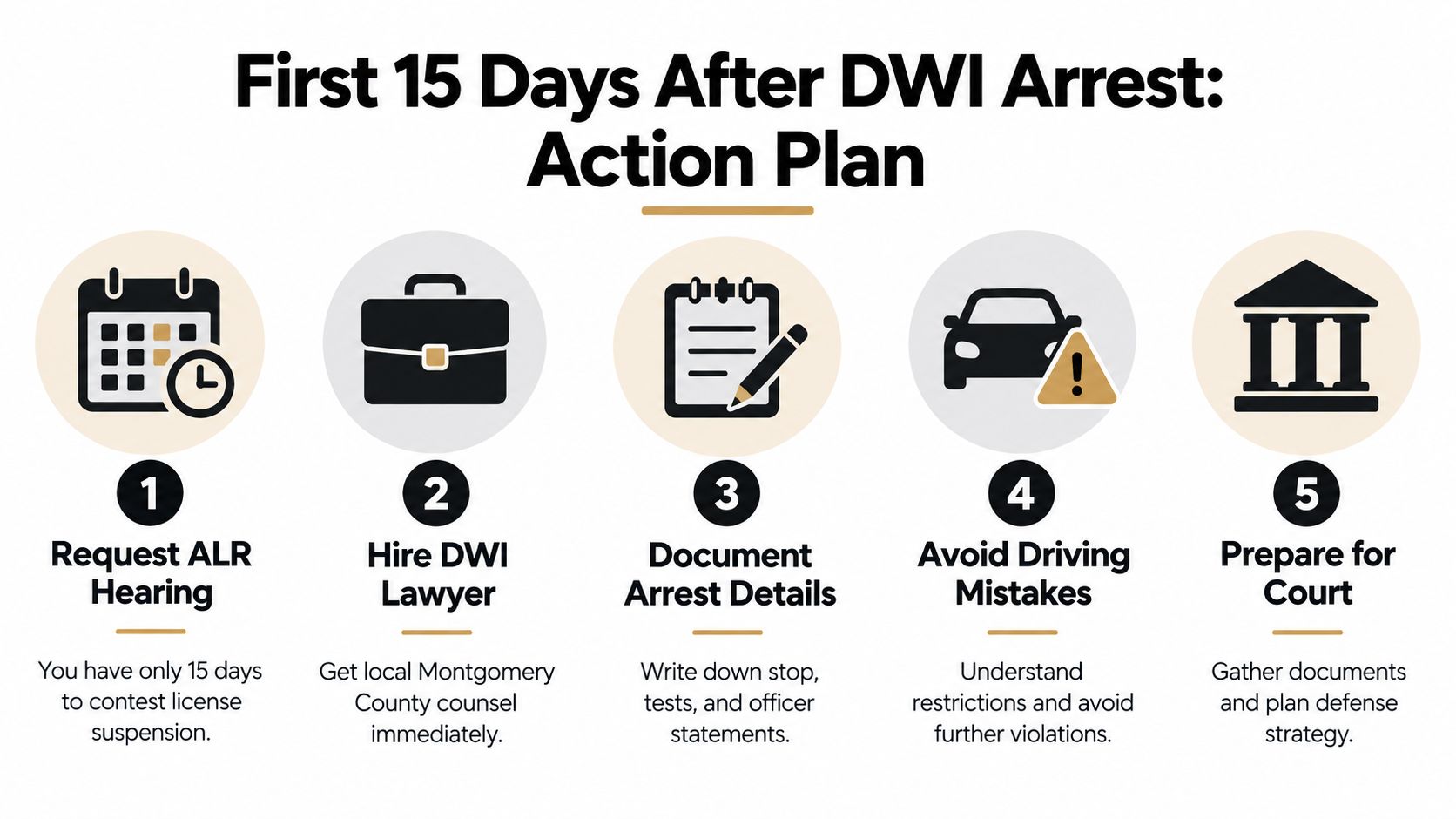
What to do next
Request the ALR hearing immediately. You generally have 15 days after service of the relevant suspension notice to make the request. The hearing concerns your license, not whether the criminal charge is ultimately dismissed or reduced. Missing the deadline can allow the administrative suspension to proceed without your requested challenge.
Contact a DWI lawyer familiar with Montgomery County. Have counsel review the notice, confirm the deadline, and coordinate the ALR matter with the criminal case. If the reported BAC was 0.15 or higher, tell the lawyer immediately because that fact can trigger more serious consequences than a routine first-offense analysis suggests.
Write down the arrest details. Record the stop's location, the officer's statements, requested tests, completed or refused tests, timing, and witnesses. Memories fade, and small details can matter when counsel reviews the reports and video.
Preserve available evidence. Save messages, receipts, location records, and videos from that evening. Identify nearby businesses or vehicles that may have captured the stop. Do not contact potential witnesses yourself before receiving legal advice.
Avoid additional driving problems. Confirm your current license status and any restrictions before driving. A new traffic or licensing violation can create another problem while the DWI and ALR matters are pending.
Prepare for the criminal case. Gather the citation, bond paperwork, and other documents. Track every court date and follow release conditions. Discuss the facts with your lawyer, not with friends, witnesses, or anyone posting about the arrest online.
A missed deadline can change daily life
A Woodlands professional who waits for the first criminal court appearance may lose the opportunity to contest the ALR suspension. Another driver requests the hearing promptly, preserves that option, and gives counsel time to investigate the stop, testing, and notice.
The difference is preserving a legal option before it expires. Do not post explanations online, apologize to witnesses, or approach the prosecutor on your own.
This video provides general background, but it cannot evaluate your notice, test result, or arrest facts:
Common Defenses and Mitigation Strategies in Montgomery County
A strong DWI defense starts with the evidence, not a predetermined script. The right strategy may be an aggressive challenge to the state's proof, a negotiation based on weaknesses, or mitigation designed to reduce the damage when the evidence is difficult.
Testing the state's case
The traffic stop matters first. Counsel may examine whether the officer had a lawful basis to stop the vehicle, whether the officer extended the detention without sufficient grounds, and whether the arrest followed the required procedures. A stop near I-45, Woodlands Parkway, or a local shopping area still has to satisfy constitutional and statutory requirements.
Field sobriety tests also require careful review. Roadway conditions, lighting, footwear, weather, medical conditions, fatigue, anxiety, and the officer's instructions can affect how the tests look on video. The issue isn't whether a test appeared imperfect. The issue is whether the state can reliably connect that performance to legal intoxication.
Chemical evidence receives separate scrutiny. A lawyer may review breath-testing procedures, maintenance and calibration records, operator training, blood-draw procedures, laboratory handling, chain of custody, and the timing of the sample. A number on a report doesn't answer every question about reliability or admissibility.
Evidence first: Never choose a defense theory before reviewing the video, reports, test records, and notice.
Mitigation when the evidence is strong
If the evidence presents real problems, counsel may seek dismissal, exclusion of evidence, or a reduced charge. If the evidence is stronger, the focus may shift toward negotiated conditions, education, supervision, and protection of your work and family obligations.
Texas requires a DWI education program for many first-time offenders. One state-certified program description identifies the course as 12 hours, and another source notes that failure to complete the program within 180 days of probation can lead to license revocation. Review those requirements through your lawyer and the court, not through assumptions about what another defendant completed. See Texas DWI education program information.
Character evidence and community ties can help counsel present a complete picture. Employment history, family responsibilities, treatment efforts, and participation in the community may matter in negotiations, though none guarantees a particular result. Montgomery County prosecutors and judges still evaluate the actual charge, evidence, prior history, and legal options in your case.
What a Local DWI Lawyer Does and How to Choose One
A DWI lawyer should do more than enter a plea and wait for the next setting. Counsel should investigate the stop, obtain available reports and recordings, evaluate chemical evidence, protect the ALR deadline, and decide whether motions, negotiation, or trial preparation makes sense.
Questions to ask at the consultation
Ask how many first-offense DWI cases the lawyer has handled in Montgomery County. Ask whether the lawyer personally handles ALR hearings, how the office tracks the deadline, and whether the attorney has reviewed cases involving breath testing, blood testing, refusals, or a BAC at or above 0.15.
You should also ask:
- Who handles the case: Will you work directly with the attorney, or primarily with staff?
- What gets investigated: Will the lawyer seek video, reports, test records, and witness information?
- What are the possible paths: Does the lawyer explain dismissal, reduction, supervision, motions, and trial without promising an outcome?
- What does the fee cover: Is the arrangement hourly, flat-fee, or divided by stages? Are hearings, experts, motions, or trial separately addressed?
- What happens next: Will you receive written deadlines and instructions about driving, court appearances, and communications?
Local familiarity helps because procedures, calendars, courtroom expectations, and prosecutorial practices can differ across jurisdictions. It doesn't replace preparation, but it can make the preparation more practical. The criminal defense lawyer serving The Woodlands page provides information about a separate local criminal-defense resource.
Be cautious about guaranteed dismissals, guaranteed no-jail outcomes, or a lawyer who won't explain the ALR process. A candid consultation should identify risks and options, not sell certainty.
Expected Outcomes Costs and Your Next Steps
No lawyer can responsibly promise a result from the arrest alone. Possible resolutions include dismissal, a reduced charge, acquittal, or conviction with probation and court-ordered conditions. The evidence, BAC issue, test history, stop, criminal record, injury or property facts, and prosecution position all matter.
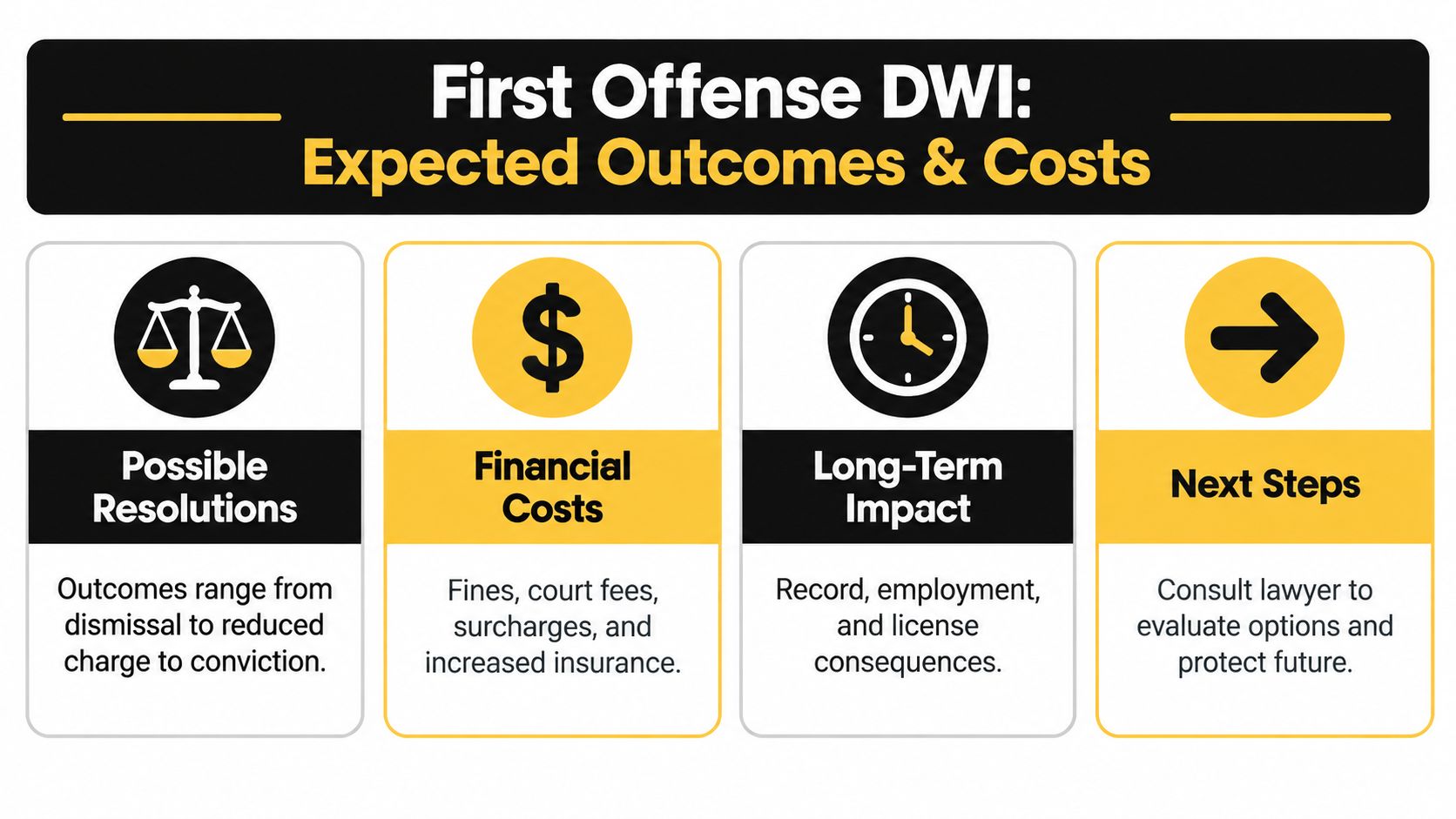
Costs extend beyond the courtroom
Potential financial burdens include attorney fees, court fines, state-imposed financial penalties, reinstatement fees, insurance increases, SR-22 requirements, education-program costs, and any ignition-interlock or supervision expenses imposed in the case. Texas guidance identifies the first-conviction state penalty as $3,000, rising to $6,000 at a BAC of 0.15 or higher, while the criminal fine can reach $2,000 for the standard Class B structure or $4,000 for the enhanced Class A structure. See Texas DWI consequences and financial obligations.
The record can affect employment, professional licensing, housing, driving, and family logistics. If a later expunction or nondisclosure question arises, a Montgomery County expunction lawyer may address that separate issue. Don't assume that completing probation automatically erases every record consequence.
Your immediate priority: Confirm the ALR deadline and preserve the hearing option before concentrating only on the criminal court date.
This article is not legal advice. It provides general information about Texas DWI cases and isn't a substitute for confidential advice from a lawyer who has reviewed your arrest, notice, test evidence, and court records. Every first-offense DWI case is different.
The Law Office of Bryan Fagan serves clients in The Woodlands and surrounding Montgomery County communities in family-law and probate matters, so it may be a useful local contact for related divorce, custody, support, property, or estate concerns that arise alongside a DWI case. Visit The Law Office of Bryan Fagan to review the firm's services and schedule a consultation about your legal needs.
