 Skip to content

You're sitting at your kitchen table in The Woodlands late at night, searching for a Montgomery County pro se divorce packet where to get it, and every result promises a quick download. Some are commercial forms. Some look official but aren't tied to Montgomery County at all.
That first choice matters more than the download itself. Pro se means you're representing yourself without an attorney, so you're responsible for choosing the right forms, filing them in the right Conroe office, and proving your case is complete. A packet built for a simple, agreed divorce won't fit every marriage, and using the wrong one can stall your case even when you and your spouse agree on most things.
Where to Get a Montgomery County Divorce Packet
Start with official sources, not a paid packet from a search ad. In Montgomery County, family matters, including divorce, are handled by the District Clerk rather than the County Clerk, according to the Montgomery County District Clerk forms page, which lists "Divorce" among the forms available to self-represented litigants alongside the New Suit Checklist for Pro Se Litigants.
That distinction saves you a wasted trip. If you walk into the wrong clerk's office in Conroe, staff will send you elsewhere. The county also directs filers to the Texas eFile self-help portal for the checklist and electronic filing resources, so you can review requirements before you drive from Panther Creek, Sterling Ridge, or Creekside.
Official Sources For A Montgomery County Divorce Packet
| Source | Where or how to reach it | Contact | What it provides |
|---|---|---|---|
| Montgomery County District Clerk forms page | Online, through the county District Clerk site | 936-539-7855 | Divorce form listing and New Suit Checklist for pro se litigants |
| District Clerk office | 301 N. Main Street, Suite 103, Conroe, TX 77301 | 936-539-7855 | In-person questions and paper filing |
| District Clerk mailing address | P.O. Box 2985, Conroe, TX 77305 | 936-539-7855 | Mailed paper documents |
| Texas Supreme Court self-help forms | Online, Texas courts self-help repository | Online repository, no county phone | Divorce Set 1 for uncontested cases with no children and no real property |
| eFileTexas self-help portal | Online, statewide Texas system | Online help resources | Filing checklists and electronic filing help |
| Bureau of Vital Statistics form | Listed on the county forms page | District Clerk, 936-539-7855 | Print and submit on paper, do not e-file |
Call before you go. Confirm office hours, accepted payment methods, and whether you should file in person or electronically. Ask whether any self-help center or law library serves pro se filers in the Conroe area, and check the eFileTexas help resources if you'll upload documents from home.
Clerk staff can explain filing logistics, copy requirements, and where a form goes. They can't tell you which packet fits your marriage or give you legal advice about property, children, or support. That limit isn't unhelpfulness. It's the boundary between court administration and legal counsel.
Paper-only rule: The Bureau of Vital Statistics form must be completed and submitted to the District Clerk in paper form and specifically should not be e-filed.
Download only from the District Clerk or Texas courts sites, check that each form is current before you fill it in, and keep a clean blank copy. If a commercial packet conflicts with the county checklist, follow the county and court instructions.
Which Packet Fits Your Case
Consider a couple in Alden Bridge who agrees on almost everything. They rent their home, have no minor children, and have divided their bank accounts. A packet they find online may fit, but only if its limits match their circumstances.
The Montgomery County District Clerk new suits filing page directs self-represented litigants to the county's New Suit Checklist and Texas's eFileTexas self-help system. The county forms page separately lists “Divorce” and the Bureau of Vital Statistics form. Forms help prepare a case; the right packet depends on what the spouses need the court to decide.

Which Packet Fits Which Case
| Your situation | Start with | Why it matters |
|---|---|---|
| No children, no real property, both spouses agree | Texas Supreme Court Divorce Set 1 | Set 1 is for uncontested divorces without minor children or real property |
| Minor children, custody or child support | A fuller set of forms or attorney review | Set 1 is not designed to cover children |
| Home, land or retirement accounts | A fuller set of forms or attorney review | Set 1 does not address property division |
| Spousal maintenance or disputed terms | Attorney review before filing | A packet cannot resolve disputed issues |
| Filing fee is a hardship | Set 1 Affidavit of Indigency | The court decides whether you qualify for fee relief |
Supreme Court-approved Divorce Set 1 is limited to uncontested divorces without minor children or real property. Its instructions do not permit adapting the forms to add a house division, parenting schedule, or retirement account split. The pleadings and decree must support the orders you ask the judge to make.
Property can require more than dividing account balances. A decree may need to address a mortgage, separate-property claims, debts, and language a title company or retirement plan can accept. A basic packet may not cover those issues.
Complete the Affidavit of Indigency accurately. Filing it does not automatically waive fees; the court decides whether you qualify.
If your circumstances do not fit a table row cleanly, consider a fuller form set or attorney review before filing. The Law Office of Bryan Fagan handles divorce and property division matters for clients in The Woodlands and across Montgomery County. The firm's divorce representation information describes its services.
Residency, Venue and the Waiting Period
County eligibility depends on dates and addresses, not just the mailing address on your petition. Texas Family Code Chapter 6 sets the residency and venue rules, so check them before choosing where to file.
| Date | Example event |
|---|---|
| December 1 | One spouse moves to The Woodlands from another Texas county |
| March 1 | The spouse has lived in Montgomery County for three months |
| Filing date | Confirm whether the residency and venue requirements are met before filing |
A recent move can make venue less obvious. If your spouse still lives in the prior county, compare both spouses' residence histories with the Texas rules rather than assuming your new address settles the question. The Montgomery County 90-day residency requirement for divorce filing in The Woodlands explains the local timing issue.
If one spouse lives outside Texas, the applicable rule may depend on where the Texas spouse resides and whether that spouse meets the required Texas domicile period. Record each spouse's addresses and move dates before completing the petition.
How The 60 Day Clock Works
Under Texas Family Code Section 6.702, a court generally cannot grant a divorce before the 60th day after the suit is filed. The clock starts on the filing date, not the separation date or the date the respondent signs a waiver.
For example, a petition filed on March 1 generally cannot result in a divorce decree during the first 60 days. The court may grant the divorce on the 61st day or later, provided the required paperwork is complete and the court is available.
The law provides narrow exceptions for certain family-violence cases. These include cases involving a final conviction or deferred adjudication for an offense against the petitioner or a household member, and cases with an active protective order or qualifying emergency protection order based on family violence during the marriage. The court must make the required findings.
Before filing, write down when you became a Texas resident, when you became a Montgomery County resident, and the date you plan to file. Those dates determine whether you may file in the county and when the waiting period can end.
File the Packet Without Dismissal Risks
A packet can be complete on paper and still leave the court without what it needs to proceed. Treat each filing step as part of a sequence: the petition starts the case, service or a waiver documents notice, and the final paperwork supports the court's decision.
The Texas Supreme Court approved Divorce Set 1 forms include forms for an uncontested divorce without minor children or real property, such as a petition, waiver of service, final decree, indigency affidavit, and address-related forms.
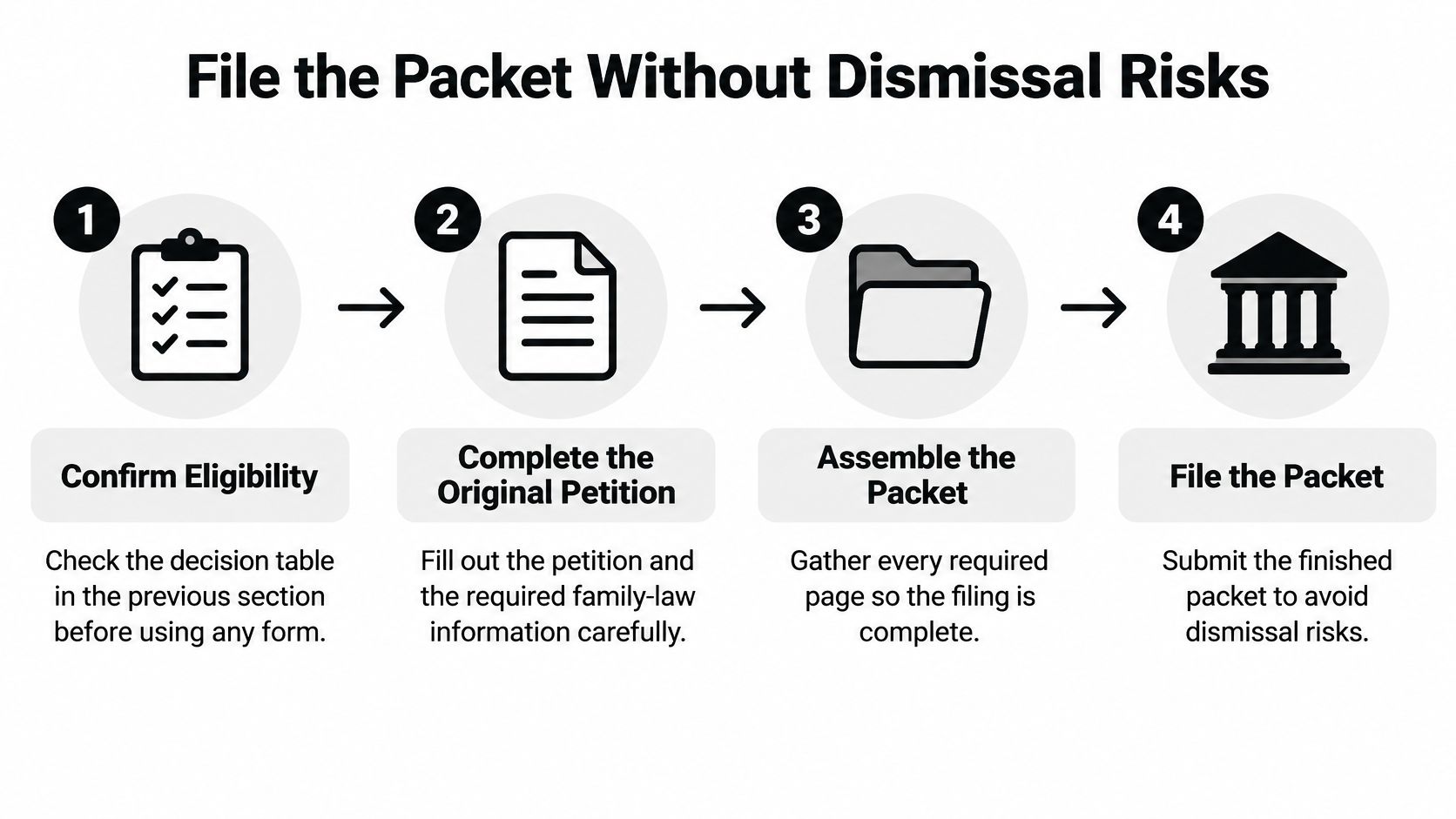
Seven Filing Steps In Order
- Complete the Original Petition: Fill in the petition and required family law information form. Check identifying details carefully, since missing information can delay review.
- Prepare two copies: Submit the original and copies to the appropriate clerk. Keep a file-stamped copy for your records.
- Arrange service or get a waiver: Use lawful service or obtain a properly executed waiver, then keep proof in your case file. The guide to serving divorce papers in The Woodlands through the Montgomery County constable precinct process explains local service basics.
- Keep the case record organized: Save filed documents, notices, and proof of service or waiver together so you can find them when preparing the final paperwork.
- Follow the waiting-period schedule: Use the filing date and timing rules explained in the residency section to plan the next steps.
- Finish signatures and blanks: For an agreed case, the respondent generally must sign an answer or waiver, and the parties must sign the final decree. Fill in every required field; use “N/A” where an item does not apply.
- Submit final prove-up materials: File the completed final decree and any required prove-up affidavit. An affidavit used to prove up an agreed divorce without children must be signed before a notary.
That final review can prevent avoidable delays. The Texas court checklist guidance warns that missing documents before a final hearing can result in dismissal, and that final decrees must contain no blank spaces.
Dismissal Risks And Their Fixes
- No proof of notice: File the return of service or signed waiver. Without proof, the court may not be able to proceed.
- Blank decree fields: Review each line, provide the required information, and write “N/A” where an item does not apply.
- Missing prior orders: If existing custody or support orders affect the case, attach certified copies rather than relying on a summary from memory.
- Paper form e-filed by mistake: Submit the Bureau of Vital Statistics form on paper as the county directs.
- Letting the case sit: Watch for court notices and respond by the stated deadlines. Filing the petition does not move the case forward on its own.
Keep a physical or digital folder with the file-stamped petition, service proof or waiver, signed decree, notarized affidavit, and paper vital statistics form. Before a hearing or submission, compare the contents with the local checklist.
For a plain-language overview of local procedures, Montgomery County Family Courts: A Local Guide describes how family law cases proceed in Montgomery County courts serving The Woodlands.
Packet availability does not replace compliance with Montgomery County clerk and court procedures. Texas courts must not reject an otherwise acceptable filing solely because you are self-represented or used approved forms. You still must follow the same procedural rules as a represented party.
Fees, Timelines and Options Compared
The filing fee is only one part of the cost. A route that seems inexpensive can require more time correcting forms or leave important terms unclear in the final decree.
Cost And Timing By Divorce Route
| Route | Typical cost | Timeline | Best fit |
|---|---|---|---|
| Self-filed official packet | Court filing fee and service costs; confirm current amounts with the District Clerk | At least 60 days from filing | Uncontested case that fits the packet's limits |
| Mediated agreement | Mediator fee quoted before the session, plus court filing and service costs | At least 60 days from filing | Spouses who agree in principle but need help organizing terms |
| Attorney-handled divorce | Attorney fee quoted after consultation based on the issues, plus court filing and service costs | At least 60 days from filing | Cases where tailored documents and legal guidance are needed |
| Indigency affidavit filing | Filing-fee relief only if the court grants it | At least 60 days from filing | Filers who cannot afford the filing fee and qualify |
The Montgomery County District Clerk sets the current filing requirements and fees. Confirm the filing fee, service cost, hours, and copy requirements before you go. The Montgomery County District Clerk divorce filing fees guide for The Woodlands can help you prepare questions for the clerk.
The timelines are similar because each route remains subject to the same waiting period. The practical cost difference is what you pay, and how much work may be needed to prepare accurate final documents. Mediation can help spouses organize agreed terms, but the agreement still needs to be put into a court-ready decree. Attorney fees depend on the issues involved; an indigency affidavit does not guarantee that the court will waive fees.
Use the packet only when its limits match the case. If the decree must divide a house or retirement account, address children, or resolve disputed terms, self-filing with a limited packet is the wrong route. A customized agreement may cost more upfront, but a decree that clearly states the parties' obligations is what makes the expense worthwhile.
Confirm Your Next Step Before You File
Before filing, make sure you can complete the case from start to finish: prepare the required forms, submit them, and turn your agreement into a final decree the court can approve. A packet may be easy to obtain and still be the wrong tool if your case involves disputed terms, children, or property that needs careful treatment.
Use this short final check:
- Confirm that every required form is complete and consistent with the facts you plan to ask the court to include in the decree.
- Gather the information needed to describe parenting arrangements, property, and support clearly. If you cannot agree on those terms, a packet alone may not resolve the dispute.
- Decide whether you can handle the case confidently without legal representation. Unclear custody or property language can affect your family long after the case ends.
A consultation may help if your case involves children, real property, retirement accounts, disputed terms, or a protective order history. The Law Office of Bryan Fagan handles divorce and child custody matters for clients in The Woodlands and across Montgomery County. Its attorneys can discuss your situation confidentially under the attorney-client privilege during a free consultation.
The office is at 25211 Grogans Mills Rd, Suite 275, The Woodlands, TX 77380. Schedule a free consultation by calling (281) 819-1726 or using the firm's online contact form.
