 Skip to content

You're sitting at a kitchen table in The Woodlands with a folder of half finished paperwork, trying to work out whether you need a divorce form, a custody form, or something else entirely. A search turns up dozens of downloads, and none of them explains which one fits your family. That's where Montgomery County Law Library self represented family forms help, if you know what the library can do and where its help stops. I would start by matching your facts to the right packet before you fill in a single line.
Where to Get Montgomery County Family Forms and Help
If you live in The Woodlands, Spring, Magnolia, or Conroe, your first question is usually simple. Where do you get a form today, and who can tell you if it's the right one? Don't drive to Conroe first and hope for the best. Call, confirm what the desk can do for your type of case, then go with a short list of questions.
The county seat is Conroe, and that's where the main access point sits. The Montgomery County Law Library at 301 North Thompson, Suite 105, in Conroe is open Monday through Friday from 8:00 a.m. to 5:00 p.m. and provides print and online legal resources to judges, litigants, and attorneys, according to the Texas Judicial Branch forms page. The general telephone number is 936-539-7960 and the pro se services number is 936-539-7976.
What the Library Can and Cannot Do
The library gives you legal information, form related books, and online resources for preparing documents. It isn't your lawyer and it won't argue your side in a contested case. Its reference attorney may help with filing court documents in simple family law matters when all parties agree on every issue and no party has an attorney.
That limit matters for divorce, custody, support, and probate. If your spouse disagrees about the house or a parenting schedule, you may fall outside the narrow help the library offers. You're still welcome to use its resources, but you shouldn't expect advocacy.
Practical rule: Call 936-539-7976 before you travel and ask, "Does my agreed case qualify for a paperwork review, and what should I bring?"
Statewide, Texas Court Help is the starting point for official self help guidance. eFile Texas Self Help is the optional online route if you don't want to file on paper. Write down both phone numbers, the hours, and that one eligibility question before you call. You'll get a clearer answer in two minutes than you'd get from an hour of random downloads.
Montgomery County family form access points
| Access point | Contact or location | What it offers |
|---|---|---|
| Montgomery County Law Library | 301 North Thompson, Suite 105, Conroe; 936-539-7960 | Print and online legal resources and form related guidance |
| Pro Se Services reference attorney | 936-539-7976 | Free review of completed paperwork in eligible simple family cases |
| Texas Court Help website | Statewide online resource | Official self help information and forms guidance |
| eFile Texas Self Help | Online, optional electronic filing provider | Electronic filing for self represented filers |
Matching Your Family Case to the Right Form Packet
Most confusion starts with statewide forms. People assume Texas has one approved packet for every divorce or custody case. It doesn't. The Texas Judicial Branch self represented litigants guidance states the Texas Supreme Court has approved uniform divorce forms for uncontested divorces that do not involve children or real property, and use of those forms is not mandatory. A trial court may not reject a proposed form merely because it was prepared by a self represented litigant or because the person is not represented by counsel.
That protection doesn't save a packet that doesn't fit your facts. Ask three deciding questions first. Are there children? Is there a home, land, or other real property? Do both spouses agree on every term?
How the Three Answers Sort Your Case
If you answer no, no, and yes, the uniform packet may fit. Change any answer and you're in different territory. Cases involving children, conservatorship, child support, property, or contested issues generally need additional pleadings and case specific compliance.
Montgomery County adds a local layer on top of state forms. That includes divorce checklists for cases in the 410th and 418th District Courts and County Court at Law No. 3, plus the VS-165 vital statistics form. Residents in Conroe, Spring, and The Woodlands follow the same packet rules, though clerk instructions can differ by court. If children are involved, it helps to understand how to file for custody before you pick a divorce packet that assumes there are none.
Protective orders follow a separate route. In Montgomery County, a protective order case is filed through the County Attorney's Office and requires attending at least one preparation appointment and one court appearance. Confirm that route with the clerk instead of mailing in a generic form. When a case becomes high conflict, a Contested Divorce Attorney in The Woodlands provides advocacy for high conflict divorces in The Woodlands and Montgomery County courts, which is a different service from library form help. Find your row below, then check the packet name with the clerk.
Form packet by family case situation
| Case situation | Packet to start from | What changes the answer |
|---|---|---|
| Uncontested divorce, no children, no real property | Supreme Court approved uniform divorce forms | Any child, home or land, or a disagreement moves the case out of this packet |
| Divorce with children or real property | Case specific pleadings with the county divorce checklist | Custody, support and property terms need their own filings; confirm with the clerk |
| Default divorce (other spouse does not respond) | Confirm with the clerk which packet applies | Requires confirmed default status and the matching county instructions |
| Initial custody order (SAPCR) | Petition in Suit Affecting the Parent-Child Relationship with birth certificates | An out of state party needs a declaration |
| Protective order | Court approved protective order forms | Confirm the filing route and local requirements with the clerk |
| Child support modification | Confirm with the clerk based on the existing order | The existing order and the court handling it control the forms |
Verify Your Forms and Avoid Costly Mistakes
Say a couple in The Woodlands downloads an uncontested divorce packet on a Sunday night. They agree on ending the marriage, so they fill in names and dates and feel finished. Three weeks later they disagree about who keeps the house, and one spouse won't sign. That single disagreement moves them out of the packet they started with, and they usually have to restart with case specific pleadings instead of patching a form that no longer fits.
That scenario isn't rare because people are careless. It's common because the packet choice depends on facts that can change. Use a steady routine and you'll catch the mismatch before the clerk does.
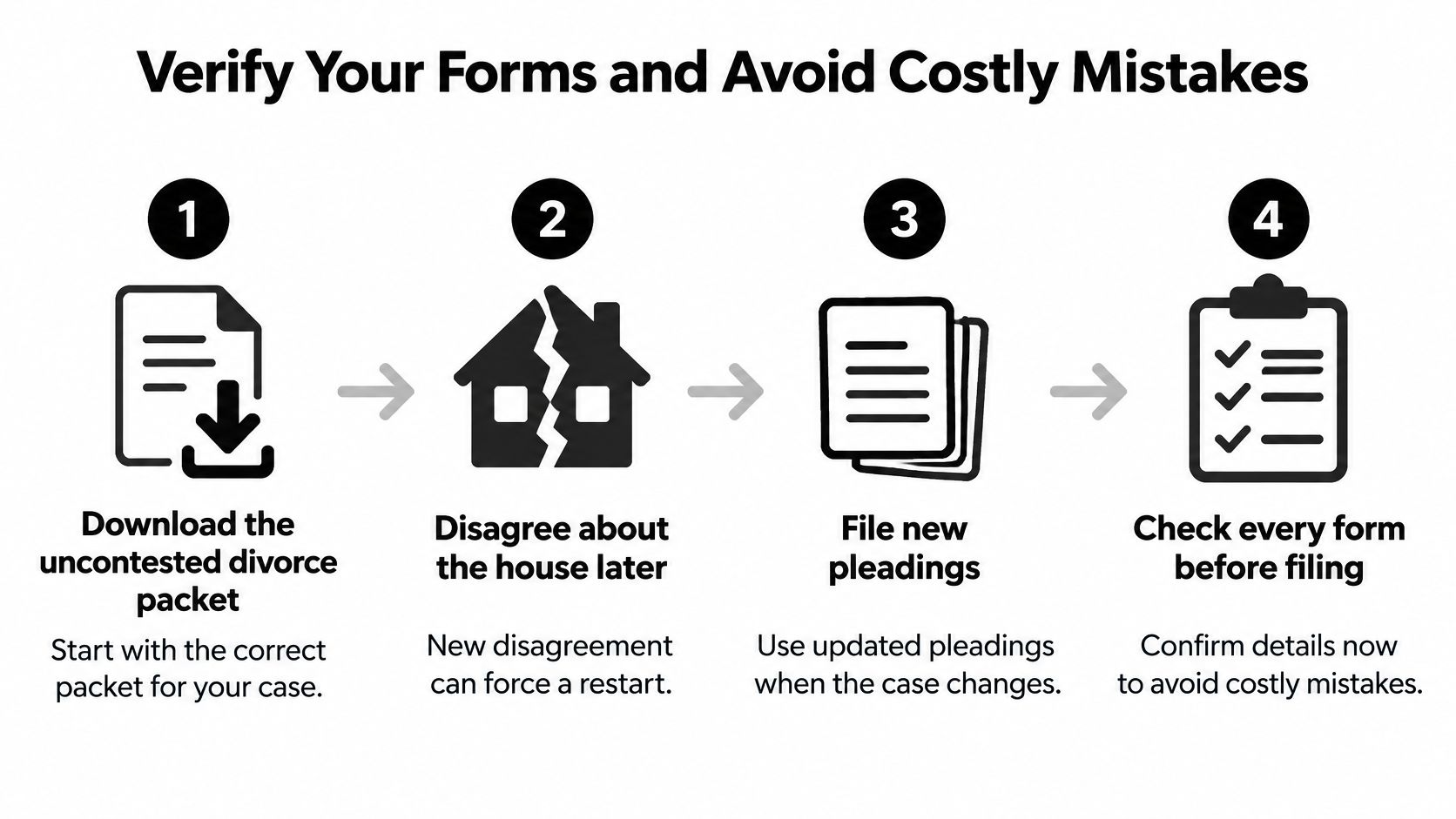
A Verification Routine That Works
- Classify the case first. Write down whether children, real property, or disagreement are present, because those three facts pick the packet. Don't start typing until you can answer all three.
- Select the matching packet. Use the case situation table to name your starting point in plain words. If you can't name it, you aren't ready to download anything.
- Confirm the version with the clerk. The Texas Judicial Branch self help page notes not every court accepts every TexasLawHelp form and advises confirming acceptance with the clerk. Saved copies and store bought forms can be outdated.
- Complete every field consistently. Use identical full legal names, dates of birth, marriage dates, and case details on every page. A middle initial on one form and a full middle name on another creates avoidable questions.
- Gather supporting documents early. Custody cases need certified paperwork, and divorce cases may need county checklist items and the VS-165. Collect these before you file, not after a rejection.
- Check acceptance, not transmission. An email saying your upload went through isn't proof the clerk accepted it. Wait for the clerk's confirmation and save it.
- Track dates on a separate calendar. Service, any response deadline, any waiting period, and the hearing date are separate events. Put each one on your phone calendar the day you file.
Custody Filings Need More Than a Generic Form
A parent seeking an initial custody order doesn't file a generic custody form. The TexasLawHelp SAPCR guide describes a Suit Affecting the Parent-Child Relationship, commonly called a SAPCR, and says the starting packet may include a Petition in Suit Affecting the Parent-Child Relationship, a certified copy of each child's birth certificate, and an Out-of-State Party Declaration if a parent or respondent lives outside Texas. Texas Family Code Chapter 102 governs SAPCR jurisdiction and filing concepts, so where the child lives matters.
That guide tells the filer to make two copies of the completed starting documents and file in the county where the child lives. Filing may be done online through eFile Texas or in person at the district clerk's office. You must pay the applicable filing fee or submit a Statement of Inability to Afford Payment of Court Costs if you cannot pay.
Don't assume a downloaded custody form covers birth certificates, copies, and out of state declarations. Missing one item can delay the whole case.
I would stop and get legal advice when children are in dispute, a house or land must be divided, or retirement and other high value assets are involved. The same applies when the other parent won't agree, won't respond in a predictable way, or hires a lawyer. At that point the issue isn't neat handwriting. It's whether the pleadings ask the court for everything you need, in language the court can enforce later.
Self help works best for narrow, agreed, procedurally simple cases. It works poorly when you need temporary orders, a detailed parenting plan, child support calculations tied to disputed income, or property division language for a deed or retirement account. Those gaps don't show up on the first page of a packet. They show up months later when an order is unclear, a title company asks questions, or a parent says the schedule doesn't say what you thought it said.
Common filing mistakes, effects and fixes
| Mistake | What it causes | Fix |
|---|---|---|
| Uncontested packet used for a contested or property divorce | Rejection, delay or a case that must be restarted | Switch to case specific pleadings or get advice before filing |
| Outdated or store bought form | Clerk refuses or returns the filing | Download the current version from an official source and confirm with the clerk |
| Treating electronic submission as acceptance | Assumed filing never accepted | Check the clerk's confirmation of acceptance |
| Custody filing without birth certificates or out of state declaration | Custody case delayed | Gather certified documents before filing |
| Requesting Pro Se review after a dispute begins | Case may no longer qualify | Book the review while every party still agrees |
Read your finished packet out loud once before filing. You'll hear mismatched names, blank lines, and dates that don't line up faster than you'll see them. Then compare each page against the county checklist for your court. That ten minute pass prevents most returns.
Filing, Service and Pro Se Review Steps
You have two filing routes in Montgomery County. Paper filing means taking your packet to the clerk's office, where staff can stamp your copies on the spot. eFile Texas Self Help is optional, and it works through an electronic filing service provider you choose yourself; several providers offer free filing. Pick the route you can monitor carefully, because you still need proof the clerk accepted what you sent before you treat the case as open.

Fees are due at filing. If you cannot pay, submit a Statement of Inability to Afford Payment of Court Costs instead. Ask the clerk which statement your case needs before you go, so a fee question doesn't stall you at the counter.
Using the Free Pro Se Review Well
The Montgomery County Law Library page describes the Pro Se Services Reference Attorney, with the library at 301 North Thompson, Suite 105, Conroe, Texas. The appointment is free and can include a review of your completed paperwork plus an explanation of the procedural steps ahead of you in court. Confirm you qualify before you schedule. The review explains the steps; carrying them out is still your job.
Once the clerk accepts your filing, keep stamped copies for each party, the clerk's confirmation, and any hearing notice in one folder. Service comes next, in plain terms: the other party must receive stamped copies by a method the Montgomery County clerk accepts. County materials list the service options, so confirm which ones apply to your case before you use them. Learning about service of process through the Montgomery County Sheriff Civil Division shows how one common option works.
Keep proof of service with your filing copy. Record the service date, the response date, and the hearing date on your calendar the same day you learn them. If you can't show proper service, the court usually can't move forward, even if every form is right.
Confirm Eligibility Before You File
A packet can look complete and still be the wrong one for your facts. Run the five-minute check below before anything reaches the clerk. It tells you whether library help fits your case or whether you need a different next step.
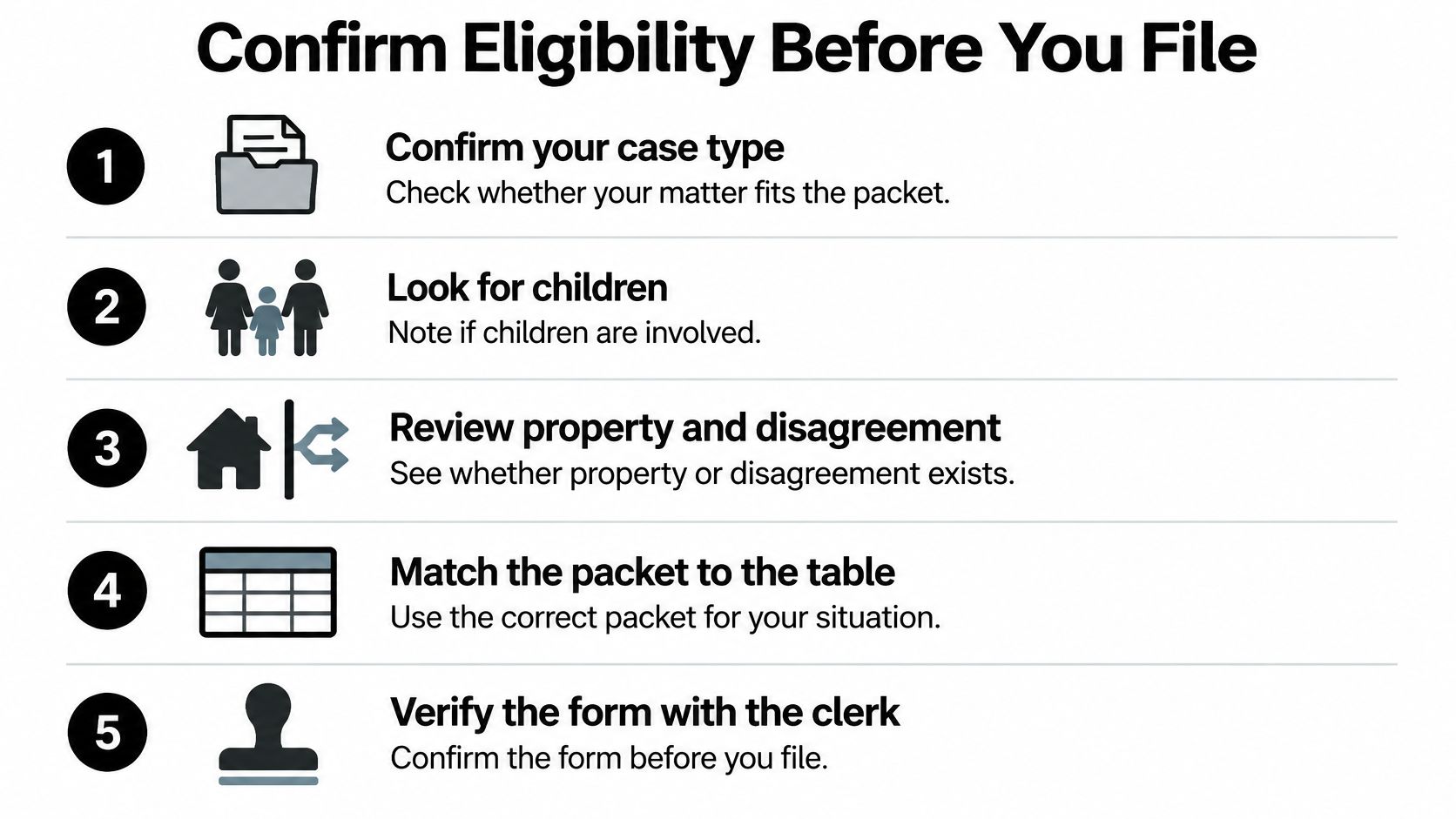
What to Do Next Checklist
- Confirm the case type. Note whether children, property, or disagreement are involved.
- Match the packet to your facts. Use the case situation table and name your packet out loud.
- Verify the form with the clerk. Ask whether that version is accepted in your court, including which Montgomery County district court hears family cases for your filing.
- Schedule the Pro Se review with finished paperwork. The appointment can include a review of completed forms, so show up with the packet filled in and your procedural questions written down.
- Put every deadline on one calendar. Service, response, waiting period, and hearing dates all belong in one place you check.
Disclaimer: This guide is general information for Montgomery County residents and is not legal advice. Your facts decide which Texas Family Code rules, forms, and local procedures apply, so confirm requirements with the clerk or a lawyer before filing.
If this check turns up a genuine dispute over children, property, or support, the library can still hand you forms, but its help ends there. The Law Office of Bryan Fagan serves families in The Woodlands and across Montgomery County, and the firm offers a free consultation you can book online or by calling (281) 819-1726. That conversation covers your specific circumstances and your legal rights, which is the practical way to decide whether self representation still fits before you file.
