 Skip to content

Can you get a Montgomery County court file by sending an open records request? Many assume yes, and most of those requests come back late, land on the wrong desk, or never get answered at all.
The reason is simple once you see it. A court file doesn't travel through the Texas Public Information Act. Courts and judicial-branch agencies sit outside that law, so a request written like an ordinary county records demand can stall before anyone even opens the folder.
What decides whether your request gets filled isn't the strength of your wording. It's three things: the records custodian, the case type, and the identifiers you put on the page. Get those right and the process is boring. Get them wrong and you'll spend a month learning what a cause number is for.
This guide walks through the order that works for The Woodlands and the rest of Montgomery County, from picking the right clerk to handling a sealed document or a stalled request.
Which Clerk Holds Your Montgomery County Court File
Start with the office, not the letter. In Montgomery County, the clerk who holds your file is decided by the type of case, and a request mailed to the wrong clerk doesn't get forwarded to the right one without anyone noticing. It sits, or it comes back, and either way you've lost two weeks.
Here's the map.
| Case type | Records custodian | Where to send the request |
|---|---|---|
| Divorce, child custody, child support, property division | District Clerk | District Clerk copy-request process, by mail or in person |
| Probate: estates, wills, guardianships | County Clerk | Montgomery County Clerk, 210 West Davis Street, Conroe, TX 77301 |
| Civil suits filed for $500 or less in County Courts at Law | County Clerk | County Clerk, main office or annex |
| Appeals from Justice of the Peace courts | County Clerk | County Clerk, main office or annex |
| Case type unclear | The clerk named in the case caption | Look up the case number in the county public-access system first |
Reading the case type correctly
Family matters are the most requested, so start there. Divorce, child custody, child support and property division filed in Montgomery County district courts live with the District Clerk, who accepts copy requests in person or by mail.
Probate is a different desk entirely. Estates, wills and guardianships belong to the County Clerk, and a probate filing from The Woodlands goes to the clerk's main office at 210 West Davis Street in Conroe. The same office keeps county-level civil case files and the records of cases appealed from Justice of the Peace courts.
The District Clerk's records and research page draws the line the same way: District Clerk records generally cover district-court civil, family-law and felony matters, while County Clerk records may cover county-level cases and official public records. Two offices, two workflows, two different sets of staff who know their own files.
For the court-by-court detail on where probate and family filings land, our Montgomery County probate court filing guide breaks down each courthouse.
A quick check that saves a week
Find the case number on any prior filing, citation or order you already have, or look it up in the county's public-access system. Then read the court name printed in the case caption. "District Court" points to the District Clerk. "County Court at Law" or "Probate Court" points to the County Clerk.
If the case type still isn't clear after that, don't guess. The steps in the next section work identically once you've confirmed the custodian, so settle that question first.
Why Court Files Follow Court Rules, Not the Public Information Act
The most expensive mistake in this process costs nothing to make. It's typing "Public Information Act request" at the top of your letter.
The Texas Judicial Branch open records policy states plainly that courts and judicial-branch agencies are not subject to the Texas Public Information Act or the federal Freedom of Information Act. Access to court case records follows court-specific procedures. Other judicial records are governed by Rule 12 of the Texas Rules of Judicial Administration.
That distinction isn't academic. A clerk who receives a Public Information Act demand for a case file is being asked to apply a law that doesn't cover the record. The likely outcomes are a redirect, a request for clarification, or silence.
The decision rule: if the document sits inside a court case file, write to the records custodian under the court-records process. If you want a county record that is not part of a court file, a separate county records request may be the right tool.
Where the Texas codes add a second layer
Family and probate files carry their own confidentiality rules on top of the access rules. The Texas Family Code governs protected personal information in family-law cases, and the Texas Estates Code addresses probate-related records. You don't need to quote either statute in your request, and a long block quote usually helps nobody.
What works better is naming the provision the clerk is relying on and asking for it in writing. If a document is withheld or redacted, you want the citation, not a shrug.
Rule 12 also settles who receives the request. It must contain enough information to reasonably identify the record and must be directed to the records custodian, not to a general court mailbox or a clerk who happens to answer the phone.
Clerk procedures shift over time, and office staffing changes. Confirm the current process with the custodian's office before you rely on any description of it, including this one.
How to Write and Submit the Request Step by Step
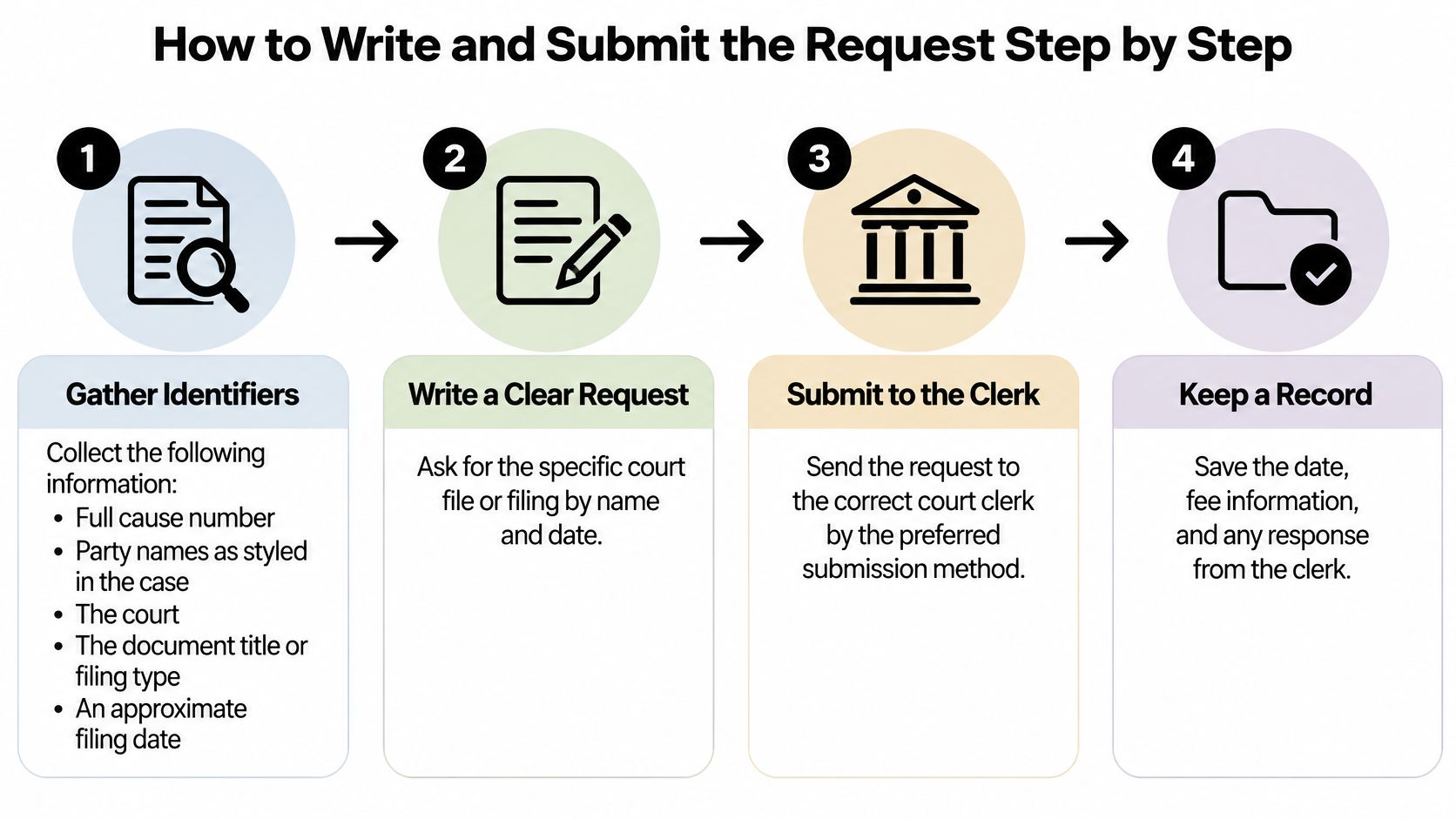
A court-file request works like a library search: the more precisely you identify the item, the easier it is for the custodian to locate it. Start with the case type and the office that holds the file, then specify the document and how you want to receive it.
The seven steps
- Gather the identifiers. Include the cause number, party names as they appear in the case, court, document title or filing type, and approximate filing date. “All records about the Smith case” leaves too much room for the clerk to search.
- Choose the format. State whether you need plain or certified copies, electronic or paper copies, or an opportunity to inspect the file. For personal reference, a plain copy may be enough. If you need a divorce decree for official use, see this guide to requesting a certified copy of a Montgomery County divorce decree.
- Check the docket details. Compare the cause number and document name with the public case information so the request points to the right filing.
- Address the records custodian. Send the request to the office that holds the file, using the process that office accepts.
- Select a delivery method. You can submit a request in person or by mail. Check Section 1, “Which Clerk Holds Your Montgomery County Court File,” to identify the appropriate office and location.
- Follow the clerk's payment instructions. For typical copy charges and timing, see “Fees and Turnaround You Should Expect.”
- Keep a record. Save the request, proof of delivery, payment record, and any notice asking you to clarify or correct something. Together, they show what you requested and when.
I request copies of the following document in Cause No. [number], styled [Party] v. [Party], filed in the [court] of Montgomery County, Texas, approximately [month and year]: [document title]. Please provide [plain or certified] copies by [mail, pickup, or electronic delivery].
What a complete request looks like
- One case per request. Separate cause numbers make it clearer which file each request concerns.
- Name the document. “Final Decree of Divorce entered in March” gives the custodian a clearer target than “all divorce paperwork.”
- Give an approximate date. A month and year can narrow the search when the exact filing date is unknown.
- State how you want the record. Ask for copies by mail, pickup, or electronic delivery, or request an inspection.
- Identify the case clearly. Include the cause number, parties, and court so the custodian can distinguish the file from similar cases.
Fees and Turnaround You Should Expect
A copy fee depends on two things: the number of pages and whether you need certification. For example, a 60-page certified record would cost about $65 at the listed rates, while a 12-page plain copy would cost about $12. These examples show why it helps to ask for a total before sending payment.
The county fee schedule lists $1 per page for plain copies and $1 per page plus $5 per document for certified copies (Montgomery County Clerk fee schedule). For a certified copy, add the certification charge to the page total for each document requested.
| Item | Amount or time | What it means |
|---|---|---|
| Plain copy | $1 per page | Charged per page; confirm the total before mailing payment |
| Certified copy | $1 per page plus $5 per document | Add the document certification charge to the page total |
| Copy turnaround estimate | 4 to 5 business days; up to 10 business days | Timing can vary; confirm the estimate with the clerk |
| Custodian response under Rule 12 | No later than 14 days after receipt, if the record is available | The custodian must allow inspection or provide a copy, or explain the delay |
| Electronic copy or inspection only | Ask the clerk for the applicable charge | Request the amount before choosing this option |
The clock starts when the custodian receives it
Texas Rule of Judicial Administration 12 requires the custodian to act as soon as practicable and, if the record is available, no later than 14 days after receiving a written request. The custodian must allow inspection or provide a copy, or explain why access cannot be provided within that period.
The rule also addresses charges. If a statute sets a copying fee, that fee applies. If no statute sets one, the charge must reflect actual cost and may not exceed 125% of the amount prescribed by Texas administrative rules (Rule 12).
Mailing time is separate from the response period. Allow for delivery before counting the days from the custodian's receipt.
Ask the clerk to confirm your total before mailing payment. For instance, calculating a certified copy as only the page rate would leave out the certification charge and could delay processing while the fee is corrected.
Ask the clerk in writing about electronic delivery or inspection-only access rather than assuming either is free. If you need a court reporter's transcript, see the guide to Montgomery County court reporter record requests and costs.
Sealed, Confidential and Redacted Records in Family and Probate Cases
A Panther Creek resident looking for her mother's probate inventory can make a focused request: name the Inventory, Appraisement and List of Claims, give an approximate filing date, and include the cause number from the citation. That helps the clerk locate a specific document without searching the entire estate file.
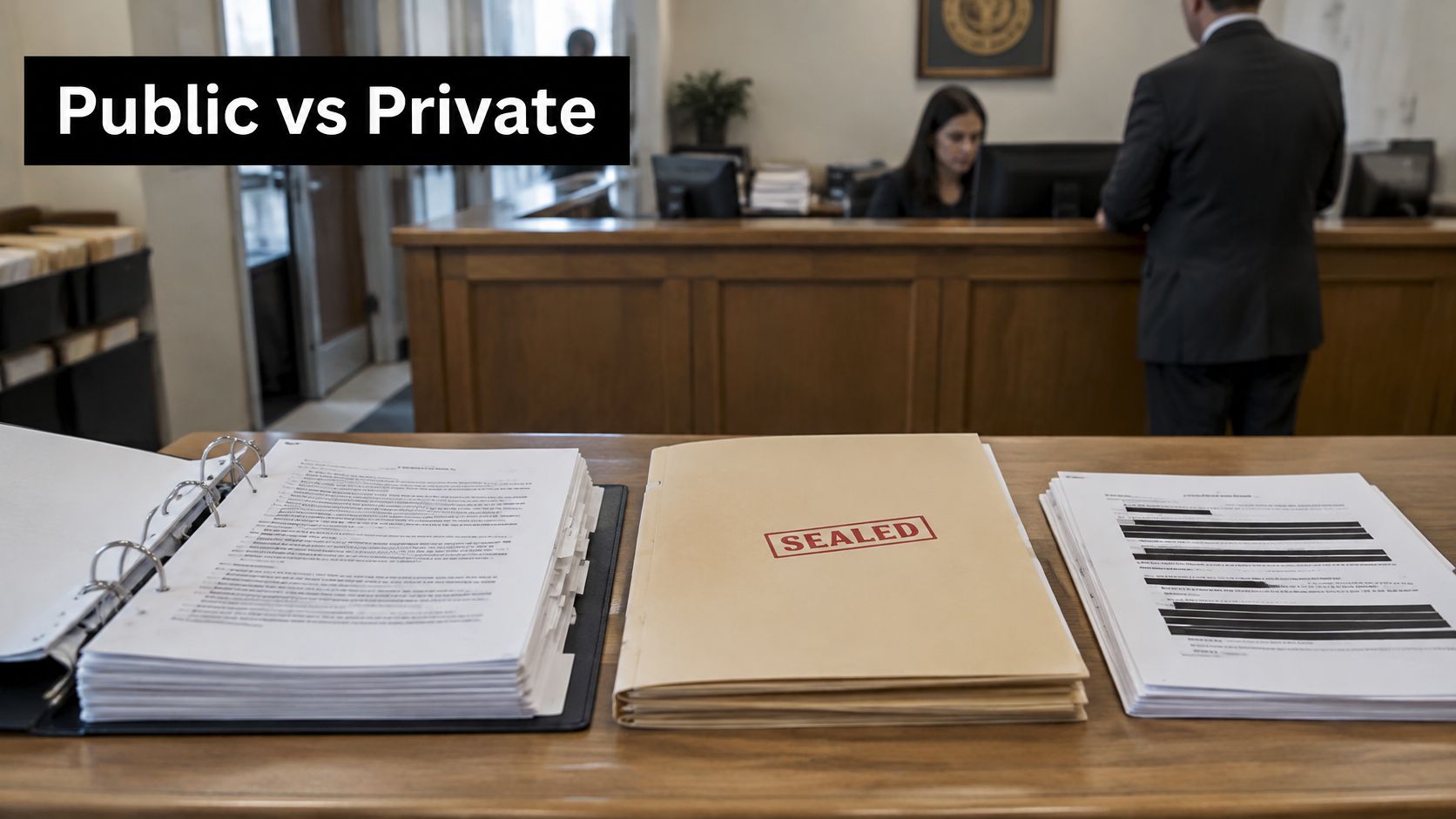
A copy may still have personal identifiers redacted, and a sealed exhibit may require a separate process. Those limits can apply even when other documents in the same file are available. The Montgomery County court records guidance explains that sealed or restricted family, juvenile, and sensitive personal-information records may require authorized access or a court order.
Three ideas people blur together
Public availability concerns whether a record is generally open. Usable access concerns whether the copy will meet the needs of a bank, agency, or attorney. Confidentiality concerns content protected from disclosure.
These distinctions matter when you need a particular document for a specific purpose. A public file may include a sealed exhibit, a redacted account number, or a protected address. A copy may be readable but still not meet the requirements of the organization receiving it.
Sealed material follows a separate process from ordinary copying. The District Clerk handles a separate unsealing process, which may begin with a motion or formal written request rather than a counter form.
The Texas Family Code governs protected personal information in family cases, while the Texas Estates Code governs probate records. For a sealed or restricted document, the case type and the specific record help determine what access is available. Certification is a separate question: ask whether a certified copy can be provided in the form you need.
What to Do If the Clerk Denies or Delays Your Request
Three issues commonly stall a court-file request: missing details, an unresolved fee, or sending it to an office that does not hold the file. Each requires a different fix, so first find out which issue applies.
Contact the office handling the request and ask what is preventing it from being processed. If information is missing, clarify what details the clerk needs. If the fee is the issue, ask for the amount due and how to pay. If the file belongs to another office, confirm the correct custodian before resending anything.
For a partial or full refusal, request the decision in writing and keep it with your request. The prior section explains how to ask about withheld records and applicable review procedures. Here, focus on getting a clear account of the status and any action the clerk needs from you.
Once you know the cause of the delay, correct that specific problem and refer to your original request date. If the office has not responded after its stated processing period, follow up in writing with the cause number and the date you submitted the request. Keep copies of correspondence and note when you called; a clear timeline helps the office locate the request and helps you explain the issue if you seek legal advice.
If the file is part of an active case or access to a sealed record is at issue, consult an attorney about whether a court filing is appropriate.
What to Do Next and How to Reach Our Office
A court file request can raise a separate question: what should you bring to a legal consultation if the clerk cannot release everything you requested? Bring the clerk's response, your request, any fee information, and the case paperwork you already have. These documents help an attorney understand what was withheld and why.
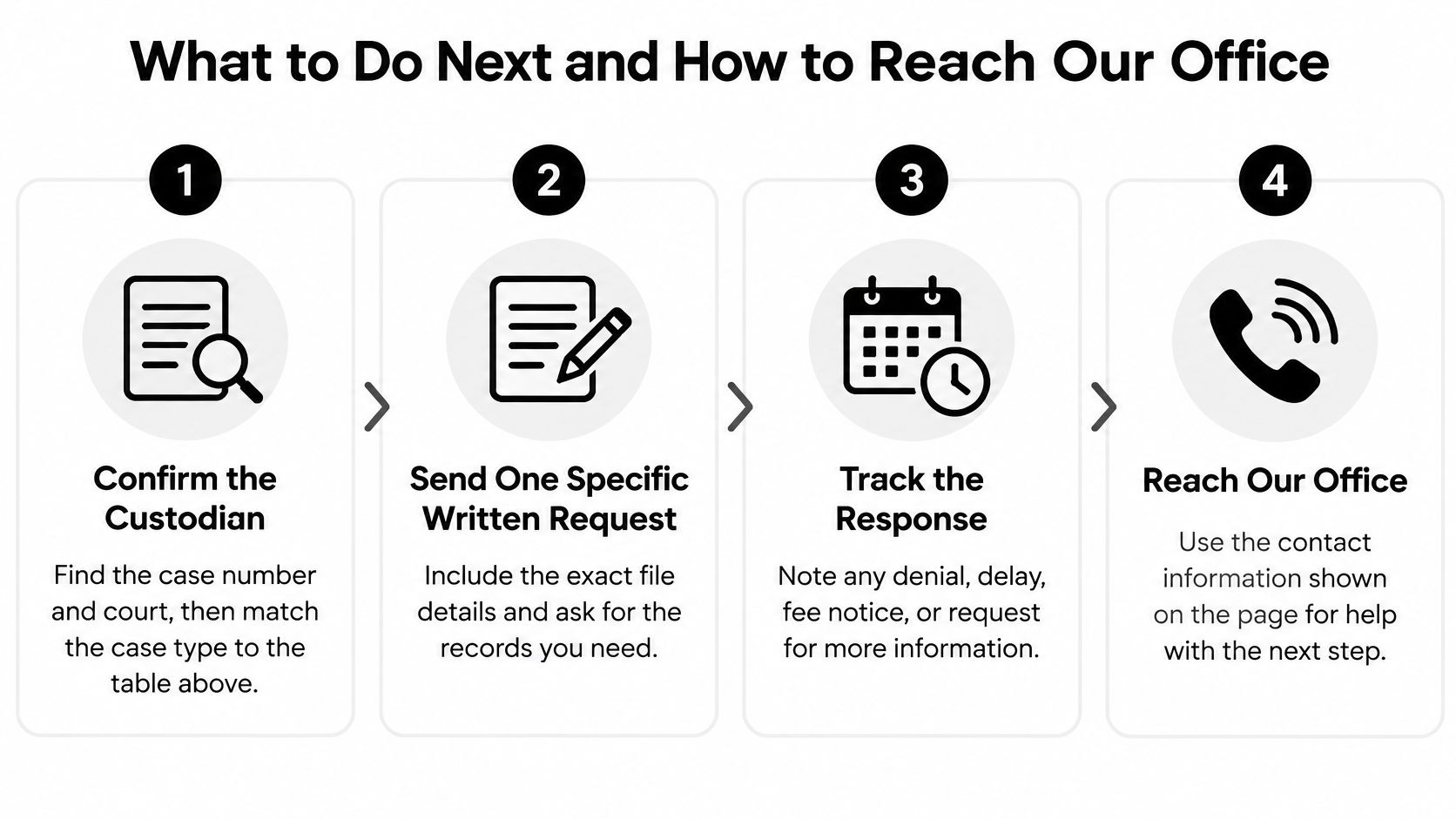
A Montgomery County family or probate file may contain sealed or redacted material. The Montgomery County Family Courts: A Local Guide explains how family cases move through the local courts.
The Law Office of Bryan Fagan serves families in The Woodlands and across Montgomery County. Clients can discuss their situation confidentially under attorney–client privilege during a free consultation.
This article provides general information, not legal advice. Review your circumstances with a licensed Texas attorney before acting.
If you need help understanding a clerk's response or a court-related legal issue, contact the firm online to schedule a free consultation.
