 Skip to content
A certified copy of a divorce decree in Montgomery County comes only from the District Clerk in Conroe, and a typical total is about $17 for a standard decree, calculated at $1 per page plus a $5 certification fee. The County Clerk and the Texas Department of State Health Services can't issue that certified decree.
You may be standing in a records office in The Woodlands with a remarriage appointment ahead, a lender waiting for proof of your divorce, or a probate matter that can't move forward without the final decree. The most common problem isn't the request itself. It's sending it to the wrong office or asking for the wrong kind of copy.
A certified decree is an authenticated court record, not an ordinary photocopy. The request needs to identify the Montgomery County divorce case clearly, use the District Clerk's records channel, and specify that you need a certified copy. The instructions below focus on what generally works for people in The Woodlands, Conroe, Spring, and other Montgomery County communities.
Why Montgomery County Divorce Decrees Start With the District Clerk
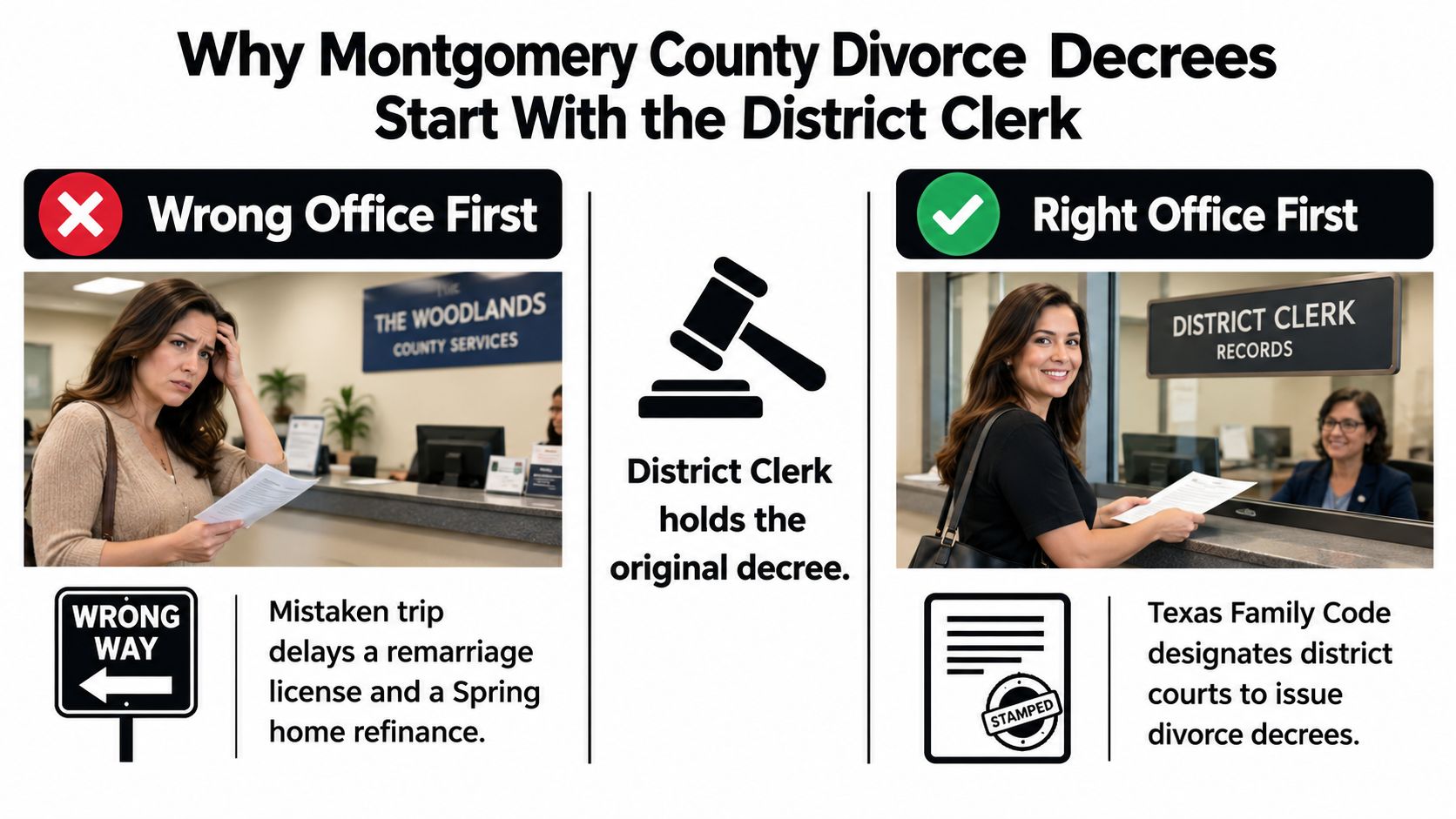
A parent from The Woodlands may need a decree before applying for a remarriage license. Someone in Spring may need the same document for a home refinance. Both can lose time by going first to the County Clerk, especially when a county website or a public search page makes several records offices appear to overlap.
The practical distinction is simple. A final divorce decree belongs to the divorce case file, and Texas guidance directs people to the district clerk in the county where the divorce was granted. The Texas Department of State Health Services divorce-record guidance expressly says the state agency can't issue certified divorce decrees. It also explains why older records aren't held in one centralized state office. County divorce records reach back to 1841 or the date of county formation, while state-level divorce records begin in 1968.
Montgomery County's District Clerk is therefore the office to contact for a certified copy of a Montgomery County divorce decree. The County Clerk handles other county records and isn't the issuing office for this court-authenticated document.
What certified means
A certified copy carries the clerk's authentication, including the clerk's signature and seal. That authentication is the feature agencies, lenders, title companies, and other institutions look for when they require proof that a court entered the decree.
A plain copy may show the same wording but still be rejected for a legal or administrative purpose. An exemplified copy may also be unnecessary if the receiving organization specifically asks only for a standard certified copy. Before paying, ask the organization receiving the document what form it requires.
Practical rule: Search tools help you locate a case. They don't replace the District Clerk's certified-copy process.
For local venue background, the discussion of Conroe versus The Woodlands family court venue can help explain why a case connected to a Woodlands residence may still be handled through the Montgomery County courthouse records system.
Who Can Request a Certified Copy and What You Need to Identify the Case
Start with your relationship to the case. A former spouse or another named party will usually have the clearest path. An attorney involved in the matter may also request records. If you're not a party, the clerk may require authorization, a release, or a court order before providing an authenticated copy. The office's decision can depend on the record, the request, and applicable access rules.
Don't rely on a name alone if you can avoid it. Give the clerk enough information to distinguish the correct divorce case from other records involving people with similar names.
Assemble the case details
The strongest request includes:
| Required identifier or document | Why it matters |
|---|---|
| Full legal names of both spouses at the time of the divorce | Helps the records staff locate the correct case |
| Cause number | Connects the request to the specific court file |
| Approximate date the final decree was signed | Narrows the search and confirms you're seeking the final order |
| Court information, if known | Helps distinguish the case within the district-court records system |
| Requester's contact and mailing information | Gives the clerk a way to respond or send the copy |
| Photo identification when requested for an in-person transaction | Helps establish the identity of the person making the request |
| Written authorization when requesting for someone else | Shows why a non-party should receive the record |
If you don't know the cause number, provide both spouses' full names and the approximate year. The clerk may be able to search, but incomplete information can make the request take longer or require follow-up.
The phrase “divorce decree” also matters. A docket entry, case search result, petition, or temporary order isn't necessarily the final decree. If you need proof that the marriage ended, identify the final divorce decree in your request.
Think about access before you send payment
A person requesting their own decree should still confirm the clerk's current identification and delivery requirements. A non-party should contact the District Clerk before sending money, particularly if the requesting person is an employer, title company, relative, or another third party.
The Montgomery County family court forms information may be useful for people who are also dealing with a current family-law filing, but forms for filing a new matter aren't a substitute for a certified-copy request.
Three Practical Ways to Submit Your Certified Copy Request
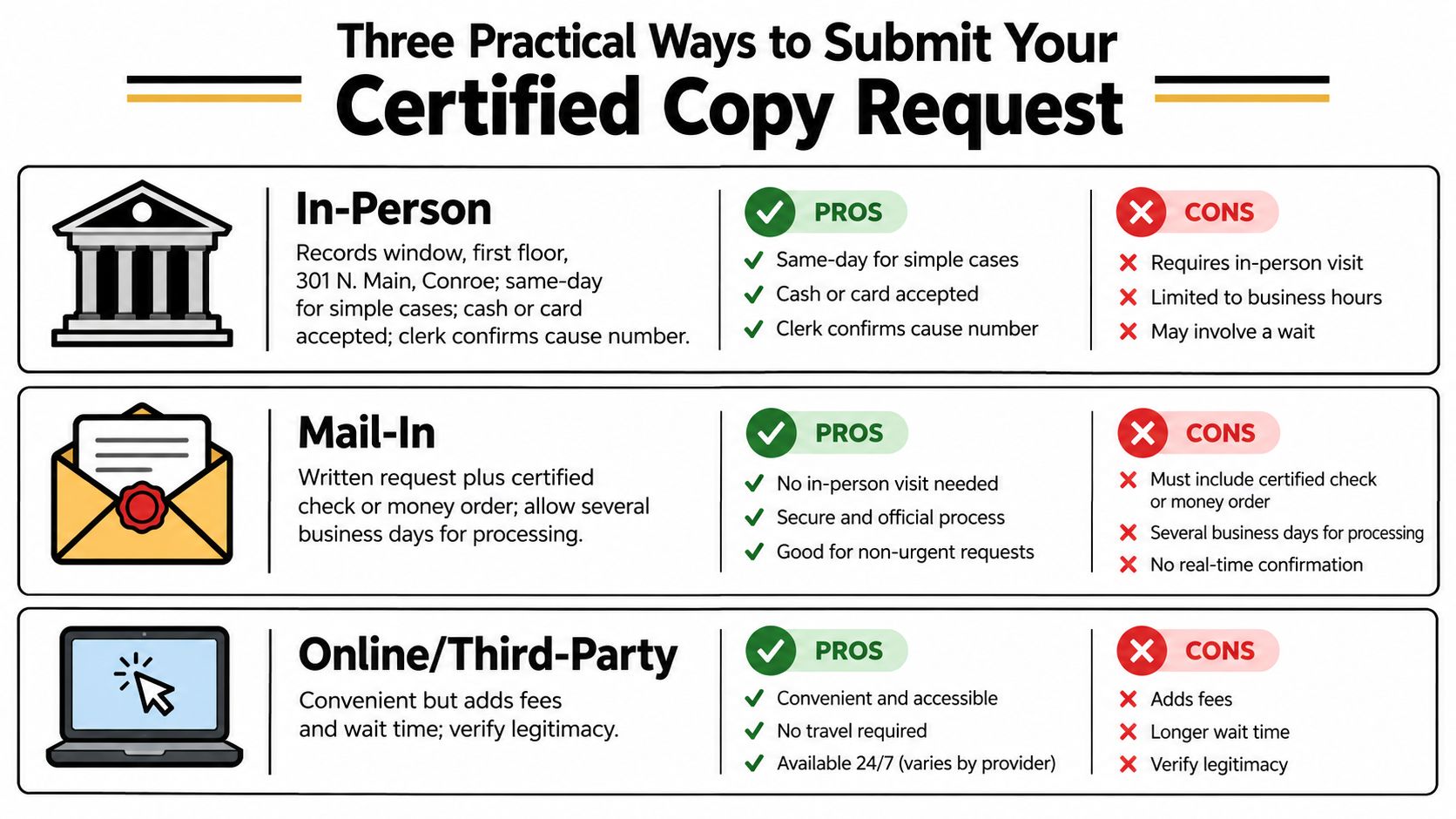
Montgomery County requesters generally choose among three practical routes. The right choice depends on urgency, distance, and how much help you need confirming the case information.
In person at the Conroe records office
An in-person request is useful when you have a deadline and want the clerk to review the information while you're there. Bring photo identification, the cause number if available, the names in the style of the case, and a clear statement that you want a certified copy of the final decree.
The main advantage is immediate clarification. If the clerk can't locate the file under the information you brought, you can correct a name or cause-number problem before leaving. The trade-off is travel from The Woodlands, Spring, or another Montgomery County community, along with the possibility that an older or complex file won't be ready immediately.
Mail a written request
Mail works well when the need is planned and you don't live near Conroe. Include a signed letter, the case identifiers, the number of certified copies requested, your contact information, and the payment method the clerk currently accepts for mailed requests. Include a self-addressed stamped envelope if the office requires one for returning the copy.
A written request creates a clear record of what you asked for. It also removes the opportunity to resolve an omitted cause number or unclear case style at the counter, so review the letter carefully before sending it.
Use the authorized online channel
An online request can be practical for someone outside Montgomery County or outside Texas. Use the District Clerk's authorized records portal rather than an unfamiliar commercial site that appears in a search result. Confirm that the service is connected to the county office, understand any convenience charges, and save the confirmation or tracking information.
Online convenience doesn't eliminate the need for accurate case details. A portal may accept a request that still requires staff to search for the correct file, and a third-party ordering service may add cost without improving the underlying record search.
Notarization usually isn't required just to make your own request. It can be sensible when a non-party is using a written release, but confirm the clerk's current requirements before arranging a notary.
Fees, Payment Options, and Realistic Processing Times in Conroe
Montgomery County's published fee structure gives requesters a useful starting point. A plain copy is listed at $1.00 per page, while a certified copy is $1.00 per page plus a $5.00 certification fee per document, as shown on the Montgomery County District Clerk's official records information.
That calculation is straightforward. A 12-page certified decree is about $17, before mailing or convenience charges. The page charge accounts for $12, and the fixed certification charge accounts for $5. The certification fee applies to the document, not each page, which is why shorter documents are more affected by the fixed charge.
| Request type | Typical total cost | Processing time | Best payment approach |
|---|---|---|---|
| Plain copy | $1.00 per page | Confirm with the records office | Use the current office-approved method |
| Certified copy | $1.00 per page plus $5.00 per document | Confirm based on the file and delivery method | Follow the District Clerk's current instructions |
| Multiple certified documents | Page charges plus the certification fee for each document | May require additional handling | Ask whether each document needs separate certification |
| Certified decree with mailing or convenience service | Base fee plus applicable delivery or service charges | Depends on the selected channel | Review the total before submitting |
If you need both the decree and another order or attachment, ask whether each item will be certified as a separate document. A request for several authenticated documents can cost more than expected because the certification charge applies per document.
Processing depends on whether the file is readily available, whether the request contains enough information, and which delivery channel you choose. The Montgomery County District Clerk fee and filing information can provide related local context, but it shouldn't replace confirmation of the current copy-request procedure.
Don't plan around the fee alone. If a remarriage appointment, lender deadline, or probate filing is approaching, confirm the office's current processing expectation before choosing mail or online delivery.
Older files may need additional handling. Ask the clerk whether the case is available for immediate copying and whether any retrieval or delivery charge applies before you finalize the request.
A Copy-Ready Sample Request Letter You Can Adapt
A good letter lets the records staff answer one question quickly: which case do you want, and what kind of copy should they issue? Use the following format for a mailed request or an in-person drop-off, then replace every bracketed field.
[Requester's full legal name]
[Mailing address]
[City, State, ZIP code]
[Phone number]
[Email address][Date]
Montgomery County District Clerk
Records Department
Conroe, TexasRe: Request for certified copy of final divorce decree
Case number: [exact cause number]
Style of case: In the Matter of the Marriage of [Petitioner full name] and [Respondent full name]
Date final decree was signed: [date, if known]
Number of certified copies requested: [number]Please provide a certified copy of the final divorce decree in the case identified above. I am [a party to the case, the attorney for a party, or the authorized representative of a party]. [If applicable, state that the written authorization or release is enclosed.]
Please contact me at [phone number or email address] if additional information is needed. I have enclosed the applicable payment and [a self-addressed stamped envelope, if required].
Sincerely,
[Signature]
[Printed full legal name][If required for a non-party request, insert the authorization or notary block requested by the District Clerk.]
Use the exact cause number if you have it. If you don't, say so and include both spouses' names and the approximate date of the divorce. Don't guess at a number.
For mail, attach the payment method and return envelope required by the office. For an in-person request in Conroe, bring photo identification and keep a copy of the letter for your records.
Common Pitfalls That Delay or Derail Montgomery County Requests
The wrong-office mistake remains the most expensive in time. A requester sees “county records” and sends the letter to the County Clerk, even though the certified divorce decree is held through the District Clerk's court-records function. The Texas State Law Library guidance on obtaining divorce documents reinforces the same routing point, and its guidance helps separate a divorce case record from other identity or vital-record documents.
Another problem is using a public search result as though it were the certified document. A search page may confirm that a case exists, but the receiving agency may need the clerk-authenticated decree. Ask the lender, licensing office, court, or other recipient whether it needs a plain copy, certified copy, or a different form of authentication.
Check the request before sending it
- Wrong office: Confirm that the request is addressed to the Montgomery County District Clerk, not the County Clerk.
- Missing case details: Include the cause number, both spouses' legal names, and the date of the final decree if known.
- Unclear document type: Write “certified copy of the final divorce decree” rather than just asking for “divorce records.”
- Incomplete authorization: If you're not a party, ask what release or court order the clerk requires.
- Incorrect fee calculation: Count the pages and remember that certification is charged per document, not merely per page.
- Unacceptable payment: Use the payment method currently specified by the office, particularly for mail requests.
- No return plan: Provide the required mailing information or confirm how an online order will be delivered.
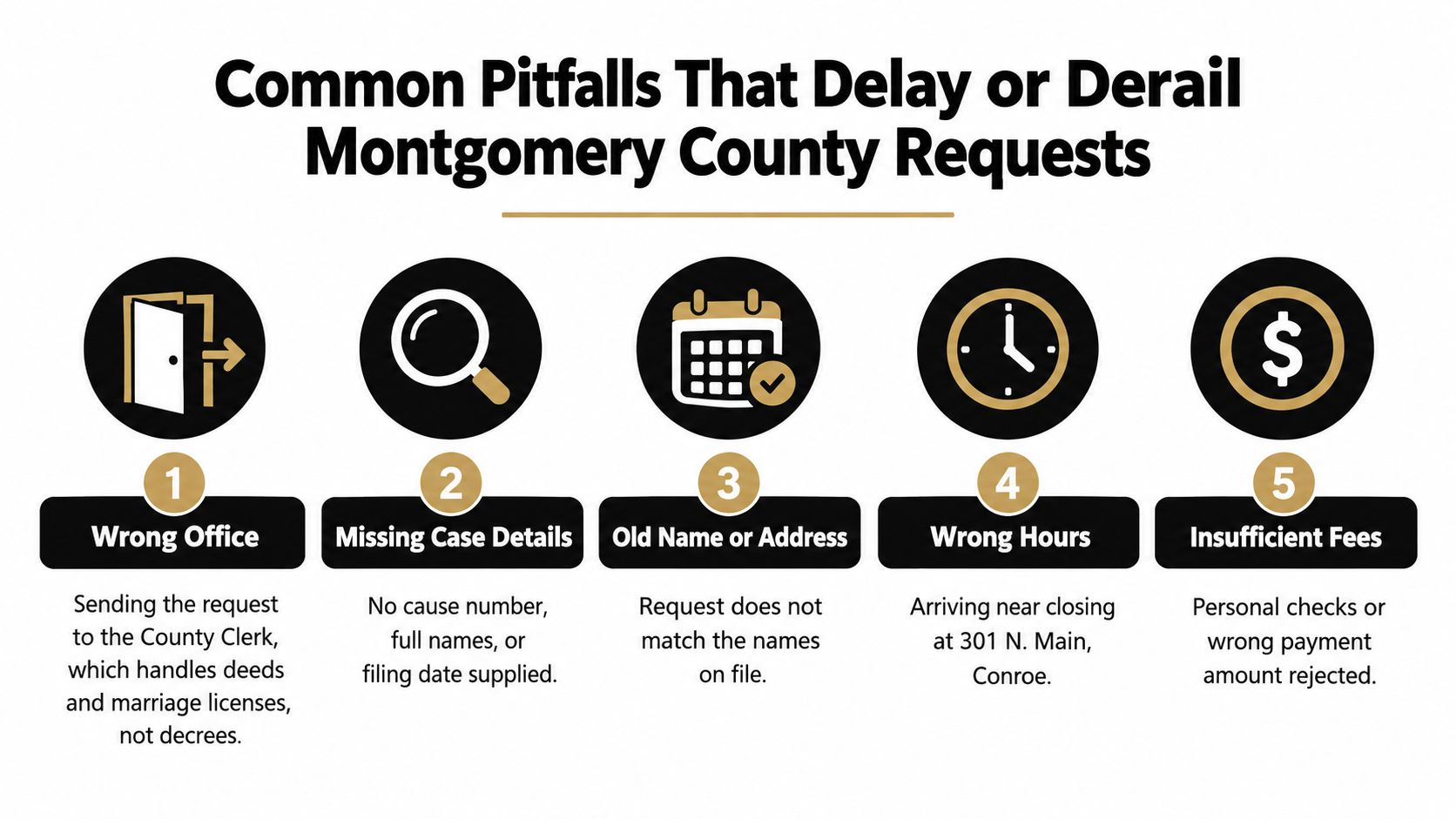
Don't assume an older surname, a nickname, or a current address will match the historical case file. Use the legal names shown in the divorce case and explain any name change in the request. If the case number is missing, say that plainly instead of entering an estimate.
Before submission, compare the name spelling, cause number, decree date, requested number of copies, payment amount, and delivery address. That short review often prevents the follow-up that turns a simple records request into a second trip or another mailing.
What to Do Next With Your Certified Copy
When the certified decree arrives, inspect it before putting it away. Confirm that it identifies the correct parties and case, and check for the clerk's authentication, including the signature and seal. If an agency asked for a certified copy, verify that the document you received matches that agency's instructions before sending away your only original.
Protect the document and create a working copy
Keep the original in a secure, protected location, such as a fire-resistant file or safe. Scan it for your private digital records, but treat the scan as a backup rather than a replacement for the certified paper copy. If you provide the original to a lender, court, licensing office, or title company, ask whether it will be returned.
A decree can affect more than the marital status itself. Review insurance policies, beneficiary designations, retirement-account titles, property records, and financial instructions after the divorce. The decree may also contain provisions about property, debts, support, or name changes that require follow-up with a separate institution.
For probate or estate planning, the decree can help establish that a prior marriage ended before a later property or inheritance issue is addressed. The Texas State Law Library information about finding copies of identity and court documents identifies the district clerk as the custodian of a divorce case file. That distinction matters when a family is gathering documents for an estate matter in Montgomery County.
If your broader family-law issue involves establishing legal paternity and related rights in Montgomery County, a Paternity Lawyer in The Woodlands may be a separate resource from the records office. Obtaining the decree proves what the court document says, but it doesn't by itself resolve a new dispute over parenting, support, property, or enforcement.
What to do next checklist
- Verify the document: Check the parties, cause number, final-decree language, clerk's signature, and seal.
- Store the original: Place it in a protected location where it won't be lost or damaged.
- Create a backup: Scan the decree and store the digital file securely.
- Confirm the recipient's rules: Ask whether a current certified copy, plain copy, or additional authentication is required.
- Update records: Review insurance, beneficiaries, retirement accounts, property records, and financial accounts.
- Track deadlines: Note any timing requirement from a lender, court, licensing agency, or other recipient.
- Separate new legal questions: Get advice if the decree raises issues involving enforcement, property, probate, custody, or support.
- Order carefully: Request additional certified copies only when an agency or transaction needs them.
Texas Family Code provisions can affect the timing and consequences of post-divorce steps, so don't rely on the records request alone when a remarriage, property transfer, or court deadline is involved. Texas Estates Code issues may also matter when the decree is being used in probate or estate planning.
This article is not legal advice. It provides general information about requesting a certified divorce decree and doesn't create an attorney-client relationship. For help identifying the correct document, reviewing how a decree affects a family-law or probate issue, or planning around a Montgomery County deadline, you can schedule a consultation with The Law Office of Bryan Fagan.
The Law Office of Bryan Fagan can help Montgomery County families understand how a certified decree fits into divorce, custody, property, support, and probate concerns. Visit The Law Office of Bryan Fagan to learn about scheduling a consultation for your situation.
