 Skip to content
You're in The Woodlands, your divorce or custody case has moved past temporary orders, and the court has assigned a final trial setting. Then someone tells you mediation must happen first. You may reasonably ask whether the mediation you already completed for temporary custody, support, or possession has checked that box.
In Montgomery County, that assumption can create a serious procedural problem. A mediation held during the temporary-orders phase may not satisfy a separate mediation requirement tied to the final trial, depending on the court's order and local procedures. The practical question isn't just whether you mediated. It's whether you completed the right mediation, within the required time, for the specific setting ahead.
Why Mediation Comes Before Final Trial in Montgomery County Family Cases
A The Woodlands couple may begin with a narrow emergency. One parent wants a temporary possession schedule. The other wants temporary child support and a decision about where the children will live while the divorce proceeds. They attend mediation, sign temporary agreements, and leave believing the hardest part is over.
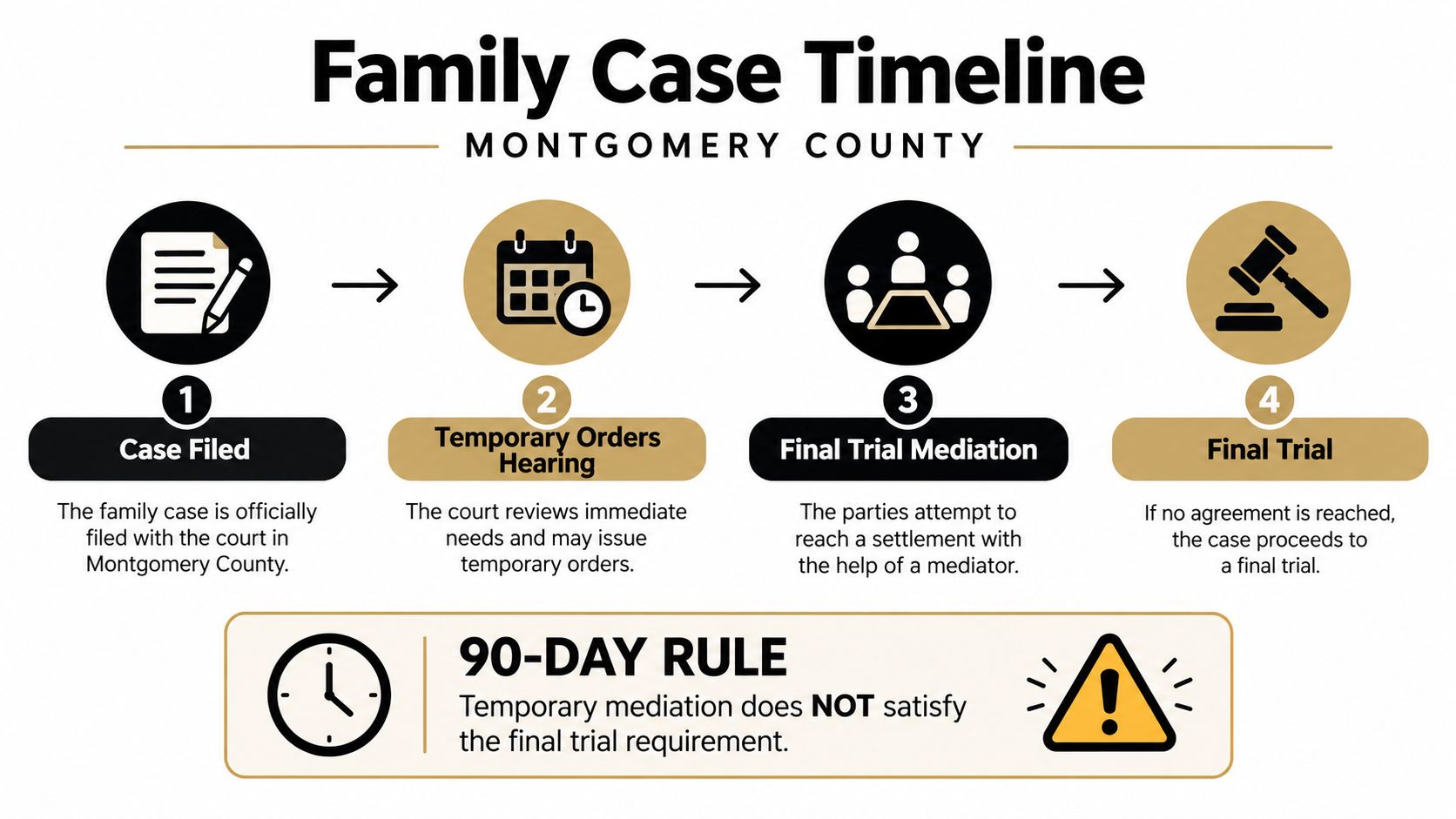
Months later, the court sets a final trial. The remaining issues include conservatorship, a long-term possession schedule, property division, and support. The court's procedures call for another mediation before that final setting. The earlier session helped stabilize the family, but it didn't necessarily resolve the claims the judge will decide at trial.
That is why local procedure matters. Montgomery County family cases are structured to encourage settlement before contested hearings and trial, not merely to offer mediation as an informal courtesy. The Texas Supreme Court's approval of Montgomery County district-court local rules dates to 2000, and those rules state that alternative dispute-resolution procedures “will be encouraged and utilized” to promote early settlement. The same rule set requires each court to adopt a mediation procedure for civil cases.
Mediation is part of the case path
For a family in The Woodlands, Conroe, Magnolia, or surrounding Montgomery County communities, that framework signals how the court expects cases to move. Temporary orders address immediate needs. Later mediation gives the parties a structured opportunity to resolve the claims that will control life after final judgment.
A final trial consumes court time, attorney preparation, witness preparation, and emotional energy. Mediation lets the parties negotiate privately, identify which issues are genuinely disputed, and make decisions that may be more detailed than a judge's ruling. It also gives each side a clearer view of the risks of proceeding.
Practical rule: Treat every mediation order as case-specific. Read what it covers, identify the setting it relates to, and confirm whether the court requires a separate session before final trial.
The framework remains active in the county's current family-court administration. Montgomery County maintains dedicated local rules for practice before the family courts and separate rules for the administration of family cases. For a client, that means local procedure can affect what must happen before the final setting, even when the underlying family-law claims arise under statewide Texas law.
A useful local overview is Divorce Mediation in The Woodlands, Texas. The important takeaway is simple: mediation is often a checkpoint on the road to trial, and an earlier checkpoint may not replace the one attached to the final trial date.
How Texas Family Code and Montgomery County Local Rules Work Together
Texas law supplies the statewide authority for mediation in parent-child cases. Montgomery County's local rules and court orders supply much of the practical scheduling structure. Those two layers work together, but they aren't interchangeable.
Under Texas Family Code Section 153.0071, a court may refer a suit affecting the parent-child relationship to mediation either because the parties agree or because the court acts on its own motion. That gives a Montgomery County judge authority to send custody and possession disputes to mediation even when one parent would rather proceed directly to court.
The statute also recognizes that mediation must be handled differently when family violence is alleged. A party may object before the final mediation order. If the objection doesn't establish the required showing, the court may still order mediation, but it must protect the parties' safety through measures such as separate rooms and no face-to-face contact.
Statewide authority, local implementation
The statute answers questions such as:
- Who can refer the case: The parties by agreement or the court on its own motion.
- When safety concerns matter: A party can object before the final mediation order when family violence is alleged.
- How the court can protect someone: The judge can require separate rooms and prohibit face-to-face contact.
- What mediation can produce: A properly executed mediated settlement agreement can create a binding path to judgment.
Local court orders answer different questions. They may identify when mediation must occur, whether a separate final-trial mediation is required, what documents must be filed, and how mediation relates to docket call or pretrial deadlines. A practical resource on court-specific administration is the Montgomery County 410th District Court family docket procedures.
This distinction matters because state law doesn't erase a court's scheduling requirements. A party may have completed a valid mediation under Texas law and still need to attend another session because the local order ties the required mediation to the final-trial setting.
For general orientation, Montgomery County Family Courts: A Local Guide describes how family-law cases proceed in Montgomery County courts serving The Woodlands. It shouldn't replace the order in your own case. Your assigned court, the wording of the order, and the date of the final setting control the immediate procedural obligations.
What Happens When a Court Orders Mediation Before Final Trial
Once a court orders mediation, don't treat the event as a casual settlement meeting. It's part of the case schedule, and the result can affect whether your case is ready for final trial.
Start with the order. Confirm the mediation deadline, the issues included, the mediator-selection process, and any requirement to file proof that mediation occurred. Counsel should also compare the mediation date with the final-trial date and other pretrial obligations. A session held too early may not satisfy an order that requires mediation close to trial.

Prepare for the actual dispute
Mediation works best when the parties arrive with the information needed to make decisions. That may include a proposed possession schedule, a support position, a property inventory, school and transportation concerns, and a list of unresolved language for the final order.
A temporary-orders session often focuses on immediate stability. A final-trial mediation should address the permanent structure of the family's legal relationship. That can include conservatorship rights and duties, possession, geographic restrictions, child support, medical responsibilities, property division, and other claims pleaded in the case.
A short scenario shows the difference. One parent in The Woodlands seeks expanded possession and objects to the other parent's proposed support amount. At temporary orders, they agree to a short-term schedule while the children remain in their current school. Before final trial, the dispute has changed. The parent now wants a different school-year schedule, a long-term holiday plan, and specific transportation terms. The first mediation produced a temporary solution. It didn't necessarily resolve the final case.
Know what a signed agreement means
A mediated settlement agreement can carry substantial legal force in a SAPCR and other family cases. Under the statutory framework described in Texas Family Code Section 153.0071, the agreement must contain the required “not subject to revocation” language, be signed by each party, and be signed by any attorney who is present. When those requirements are met, a party is generally entitled to judgment on the agreement despite conflicting procedural rules.
That doesn't mean every handwritten note or informal email resolves a case. The language, signatures, scope, and drafting matter. If the parties settle only some issues, the remaining disputes still need a plan for trial or additional negotiation.
If mediation fails, preserve the documentation showing attendance and discuss what remains unresolved. The case doesn't disappear because the parties tried and couldn't agree. Instead, the attorneys should narrow the trial issues, exchange required materials, prepare witnesses, and comply with the court's remaining deadlines.
The 90-Day Final-Trial Mediation Rule and Why Earlier Mediation May Not Count
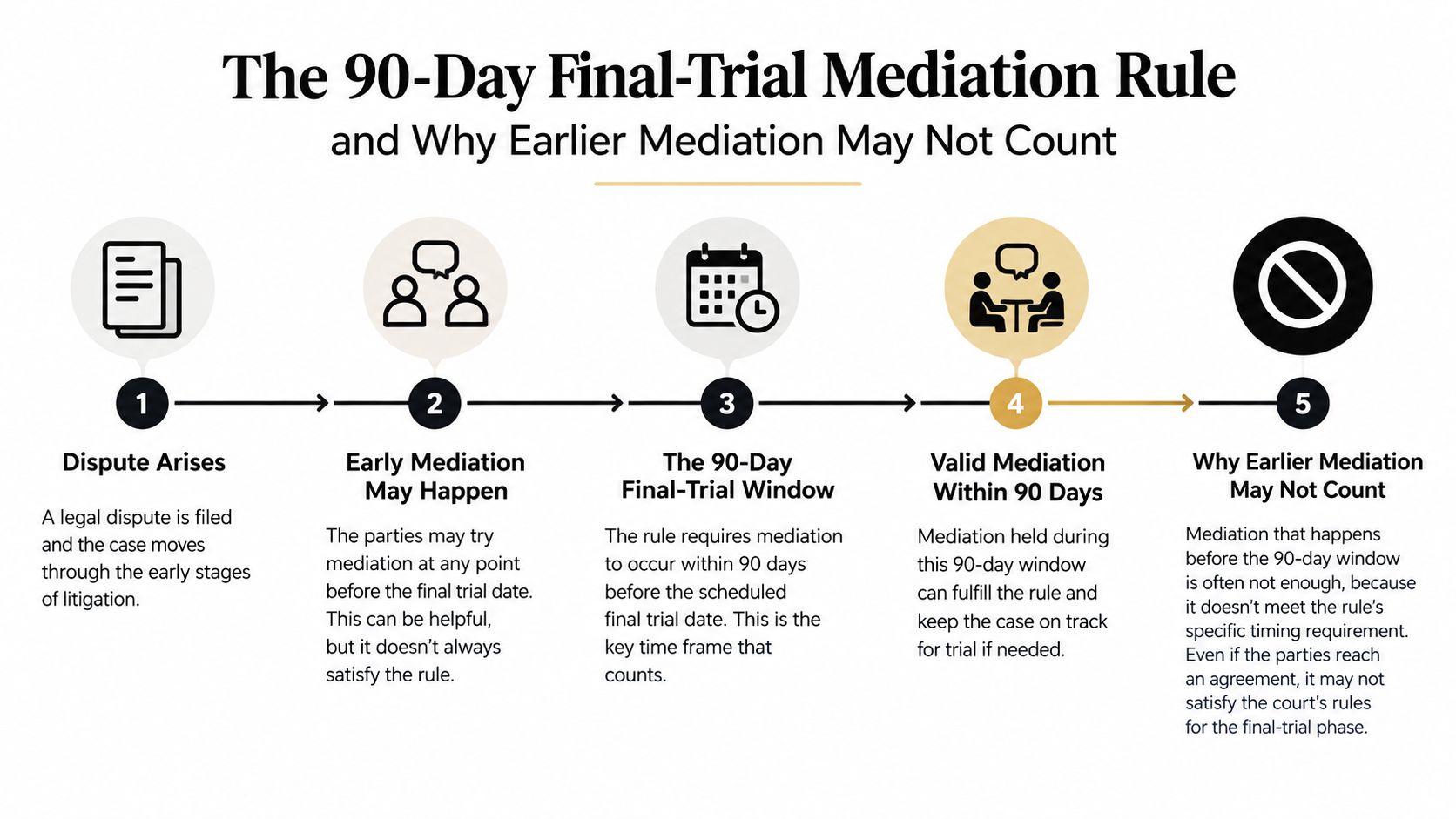
A temporary-orders mediation can resolve immediate problems without resolving the case for final trial. Under the 418th District Court documents and forms, the 418th Judicial District Court's published mediation procedures require a separate final-trial mediation no more than 90 days before the trial date. An earlier mediation about temporary orders does not satisfy that requirement.
The distinction creates two separate procedural events:
| Mediation | Main purpose | Does it automatically satisfy final-trial mediation? |
|---|---|---|
| Temporary-orders mediation | Address immediate custody, possession, support, or financial needs | No, not when the court order requires a separate final-trial session |
| Final-trial mediation | Attempt to resolve the claims scheduled for final adjudication | Yes, if completed in the required window and according to the order |
Why the timing changes strategy
Suppose the parties mediated temporary possession shortly after the case began. They reached a temporary agreement, then spent months exchanging financial records and addressing school, holiday, transportation, and support issues. As final trial approaches, they may need another mediation within the court's final-trial window.
That timing affects settlement strategy. The parties have less time to postpone decisions, and an unsuccessful mediation can leave limited time for witness preparation, exhibit organization, and drafting a proposed final order. The temporary agreement may show what worked for the family, but it does not resolve permanent disputes under the current pleadings and evidence.
The 418th District Court's published procedures distinguish mediation, docket call, and the final-trial deadline. Those procedures also address the need to meet pretrial obligations and have the decree ready for the final-trial setting. Missing a required docket-call or pretrial step, or failing to have the decree prepared, can create serious procedural consequences, including dismissal. Review the court's 418th District Court documents and forms and the current orders in the case rather than relying on a general summary.
The question to ask your lawyer: “Does my order require final-trial mediation, and does the mediation date fall within the required window before trial?”
Check the latest order well before trial week. Compare its deadlines with the assigned court's current procedures, confirm the mediation date in writing, and address scheduling problems early enough for the court to act without disrupting final-trial preparation.
When Mediation Breaks Down or One Party Refuses to Participate
A party who will not cooperate can still be required to attend mediation. The response depends on the problem: scheduling, mediator selection, unpaid fees, nonappearance, or a safety concern. Document the issue early, because waiting until final-trial preparation is underway can leave too little time for the court to set a hearing or enforce its order.
Under the 418th Judicial District Court's procedures, counsel must file a motion to compel mediation at least 45 days before trial when the opposing party refuses to cooperate. Review the court's current mediation procedures and documents for the applicable requirements. A late request can interfere with trial preparation and may not give the court enough time to address the refusal.
Private mediator or court-assigned mediator
A privately selected mediator may provide more control over scheduling and allow the parties to choose someone experienced with high-conflict custody, complex property, or financial disputes. The trade-off is that the parties must coordinate availability and resolve the mediator's fee arrangements themselves.
A court-assigned mediator may operate under a different scheduling and payment process. The 418th District Court's mediation procedures set out different fee arrangements for court-assigned and privately selected mediators. Read the current procedures before assuming that the parties will divide the cost, that a fee will be waived, or that the court will assign a mediator on a particular schedule.
| Problem | Practical response |
|---|---|
| One party will not select a mediator | Keep written records of proposed mediators and dates, follow the order, and consider asking the court to intervene |
| A party refuses to attend | Confirm the applicable deadline and ask counsel whether a motion to compel is required |
| Family violence is alleged | Raise the concern before mediation and request protective arrangements |
| Mediation ends without agreement | Preserve proof of attendance and organize the unresolved issues for trial |
High-conflict custody example
A parent in Magnolia repeatedly ignores requests to select a mediator. The other parent's lawyer sends proposed dates, identifies available mediators, and preserves each unanswered communication. Because trial is approaching, counsel files a motion to compel within the court's required timeframe instead of waiting for docket call.
Safety concerns require a separate response. Texas Family Code Section 153.0071 permits protective measures, including separate rooms and no face-to-face contact, when the court refers the case despite an objection based on family violence. The objection should identify the specific risk and request a mediation format that prevents avoidable contact.
A failed mediation does not end the case. Counsel should determine whether the mediator will report attendance, identify the remaining disputes, and prepare the evidence and proposed orders needed for final trial. General guidance on what to expect in divorce court in The Woodlands may help with courtroom orientation, but only the operative order and the assigned court's current procedures establish whether mediation requirements were satisfied.
What to Do Next After Understanding Mediation Rules in Montgomery County
The safest approach is to treat final-trial mediation as a separate planning project. Don't assume the label “mediation completed” tells the whole story. Identify the order that required it, the phase of the case, the date of the session, and the trial setting it was intended to address.
Start by collecting every operative document. Include the mediation order, temporary-orders rulings, scheduling orders, docket-call instructions, pretrial requirements, and any notice setting final trial. If the case has moved between courts or the judge has entered a later order, the newer document may control.
A practical checklist
- Read the exact order: Look for language requiring mediation before a hearing, before final trial, or within a specified period.
- Compare the dates: Confirm whether the mediation occurred within the court's required window before final trial.
- Separate temporary and final issues: List what was resolved temporarily and what still needs a permanent order.
- Confirm attendance proof: Ask whether the mediator or counsel must file a certificate, notice, or other documentation.
- Choose the mediator deliberately: Consider subject-matter experience, scheduling, format, safety needs, and fee procedures.
- Prepare a settlement proposal: Bring specific terms for possession, holidays, transportation, support, property, and unresolved language.
- Protect the trial date: If mediation fails, immediately identify witnesses, exhibits, testimony, and the terms the judge must decide.
- Address noncooperation early: If the other party won't schedule or attend, ask counsel whether a motion to compel is needed before the court's deadline.
Keep mediation, pretrial, and trial separate
These events serve different purposes. Mediation is a settlement process. A pretrial conference or docket call handles readiness, scheduling, and compliance. Final trial is the proceeding where the judge decides the remaining disputes after hearing admissible evidence.
Confusing those functions can lead to missed obligations. A party may attend mediation and still need to appear for docket call. A party may reach agreement and still need a properly drafted decree and final court approval. A party may fail to settle and still need to meet every pretrial deadline.
The local procedure also changes how you prepare for a hearing if mediation breaks down. One Montgomery County family-court guidance document limits temporary matters to 3 hours total when primary residence is at issue and 2 hours total for all other temporary matters, with the time divided equally between the parties. It also states that proceedings are conducted in person unless the court gives advance approval for a remote appearance. Those limits concern temporary proceedings, not a substitute for understanding the final-trial process, but they show why focused preparation matters.
This article provides general information about Montgomery County mediation procedures. It isn't legal advice, and a court's current order may differ from another court's order. Texas Family Code Section 153.0071, local rules, standing orders, and judge-specific procedures can affect the result. Talk with a Texas family lawyer before assuming your earlier mediation satisfies the final-trial requirement.
If you're in The Woodlands, Conroe, Montgomery, Magnolia, or a nearby Montgomery County community, gather your orders and mediation records before the consultation. The Law Office of Bryan Fagan handles divorce, custody, support, property division, and related family-court disputes, including planning for mediation and final-trial preparation.
The Law Office of Bryan Fagan can review your Montgomery County orders, identify whether a separate final-trial mediation is required, and help prepare settlement terms or trial strategy. Visit The Law Office of Bryan Fagan to schedule a consultation about your mediation deadline and next court setting.
