 Skip to content

If your child has been referred to juvenile probation in Montgomery County, here is what to know right away: intake is an early review after a referral. It is not a trial. It is not a finding. And it is not a final custody order.
Think of it as the first decision point. An intake officer reviews what was reported and helps decide what should happen next.
Who You Will Meet at Intake
For families in The Woodlands, Conroe, and nearby Montgomery County communities, that first call from a school resource officer or local police department can be stressful. The reassuring part is that intake is designed to sort cases out, not to decide punishment.
Here is who is typically involved:
- Your child, who will be asked about the reported incident
- A parent or guardian, who attends and provides family background
- An intake officer, who reviews the referral and screens for next steps
- A prosecutor or judge, but only if the case moves beyond intake
Most families arrive here after a school incident, a police referral, or another outside report. That first meeting has one job: choose the right path forward.
Montgomery County Juvenile Intake at a Glance
Before we get into specifics, it helps to see the early stages together. Intake covers more than one meeting, and each stage answers a different question.
| Stage | What It Means | Who Is Usually Involved |
|---|---|---|
| Referral | A school, police, or other report starts the process | Reporting party, child, parent |
| Screening | The intake officer reviews the report with the family | Intake officer, child, parent |
| Detention Review | A separate decision on going home or staying in custody | Intake officer, judge if raised |
| Informal Handling | Services like counseling or community service | Child, parent, probation |
| Formal Case | A petition is filed and court dates follow | Prosecutor, judge, family |
In short, a referral does not automatically lead to court. The path branches quickly depending on risk, history, and what the screening shows.
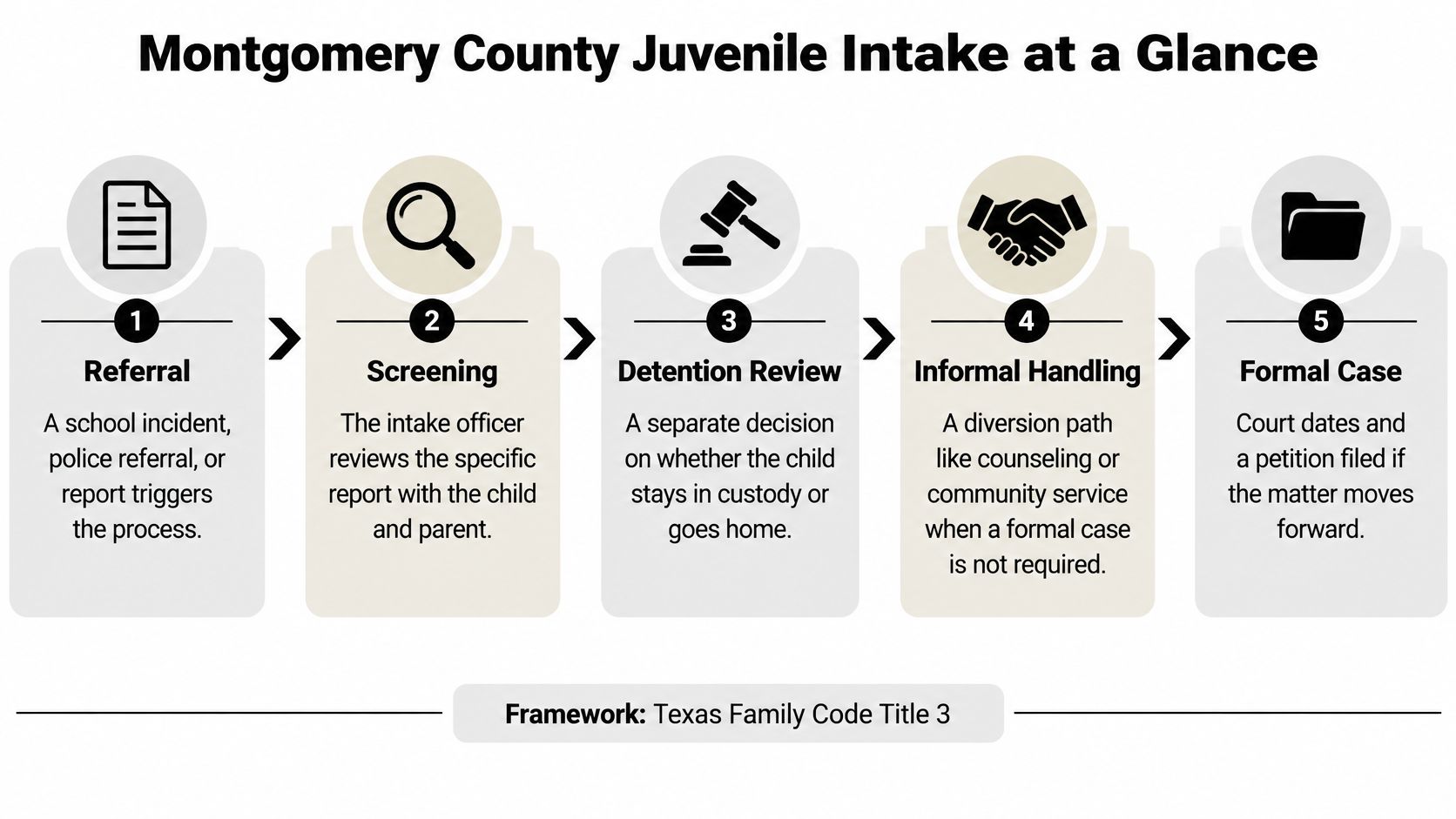
The visual above breaks those five stages into a simple flow, from referral to a possible formal case. Notice that detention review and informal handling are separate forks. One deals with where your child stays right now. The other deals with how the case might be resolved without a petition.
Texas Family Code Title 3 provides the statewide framework behind those choices, including how referrals are screened and what options exist short of filing a petition.
Intake is a review, not a verdict. Walk into that first meeting ready to listen, answer clearly, and learn what comes next.
This article is general information only and is not legal advice.
What Can Start Juvenile Probation Intake
Every case starts with the referral itself — what was reported, who reported it, and where that report went.
A school fight, a shoplifting report, an alcohol-related incident, or other police contact can put a child on officials' radar. But not every incident belongs in the Montgomery County Juvenile Probation Intake Process. Get clear on the reported conduct and which agency received it.
A curfew complaint is a good example. It does not move through the system the same way an assault allegation does. Under Texas Family Code Title 3, the legal category drives what happens next, and the intake officer must look closely at the specific report.
Start with the paperwork, not the label someone used over the phone.
If you live in Panther Creek, Alden Bridge, Sterling Ridge, or Creekside Park in The Woodlands, these three questions will ground you fast:
- Where is my child now? Confirm the location yourself, do not guess.
- Who made the referral? Get the agency name and a contact person.
- Is a hearing already scheduled? Write down the date, location, and any instructions given.
Those answers place your family inside the process before the interview even starts.
Find Out Whether Your Child Is Coming Home
Release to a parent usually means arranging pickup and following instructions about supervision and upcoming appointments. If your child is still being held, the focus shifts immediately to detention review and confirming hearing details under Texas Family Code Title 3.
What to Do Next
- Stay reachable and line up reliable transportation now
- Pull together the referral paperwork plus any current custody or possession order
- Do not coach your child to add details or practice answers
That existing order matters more than most parents realize. It can affect notice, access to information, and who can make decisions. Bring a copy instead of assuming the parent who got the call has full authority.
This is general information only and is not legal advice. If the referral raises custody or possession questions, consider scheduling a consultation with The Law Office of Bryan Fagan.
The Intake Interview, Screening, and Detention Review

Going into the Montgomery County Juvenile Probation Intake Process, it helps to know what the officer is actually reviewing. The officer will go over the referral, then talk with you and your child.
Expect plain, practical questions. Age, what was reported, school enrollment and attendance, any prior referrals, and whether your child can safely go home that day.
How Screening Is Different From Detention Review
Screening is a structured check of risks and needs. It is not a finding of fault. And it does not predict what a judge will do later.
Ask which decision is being made today. Screening and detention review answer two very different questions.
A detention review is much narrower. It only addresses whether your child stays in custody or returns home while the case is pending. That process falls under Texas Family Code Title 3, including Sections 53.01 and 54.01 on preliminary investigation and detention hearings.
Remind your child to be polite and honest, but not to guess. If they do not remember something, “I don’t remember” is better than filling in blanks.
What To Bring and How To Keep Track
Parents in The Woodlands should bring what you have on hand, if you have it:
- Photo ID and any referral or citation paperwork
- School contact information, including counselor or attendance office
- Medical or counseling notes you are comfortable sharing
- Custody or protective orders, if one is in place
Once you are there, keep good notes:
- Write down every name, date, and instruction you are given
- Ask what the next step is before you walk out the door
- Confirm the date, time, and location of any follow-up
One common mix-up: the intake office and the courtroom are not always in the same building. Double-check the address on your notice.
This is general information only and is not legal advice. Every family’s situation is different. If you are unsure how the referral affects custody or school matters, consider scheduling a consultation with The Law Office of Bryan Fagan.
The Montgomery County Juvenile Probation Intake Process does not end with the first meeting. For families in The Woodlands, what matters most is which direction the case takes next — services without a formal filing, a court petition, or no further action.
Services, Informal Handling, and Common Outcomes
Under Texas Family Code Title 3, specifically Sections 53.01 through 53.04, the department handles preliminary review, deferred prosecution decisions, and petitions. When a formal case is not needed, informal handling might include counseling, community service, an education class, or agreed supervision.
Here is how those paths usually compare in practice.
Common Paths After Juvenile Intake
Each option carries different expectations for parents, so it helps to know what you are agreeing to before you leave the office.
| Path | Typical Family Tasks | Court Involvement | What to Track |
|---|---|---|---|
| Informal handling | Complete agreed services | Not necessarily | Conditions and completion |
| Formal petition | Respond and attend hearings | Yes | Notices and dates |
| No further action | Confirm referral status | Not necessarily | Written confirmation |
A formal petition is not the same as a program offer. It triggers court dates and deadlines. A decision to take no further action can happen when the referral does not support moving forward.
Signing a program agreement does not automatically close the referral. Ask what successful completion changes and how it will be recorded.

Read Program Terms Before Agreeing
Read every condition closely before you sign. Meeting times can conflict with school and activities in The Woodlands and Conroe, and both the underlying referral and any compliance issues could come up later in a family law matter.
For example, if staff offers counseling for your teen, ask about evening options if the first slot conflicts with school, and ask what attendance letter the program will provide.
What to Do Next
- Keep copies of every agreement and notice you receive.
- Calendar each class, service deadline, and check-in date.
- Ask who verifies completion and get it in writing.
- Talk through any custody concerns before signing unfamiliar terms.
If staff mentions a specialty court, review Montgomery County specialty court eligibility and ask whether it fits your child's referral.
This is general information only and is not legal advice. Outcomes turn on the specific referral.
If you would like help understanding family-law implications, schedule a free consultation with The Law Office of Bryan Fagan.
A Short Real-World Scenario From Montgomery County
Picture a ninth grader who splits time between Alden Bridge during the week and Conroe on weekends. After a fight at school, only one parent gets the call. The other learns about the referral hours later.
Both parents are worried about custody schedules, school attendance, and whether their child will be held or released. Instead of debating who was notified first, they share the paperwork, bring the school counselor’s contact to intake, and ask how required meetings could affect weekend exchanges. They leave with clear notes on who will drive to appointments and who will track completion letters.
This scenario is an illustration only and is not legal advice. It shows how staying organized and focused on the child’s needs helps at intake.
Keep Custody Orders and Intake Responsibilities Separate
Texas Family Code Title 3 controls juvenile proceedings. Custody and possession still come from your existing orders, and those stay in place unless a court changes them.
An intake referral can still affect a Montgomery County custody, support, or modification matter. Let your family lawyer know about the referral instead of treating intake directions as a new custody order.
What to Do Next
- Share notices and paperwork, consistent with existing orders.
- Confirm supervision and transportation between both homes.
- Attend required meetings and help the child finish agreed tasks.
- Ask counsel about conflicts between intake requirements and possession.
This is general information only and is not legal advice. If these responsibilities overlap with a family dispute, consider scheduling a consultation. You can discuss your situation confidentially with The Law Office of Bryan Fagan.
What to Do Next Before the Intake Meeting
Getting ready for intake goes smoother when everything is in one place. Put together a single folder for the Montgomery County Juvenile Probation Intake Process and keep your paperwork, notes, and questions together.
Use This Short Checklist to Stay Organized
- Pull together the referral paperwork, then write down every appointment, deadline, and name you are given.
- Double-check any custody order so you are clear on who can make decisions for your child.
- Bring ID, school contacts, and any medical or counseling information you are comfortable discussing.
- Remind your child to be polite and honest. Do not practice a script.
- Ask the intake officer what decision is expected that day — and how you will get the next notice.
- Save copies of anything you sign and note who told you what.
Texas Family Code Title 3 sets the rules for juvenile cases. If you already have custody, support, or possession litigation in Montgomery County, let your family lawyer know about the referral right away so nothing conflicts.

Plan Your Trip From The Woodlands
Confirm the address before you leave, plan for traffic, arrange time off work, and bring a notebook. Intake is not always at the courthouse.
If your meeting runs into school pickup, line up another authorized adult in advance instead of having to step out early.
Preparation means organizing information, not predicting an outcome.
This checklist is general information only and is not legal advice. Local procedures can change, so always follow what is on your notice and what the office tells you directly.
Still have questions? For help with family-law questions tied to your child’s referral, consider scheduling a free juvenile consultation with The Law Office of Bryan Fagan.
Does Intake Mean My Child Now Has a Record?
No. Intake is a review, not a finding. Under Texas Family Code Title 3, juvenile cases work differently than adult cases, and what gets recorded depends on how the referral is resolved.
Do not assume no further action automatically means no paperwork exists. Ask specifically how your child's referral and outcome will be documented.
Can Both Parents Attend?
Usually, yes — but check with the intake officer first. Both parents can often provide helpful background, yet your existing Montgomery County order still controls who can make decisions.
Bring a copy of that order with you. And keep any co-parent tension out of the interview room.
Attendance and legal authority are not the same thing. Sitting in on intake does not change either parent’s court-ordered rights.
What If We Miss a Meeting or Do Not Have the Paperwork?
Call the number on your notice right away. Ask whether you can reschedule and what alternative proof the office will accept if something is missing.
An incomplete folder is fixable. Ignoring the date is not.
For related obligations, review Montgomery County community supervision reporting requirements, but always confirm your child’s specific instructions directly with staff.
Know When to Ask for Legal Help
When Should We Talk to a Lawyer? Get advice quickly if your child may be held in custody, someone mentions a formal petition, you are asked to sign paperwork, or custody or possession could be affected.
Never sign an unfamiliar form just to get out the door faster.
This article is general information only and is not legal advice.
Families in The Woodlands and Montgomery County who have questions about how intake affects custody, possession, or support can schedule a free consultation with The Law Office of Bryan Fagan or reach out through the firm’s online contact form. Bring your notice and current parenting order so you can discuss next steps for your family.
