 Skip to content
The phone rings after bedtime. Your teenager has been picked up after an incident near a Woodlands shopping center or local park, and the officer wants you to come to Montgomery County juvenile intake. You may not know what happened, whether your child will come home, or what to say without making things worse.
That uncertainty is understandable. Texas juvenile cases move quickly, and early decisions can affect detention, questioning, release conditions, and the direction of the case. A juvenile defense lawyer in The Woodlands, TX, can help your family understand those decisions before a rushed conversation becomes part of the record.
A Late-Night Call and What Comes Next for Woodlands Families
Consider a common situation. A parent in The Woodlands receives a call late at night and learns that a teenager was taken into custody after several young people were accused of damaging property near a shopping center. The parent wants answers immediately, but the child may still be waiting for intake, an officer may be asking questions, and a detention hearing may be approaching.
The first legal question isn't whether the family believes the child is innocent or whether the incident seems minor. The immediate questions are where the child is being held, whether the child is being questioned, and when the detention hearing will occur. Under Texas Family Code Section 54.01, a detention hearing generally must occur no later than the first working day after a juvenile is detained. If the child remains detained, later detention orders generally can't last more than 10 working days.
Why the first conversation matters
A worried parent may say, “My child told me everything,” or volunteer an explanation to an officer before speaking with counsel. That reaction is human, but it can create confusion about what happened, who was involved, and whether the child understood the questions. A lawyer can help the family separate known facts from assumptions and decide how to respond.
The child also has a right to counsel before the first detention hearing. The Texas Juvenile Justice Handbook explains that courts must notify the child and parents of that right, and an indigent family must receive appointed counsel before the hearing.
Practical rule: Ask where your child is, ask when the detention hearing is scheduled, and avoid discussing the facts with investigators until you've received legal guidance.
The case may resolve through a community-based option, or it may involve probation, placement, or a serious transfer issue. The next steps depend on the allegation, the child's age, the evidence, prior referrals, school circumstances, and the child's treatment needs. A calm response during the first hours gives your family room to make informed choices.
What a Juvenile Defense Lawyer Does in The Woodlands
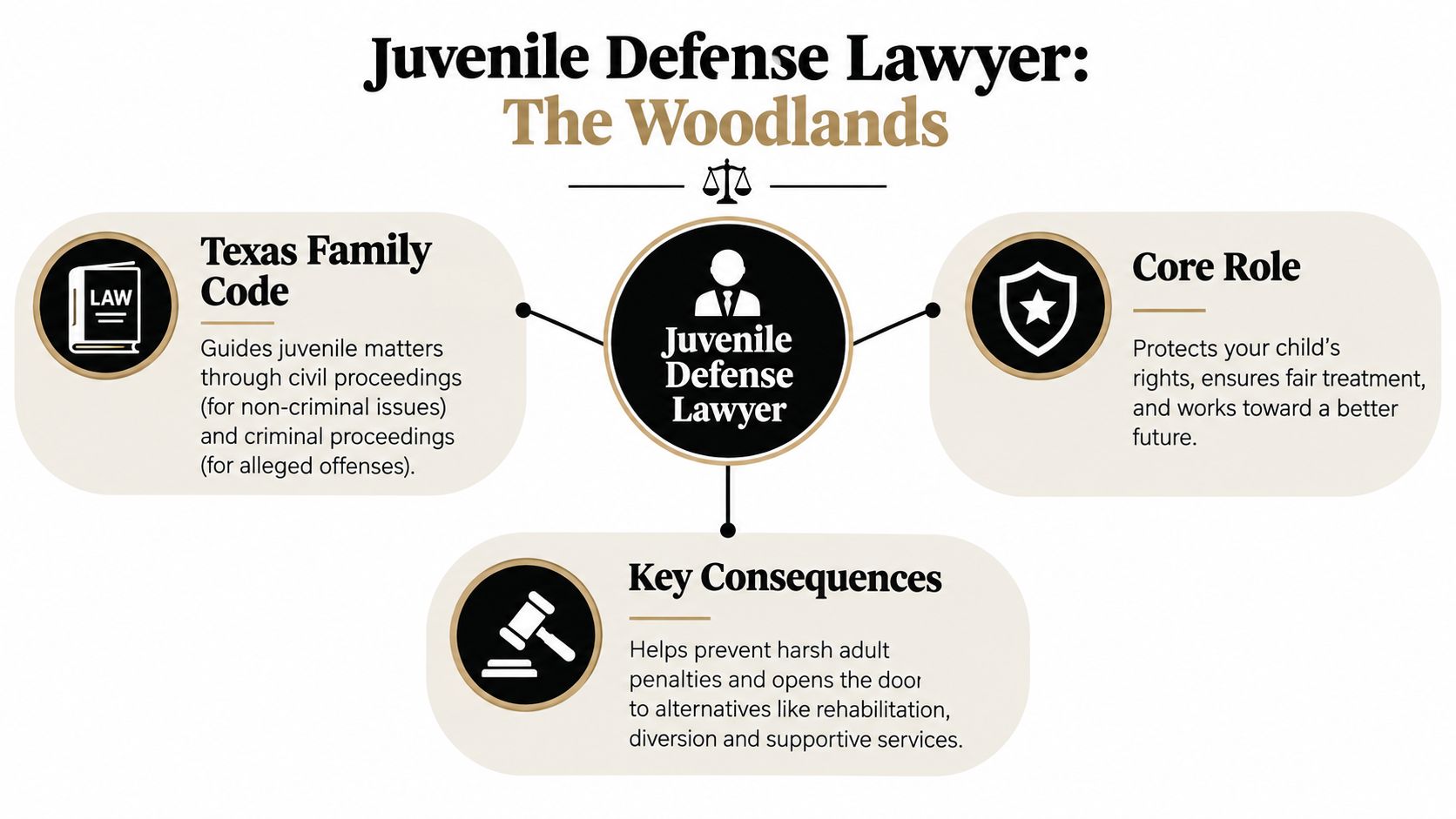
A juvenile defense lawyer does more than just appear in court and wait for a judge to decide what happens. Counsel protects the child's rights at each stage, beginning with detention and continuing through adjudication, disposition, probation, or a possible transfer proceeding.
Texas juvenile proceedings are structured differently from adult cases. The system is generally treated as civil, but that label doesn't make the consequences unimportant. A child may face detention, supervision, placement, school disruption, or restrictions that affect family life and future opportunities.
The work begins before the first hearing
Before detention review, counsel may:
- Review the intake decision: Determine what law enforcement reported and how the referral reached juvenile probation.
- Assess probable cause: Examine whether the available facts support continued detention or the allegations under review.
- Protect against unnecessary statements: Explain the child's right to remain silent and the risks of answering questions without advice.
- Prepare for release: Address proposed conditions such as curfews, school attendance, counseling, or contact restrictions.
- Gather context: Identify school concerns, mental health needs, medication issues, family support, and potential treatment resources.
The right to counsel is especially important because the Texas Family Code makes representation non-waivable at several major stages. Under Texas Family Code Section 51.10, counsel can't be waived in transfer-to-adult-court proceedings, adjudication, disposition, and certain modification proceedings.
A defense plan should fit the child
Effective juvenile advocacy focuses on more than the accusation. It may involve negotiating with the Montgomery County District Attorney's juvenile division, challenging the petition, seeking informal adjustment or deferred prosecution, and presenting a realistic rehabilitation plan.
A lawyer may also review school records, witness accounts, digital evidence, or the circumstances of the interview. The point isn't to excuse harmful conduct. It's to give the court accurate information about the child and a legally sound alternative to a more restrictive outcome.
Families sometimes need help with connected issues outside the juvenile petition. For example, a CPS Defense Attorney in The Woodlands handles defense against CPS investigations for The Woodlands families. That is a different proceeding, but the issues can overlap when a juvenile case brings family safety concerns to the attention of another agency.
How the Texas Juvenile Court Process Actually Works
The process can feel confusing because several decisions happen close together. A referral doesn't automatically mean a child will be committed to state custody, and detention doesn't automatically mean the case will end with a finding of delinquent conduct. Each stage has a separate purpose.
From referral to detention review
Texas juvenile court jurisdiction generally begins at age 10 and applies to a person under 17, with a separate rule for some 17-year-olds when the conduct occurred before age 17. The key statute is Texas Family Code Section 51.02.
After law enforcement refers a matter, juvenile probation may screen the allegation and assess whether detention is appropriate. If the child is detained, the court must hold a detention hearing by the first working day after detention under Section 54.01. For status offenders and nonoffenders, Section 54.011 requires a hearing before the 24th hour after arrival at a detention facility, excluding weekend and holiday hours.
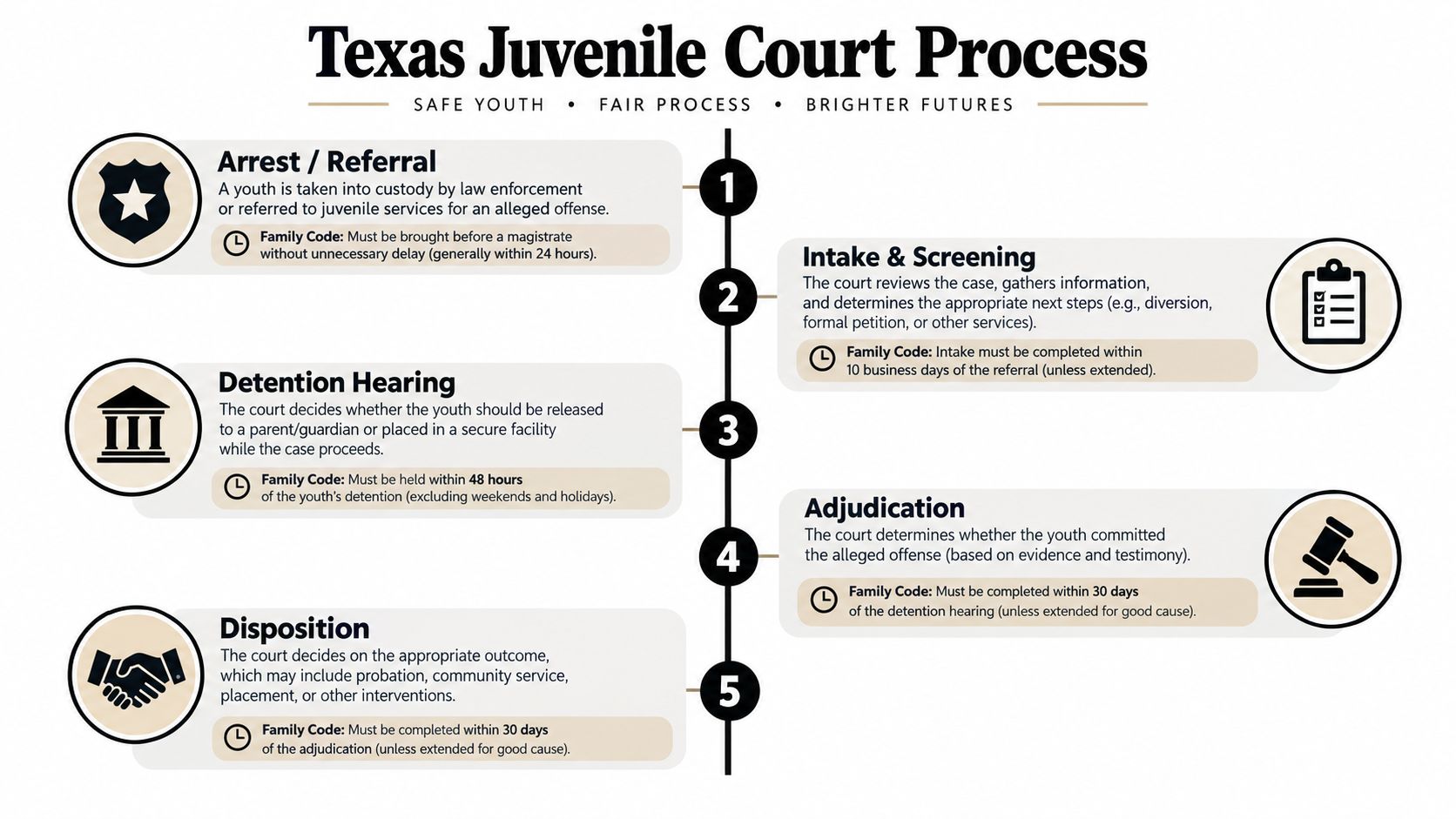
At detention review, the judge considers whether the legal basis for continued detention exists. Counsel may present information about supervision at home, school attendance, treatment, family support, and safety. Release can include conditions, so coming home doesn't necessarily mean the case is over.
Petition, adjudication, and disposition
A petition identifies the alleged delinquent conduct or conduct indicating a need for supervision. The defense reviews the allegations, challenges legal or factual weaknesses, and determines whether negotiation, litigation, or a jury trial is appropriate.
Adjudication addresses whether the allegations are proven. Disposition addresses what happens afterward. Depending on the facts, the court may consider probation, services, placement, or another lawful response. The child and parents should understand that these are separate decisions, even though they may feel like one continuous case.
Serious allegations raise additional concerns. Texas training materials identify 14 as the minimum age for certification as a controlled-substance felony in juvenile transfer contexts, and 15 as the minimum age for certification for all offenses. Those thresholds come from TJJD Foundations of Juvenile Law.
Local courthouse procedures and scheduling can add practical pressure. Families looking for general orientation may also review Montgomery County Family Courts: A Local Guide, which addresses how family law cases proceed in Montgomery County courts serving The Woodlands. Juvenile counsel should still explain the specific juvenile docket, deadlines, and orders in your child's case.
What to Do in the First 48 Hours After a Juvenile Arrest
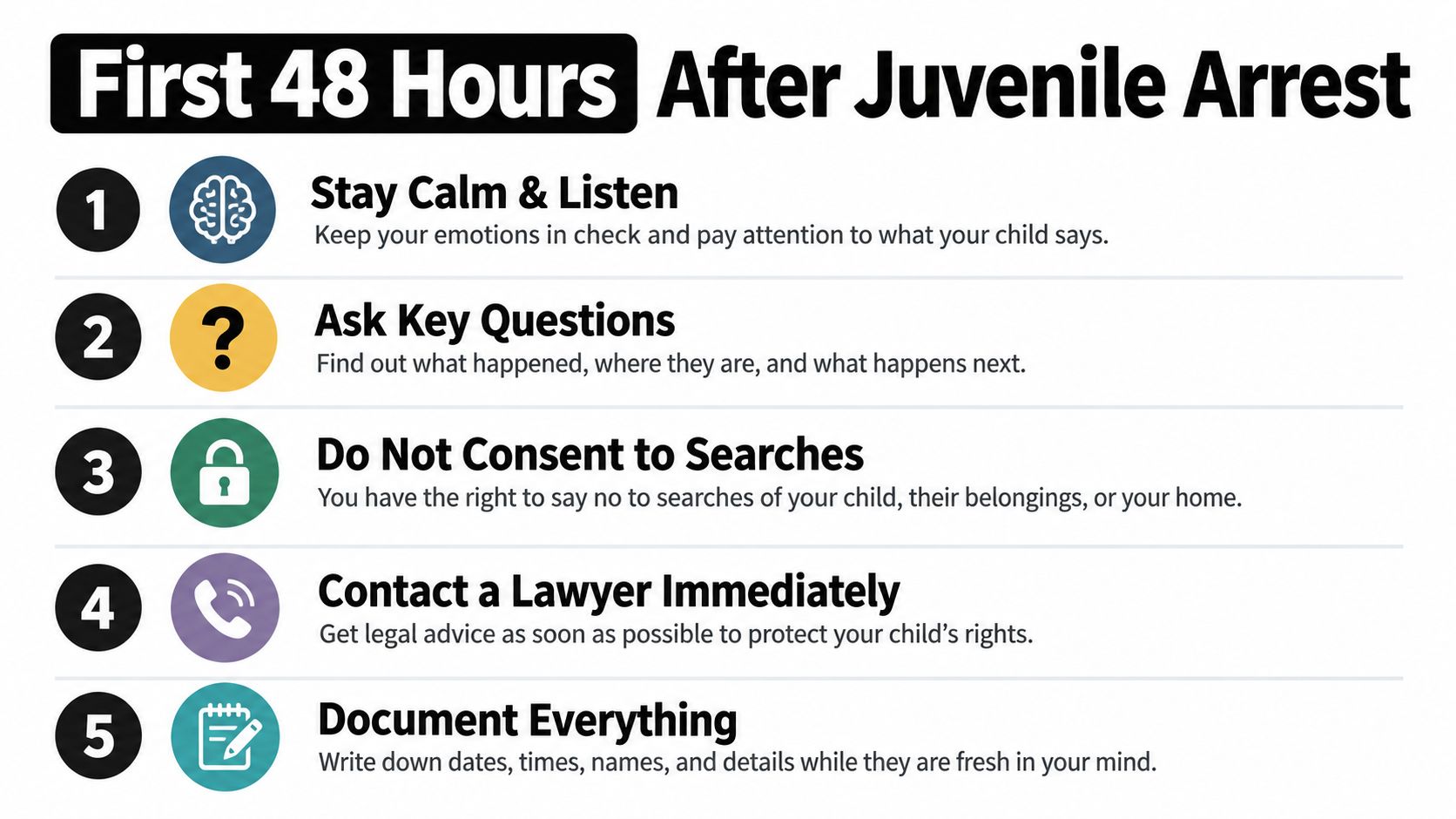
The first two days should be organized around safety, accurate information, and legal protection. Parents don't need to solve the entire case overnight. They do need to prevent avoidable mistakes while the court's deadlines are running.
A short action checklist
-
Stay calm and listen. Ask the officer or intake staff where your child is being held, what agency made the referral, and whether a detention hearing has been scheduled.
-
Don't volunteer facts. Be respectful, but don't try to explain the incident, identify other children, or argue the case by phone. Your child should also avoid answering investigative questions until counsel has provided guidance.
-
Ask about immediate health needs. Tell intake staff about medications, allergies, mental health concerns, or other safety information. Arrange for necessary prescriptions through the facility's approved process.
-
Contact a juvenile defense lawyer promptly. Counsel should have an opportunity to speak with the child before a formal statement is given to law enforcement, probation, or prosecutors.
-
Document the timeline. Write down when you received the call, who contacted you, where the child was taken, what paperwork you received, and the names of people involved.
Questions parents often miss
Ask whether the child is being held for a delinquency allegation, a status matter, or another reason. Confirm the hearing deadline rather than relying on a general promise that “someone will call.” Ask about visitation, approved clothing, and prohibited items before traveling to the detention facility.
A lawyer can also help you contact the school without disclosing unnecessary details. If the child needs medication, transportation, or a safe adult at home, handle those tasks while counsel addresses the legal side.
Parental involvement matters, but a parent isn't automatically entitled to direct every interview. Whether a child is free to leave, detained, or being questioned under formal safeguards can change the legal analysis. The safest course is to request counsel and avoid consenting to searches or interviews without understanding the consequences.
Some families also face a separate custody question involving relatives. Grandparents' Rights in The Woodlands concerns custody and visitation rights for grandparents in Montgomery County, which is distinct from defending a juvenile allegation.
Possible Outcomes From Diversion to Adult Certification
A late-night allegation does not determine the final result. A juvenile case may end through informal adjustment, deferred prosecution, probation, secure placement, determinate sentencing, or certification to adult court. The path depends on the evidence, the allegation, the child's history, the supervision available at home, and the court's assessment of safety and rehabilitation. Attorney involvement matters early because counsel can test the evidence and address the option that fits the facts before a family accepts conditions.
Texas data also helps parents separate system involvement from secure state commitment. In FY 2025, about 1% of youth referred to the Texas juvenile justice system were committed to the Texas Juvenile Justice Department. Texas's commitment rate ranked 27th overall, placing the state in the middle nationally for per-capita secure commitments. The figures are reported in TJJD data and statistics.
The lower end of the range
An informal adjustment may resolve a matter without formal adjudication when the circumstances support it. Deferred prosecution lets a child complete agreed conditions while the case remains focused on rehabilitation. Probation may require counseling, school attendance, community service, curfews, restitution, or other court-ordered terms.
For a Woodlands family, “lower” does not mean consequence-free. Supervision can affect transportation, school routines, friendships, treatment, and household rules. Before agreeing, parents should ask what counts as completion, what happens after noncompliance, and whether the result may support later record relief. A record-sealing lawyer serving The Woodlands can explain why eligibility depends on the case and the applicable Texas Family Code provisions.
More restrictive outcomes
Placement in a TJJD facility is more restrictive than community supervision. In FY 2025, 31.6% had a determinate sentence among youth admitted to TJJD, and 7.3% were admitted for murder, according to the same TJJD data. Those figures describe the system overall, not a prediction for one child, but they show that the most serious matters form a distinct portion of total involvement.
As of August 2024, Texas probation supervised 18,692 youth, compared with 790 in state residential facilities and 154 on parole, according to TJJD's published data. The comparison does not decide a Montgomery County case. It explains why probation is a common management route, while secure placement carries greater restrictions.
Determinate sentencing and adult certification require prompt legal attention. They can increase long-term consequences, so families should ask counsel to evaluate the evidence, deadlines, and available record options before agreeing to a proposed resolution.
Choosing the Right Juvenile Defense Lawyer in Montgomery County
A parent choosing counsel should look for juvenile-specific experience, not only general courtroom confidence. Juvenile procedure has its own deadlines, terminology, detention rules, treatment considerations, and transfer concerns.
Use a consultation to ask direct questions:
- Local juvenile practice: How often does the lawyer appear in Montgomery County juvenile court and handle cases involving The Woodlands?
- Case mix: What types of juvenile matters does the lawyer regularly handle?
- Resolution strategy: How does counsel evaluate informal adjustment, deferred prosecution, probation, and contested adjudication?
- Transfer experience: Has the lawyer handled certification-to-adult-court issues and the non-waivable representation requirements under Texas Family Code Section 51.10?
- Record remedies: How does the lawyer evaluate sealing or expunction under the Texas Family Code, including Chapter 58?
- School concerns: Will counsel help the family understand related school disciplinary issues, or will another professional be needed?
- Communication: Who will explain detention conditions, deadlines, and proposed agreements to the parent and child?
A lawyer shouldn't promise a dismissal, a particular probation term, or a guaranteed release. The outcome depends on facts the lawyer may not yet have, the allegations filed, the child's history, and the court's decisions.
A useful test: After the consultation, you should understand the next deadline, the immediate risk, the information counsel still needs, and the decisions that can't be undone casually.
The lawyer's role should remain clearly defined. If your family is searching for unrelated adult matters, don't confuse a criminal defense lawyer in The Woodlands with counsel whose practice includes juvenile proceedings. Ask what the attorney will do before the first hearing, not only what the firm lists on a website.
Montgomery County Juvenile Court and Local Practice
Families in The Woodlands generally begin with the Montgomery County Juvenile Probation Department intake process. The department gathers information, screens the referral, assesses detention needs, and connects the matter to the county's designated juvenile court process.
Local practice can affect how quickly parents receive instructions and how conditions are presented. A judge may consider a curfew, school attendance, treatment participation, electronic monitoring, or limits on contact with certain people. Those conditions should be reviewed carefully because violating them can change the child's detention status or probation posture.
Preparing for a local hearing
Confirm the courthouse location and courtroom before leaving The Woodlands. Juvenile matters are handled through the county's juvenile court system, and families may need to travel to Conroe, including the courthouse area on North Thompson Street. Check parking arrangements, allow time for security, and arrive early enough to speak with counsel before the docket begins.
Detention reviews, status hearings, and disposition reviews follow the court's schedule. Parents shouldn't rely on an informal estimate from a friend or social media post. Ask the assigned lawyer or probation contact for the exact date, time, courtroom, and documents required.
The probation unit assigned to a case can also shape the practical conversation about supervision and services. An attorney familiar with Montgomery County can account for the assigned unit's information, the judge's expectations, and the prosecutor's position while still protecting the child's legal rights. Local familiarity doesn't replace preparation, but it helps counsel prepare for the setting where decisions will be made.
Common Questions From Woodlands Parents and How to Get Help
Will my child be fingerprinted or photographed?
That depends on the allegation, intake process, and applicable juvenile rules. Ask counsel what records were created, who can access them, and whether later sealing or expunction may be available.
Can my child speak with police without me?
A parent may not always be present for every interview. The important distinction is whether the child is free to leave or is being detained, and whether questioning is formal custodial interrogation. Your child should ask for a lawyer and avoid making a statement until counsel explains the situation.
How does school discipline interact with the case?
A school may use its own disciplinary process even when a juvenile case is pending. Ask about attendance, suspension, extracurricular participation, special education needs, and whether school records may help explain the child's circumstances.
How is restitution determined?
In a property case, restitution generally relates to the claimed loss and the evidence supporting it. Don't agree to an amount without reviewing the documentation and understanding how payment terms may affect the juvenile disposition.
When will the first court date occur?
A detained child must receive prompt detention review under the Texas Family Code. The exact later schedule depends on the petition, the court, the allegation, and whether the case is resolved through negotiation or litigation.
A juvenile matter may also bring a CPS investigation or family-safety concern. A CPS investigation lawyer in The Woodlands addresses defense against CPS investigations for The Woodlands families, which is separate from juvenile defense but may require coordinated advice.
This article is general educational information, not legal advice. The law and procedure can depend on the child's age, the allegation, detention status, evidence, and local orders. Don't rely on this article to make a decision in a pending case.
The Law Office of Bryan Fagan offers legal guidance to families dealing with juvenile-related concerns and connected family-law issues in The Woodlands and Montgomery County. To discuss your child's situation before formal statements are made to probation officers or prosecutors, visit The Law Office of Bryan Fagan and schedule a consultation.
