 Skip to content

Eligible Montgomery County family appeals go to the Ninth Court of Appeals in Beaumont, and the judge's signature on the order starts a short clock that can mean 30 days, 90 days, or 20 days to file notice. Choosing the wrong deadline can prevent the court from reviewing the dispute at all.
For a parent in The Woodlands, the surprising part is that preparing a persuasive argument isn't the first priority. Identifying the order, checking whether it can be appealed, and protecting the filing deadline come first. An argument about your children or property can't help if the court never reaches it.
Yes Your Family Appeal Goes to the Ninth Court in Beaumont
Yes, an eligible family appeal from a Montgomery County trial court generally goes to Beaumont, including cases involving families in The Woodlands, Conroe, Shenandoah, and Oak Ridge North. There is no separate Montgomery County court of appeals.
The trial court and the appellate court do different jobs. The trial judge hears witnesses and signs the order. The appellate judges examine whether the trial court followed Texas law and whether the record supports the challenged result under the applicable standard of review.
The Ninth Court of Appeals' official description identifies its jurisdiction over Montgomery County and nine other Southeast Texas counties: Hardin, Jasper, Jefferson, Liberty, Newton, Orange, Polk, San Jacinto, and Tyler. It also traces the court's creation to 1915.
Which family decisions can reach Beaumont
Eligible matters can include a final divorce decree, a final custody or conservatorship order, a child-support order, or a property-division judgment. Some rulings made before a case ends may qualify for an authorized interlocutory appeal. Other complaints may require a mandamus petition, a request for extraordinary appellate relief.
Temporary orders can be harder to challenge. Many are not subject to an ordinary appeal, and a parent's disagreement with the judge does not by itself make mandamus available. The route depends on the type of order and the requirements for obtaining appellate relief.
Practical rule: Beaumont reviews the trial court's work. The hearing record and the appellate record serve different purposes: the hearing record captures what happened in court, while the appellate record is what the judges use to review the challenged order.
A parent seeking a different result must identify a reviewable error and connect it to the record. The appellate court works from the documents and testimony presented in Montgomery County, rather than hearing the dispute again or creating a new possession schedule.
Why local filing volume doesn't change your obligations
Montgomery County is a major part of the court's workload. A Texas Judicial Branch legislative appropriations request states that filings from Montgomery County exceed the combined filings from the district's other nine counties. That figure describes the broader docket, not a separate count of family appeals.
Local filing volume does not change a parent's filing requirements. A late notice or incomplete record can still prevent review.
Start with the judge's signature date. The applicable timetable generally runs from that date, not from the day a copy arrives by mail or email.
Notice and Record Deadlines That Decide the Case
Family appeal deadlines for Montgomery County orders
| Order type | Notice of appeal | Appellate record | What changes the row |
|---|---|---|---|
| Ordinary final divorce, custody, support, or property judgment | 30 days after signature | Generally 60 days after judgment | No timely qualifying post-judgment motion |
| Timely motion for new trial or motion to modify | 90 days after signature | Clock follows the extended appeal; confirm the applicable record deadline separately | The motion itself must be timely |
| Accelerated appeal | 20 days after signature | Expedited schedule | Statute or rule labels the appeal accelerated |
| Parental termination or child-protection case | 20 days after signature | Typically 10 days after notice of appeal | Courts aim to dispose within 180 days where reasonably possible |
The notice periods, ordinary record period, and expedited child-protection timing above come from the Texas Rules of Appellate Procedure, which generally provide 30 days for ordinary notice, 90 days after qualifying timely motions, and 20 days for accelerated notice, with an ordinary record generally due within 60 days, an expedited record typically due 10 days after notice, and an intended child-protection disposition within 180 days where reasonably possible.
Choose the case type before counting days
Don't choose a row based only on the word custody in the order. A private custody dispute, a governmental conservatorship proceeding, and a parental-termination case can involve children but follow different appellate timetables.
A suit affecting the parent-child relationship, often called a SAPCR, isn't automatically an ordinary appeal or automatically an accelerated appeal. Read the actual order and identify the statute and rule governing it. Many parental-termination and governmental child-protection orders require accelerated treatment.
A post-judgment motion also isn't a universal extension. A timely qualifying motion may change an ordinary appeal's timetable, but you shouldn't assume it extends an accelerated notice deadline.
The central risk is simple: misclassification can end the appeal before review of the merits. An appellant might have a serious complaint about the evidence and still lose the opportunity to present it by using the ordinary timetable for an accelerated order.
Protect both the notice and the record
Treat the notice of appeal and the appellate record as separate tasks. Filing notice doesn't mean the clerk's documents and hearing transcripts have been requested, paid for, or properly arranged.
Use a written calendar that identifies:
- The controlling order: Save the complete signed version, including incorporated attachments.
- The applicable category: Identify whether ordinary or accelerated procedures govern.
- The motion history: Obtain file-stamped copies of any potentially qualifying post-judgment motions.
- The record requests: Track requests to the trial-court clerk and each relevant court reporter.
Informal negotiations, a casual request for reconsideration, and waiting for a mailed copy don't pause the ordinary appellate clock. File the notice with the trial-court clerk, and provide the required notice to parties and the court reporter.
Parents facing governmental child-protection litigation can use the firm's information about a CPS appeal attorney in Montgomery County to prepare questions about expedited review. Bring the signed order rather than relying on a description of what happened at the hearing.
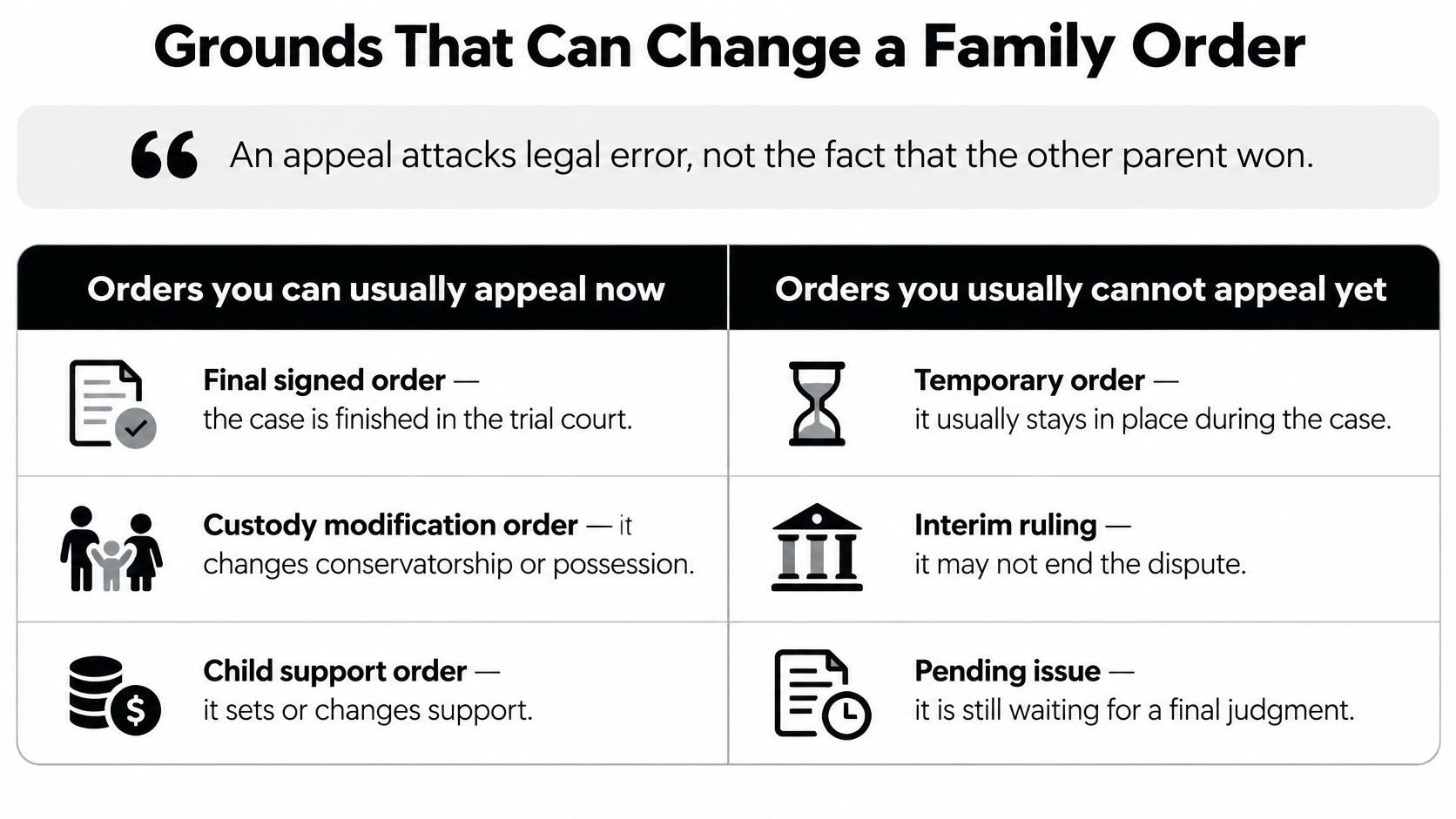
Grounds That Can Change a Family Order
The legal route depends on the order, and choosing the wrong deadline can end an appeal before Beaumont considers its merits. A family order may allow a 30-day appeal, a 90-day appeal, or a 20-day accelerated appeal. Identify the order's category first, then examine the alleged legal error.
Which Montgomery County family orders can go up now
| Order | Appeal now? | Usual route | Typical problem on review |
|---|---|---|---|
| Final divorce decree | Yes | Ordinary appeal to the Ninth Court | Property or support finding without sufficient evidence, or a legal error |
| Final custody or support modification | Usually yes | Ordinary appeal unless a statute accelerates it | Abuse of the trial court's discretion |
| Temporary orders during a pending divorce | Usually no | Evaluate mandamus rather than a standard appeal | Waiting for the final decree may be required |
| Termination of parental rights | Yes, on a fast track | Accelerated appeal | Missing the short notice deadline |
| Order with no statute allowing an early appeal | No, if the order is interlocutory and no statute allows early review | Stay in the trial court until a final judgment | Treating an interim ruling as final |
An order's status controls whether review can begin now. The comparison below shows how different family orders can follow different routes.
Disagreement isn't the same as reversible error
An appeal challenges legal error in the order, not the outcome the other parent obtained. Property division and support decisions often receive abuse-of-discretion review, with evidentiary sufficiency informing that analysis. The standard depends on the issue raised.
A Woodlands spouse who dislikes an equal property division needs more than a preference for a different allocation. The complaint might concern a property mischaracterization, an incorrect legal rule, or a result the record does not support.
Custody decisions also give trial judges substantial discretion. A claim that the other parent was not believable differs from a claim that the judge applied the wrong Texas Family Code standard. Pure legal questions generally receive independent appellate review, but the appellant must also address whether the error warrants changing the judgment.
The complaint must fit the trial record
Preservation means giving the trial court the legally required chance to address a complaint. Depending on the issue, that may require an objection, a requested ruling, findings, or a post-judgment motion. Exceptions require careful analysis.
The firm's guide to how to present evidence in court explains trial-stage preparation. Appellate briefing cannot substitute for evidence that was never admitted.
A later violation of an order may call for enforcement. A qualifying change in circumstances may call for modification instead of an appeal alleging an original error.
For trial-stage representation, the Divorce Lawyer in The Woodlands, TX page describes divorce representation for clients in The Woodlands and Montgomery County. Before paying to prepare a record, match the complaint to an available procedural route while protecting any filing deadline.
How a Family Appeal Moves From Conroe to Beaumont
The appeal's route runs from the Montgomery County trial court to the Ninth Court of Appeals in Beaumont. The briefs and appellate record carry the dispute between those courts, so each document must support the arguments the parties ask the court to decide.
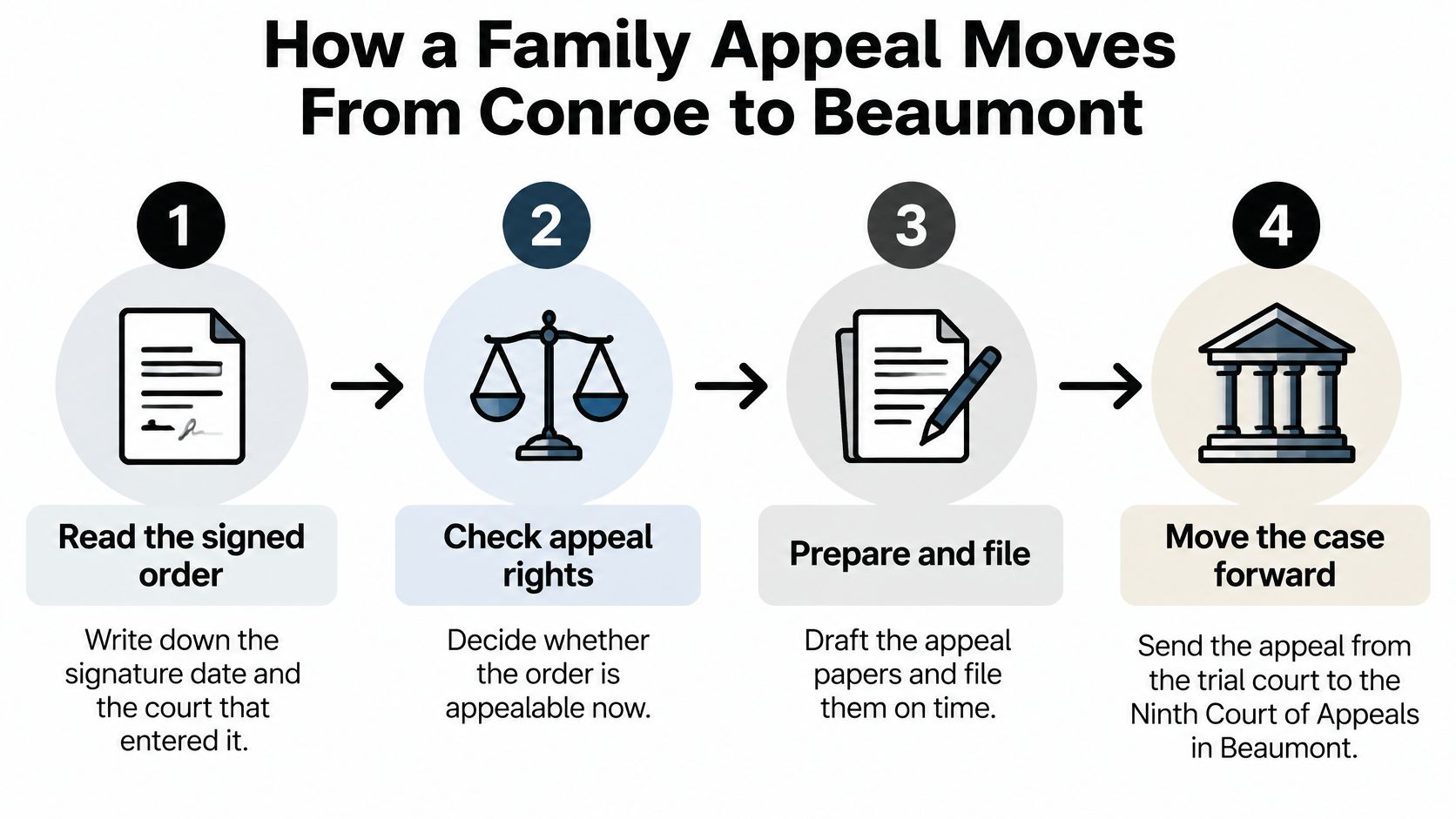
The briefing and review path
Frame the issues. The appellant's brief explains the alleged errors, cites the appellate record, discusses the governing law, and states the relief requested. Each argument needs a clear connection between the challenged ruling and the supporting parts of the record.
Respond to the arguments. The appellee's brief answers the appellant's claims and explains why the order should stand. The appellant may then file a reply brief addressing points raised in that response.
Prepare for submission. The court may consider the appeal on the briefs or schedule oral argument. Oral argument gives the parties an opportunity to address the judges' questions; it does not replace the written briefs or the record.
Follow the court's decision. The Ninth Court issues an opinion and judgment after submission. Keep contact information current and review court notices promptly so required responses are not missed.
Build an argument the record can support
The clerk's record contains filed documents and orders. The reporter's record contains transcripts of proceedings and associated exhibits. Each serves a different purpose, much like two parts of a case file: one shows what was filed, and the other captures what happened in court.
Tell counsel which hearing relates to the challenged ruling and which admitted exhibits matter to the argument. A document kept at home may not be part of the appellate record.
Record check: A document in your personal folder isn't necessarily evidence in the appellate record.
The Montgomery County district courts that hear family cases are the trial courts where family orders originate. Use the court and cause number printed on the order when identifying the case.
A Woodlands Custody Order and What Comes Next
A Montgomery County custody appeal can fall under a 30-day, 90-day, or 20-day deadline. The order's category determines which clock applies, and choosing the wrong one can end the appeal before the Ninth Court considers the arguments.
Consider a hypothetical Alden Bridge parent whose final order modifying custody is signed on Tuesday. The lawyer emails the PDF on Friday. The parent worries about weekday possession and assumes Friday starts the filing clock.
The signature date is the first date to check.

Apply the order's actual category
The parent marks Tuesday as the order's signature date and asks whether a timely motion for new trial or motion to modify the judgment affects the deadline. Counsel confirms that the order is an ordinary final private custody modification, not a termination proceeding or another accelerated matter.
That classification determines the applicable timetable. The parent requests the clerk's record and the reporter's record of the modification hearing, while counsel examines what relief the parent requested, what evidence the judge heard, and whether the decision may involve a reviewable error.
Why the Family Code chapter matters
The Texas Family Code supplies substantive rules for family proceedings, while appellate rules govern much of the filing process. The statutory chapter helps identify which procedures apply to the specific type of case.
For contrast, Texas Family Code Chapter 56 addresses juvenile-court appeals and generally connects their appeal requirements to civil procedures. It does not set the process for an ordinary divorce or private custody modification.
A checklist labeled “family appeal” may cover several different proceedings. The parent and counsel must identify the kind of order before choosing a deadline.
For this hypothetical parent, counsel confirms the order category and motion history, then files under the ordinary timetable using Tuesday as the signature date.
What the Ninth Court Can Do After It Rules
An appellate decision can leave the order intact, set aside part of it, or require more work in Montgomery County. Read both the opinion, which explains the court's reasoning, and the judgment, which states its disposition.
The result may address only a particular issue. Winning an argument about property doesn't necessarily undo unrelated custody provisions.
Understand the disposition
- Affirm: The appellate court leaves the challenged result in place.
- Reverse: The court sets aside all or part of the trial court's result. The precise relief follows the judgment.
- Remand: The court sends the matter back for further proceedings, which may include another hearing, findings, or a new order.
- Render: When appropriate, the appellate court enters the judgment the trial court should have entered rather than requiring another determination below.
A reversal doesn't necessarily create an immediately usable replacement possession schedule or payment instruction. Counsel must examine the appellate judgment, any continuing orders, and the steps required in the trial court before advising what changes.
Calendar the next decision immediately
A party dissatisfied with the result may consider rehearing within the applicable appellate deadline. Calendar that deadline when the opinion issues rather than waiting to decide whether further review seems worthwhile.
A petition for review asks the Texas Supreme Court to choose the case for review. A denial doesn't itself amount to a merits ruling endorsing every part of the lower court's reasoning.
Treat the appellate opinion as instructions for the next legal decision, not permission to improvise a new parenting arrangement.
If the problem is conduct occurring after judgment, distinguish compliance questions from appellate error. Counsel can evaluate whether enforcement or modification addresses that problem more directly than further appellate proceedings.
Confirm the Signed Order Before You Act
A signed order is the starting point for a useful consultation. Gather the order, relevant filed motions, hearing information, and any notices from the clerk or court. Then write down what result you want changed, separating complaints about the original ruling from problems that arose later.
Prepare for a focused consultation
Bring questions that help counsel identify the right remedy. Ask whether the order can be appealed now, whether a post-judgment motion remains available, and what relief an appeal could provide. If enforcement is a concern while review proceeds, ask whether a separate action may be needed.
A short summary can help keep the discussion focused: what the order requires, what you believe the court got wrong, and what outcome you are seeking. The answers can clarify whether an appeal, a motion, or another step best addresses the problem.
Families still litigating in Montgomery County can review the firm's contested divorce page for trial-stage context.
The Law Office of Bryan Fagan represents families in The Woodlands and surrounding Montgomery County communities in divorce, custody, support, and property disputes. To discuss a signed order, contact The Law Office of Bryan Fagan.
This article provides general information about Texas appellate practice. It is not legal advice, and reading it does not create an attorney-client relationship. Appeal rights and deadlines depend on the actual order and procedural history.
