
Supervised exchanges through Montgomery County custodial services in The Woodlands run on fixed shifts, from 6:00 a.m. to 1:00 p.m. and from 6:00 p.m. to 12:00 a.m., at designated public locations. The county's line is answered 24 hours a day, 7 days a week, so this is a scheduled county process, not an informal meeting between parents.
You may be searching this because the next exchange is approaching, the other parent refuses to meet face-to-face, or a prior handoff ended in an argument. You need to know where to go, when to arrive, what the staff supervise, and what to do if the written order doesn't match the practical process.
For families in The Woodlands, the Montgomery County domestic relations office supervised exchange system is built around neutral public sites and defined operating windows. The important distinction is whether your order requires supervised exchange only or full supervised visitation. Those are different services, with different safety controls, costs, and legal consequences.
What a Supervised Exchange Actually Means
A parent arrives at a Woodlands exchange site with a child's backpack. The other parent is waiting separately. Staff coordinate the handoff, keep the parents from confronting each other, and record what happened. Once the child leaves with the receiving parent, the staff's role may end. They aren't necessarily watching the entire visit.
That is the point many parents miss. A supervised exchange monitors the transfer at the beginning and end of possession. Full supervised visitation monitors the parent-child contact throughout the visit. The order must tell you which arrangement applies.

The legal difference matters
Texas Family Code Section 153.004 addresses supervised possession and access when a court finds a history or pattern of family violence, child abuse, or neglect. A court can require access to be continuously supervised by a person or entity selected by the court. That authority can support a full supervised visitation order, while a neutral exchange arrangement may address the narrower problem of unsafe or hostile transfers.
A neutral exchange is designed to reduce direct parent contact. The staff, location, timing, and reporting process create structure around pickup and return. The parent-child time between those handoffs is usually not continuously observed in an exchange-only model.
Practical rule: Read the operative custody order, not a text message or a prior informal arrangement. If the order says “continuously supervised,” an exchange-only service may not satisfy it.
The supervised visitation guidance for The Woodlands can help you identify the questions that need to be answered before the first scheduled transfer. If the language is vague, don't guess at the courthouse door. Ask the county program how it interprets the order and get legal advice if the safety requirements remain unclear.
How to Schedule Your Exchange at the County Office
A court order may require an exchange before either parent can use county custodial services. Start by confirming the order, then contact the program before promising the other parent a date or location. The Texas Access and Visitation program includes supervised visitation and neutral exchange as contract services and directs families to local resources, including the Dispute Resolution Center of Montgomery County. The Texas Attorney General's Access and Visitation information also lists the statewide parenting help line, 866-292-4636, answered in English and Spanish Monday through Friday from 1:00 p.m. to 5:00 p.m.
County custodial-services rules set the Woodlands operating windows and approved exchange sites. The county line is answered 24 hours a day, 7 days a week, but that does not promise a same-day appointment. Intake, eligibility, order review, staffing, and site availability determine how quickly the exchange can begin.
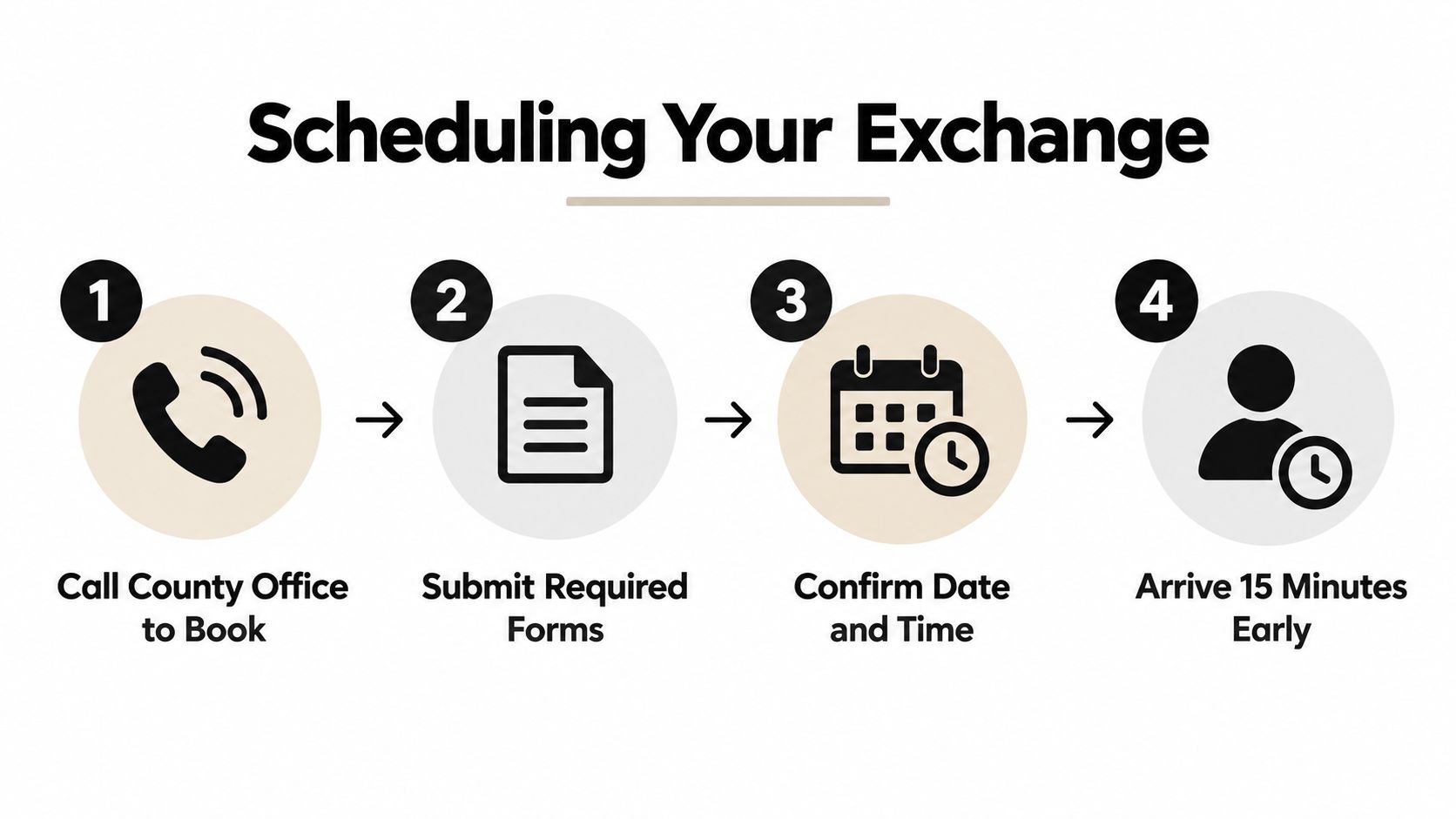
Use this intake sequence
Call and name the service. State that you need a court-ordered supervised exchange in The Woodlands. Provide the case information and ask which intake forms and eligibility documents the program requires.
Submit the complete order. Send the possession and access language, every modification, temporary order, protective provision, and agreed order affecting pickup, return, supervision, or communication. This Montgomery County family-court filing forms guide can help organize court paperwork, but the operative custody order controls.
Complete screening and review. Expect questions about threats, stalking, substance misuse, weapons, and prior violations. Answer plainly. Staff use those facts to choose the appropriate setting and document the handoff.
Confirm everything in writing. Obtain the date, assigned shift, exact site, arrival instructions, identification requirements, permitted belongings, and late-arrival procedure. A verbal agreement between parents is not enough.
Arrive prepared. Bring photo identification, relevant court papers, required forms, medication, school items, and only belongings the program permits. Arrive early enough for check-in, but follow staff directions about where to wait and when to bring the child forward.
A Child Custody Lawyer in The Woodlands, TX can review unclear language about whether the county service, a private provider, or a named supervisor must handle the exchange. Get that answer before the appointment, not during a dispute at the site.
Woodlands Exchange Locations and Arrival Procedures
The county's listed Woodlands exchange sites are public, recognizable locations rather than a parent's home or an improvised parking-lot meeting. The designated locations include Michell Library, 8125 Ashlane Way, South County Community Center, 2235 Lake Robbins Rd., and South County Public Safety Center, 9200 Grogan's Mill Rd. The Montgomery County custodial services rules identify these locations and the Woodlands shifts.
Match the site to the assigned shift
The daytime Woodlands shift runs from 6:00 a.m. to 1:00 p.m. The evening shift runs from 6:00 p.m. to 12:00 a.m. Your appointment should identify the assigned location and time. Don't assume you can use another listed site because it's closer to Panther Creek, Alden Bridge, Sterling Ridge, or Creekside.
The fixed schedule serves a safety purpose. Neutral sites reduce the pressure that comes with one parent entering the other parent's home, and defined windows reduce the chance of parents negotiating an unsupervised meeting at the last minute. The structure also creates a record of whether each parent appeared, arrived late, followed instructions, or refused the transfer.
Plan the arrival, not just the destination
Before leaving, verify the exact entrance, check-in instructions, and whether the child should remain in the vehicle until staff direct the transfer. Keep communication limited to the approved channel. Don't use the public location as an excuse to approach, argue, record the other parent, or discuss the case in front of the child.
Bring identification and the paperwork requested during intake. Pack the child's necessary items in a clearly labeled bag, and keep the exchange focused on the child rather than disputed clothing, money, school issues, or relationship grievances. If a disagreement arises, ask staff to document it instead of trying to resolve it at the curb.
The safest exchange is boring. Follow the assigned time, use the assigned entrance, speak through staff, and leave when the transfer is complete.
If you work standard hours, the morning and evening windows may affect your schedule. Raise that problem during intake. A work conflict doesn't automatically authorize a different time, location, or substitute supervisor.
Neutral Exchange vs Full Supervised Visitation
The decision isn't about convenience. It concerns what the court believes must be controlled. Exchange-only supervision focuses on parent-to-parent contact. Full supervised visitation focuses on the parent's conduct with the child during the entire possession period.
Current Texas supervised-visitation guide data place standard supervised access at roughly $40 to $65 per hour, therapeutic supervision at $80 to $100 per hour, and supervised exchange-only services around $40 per exchange. Intake and setup fees commonly add $25 to $300. These figures come from the Texas supervised visitation cost guide, and an individual provider or county program may use different terms or fees.
| Feature | Neutral Exchange | Full Supervised Visitation |
|---|---|---|
| Main purpose | Controls pickup and return | Monitors parent-child contact |
| Staff role | Observes or manages the handoff | Remains involved throughout the visit |
| Contact between parents | Structured to prevent direct interaction | Usually controlled as part of the visit plan |
| Time between handoffs | Usually unsupervised | Supervised by the approved person or entity |
| Typical use | Persistent conflict or unsafe transfers | Documented concerns involving the child's safety or the parent's conduct |
| Cost structure | Often charged per exchange | Usually charged by the hour, with possible intake fees |
Don't select the cheaper model by instinct
Exchange-only can be appropriate when the child is safe during possession but the parents cannot manage a direct transfer. It is not enough when the concern involves what happens after the child leaves the site. Texas Family Code Section 153.004 is especially important where the court has found a history or pattern of family violence, abuse, or neglect.
Family-member supervision also deserves caution. In the custody-exchange study summarized in the available guidance, supervision by relatives didn't eliminate abuse, stalking, or threats. In that sample, police-station exchanges were associated with no physical violence or death threats. That doesn't guarantee safety in every case, but it supports using trained staff and a professionally controlled site when the risk indicators are serious.
Your order, not a parent's preference, controls. If the language requires continuous supervision, don't treat a neutral handoff as equivalent. If the order only addresses exchanges, don't assume staff have authority to monitor every minute of the visit.
Safety Protocols and What to Do If Conflict Escalates
A parent arrives early, the other parent refuses to leave, and the child is caught between them. Staff need a clear procedure before that moment occurs. A supervised exchange reduces contact, but it does not eliminate threats, intimidation, or unsafe conduct. Supervised does not mean safe by default.

Set the controls before trouble starts
Ask the program to explain separate arrival and departure windows, late-arrival rules, failed exchanges, prohibited contact, and incident reports. Written procedures give staff a consistent basis to stop a handoff, relocate it to a more secure site, or call for help.
Follow the site's instructions exactly. Do not bring friends or relatives to confront the other parent. Do not wait outside, follow the other vehicle, send threatening messages, or use the child to pass information. If a parent refuses to leave, threatens someone, appears impaired, or violates a no-contact condition, notify staff immediately and follow the emergency procedure.
Document the conduct, not your conclusions. Record the date, assigned site, scheduled time, what happened, who observed it, and what staff did. Preserve messages and photographs without provoking further contact.
Specific incident records can support later enforcement or modification proceedings. A repeated failure to follow the exchange order may matter in court. Staff reports carry more weight when they describe observable conduct rather than broad accusations.
Choose a police station or professionally staffed site if stalking indicators, threats, or physical violence make a library or community center unsuitable. If anyone faces immediate danger, contact emergency services. Do not try to resolve an escalating safety problem through a private compromise.
This video shows why staff positioning, controlled movement, and the physical exchange environment matter:
Your Next Steps and When to Consult an Attorney
Start with the order. Look for the sections addressing possession, access, supervision, exchange location, transportation, communication, and protective conditions. If you can't tell whether the order requires a monitored handoff or continuous supervision, pause before the next transfer and obtain clarification.
What to do next
- Review the controlling order: Use the most recent signed order, including temporary or modified provisions.
- Contact custodial services: Ask about Woodlands intake, eligibility, required forms, available shifts, and assigned sites.
- Prepare your documents: Gather photo identification, court paperwork, contact details, and the child's necessary items.
- Confirm logistics: Get the date, time, location, arrival instructions, and late-arrival rules in writing.
- Plan for safety: Request separate arrival and departure procedures if direct contact creates a concern.
- Document problems: Keep factual records of missed exchanges, threats, harassment, or refusal to follow instructions.
Consult a Montgomery County family-law attorney when the order is unclear, the current arrangement no longer protects the child, violence or stalking concerns have developed, or the other parent repeatedly violates the exchange process. A custody attorney near The Woodlands, TX can evaluate whether you need clarification, modification, enforcement, or emergency relief.
This article is not legal advice. It provides general information about supervised exchange logistics and Texas family-law concepts, and rules, county procedures, and court orders can change. Your result depends on the facts of your case and the exact language of your order, so speak with a qualified Texas family-law attorney before relying on this information.
The Law Office of Bryan Fagan helps families address custody orders, supervised exchange logistics, modifications, and enforcement concerns in Montgomery County. If you need a practical review of your order before the next handoff, visit The Law Office of Bryan Fagan to schedule a consultation about your situation.