 Skip to content

Your divorce is final, the decree says you keep the house in The Woodlands, and you're ready to put the paperwork away. Then a lender or title company asks for the recorded deed, and you discover that the divorce court file and the county land records aren't the same thing.
For homeowners searching Montgomery County Clerk real property records, a deed after divorce requires more than submitting the judge's order. You need the right conveyance document, a filing that meets the clerk's requirements, and a final check that someone can find the recorded transfer.
Fees and Documents for a Post-Divorce Deed
Recording a post-divorce deed costs more than the base filing charge once extra pages, indexed names, and attachments enter the packet, and the county adds a penalty when the deed leaves out the grantee's mailing address. The clerk collects the full amount at submission, so tally the pages and names before you write the check.
Recording fees and penalties for a post-divorce deed, per the Montgomery County recording fee schedule effective January 1, 2025
| Item | Amount | Notes |
|---|---|---|
| First page of a standard real-property recording | $25 | $5 recording fee, $10 records management, $10 records archive |
| Each additional page | $4 | Standard 8.5-by-14-inch pages |
| Each additional attachment or rider | $4 | Each 8.5-by-14-inch attachment |
| Each indexed name beyond five | $0.25 | Charged per name over the first five |
| Deed missing the grantee's mailing address | $25 or twice the filing fee | Whichever amount is greater under the county's recording guidance |
| Certified copy of the divorce decree | Fee set by the issuing district clerk | Issued by the district clerk, not the County Clerk |
| Processing and indexing estimate | Confirm with the County Clerk | Ask before setting a closing date that depends on the recorded deed |
A two-page quitclaim naming both former spouses costs $29 at submission: $25 for the first page, $4 for the second, and no per-name charge because two indexed names fall within the first five. Put the receiving spouse's mailing address in the deed itself; paying the penalty does not excuse the omission. And treat the index entries as part of what you are buying, since the grantor and grantee names are what let someone find the recorded transfer later.
Assemble the documents before paying to file
Keep the final divorce decree or incorporated property-settlement agreement beside the last recorded deed while preparing the transfer. Those documents establish who receives the interest and which parcel the conveyance must describe.
Your working packet should include:
- Court paperwork: The final decree and any incorporated agreement identifying the property award.
- Prior title document: The last recorded deed, including its complete legal description.
- Execution-ready deed: Original signatures, the appropriate notary acknowledgment, and the receiving spouse's mailing address.
- Certified decree copy: Obtain it from the issuing district clerk using the appropriate Montgomery County certified divorce decree request process.
A special warranty deed or quitclaim deed may come up when one spouse keeps the home, but they aren't interchangeable. A special warranty deed provides limited title warranties; a quitclaim conveys whatever interest the signer has without those warranties and may raise title concerns.
A deed of distribution belongs mainly to estate administration under the Texas Estates Code, not an ordinary divorce transfer. Choosing a form because its title sounds like a way to divide property sends you down the wrong path.
A packet missing any of these pieces risks rejection at the counter, so assemble everything before you pay to file.
Search County Records Before and After Recording
Start with the existing ownership record, not a blank deed template. The Montgomery County Clerk's recording and research guidance identifies a real-property collection that includes deeds, land-patent records, mortgages, judgments, and tax liens, and sets out the county's recording requirements, including the missing-address penalty.
Those records help answer practical questions: Who holds the recorded interest? Does the description match the divorce paperwork? Are there recorded obligations that need attention before someone signs?
Search before drafting
Search the former owners' names, including names used before marriage or after a name change. Use the legal description wherever the available search tools allow it, rather than relying only on a street address.
Pull the last recorded deed and save its recording number and complete legal description. Preserve the subdivision, lot, block, survey, and exhibit references exactly as they appear, then compare them against the decree.
If the decree and prior deed disagree, stop before copying either description into a new document. An attorney or title professional should determine whether the discrepancy is a harmless abbreviation or a different parcel.
Look for recorded mortgages, judgments, and tax liens as well. An online search is a useful starting point, but it isn't a substitute for a title examination when a sale, refinance, disputed lien, or complicated ownership history is involved.
Where to search and file Montgomery County real-property records
| Route | Best for | Limits |
|---|---|---|
| Official online public records index | Finding the last recorded deed, liens, and judgments | Shows only indexed information; spelling and name variations can hide results |
| In-person search at the County Clerk's office in Conroe | Certified copies and help with unusual names | Requires a trip; confirm current office hours before traveling |
| Authorized electronic-filing vendor | Submitting a properly prepared deed without a visit | County formatting and notarization rules still apply; request the vendor's fee quote |
An electronic-filing vendor delivers documents; it doesn't resolve inconsistent property awards or decide which deed protects your interests. Likewise, recording staff check recording requirements, not whether your document accomplishes every obligation in the divorce.
Practical rule: A submission receipt proves delivery. Keep the recorded instrument to prove what the clerk actually recorded.
Run the post-recording county index test
The County Clerk's public property-records guidance warns that searches cover only indexed information. A deed can be recorded yet remain difficult to locate because of indexing delay, spelling, a changed surname, or an abbreviated description.
Use this verification sequence:
- Keep the evidence. Obtain the clerk-stamped instrument and recording number, not just an upload confirmation or mailing receipt.
- Search both sides of the transfer. Try former and current names as grantor and grantee. Check spelling variations and any surname used in the prior deed.
- Compare the property description. Match the recorded document against the decree and prior deed. Flag misspelled subdivisions, omitted exhibits, and unexplained abbreviations.
- Investigate missing results. Allow for indexing, search again, and contact the County Clerk with the recording number if the instrument still doesn't appear.
- Verify appraisal records separately. Confirm the appraisal district's ownership and tax mailing information rather than assuming the deed updated everything.
- Check related accounts. Review lender, HOA, insurance, and homestead records with the appropriate organization.
The district clerk is generally the source for a certified divorce decree from the divorce case. The County Clerk maintains the county land-record filing. Asking the correct office prevents an unnecessary trip and avoids confusing a court-certified order with a recorded conveyance.
Finish with a practical test: Could someone find the deed by searching the grantor's name and the legal description? Where the online system doesn't offer a direct description search, inspect the description attached to the name-search result. If the connection isn't clear, ask the clerk about the index entry rather than assuming a future buyer will work it out.
How to Record a Deed After Divorce Step by Step
Recording is where the decree becomes public title evidence. Use the Montgomery County property-records guidance as the county reference while you prepare a conveyance that matches the award, satisfies execution and formatting requirements, and comes back as a recorded instrument.
The work splits into drafting, signing, submission, and confirmation.
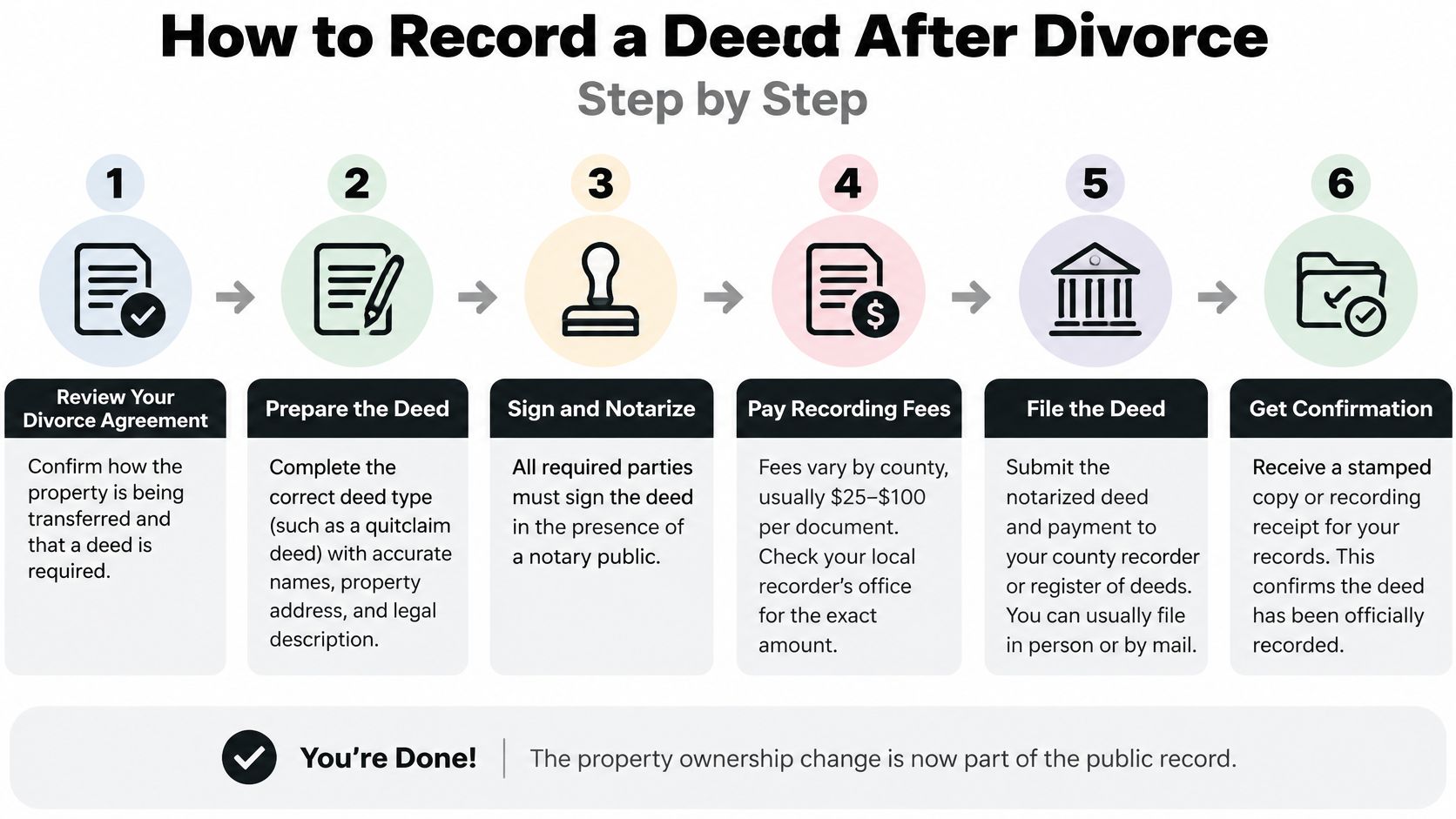
Prepare and execute the transfer
Reconcile the legal description before drafting. Put the decree exhibit beside the last recorded deed. If the decree gives only a street address or short reference, carry forward the full lot, block, subdivision, or metes-and-bounds description from the recorded instrument. If the two descriptions conflict, resolve that conflict before signing instead of blending versions.
Draft to the award. Identify the conveying spouse as grantor, the receiving spouse as grantee, and include the grantee's mailing address. Preserve any reserved interest, lien, or payment term even when a template makes the clause awkward to place.
Resolve the mortgage and lien questions. Review the decree's payment, refinance, and lien provisions with the actual loan documents. The frequent slip is assuming that changing ownership also changes the lender's contract.
Complete signing and acknowledgment. Arrange the grantor's original signature and a completed acknowledgment before a notary. Check that the acknowledgment names the correct signer and is not left unsigned or incomplete.
Submit and preserve the result
Check the clerk's current format rules before printing. Confirm acceptable page size, margin room for recording data, legibility, exhibit labeling, and whether electronic submission has different requirements. A detached legal-description exhibit or text crowding the recording area can slow acceptance.
Choose the submission route and pay the charges. Submit in person in Conroe, by mail, or through an authorized electronic-filing vendor after confirming the current delivery instructions. Mailing an instrument without checking payment and return requirements can create avoidable follow-up.
Collect the recorded copy. Save the stamped deed and recording number with the certified decree and supporting title documents. Payment clearing is not the finish line; inspect the returned instrument.
Run the index test. Search the grantor's name and confirm the result carries the same legal description you intended to convey. If the name hit and description do not connect cleanly, ask the clerk about the index entry before assuming a future buyer will work it out.
A death-based transfer follows a different track. The process for recording an affidavit of heirship in Montgomery County real-property records handles title after an owner dies; for divorce, the instrument should implement the property award in the decree.
The clerk's acceptance does not establish that the deed matches your decree, satisfies your lender, or will meet a future title insurer's requirements.
When a Divorce Decree Alone Does Not Transfer Title
Consider an Alden Bridge couple whose decree awards the home to the husband. The wife signs a deed, the deed is recorded, and she expects the paperwork to be finished, but she continues receiving mortgage notices because the lender hasn't released her and the loan hasn't been refinanced.
That scenario separates ownership, the divorce court's allocation of responsibility, and the lender's contractual rights. They involve the same house, but different documents control them.

An award isn't always a completed conveyance
The Texas Family Code governs division of marital property in divorce. But an award in the decree doesn't necessarily complete the separate title paperwork.
TexasLawHelp's property deed guidance explains that parties generally still need a deed consistent with the decree and that a deed must be recorded in every county where the property is located. The judge's award therefore shouldn't be treated as proof that the public ownership chain is ready for a sale or refinance.
Nor does a deed generally release a signing spouse from an existing loan. Ask the lender what release, assumption, or refinance options are available, and compare those options against the decree's obligations before promising a completion date.
Choose the instrument for the title problem
There isn't a verified Montgomery County rule here that selects a single divorce deed form. Compare the actual alternatives:
- Special warranty deed: Consider the limited warranties the conveying spouse will give and whether they fit the decree.
- Quitclaim deed: Understand that it may create chain-of-title questions rather than the clean transfer the receiving spouse expects.
- Deed executed under the decree: Make sure its operative terms carry out the award rather than relying on the document's label.
- Certified decree: Ask whether recording it is appropriate for the particular title issue, rather than assuming it always replaces a deed.
Ask your attorney whether a homestead designation or homestead rights affect the proposed transfer before anyone signs. Also ask the County Clerk for current filing-to-indexing turnaround before arranging a closing; a dependable processing estimate hasn't been established here.
If a former spouse refuses to sign, preserve the decree and written requests instead of improvising a replacement signature. Advice about enforcing a property division order in The Woodlands can help identify the appropriate court remedy.
Our Property Division Lawyer in The Woodlands service addresses division of community property and complex assets in Woodlands divorces. A refusal to cooperate or a conflict between the decree and title documents calls for case-specific review.
Finally, verify the property's actual county, not just its neighborhood or mailing address. Property outside Montgomery County requires attention to the land records where that property is located.
Confirm the Deed Before You File
Everything so far produces one deed. What remains is deciding who files it, then proving after recording that anyone can find it.
What to do next
- Contact the lender. Ask whether a release, assumption, or refinance is needed before signing and how that fits the decree.
- Call the County Clerk. Confirm formatting and submission instructions for the instrument you plan to file.
- Choose your review level. Decide whether you're ready to submit a properly prepared deed yourself or need an attorney to resolve drafting and title questions.
The filing charge is only part of the decision. Self-submission may be practical when the deed has already been properly prepared and the decree is clear, but it doesn't replace legal review of an ambiguous award, disputed lien, or continuing joint mortgage.
Recording is not the finish line. After the clerk accepts the deed, search the county's real property records the way a future buyer or lender would: by the grantor's name and by the legal description. The deed should come up under both, with names spelled correctly and the right parcel attached. A deed indexed under a misspelling or an incomplete description sits in the records unfindable, and the gap between decree and title stays open.
If that search finds nothing, or the entry points to the wrong names or parcel, raise it with the clerk's office before treating the transfer as done.
Before you put the file away: Keep enough information for a future buyer, lender, or attorney to locate the recorded transfer without reconstructing your divorce case.
This is general information, not legal advice. Each divorce depends on its own decree, loan documents, ownership history, and title issues. County recording acceptance doesn't resolve those legal questions.
We serve The Woodlands and Montgomery County, including Panther Creek, Alden Bridge, Sterling Ridge, and Creekside. If your decree is unclear, the mortgage remains joint, or a former spouse won't sign, a consultation can help you identify the unresolved issue before filing. During a free consultation, you can discuss your situation confidentially under the attorney-client privilege.
The Law Office of Bryan Fagan handles complex divorce and child custody matters and can help you evaluate property-division questions behind a proposed post-divorce deed. Bring your decree, last recorded deed, and mortgage information, and visit The Law Office of Bryan Fagan to schedule a consultation before you record.
