 Skip to content

A Montgomery Central Appraisal District value is a January 1 property-tax figure, not the equity a Montgomery County divorce court divides. Using the lowest number on the tax record can confuse a tax benefit with the value of the house.
The familiar advice to just use the appraisal district value skips the question that matters: which value? Your MCAD printout can show market value, appraised value, exemptions, and taxable value, none of which is automatically the amount either spouse will receive.
For homeowners in The Woodlands, Conroe, and surrounding Montgomery County communities, the practical task is to separate the tax calculation from the divorce calculation. Then you can evaluate the house using evidence, debt records, and the valuation date that fits your case.
Three Numbers on a Montgomery County Tax Record
The capped tax number isn't equity. An MCAD printout is a property-tax record, not a divorce award, a guaranteed sale price, or a check payable to either spouse.
Start with market value. MCAD uses this figure for tax administration, generally valuing property at 100 percent of market value as of January 1, using accepted appraisal methods and property-specific evidence; MCAD's appraisal information also illustrates a home with a $140,000 market value and a $110,000 capped appraised value, a $30,000 gap before mortgage debt.
Appraised value may match market value or sit below it because a qualifying homestead receives an appraisal limitation. The Texas Comptroller's property-valuation guidance explains that the limitation generally restricts qualifying homestead appraisal increases to 10 percent annually, subject to the applicable rules.
Taxable value is the amount remaining after applicable exemptions. It's used to calculate taxes, not to establish what a buyer would pay. Different taxing units may apply different exemptions, so don't assume every taxable-value entry on a notice will match.
Which home number to use in a Montgomery County divorce
| Figure | What it measures | Date it uses | Role in the divorce |
|---|---|---|---|
| MCAD market value | Tax-administration estimate of price, generally at full market value | January 1 of the tax year | A data point only, not conclusive equity |
| MCAD appraised value | Market value or the lower homestead-capped amount | January 1 of the tax year | Don't treat the cap as the sale price |
| Taxable value | Appraised value after exemptions | January 1 of the tax year | Drives the tax bill, not the marital asset |
| Divorce fair-market value | Evidence-based probable price | Separation, mediation, trial, or another legally relevant date | Starting figure for division |
| Net divisible equity | Fair-market value minus mortgage, liens, and transaction costs | Same date as the fair-market value | Estimated amount available to divide, subject to property claims |
The divorce calculation starts with a defensible fair-market value, supported by evidence relevant to the case. A tax cap doesn't establish a discount that a buyer would receive.
Estimated divisible equity equals a defensible fair-market value, minus mortgage payoff, minus other liens, minus reasonable transaction costs.
That formula is a working estimate, not a complete legal analysis. Whether transaction costs should be deducted, and which costs are reasonable, should be addressed rather than assumed, particularly if neither spouse plans to sell.
Characterization, separate-property claims, and reimbursement claims sit beside this calculation. The tax record doesn't decide whether the house belongs to the community estate, whether a spouse has a separate ownership interest, or whether an estate has a reimbursement claim.
On your own notice, circle market value, appraised value, exemptions, and the tax-year valuation date. Keep the labels attached whenever you transfer a number into a settlement spreadsheet.
How Family Courts Use a Home Value
Texas is a community-property state. Under the Texas Family Code, property either spouse possesses during the marriage or at its dissolution is presumed to belong to the community estate unless a spouse establishes separate character by clear and convincing evidence. The name on the tax account settles nothing by itself.
Texas Family Code section 7.001 then directs the court to divide the community estate in a manner that is just and right. That standard gives the judge room to weigh each spouse's earning capacity, health, and financial circumstances, so two families with identical houses can leave court with different divisions. An equal split is one possible outcome; the percentage follows the facts presented.
Ownership, value, and division are different questions
The court works through the questions in order. Characterization decides whether the home sits in the community estate at all. Valuation sets the number the division will use. Division allocates that equity between the spouses alongside everything else in the estate.
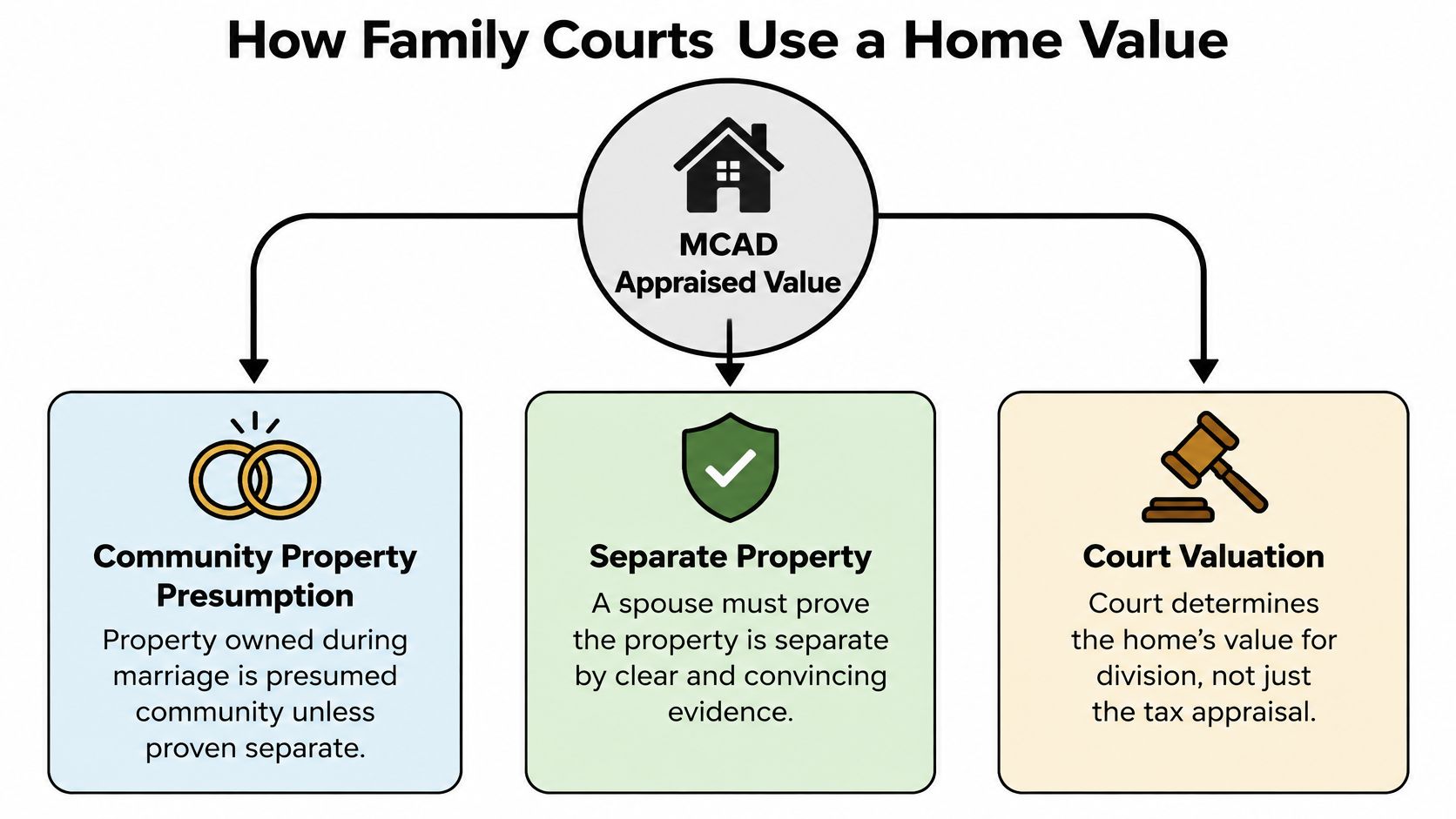
A judge weighs competing valuation evidence, outstanding debt, which spouse will keep the house, and the circumstances relevant to a just-and-right division. An independent appraisal usually carries more weight than a mass-appraisal figure, and well-supported comparable sales or an arm's-length closing statement can outweigh both. Courts treat the MCAD number as one input among several because it answers a tax question rather than a market one.
Evidence quality cuts in both directions. An appraisal built on wrong assumptions about a home's condition invites challenge, and so does a spouse's unsupported opinion of value. Value evidence works like a foundation: a crack in the assumptions weakens everything resting on it.
For someone evaluating property division in a Woodlands divorce, the useful questions are concrete:
- Ownership: What evidence supports community or separate characterization?
- Value: What information supports the proposed price?
- Debt: Which obligations must be addressed?
- Allocation: Can the spouse who wants the home realistically maintain it and complete the settlement terms?
Where the house fits in support calculations
Guideline child support under Texas Family Code Chapter 154 starts with the paying parent's net resources, meaning wages and other income. The residence's appraised value plays no role in that formula, so a higher tax figure does not raise guideline support on its own.
Spousal maintenance follows separate eligibility and need requirements, and the statute sets those thresholds without any percentage-of-appraisal calculation.
The house still matters indirectly. Mortgage payments, occupancy during the case, and the equity each spouse receives shape both household budgets and the practical terms negotiated in temporary orders, mediation, and the final decree.
A spouse can receive valuable equity without receiving enough monthly cash to afford the house.
These distinctions come up in the Montgomery County district courts serving The Woodlands, Conroe, and nearby communities. Keeping the categories separate prevents a common settlement mistake: treating a large equity figure on paper as proof that a spouse can carry the home month to month.
January 1 Versus the Divorce Valuation Date
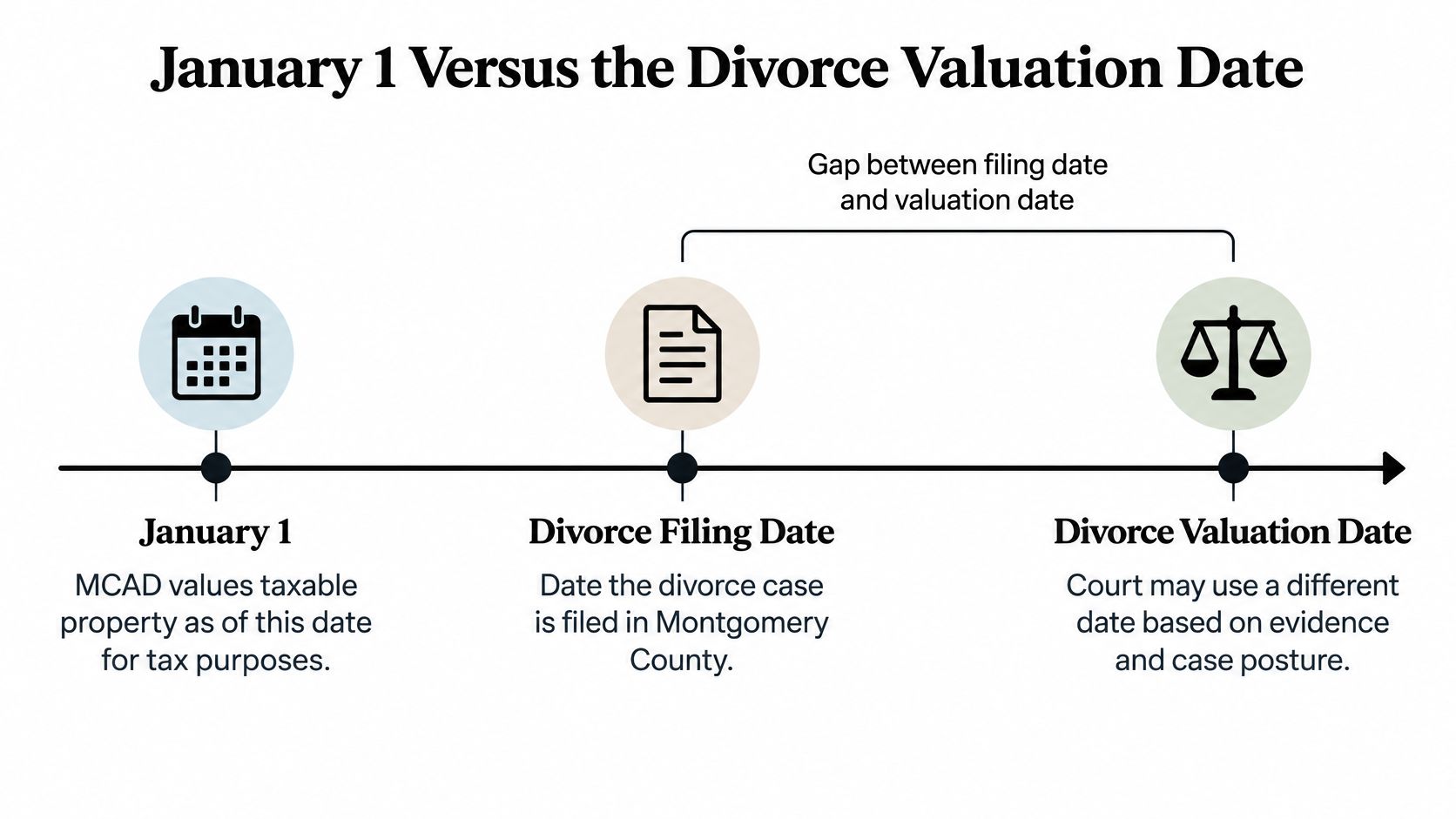
The tax valuation date and the divorce valuation date aren't automatically the same. The Texas Comptroller's property-tax basics explains that appraisal districts generally value taxable property as of January 1, a date that doesn't automatically establish the proper valuation date for a divorce.
Ask counsel early which date should govern the valuation evidence. Separation, mediation, and trial may all become reference points during negotiations, but don't assume any of them controls because it appears on your calendar.
The timing distinction can be visualized this way.
An Alden Bridge example
Consider this hypothetical scenario, not a report of an actual transaction or current neighborhood prices.
Two spouses have lived in their Alden Bridge house for years. Their January tax record lists $550,000 in market value, while the appraised value is lower because of the homestead cap. One spouse proposes using the capped amount as equity.
Assume the mortgage payoff is approximately $310,000. By mediation, comparable sales in Alden Bridge and nearby Sterling Ridge support a hypothetical price of $610,000.
The different starting prices produce noticeably different results:
| Hypothetical calculation | Amount before other liens and selling costs |
|---|---|
| $610,000 proposed current price minus $310,000 payoff | $300,000 |
| $550,000 older tax-market figure minus $310,000 payoff | $240,000 |
The $60,000 difference comes from the valuation assumption, not from a change in the mortgage balance. Neither result is automatically the amount either spouse receives.
For illustration only, assume 6 percent in commission and closing costs. Applied to the hypothetical $610,000 sale price, that would be $36,600, deducted from the market price calculation, not from taxable value. Actual transaction costs must be established, and their treatment in a buyout should be negotiated or addressed with counsel.
Condition and debt need dates too
Suppose the same spouses also have a recent storm-repair invoice and records showing principal paid down during the case. The repair documentation may help explain the home's condition, while the lender records establish how much debt remains.
A repair invoice doesn't necessarily change market value dollar for dollar. Likewise, the amount spent renovating a kitchen doesn't automatically equal the increase in the home's probable sale price.
Events that warrant a fresh look include:
- A later arm's-length sale: A genuine transaction may provide stronger evidence than an earlier estimate.
- Renovation or storm damage: The property being valued may no longer match the tax record's assumptions.
- Changes in comparable sales: Evidence from the relevant period may support a different price.
- Principal payments: The debt side of the calculation may have changed even if the house price hasn't.
The accompanying video provides additional context for considering the valuation issue.
Bring the tax notice, mortgage payoff, and comparable-sale analysis to mediation as separately labeled documents. Mark each with the date it measures, not merely the day you downloaded it.
If those dates don't align, identify the mismatch before negotiating. Otherwise, spouses can appear to agree on a calculation while using a property value and debt balance from different points in the case.
Documents to Pull Before Mediation
Start with the owner's MCAD account and the mailed notices. Pull the property card and valuation history, then compare the recorded improvements, exemptions, and physical description against the actual house. Every other document in the packet exists to explain or challenge what those records say.
MCAD's departmental guidance describes opportunities to submit evidence and review district evidence during an informal protest, along with a written request for district data, schedules, formulas, and other information to be provided during the 14 days before the protest hearing. Those materials reveal the district's assumptions, but they still need to be matched to the relevant divorce valuation period.
Evidence to test an MCAD value in a divorce
| Document | What it proves | Where it usually comes from |
|---|---|---|
| MCAD property card and value history | Recorded improvements, exemptions, and prior-year values | MCAD account or notice |
| Tax notices for the years in the case | Which figure was measured and when | Owner's mail or online account |
| District data, schedules, and formulas | Comparable sales, adjustments, and condition assumptions | Written request before a protest hearing |
| Mortgage payoff and lien statements | Debt to subtract from price | Lender or servicer |
| Independent appraisal or broker opinion | Supported price near the divorce valuation date | Appraiser or local broker |
| Contract or closing statement | An arm's-length price close to the case | Title company or prior sale file |
| Repair, storm, and improvement invoices | Condition or work a mass appraisal may miss | Contractor, insurer, or owner records |
Put the differences in a spreadsheet
Use columns for document, valuation date, price opinion, debt, condition assumptions, and unresolved questions. Keep the MCAD entry and the appraisal figure in separate rows. Both numbers belong in the spreadsheet, because the reason for the difference is what a mediator will ask about.
A property card may reveal an outdated sketch, an addition, or a condition assumption that needs correction. The value history may help distinguish a change in estimated market price from changes tied to the capped appraisal. That distinction matters here: the taxable figure a protest lowered measures something different from the equity a buyout is built on.
An independent appraisal or broker opinion should identify its effective date and supporting sales. If the house was recently bought or sold in an arm's-length transaction, include the contract and closing statement; a genuine sale usually carries more weight than any estimate.
Preparation rule: Every adjustment should have an explanation, and every debt deduction should have supporting paperwork.
The packet feeds directly into your financial disclosure form, where the home's listed value should trace back to a specific document. If the other spouse asks why your number differs from the district's, the answer should come from a page in the packet.
When a Tax Protest Helps or Hurts
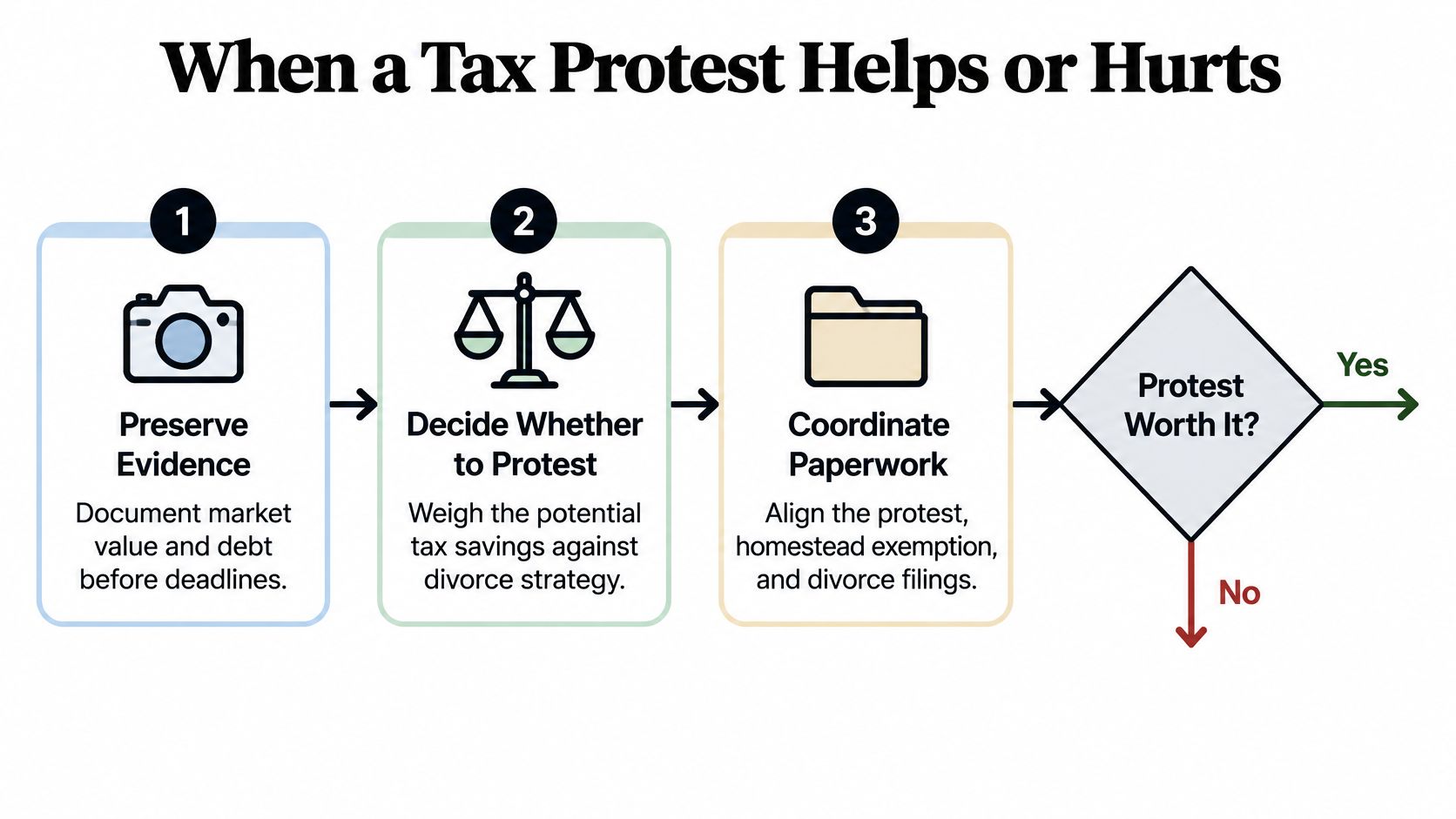
A lower MCAD appraisal can cut the tax bill. It can also weaken a buyout argument if the spouse who asked for that lower number later claims the home is worth more.
The conflict is easy to spot: in the protest file, the owner says comparable sales and condition justify less; in mediation, the same owner points to different sales and says equity should be higher. Sometimes both positions are defensible because the proceedings use different dates, conditions, or evidence. The explanation has to be documented, not improvised.
Preserve market-value and debt evidence first, evaluate the protest second, and coordinate the paperwork third. This order keeps a tax decision from becoming an avoidable settlement problem.
Watch the notice and eligibility rules
The Texas Comptroller's protest guidance states that residence-homestead notices generally must be sent by April 1, and most protests are due by May 15 or 30 days after delivery of the notice, whichever is later. A divorce filing, a move-out, or a pending decree does not stretch that window.
A spouse still living in the house may need to document principal-residence eligibility. A departing spouse should not treat the exemption, appraisal limitation, or prior tax treatment as permanent.
Leaving the home does not decide eligibility by itself. Ownership, occupancy, and the decree need to be reviewed together before either spouse budgets for future taxes.
Appraisal calendar items that can collide with a divorce
| Event | Usual timing | What it does not do | Divorce implication |
|---|---|---|---|
| Residence homestead notice | Spring notice period | It doesn't set the divorce value | Save the notice and identify every figure |
| Protest deadline | Statutory deadline tied to the notice | A divorce filing doesn't extend it | Missing it can leave the tax figure in place, subject to available remedies |
| Informal protest | Before a formal hearing | It isn't a court appraisal | Review comparable sales and condition assumptions |
| Request for district data | Pre-hearing disclosure period | It doesn't replace an independent appraisal | Request schedules, formulas, and evidence in writing |
| Homestead limitation | While the owner qualifies under applicable rules | It doesn't survive loss of eligibility automatically | A move-out or decree can affect future taxes |
The informal process lets an owner submit evidence, review the district's evidence, and consider a settlement offer. Keep copies of the evidence and any resolution, especially if either spouse expects to use them in divorce negotiations.
For a house in Alden Bridge or Sterling Ridge, a successful protest does not stop the other spouse from offering current comparable sales for a higher divorce value. A tax saving belongs to the tax file; divisible equity is decided from the valuation evidence and debt in the family case.
The table above is the calendar check; keep comparable sales and payoff evidence beside it, then judge any requested reduction by whether it contradicts the equity story before asking for district data in writing.
Do not shade evidence to make either proceeding look better. Explain every difference by date, condition, and source.
What to Do Next With the MCAD Number
Start with the disagreement, not the paperwork. Before you meet with counsel, write down which question you and your spouse fight over: what the house is worth, what is owed against it, or who owns what share. Each problem uses different evidence, and confusing them is how a capped appraisal figure ends up treated as equity in a settlement offer.
Once the dispute is sorted, a short checklist prepares you for the first consultation and for mediation:
What to do next
- Sort the dispute. Mark each open issue as a price question, a debt question, or an ownership question. Price calls for comparable sales or an appraisal; debt calls for a current payoff and a lien list; ownership is a question for counsel.
- Write out your consultation questions. Ask which valuation date fits the case, whether both spouses can agree on one date, and how a recent or pending tax protest reads next to the equity figure you intend to propose.
- Build a one-page settlement spreadsheet. Show the value you propose, the payoff, the resulting equity, and every issue still unresolved.
- Keep the figures current. If mediation is still weeks away, refresh the payoff and sales information beforehand, because stale numbers invite fresh disputes about accuracy.
If you are comparing local mediation options, review the practical questions involved in Montgomery County Dispute Resolution Center mediation costs for a family case. Bring the spreadsheet to the session itself. A proposal tested against documents holds up better than a figure recalled from memory.
Get advice about your specific house
This is general information for readers in The Woodlands and Montgomery County, not legal advice. A judge's just-and-right division turns on the evidence and circumstances of each case.
Bring your notice, payoff, and proposed settlement terms when you schedule a consultation with a Property Division Lawyer in The Woodlands. The aim of that first meeting is concrete: whether the numbers support keeping the house or selling it, and what each choice costs once the debt is paid.
The Law Office of Bryan Fagan serves families in The Woodlands and across Montgomery County with divorce, property division, child custody, and child support modifications. During a free consultation, you can discuss your house, debt, and proposed decree confidentially under attorney-client privilege. Visit The Law Office of Bryan Fagan to schedule a consultation and discuss how to separate your home's tax figures from the property issues in your divorce.
