
You're probably reading a trial setting notice with a yellow sticky note on your desk, trying to figure out whether the jury demand has to go in now or whether there's still time. In a Montgomery County divorce or custody case, that question turns into a deadline problem fast, especially if the case is in The Woodlands, Conroe, or a nearby community and the docket already feels crowded. The safer move is to treat the jury demand like a filing that lives or dies by the actual trial date, the clerk's file stamp, and the court's local scheduling order, not by guesswork.
If the setting is in a district court family case, the written demand and the jury fee have to be handled together, and missing either step can create a waiver fight later. The Texas Family Code still controls the family issues themselves, but the jury-demand mechanics come from the Texas Rules of Civil Procedure and the clerk's procedures. That split matters because a family case can be procedurally late even when the underlying dispute is still very much alive.
Practical rule: calculate backward from the actual trial date, not from mediation, temporary orders, or a scheduling conference.
A good rule for Montgomery County families is simple. File early, confirm the clerk received it, and don't assume a late demand will be forgiven. If you're already in a contested divorce, The Divorce Process in The Woodlands: What to Expect gives useful context for where a jury demand fits in the bigger filing sequence.
Why the Jury Demand Decision Matters Early in a Woodlands Divorce
A spouse in Indian Springs may get a trial setting, look at a fight over conservatorship or a disputed asset, and decide a jury sounds better than a bench trial. By that point, the problem is usually not persuasion. It is whether the demand can still be filed on time, in the right court, with the fee paid correctly.
In Montgomery County family cases, that decision has to be made early because the filing deadline can close well before trial prep gets serious. If you are already trying to map the case timeline, the clock that matters is the one tied to the trial setting and explained in how long a contested divorce takes in Texas, not the date of mediation or the next status hearing.
The choice is procedural before it is strategic
Lawyers talk about juries in terms of theme, credibility, and presentation. At the clerk's office, the first question is more basic. Which court is this case pending in, and what does that court's paperwork require?
That distinction matters in Montgomery County. A family case filed in district court is handled differently from a matter in county court, and the jury demand process follows the court where the case is pending, not the label the parties use in conversation. If the case is on an associate judge track and the docketing order sets the jury-demand cutoff at 45 days before the trial setting, the statewide 30-day floor does not save a late filer. The earlier case-specific deadline controls in practice, and that is where people get burned.
I tell clients to treat the jury demand as a filing checkpoint, not as a late strategic add-on. The written demand, the fee, the file stamp, and the court assignment all need to line up.
Why the actual trial setting controls
The controlling date is the actual nonjury trial setting. It is not the temporary-orders hearing. It is not mediation. It is not a scheduling conference unless the order says that event triggers the deadline.
That confusion comes up all the time in Woodlands divorces because the case can have several hearings before anyone reaches a final trial. A party who calendars from the wrong hearing may believe there is still time, only to learn the jury right was waived weeks earlier.
A timely demand also does not mean jurors decide everything. Family law still has issues reserved to the judge, even in a jury case. The smart question at the start is narrower and more useful. Is this the kind of issue a jury can decide, is the case in the court you think it is, and can the demand still be filed without inviting a waiver fight?
The Texas Rule That Sets the 30-Day Floor
Texas Rule of Civil Procedure 216 gives the basic framework. The written jury demand must be filed within a reasonable time before the nonjury trial setting, and never less than 30 days before trial. Texas appellate authority treats a request filed at least 30 days before trial as presumptively timely, which gives lawyers and litigants a clean benchmark when the docket is normal.

The floor is not the whole deadline
The 30-day rule is a floor, not a promise that waiting until day 30 is smart. A Montgomery County scheduling order can create an earlier date, and the safer practice is to follow the case-specific order if it comes first. That's the part public guides often leave out, and it's the part that causes avoidable waiver arguments later.
A family-law litigant should calculate the deadline backward from the actual trial date shown on the docket. Don't use a mediation date. Don't use a temporary-orders hearing. Don't use the date of a status conference unless the order specifically says that is the operative trigger.
Why the Texas Family Code still matters here
The Family Code shapes the substance of divorce, conservatorship, possession, and support disputes, but it doesn't replace the procedural rules for requesting a jury. That distinction matters because some family-law issues are jury-eligible while others remain judicial. A jury demand can preserve the right to have jurors decide some disputed facts, but it doesn't transfer the whole case out of the judge's control.
Bottom line: the statewide rule gives you the minimum, the scheduling order may shorten it, and the trial date is the anchor that controls the calculation.
If the deadline has already been set by a local order, the statewide 30-day floor won't save a late filing. The practical lesson is blunt. File early enough that you're not depending on the minimum rule to rescue a narrow timeline.
Filing the Demand With the Montgomery County District Clerk
A jury demand in a district-court family case is a filing problem before it is a courtroom problem. The demand has to be filed with the district clerk in the court where the case is pending, and the jury fee has to go in with it. If the clerk does not file-stamp the demand, you have little to show if timing later becomes disputed.
What the filing should do
The demand does not need extra language. It should identify the existing cause number, ask for a jury trial, and be placed in the clerk's hands on time. In a divorce, custody, or enforcement matter already on file, the caption should match the pending case exactly. Keep the file-stamped copy in your records, because that is the version that matters when someone questions whether the request was made.
The safest approach is to file before the deadline gets tight. That gives room for a clerk-side delay, a docketing error, or a notice issue. It also leaves a cleaner paper trail if the other side later argues that the demand was late or incomplete.
Local practice is part of the job
A jury demand that stays in your own folder does nothing. A draft email does nothing either. The demand has to be docketed, and the opposing party should be served or otherwise notified under the local procedure. I also check the docket entry myself, because the filing only helps if it lands in the right court file.
For local court workflow, the Montgomery County district-court docket guidance at Montgomery County 410th District Court Family Docket Procedures is a useful reference. Before filing, confirm which court your case is in, because the demand goes to the clerk of that court, not to a central filing desk.
What does not work
A demand left in a mailbox, dropped into a mediation folder, or sent to the wrong office will not preserve the jury right. The file stamp matters because timing disputes usually turn on what the clerk received and when. That is the record judges and opposing counsel will look at if the demand is challenged.
How Much the Jury Fee Actually Costs in Montgomery County
The jury fee in a district-court family case is $10 under the Texas Judicial Branch civil fee schedule, which covers family-law cases within the civil-case category (Texas Judicial Branch fee schedule). That amount is mandatory when a written demand is filed in district court, and it is separate from ordinary filing or service charges. The fee is assessed when the demand is made, so counsel should not rely on an older form or an assumption from a prior case.
District court and county court use different fee amounts
The public often talks about “the jury fee” as if there's only one. That isn't accurate. For certain county-court proceedings, the fee can be different, and the district-court family case in Montgomery County usually sits under the district-court schedule instead. The key point is not “what did someone pay last time,” but “what court is this case in.”
If a person can't pay the fee, the relevant alternative is a Statement of Inability to Afford Payment of Court Costs, subject to the court's acceptance and procedural rules. An existing indigency status does not automatically solve every filing requirement. The demand and the substitute filing have to be handled together.
Fee comparison for Texas family law cases
| Court Level | Jury Fee | Deadline Source | How to Pay |
|---|---|---|---|
| District court | $10 | Texas Rule of Civil Procedure 216 and any earlier scheduling order | Written demand plus fee, or applicable inability-to-pay statement |
| County court | $5 | Texas Rule of Civil Procedure 216 materials and court-level procedure | Written demand plus fee, or applicable inability-to-pay statement |
The practical mistake is assuming a fee is optional because the case is “just family law.” It isn't optional when the demand is filed in district court and the clerk expects the full package. If the filing is incomplete, the clerk may reject it, and that's a problem no one wants to discover after the deadline has passed.
For a local fee walkthrough, readers often review Montgomery County District Clerk Divorce Filing Fees in The Woodlands. The key takeaway is still the same, confirm the court, confirm the fee, and confirm the substitute filing if cash payment isn't possible.
What a Jury Actually Decides in Family Law Cases
A jury demand doesn't move every family-law decision away from the judge. It preserves the right to jury participation only on issues that the law treats as jury-eligible. In many divorce and custody cases, that includes a mix of custody-related and property-related determinations, while procedural and equitable matters remain with the court.
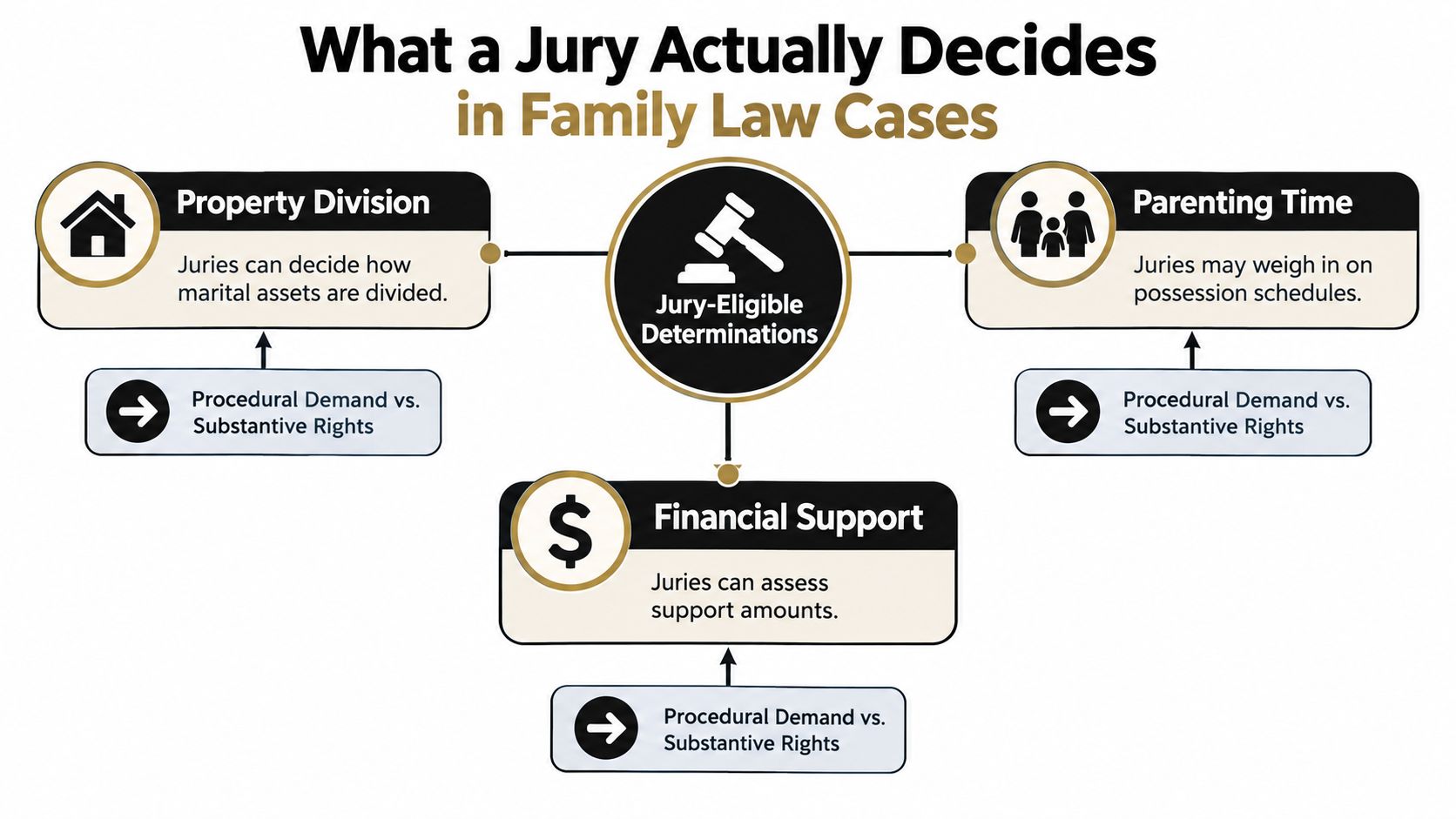
Jury demand and substantive rights are different questions
The Texas Family Code governs the underlying family issues. That includes divorce, conservatorship, possession, child support, and property-related disputes. The jury-demand rule is procedural. It tells you how to preserve the right to have jurors answer some of the disputed fact questions, but it doesn't expand the law beyond what the Family Code and related procedure allow.
The Texas Supreme Court has also described Chapter 201 of the Family Code as a statutory mechanism for jury trials in proceedings involving associate judges. That matters because the route into jury participation can depend on how the case is structured and what kind of proceeding the court is handling.
What still stays with the judge
Some matters are not for the jury, even when a demand is filed. Equitable issues, procedural matters, and relief that requires judicial supervision can remain with the court. That's why a litigant should think in terms of specific issues, not broad slogans about wanting “a jury for everything.”
A jury can decide factual disputes, but it doesn't take over the judge's role on every remedy.
Here's the practical trade-off. If a parent asks for a purely equitable remedy, demanding a jury may not change the outcome the way that parent expects. The judge may still control the remedy, even if some facts are disputed. That's why the decision should be tied to the actual relief sought, not just to the instinct that jurors might be more sympathetic.
What Happens When the Deadline or Fee Was Missed
A missed deadline doesn't automatically end the discussion, but it does change the posture of the case. An untimely jury demand generally waives the jury right, although a Montgomery County judge may excuse a late filing in appropriate circumstances. That's the recovery path people rarely talk about until they're already behind.
What can support a late request
The strongest late-request situations usually involve something concrete, not just simple delay. A surprise trial reset, a new trial setting that moves faster than expected, or a genuine scheduling-order confusion can support a good-cause argument. The court still has discretion, so the explanation has to be credible, specific, and prompt.
A parent in Conroe once realized the demand deadline had passed after a reset shortened the timeline. Counsel immediately filed a sworn explanation, tendered the fee issue in the same package, and asked the court to excuse the delay for good cause. That kind of prompt correction is very different from waiting until the day before trial and hoping the judge will absorb the problem.
What the corrective filing usually looks like
A late filing should not be casual. It usually needs:
- A written demand, clearly asking for a jury trial.
- A sworn explanation, stating why the deadline was missed.
- The fee or an inability-to-pay statement, handled at the same time if applicable.
- A request for the court to excuse the delay, tied to good cause.
The point is to show the court that the failure was not strategic ambush or neglect without explanation. The judge is much more likely to consider a prompt, documented correction than a vague request filed after the case is already on the eve of trial.
What not to do
Don't treat the demand as a trial memo you can fix later. Don't assume the clerk will sort out an incomplete filing. Don't wait for opposing counsel to raise the issue first. By the time the deadline is blown, the question is no longer whether a jury sounds useful. It's whether the court will excuse the late filing at all.
Your Next Steps and When to Schedule a Consultation
Use a short checklist and move in order.
- Identify the court, district court or county court.
- Count backward from the actual trial date, not a mediation or temporary-orders hearing.
- File the written demand with the proper clerk and keep the file-stamped copy.
- Pay the applicable fee or file the Statement of Inability to Afford Payment of Court Costs if that's the proper substitute.
- Confirm the docket entry so there's proof the filing was received.
Texas family-law procedure can be unforgiving, and a missed jury deadline is often harder to repair than people expect. This is not legal advice, and it doesn't replace a review of your actual notice of setting, local order, and court assignment. If you want a case-specific read on the deadline or the fee, a Montgomery County family-law lawyer can review the docket and the clerk's requirements before the window closes.
The Law Office of Bryan Fagan helps families in The Woodlands and Montgomery County evaluate jury-demand deadlines, clerk filing requirements, and the practical trade-offs in contested divorce and custody cases. If you're trying to preserve a jury right or clean up a missed filing, visit The Law Office of Bryan Fagan to schedule a consultation and get guidance specific to your court setting.