
A parent in The Woodlands may have a valid child support order from another state, yet still struggle to collect because the paying parent moved to Texas. The order hasn't disappeared, but Texas courts and agencies need the correct interstate procedure before they can use local enforcement tools.
That procedure is governed by the Uniform Interstate Family Support Act, commonly called UIFSA. For Montgomery County families, the practical questions are usually straightforward: Which state controls the order? What documents must be filed? Should you seek enforcement, modification, or both? And what can you do when the other parent ignores the obligation?
This guide explains the Texas process in plain English. It provides general information, not legal advice. Your filing strategy can depend on the issuing state, the parties' current residences, the child's residence, prior modifications, and service requirements. A qualified family law attorney should review your specific order before you file.
Understanding Interstate Child Support and UIFSA Basics
Suppose a parent living in The Woodlands receives a child support order from another state. The other parent has moved to Texas, works for a Texas employer, or owns property in Montgomery County. The receiving parent wants to collect support locally but doesn't want to restart the entire child support case.
That's the problem UIFSA addresses. Texas Law Help explains that an out-of-state support order can be enforced in Texas after registration. The filing package should include a certified copy of the support or income-withholding order, along with a regular copy, and registration is filed in the Texas county where the child has lived for the prior six months. See the Texas Law Help explanation of interstate child support and UIFSA.

What UIFSA does for a Montgomery County family
UIFSA creates an interstate enforcement framework instead of forcing a parent to relitigate the original support obligation in every state. Once the foreign order is properly registered, Texas can treat the case as an enforcement matter involving an existing obligation.
That distinction matters. Enforcement focuses on collecting unpaid support, honoring income withholding, and using available remedies for arrears. It isn't the same as asking a Texas judge to calculate support from the beginning.
UIFSA also helps prevent forum shopping, where a parent tries to obtain competing orders in different states. Its controlling-order structure is designed to prevent duplicate child support obligations. One order generally controls, while the states cooperate on enforcement.
Practical rule: Moving across state lines doesn't cancel a child support order. It changes the procedure used to collect or modify it.
For a parent in Panther Creek or Creekside, the practical advantage is coordination. The Texas side may be able to reach a Texas paycheck or pursue local enforcement while the issuing state's order remains the legal foundation. If you're unsure which income counts in the underlying calculation, review this resource on income that counts for child support in Texas.
UIFSA doesn't guarantee immediate payment. Missing certifications, incomplete addresses, unclear arrearage records, and jurisdiction disputes can delay a case. The process works best when the filing identifies the controlling order and includes the documents Texas law requires.
Jurisdiction Rules and Continuing Exclusive Jurisdiction
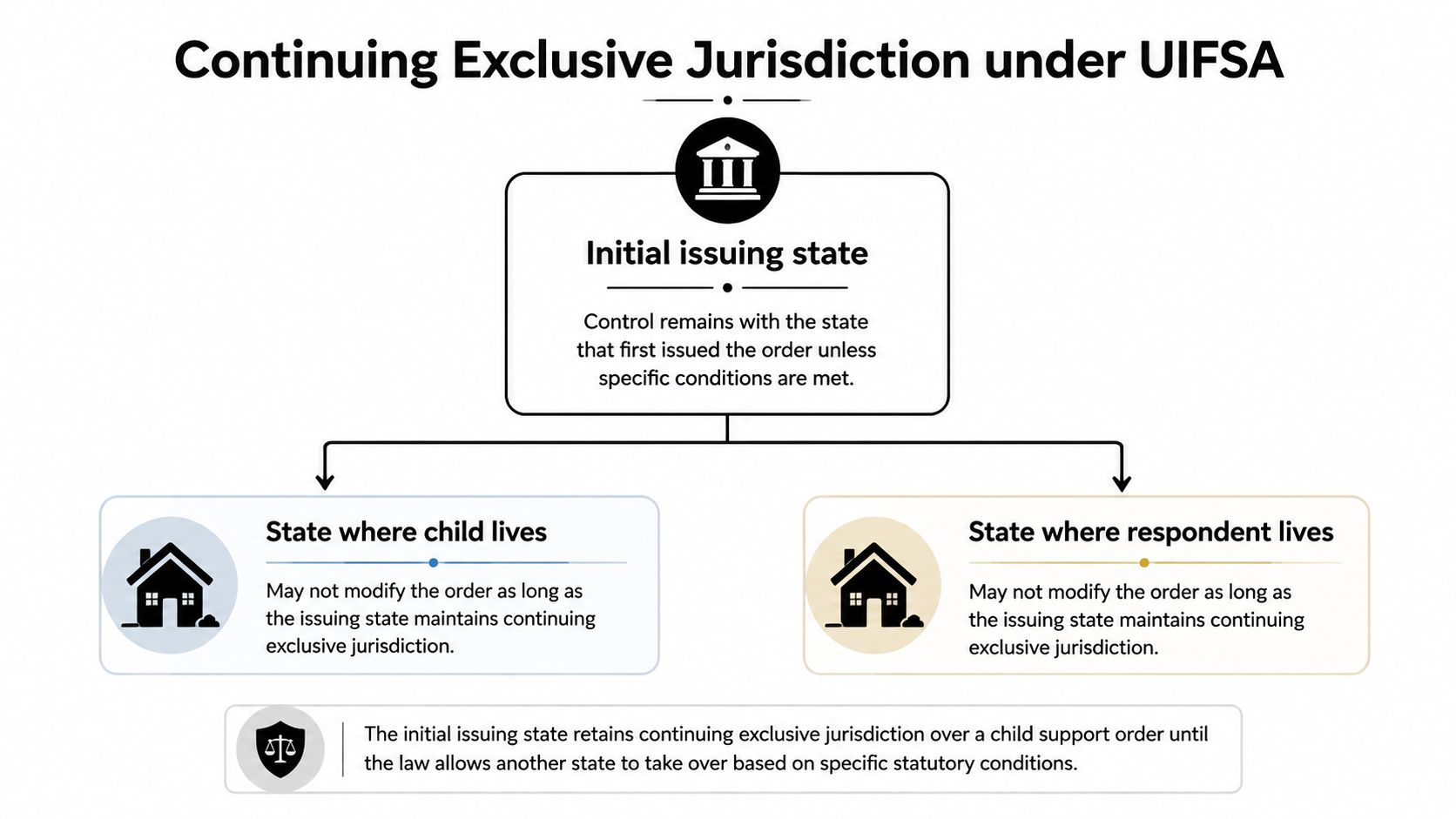
The most important jurisdiction question is not merely, “Where does the paying parent live?” UIFSA asks which state has continuing, exclusive jurisdiction, often called CEJ, over the support order.
Texas Family Code Chapter 159 allows the state that issued a support order to act as an initiating tribunal, asking another state to enforce the order. Texas can also act as a responding tribunal when it has jurisdiction to enforce an order presented for enforcement. Those roles allow states to cooperate without creating competing support obligations. The relevant framework appears in Texas Family Code Section 159.206.
Start with the issuing state
Identify the court that issued the controlling support order. Then determine whether the obligor, obligee, or child still has a legally relevant connection to that state. If Texas issued the controlling order and one of those people still resides in Texas, Texas may retain authority to modify its order.
Texas Family Code Section 159.205 provides that Texas keeps continuing, exclusive jurisdiction to modify its own order when Texas issued the controlling order and Texas remains the residence of the obligor, obligee, or child when modification is requested. The parties may also preserve Texas authority through consent in a record or in open court. Read the statutory rule in Texas Family Code Section 159.205.
Consider two different situations:
- Texas issued the order: One parent still lives in Montgomery County. Texas may retain modification authority.
- Another state issued the order: The original state may continue controlling modification, even if the receiving parent now lives in The Woodlands.
Enforcement and modification are related but separate. A Texas court may be able to enforce an order after registration even when Texas cannot modify the support amount. That distinction prevents a common mistake, filing a modification request in the most convenient state without first proving that the state has authority.
A local procedural overview, Montgomery County Family Courts: A Local Guide, can help explain how family law cases proceed in Montgomery County courts serving The Woodlands. It can't replace a jurisdiction analysis based on your actual orders and residence history.
Before filing, make a timeline showing where each parent and the child lived when the order was issued, whether later orders changed it, and where everyone lives now. That timeline often reveals whether Texas should enforce, modify, initiate an interstate request, or defer modification to another state.
Registering Out-of-State Orders in Texas Courts
Registration is the procedural gateway for enforcing an out-of-state child support order in Texas. The filing should be complete enough for the Texas court to identify the controlling order, understand the claimed arrearage, and provide the other parent with meaningful notice.
Texas Family Code Section 159.602 identifies the required registration materials. The packet must include:
- A written request: Provide a letter requesting registration and enforcement.
- Two copies of the order: Include two copies of the support order, with one copy certified by the issuing court.
- An arrearage statement: Submit a sworn statement identifying the amount claimed to be unpaid.
- Obligor information: Include identifying information for the parent who owes support.
- Obligee information: Provide the obligee's name and address.
The statutory filing mechanics appear in Texas Family Code Section 159.602. Texas Law Help also identifies the Texas county where the child has lived for the prior six months as the filing location described for registration. For a family based in The Woodlands, that commonly points the matter toward Montgomery County, but residence facts should be confirmed before filing.
A practical filing sequence
Begin by obtaining a certified copy from the issuing court. Don't assume a scanned copy, an unsigned printout, or an old order is enough. Gather every later order that may affect the controlling terms, payment amount, or arrearage calculation, then compare the documents before preparing the Texas packet.
After filing, the obligor receives notice and has an opportunity to contest registration. A contest can raise issues involving the order's validity, identification of the correct order, arrearage calculation, or jurisdiction. That's why accurate records matter before the hearing, not after a challenge has already delayed the case.
Document warning: A sworn arrearage statement should match the payment history and the order's terms. An unexplained balance can create avoidable disputes.
A parent can work with the Texas Attorney General's Child Support Division, often called the IV-D agency, or retain private counsel. The agency can provide enforcement services without charging the same type of private attorney fee, but agency processing may not move at the pace a parent needs. Private counsel can focus on the registration record, service problems, contested issues, and hearing strategy.
If a family safety issue exists alongside the support dispute, Protective Orders in The Woodlands addresses protective orders in domestic violence and family safety matters. That is a separate legal process and shouldn't be treated as a substitute for UIFSA registration.
Once registration is properly completed, the matter shifts from proving the original support obligation to enforcing it in Texas. That change can support income withholding and arrears collection without reopening the original support calculation.
Enforcement Tools Available in Texas
Registration gives Texas a procedural foundation, but collection still requires selecting the remedy that fits the obligor's circumstances. A parent with a regular employer presents a different enforcement problem from a self-employed parent who changes businesses, receives irregular income, or keeps financial records out of reach.
Match the remedy to the payment problem
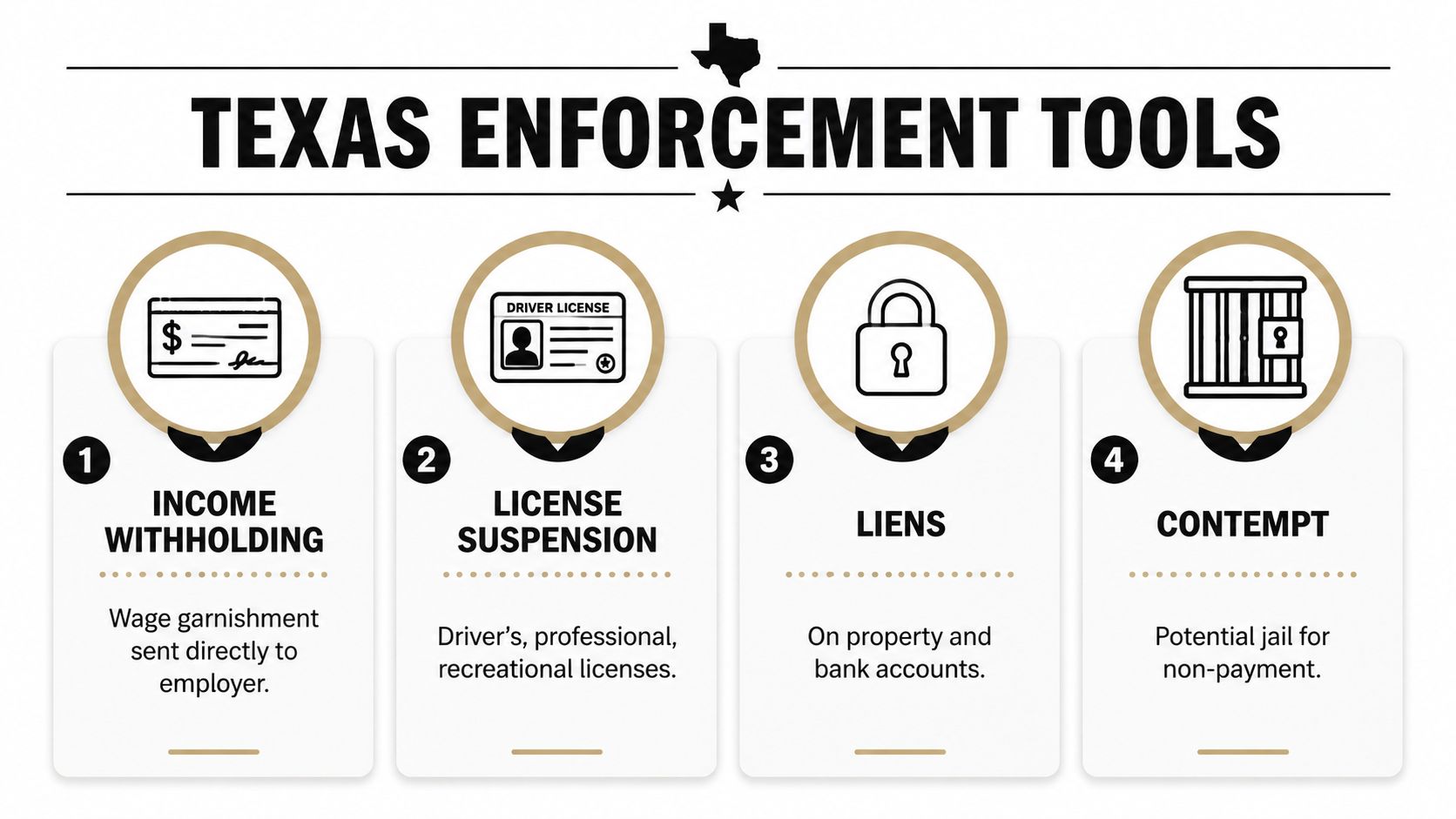
Income withholding is often the most direct option when the obligor has identifiable employment. A withholding notice directs the employer to deduct support from wages and send the payment through the established child support system. It works less cleanly when the parent changes employers, works for cash, or operates through a business entity.
Other tools may become relevant when payroll withholding doesn't solve the problem:
- Contempt proceedings: A court can address willful nonpayment through an enforcement case. The court examines the order, payment history, ability to comply, and defenses before imposing consequences. Possible consequences can include incarceration or license-related sanctions, but those outcomes depend on the evidence and the court's findings.
- License suspension: Texas enforcement may affect driver's, professional, or recreational licenses when statutory requirements are met. This tool can create pressure, but it doesn't itself calculate the arrearage or guarantee payment.
- Liens: A lien may help preserve a claim against property or certain financial assets. It can be useful when the obligor owns identifiable property but doesn't maintain regular payroll.
- Refund interception and credit reporting: Government collection systems may intercept qualifying tax refunds and report qualifying delinquency to credit bureaus. These measures may produce a payment, but they're not substitutes for a complete arrearage record.
Agency enforcement versus a court case
The Texas Attorney General's Child Support Division can coordinate with other states' IV-D agencies. That cooperation is valuable when the obligor lives elsewhere, changes employers, or has assets connected to another state. Agency cases can be practical for routine enforcement, but communication and processing may take longer than a parent expects.
A private attorney can pursue a focused court strategy, especially when the other parent disputes the arrearage, hides income, or repeatedly ignores notices. Private representation also lets counsel address related issues, such as discovery, evidentiary preparation, and contested enforcement hearings, within the limits of the particular case.
There isn't a reliable universal timeline for Montgomery County enforcement. Service, objections, court calendars, employer information, and the obligor's response can all affect progress. The Texas Family Code framework for child support enforcement can provide general context, but your registered order and payment records determine what a court can consider.
The strongest first move is usually not filing every available remedy at once. It's identifying the collection path most likely to reach the obligor's actual income or assets, then preserving the record needed for stronger relief if that path fails.
Modifying Interstate Child Support Orders
Enforcement collects what the current order requires. Modification changes the obligation going forward. Mixing those objectives can lead to the wrong filing and leave a parent exposed to continuing arrears.
Texas Family Code Section 159.609 allows a petition to modify an out-of-state support order to be filed at the same time as registration or later. The petition must state the grounds for modification. Registration is therefore not a formality to skip. It establishes the procedural connection between the foreign order and the Texas modification request. See Texas Family Code Section 159.609.
When Texas may modify
Texas may modify its own controlling order when Texas issued it and Texas still has continuing, exclusive jurisdiction because the obligor, obligee, or child resides here. The parties may also consent to continued Texas authority in the manner recognized by Texas law.
For an order issued elsewhere, the analysis is narrower. Section 159.611 limits modification to specific jurisdictional situations, including circumstances where the issuing state no longer has all relevant parties and a nonresident petitioner seeks modification. The court must still have authority over the parties and the case must satisfy the statutory requirements.
That creates two paths:
| Situation | Practical direction |
|---|---|
| The issuing state still has continuing, exclusive jurisdiction | Modification may need to be pursued in the issuing state. |
| Texas has jurisdiction after registration and the statutory conditions are met | Texas may consider the modification petition. |
| Texas can enforce but cannot modify | Register for enforcement while evaluating modification in the proper state. |
| The parties' residences and consent support Texas authority | Texas may retain or exercise modification authority under Chapter 159. |
A parent in Alden Bridge might live in Texas while the other parent remains in the issuing state. Registration in Montgomery County may support collection, but it doesn't automatically give a Texas judge power to change the support amount. Filing modification information for child support in The Woodlands before resolving jurisdiction can create delay or dismissal risk.
Strategically, the original state may sometimes be the more efficient place to seek modification, especially when it still controls the order and the evidence is located there. In other cases, Texas may be the practical forum after registration. A Child Support Attorney in The Woodlands handles establishing, modifying, and enforcing child support in Montgomery County, but the right forum still depends on the facts and Chapter 159.
Your Next Steps and Getting Local Legal Help
Interstate support cases become easier to manage when you separate the legal questions and build the record in the right order. Start with the order, not the argument.
What to do next
- Gather the complete order: Obtain certified copies of the original support order and later orders, including any income-withholding order.
- Build a residence timeline: Record where the child, obligee, and obligor lived when the order was issued and where they live now.
- Choose the objective: Decide whether you need enforcement, modification, or enforcement while modification is addressed elsewhere.
- Prepare the registration packet: Include the request letter, two order copies with one certified copy, sworn arrearage statement, obligor information, and obligee name and address.
- Confirm the filing county: Verify whether Montgomery County is the proper Texas venue based on the child's residence and the applicable filing rules.
- Plan for notice and objections: Keep reliable addresses and supporting payment records ready for service and any contest.
- Set realistic expectations: Payroll withholding may be effective for regular employment, while self-employment and disputed arrears may require court involvement.
The Texas Attorney General's IV-D services can be useful when you want agency assistance with interstate coordination and routine collection. Those services are free, but agency movement may be slower and less suited to contested issues. Private counsel can provide a focused strategy for registration, service, discovery, and hearings.
Local representation can also help with Montgomery County procedures serving communities such as Panther Creek, Alden Bridge, Sterling Ridge, and Creekside. A lawyer familiar with the local courts can help organize the filing and identify procedural problems before they consume more time.
This article is general information, not legal advice. UIFSA jurisdiction can turn on facts that aren't obvious from a single order, so have the documents reviewed before requesting registration or modification.
The Law Office of Bryan Fagan helps families in The Woodlands and Montgomery County evaluate interstate child support registration, enforcement, and jurisdiction questions. Visit The Law Office of Bryan Fagan to schedule a consultation and discuss a practical strategy for your specific case.