
If you're in The Woodlands and your marriage has reached the point where divorce is on the table, you're probably dealing with two problems at once. One is emotional. The other is practical. You may be wondering where the children will sleep next month, who will pay the mortgage, whether your spouse is moving money, and how much damage a court fight could do to your finances.
Many individuals start with the wrong question. They ask how to beat the other side.
A better question is this: What outcome protects your children, your property, your income, and your peace of mind? In Texas, that's usually what winning looks like.
That matters because divorce litigation can get expensive fast. One Texas law-firm publication reported average divorce costs of about $15,600 without shared children and $23,500 with shared children, with filing fees around $250 to $350, as discussed in these Texas divorce statistics. For many families in Montgomery County, the smartest strategy is the one that protects the estate from being consumed by the process.
This article is for general information only. It is not legal advice. Texas family law is fact-specific, county-specific, and sometimes judge-specific. What works in one case may be the wrong move in another.
Redefining What It Means to Win Your Texas Divorce
A lot of spouses in The Woodlands picture divorce as a final hearing where one person tells the truth, the judge sees through everything, and justice arrives in a single ruling. That image is understandable. It also isn't how most cases are decided.
In real Texas divorce practice, "winning" usually means something quieter and more strategic. It means getting a workable temporary parenting schedule in place. It means stopping financial chaos early. It means identifying what is community property, what may be separate property, and what evidence you need before you make demands.
What clients usually mean by winning
When someone asks how to win a divorce case in Texas, they usually mean one or more of these goals:
- Protect the children: Keep daily life stable, reduce conflict, and avoid a parenting plan that doesn't fit school, work, and transportation realities in Montgomery County.
- Protect assets: Find accounts, preserve records, and prevent one spouse from controlling the money by virtue of having the passwords.
- Avoid bad orders early: Temporary mistakes can shape the rest of the case.
- Settle from strength: Negotiate only after you've built enough evidence to know what's fair.
- Go to trial only if needed: Trial is a tool, not the default definition of success.
Practical rule: In Texas divorce, the spouse who is organized, credible, and prepared often has more leverage than the spouse who is angriest.
Texas is a no-fault divorce state. A divorce can still be granted even if one spouse refuses to agree. But fault can still matter in the background when a court is dealing with children or making a "just and right" division of community property, as explained in TexasLawHelp's guide to divorce in Texas. That's why a smart case strategy doesn't obsess over blame just to end the marriage. It focuses on where proof can change the result.
What doesn't work
Some habits hurt people early:
| Mistake | Why it backfires |
|---|---|
| Threatening your spouse in text | Those messages often become evidence |
| Draining accounts without advice | It can damage your credibility and trigger emergency court action |
| Refusing all settlement talks | It usually increases cost without improving leverage |
| Hiding records | Courts care about transparency, especially in property disputes |
| Treating the case like a moral contest | Judges decide legal issues, not personal vindication |
If you're in Panther Creek, Creekside, Alden Bridge, or another Montgomery County community, the practical pressure is the same. You need a plan that works in actual situations, not a movie version of family court.
Your First 60 Days The Critical Opening Moves
The initial phase of a Texas divorce is more critical than generally acknowledged. Texas law requires a spouse to have lived in the state for at least 6 months and in the county of filing for at least 90 days, and a court generally can't grant a divorce until at least 60 days after filing, as outlined in Texas residency and waiting-period rules. In Montgomery County, that waiting period isn't dead time. It's a period for strategic positioning.
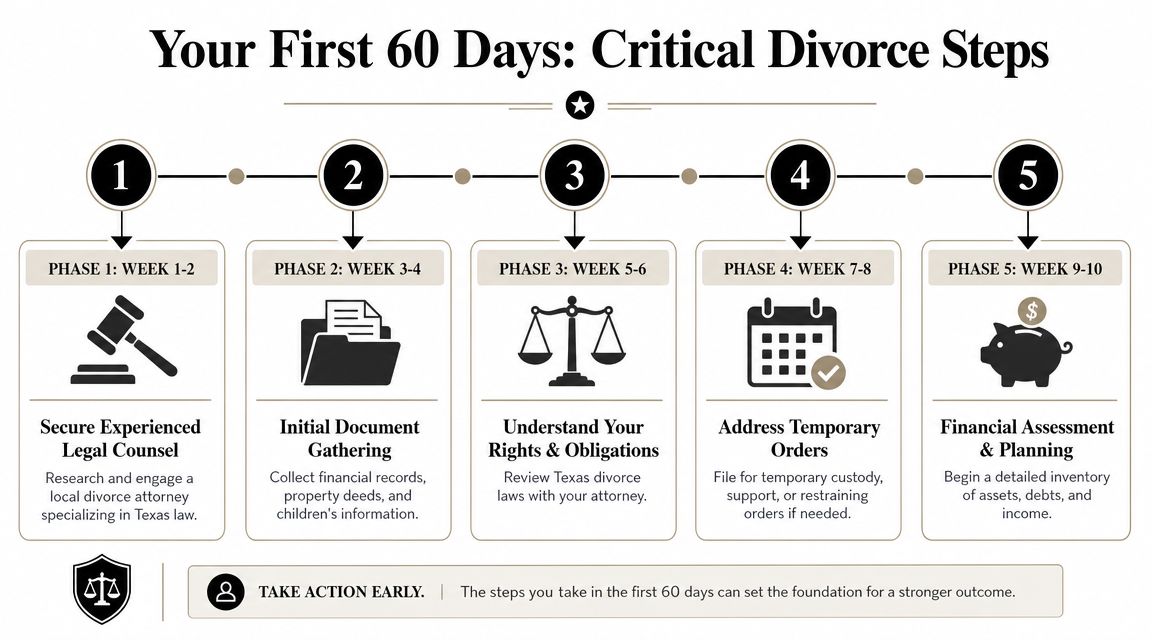
Move fast on the right tasks
The first weeks shouldn't be spent arguing by text or trying to convince your spouse to "be reasonable." They should be spent getting control over facts.
Confirm filing eligibility
If you're new to Montgomery County, don't assume you can file in The Woodlands immediately. Residency mistakes waste time and create avoidable complications.Secure records before access changes
Download statements, tax returns, pay records, retirement documents, loan information, and anything that shows the history of major assets or debts.Map the family routine
Write down who takes the kids to school, who handles medical appointments, how after-school activities work, and what schedule the children have been living.Stop making careless digital evidence
Don't post on social media. Don't send threats. Don't announce new relationships. Don't assume deleted messages are gone.
If you've just been served, a practical primer on what to do after being served divorce papers in The Woodlands can help you avoid early mistakes.
Temporary orders often decide the tone of the case
Temporary orders deserve more attention than they get. In Texas practice, they can address child support or spousal support before the final divorce, and the process after filing usually moves through service, the waiting period, and then either agreement or trial, as noted by the Texas State Law Library divorce filing materials.
That matters because temporary orders can decide:
- Who stays in the house
- Who pays which bills
- What the possession schedule looks like
- How temporary support is handled
- Whether certain conduct is restricted while the case is pending
A weak temporary-orders position can put you on defense for months. A solid one can stabilize your finances and your children quickly.
Get specific before any temporary-orders hearing. "I want fairness" doesn't help much in court. "I need a school-week schedule that keeps the children in their current routine and a bill-payment plan that prevents missed mortgage payments" does.
Focus on what a judge can actually use
Judges respond to clear facts. They don't have time for every grievance in the marriage. In the first 60 days, the best evidence usually includes:
- Documents: bank statements, payroll records, account histories, insurance documents
- Calendars: school drop-offs, extracurricular schedules, travel realities
- Short timelines: when separation happened, when accounts changed, when problems started
- Clean communication: messages that show you were reasonable and child-focused
Local knowledge helps significantly. A Montgomery County divorce case isn't won by volume. It's won by bringing the right issues forward in a disciplined way.
Building Your Case with Evidence and Discovery
The document gathering you do at home is only the start. The formal process is called discovery, and in this process, a divorce case stops being a story and starts becoming a record.
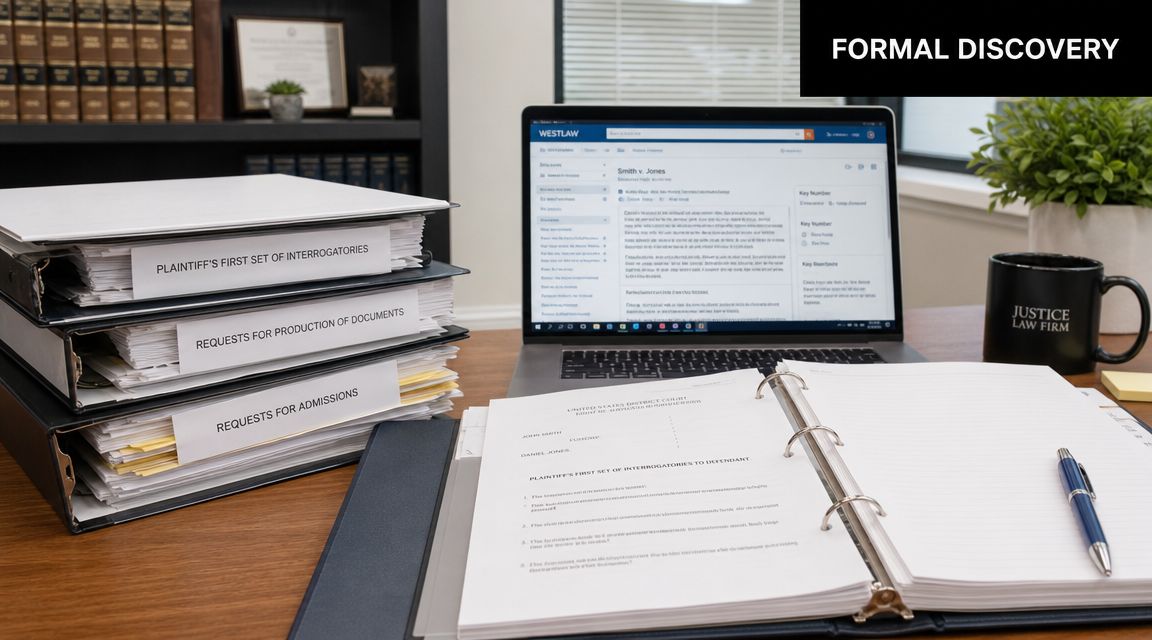
What discovery actually looks like
In plain English, discovery is how each side can require the other to provide information. Common tools include:
- Interrogatories: written questions that must be answered.
- Requests for production: demands for documents, electronic records, statements, communications, and other materials.
- Depositions: sworn testimony taken before trial.
- Requests for disclosure or admissions: tools to identify positions and narrow disputes.
For a Woodlands family, that may mean tracing an inheritance, reviewing compensation tied to an energy-sector job, locating deferred compensation records, or identifying whether a business interest grew during the marriage.
The process is similar to exploring key due diligence areas in a business review. You don't rely on assumptions. You ask for source material, test claims, and look for gaps.
Evidence changes outcomes when it connects to a legal issue
Under the Texas Family Code, community property is divided in a manner the court considers just and right. Under Texas Family Code Section 3.002, property acquired during marriage is generally community property, and under Section 7.001 the court divides the estate on a just-and-right basis. That doesn't guarantee an exact split.
Fault can matter here, but only when you can prove something relevant. In Texas, no-fault divorce is available, but fault grounds such as cruelty or adultery may affect outcomes. In family-violence situations, protective orders may be available and the usual waiting period can be bypassed in some cases, as discussed in Texas legal aid guidance on family violence and divorce.
What works is targeted proof. What doesn't work is bringing up every painful fact in the marriage and expecting all of it to carry legal weight.
Examples of useful evidence
| Issue | Evidence that may matter |
|---|---|
| Separate property claim | Pre-marriage statements, inheritance records, gift records, tracing documents |
| Business valuation dispute | Tax returns, profit-and-loss statements, ownership records, contracts |
| Hidden spending | Bank records, transfer histories, credit-card statements |
| Parenting dispute | School records, medical records, calendars, messages about exchanges |
| Adultery or cruelty claim | Messages, financial records, witness testimony, spending connected to the conduct |
If you're trying to understand the mechanics, this overview of the divorce discovery process gives a practical picture of how the process unfolds.
The best discovery requests are narrow enough to enforce and broad enough to expose what matters.
When I see discovery used well, it usually does three things. It clarifies the money, clarifies the parenting history, and removes guesswork before mediation.
A Montgomery County Divorce A Real-World Scenario
Sarah lives in Creekside Park. Tom works in the energy industry and receives salary plus compensation that isn't easy to understand from a single paystub. They have two children whose school and activity schedule keeps the family moving between The Woodlands and the broader Montgomery County area.
Sarah first came in saying she wanted to "win." What she meant was simpler. She wanted the children to stay stable, she didn't want bills missed, and she wanted to know whether Tom had been moving money.
What happened first
The early concern wasn't trial. It was control.
Temporary orders were used to create a predictable possession schedule, assign responsibility for key household bills, and reduce direct conflict. That gave the children structure and gave both sides a clear set of rules while the case moved forward.
Sarah also started gathering information at home. Not by taking random screenshots and forwarding every text. She organized mortgage records, account statements, tax returns, school calendars, and notes showing who had historically handled the children's day-to-day needs.
The case became about proof, not suspicion
Tom said most of the disputed financial questions were misunderstandings. That can be true in some cases. It can also be false.
Formal discovery focused on compensation records, account histories, and documents tied to property issues. The goal wasn't to punish Tom. It was to establish what existed, what was earned during the marriage, and whether any assets needed closer scrutiny.
At the same time, the parenting side of the case became more realistic. A proposed schedule had to fit actual school mornings, extracurriculars, and transportation. Good family-law strategy always sounds less dramatic than clients expect. It sounds like logistics, records, and timing.
A judge is more likely to trust the parent who brings a workable plan than the parent who brings a speech.
Where the real win happened
By the time mediation arrived, Sarah wasn't negotiating from fear. She had a temporary framework that worked. She had enough financial documentation to evaluate settlement proposals. She knew which issues were worth fighting over and which ones weren't.
The result was not a cinematic courtroom ending. It was better than that. The parties resolved the major property and parenting issues in mediation with terms that reflected the evidence, not bluffing.
That is how many people in Montgomery County win divorce cases. They don't "win" because they talked the loudest. They win because they prepared early, used discovery intelligently, and reached the negotiation table from a position of strength.
The Strategic Choice Between Mediation and Trial
Most divorce clients say they're ready for trial in the first meeting. Far fewer still want trial after they understand the trade-offs.
Many Texas divorces are decided through settlement, temporary orders, mediation, and short prove-up hearings rather than contested final trial, as explained by the Texas State Law Library's materials on finalizing divorce. That doesn't mean trial is irrelevant. It means trial is often the pressure behind settlement, not the destination.
A quick visual helps frame the difference.
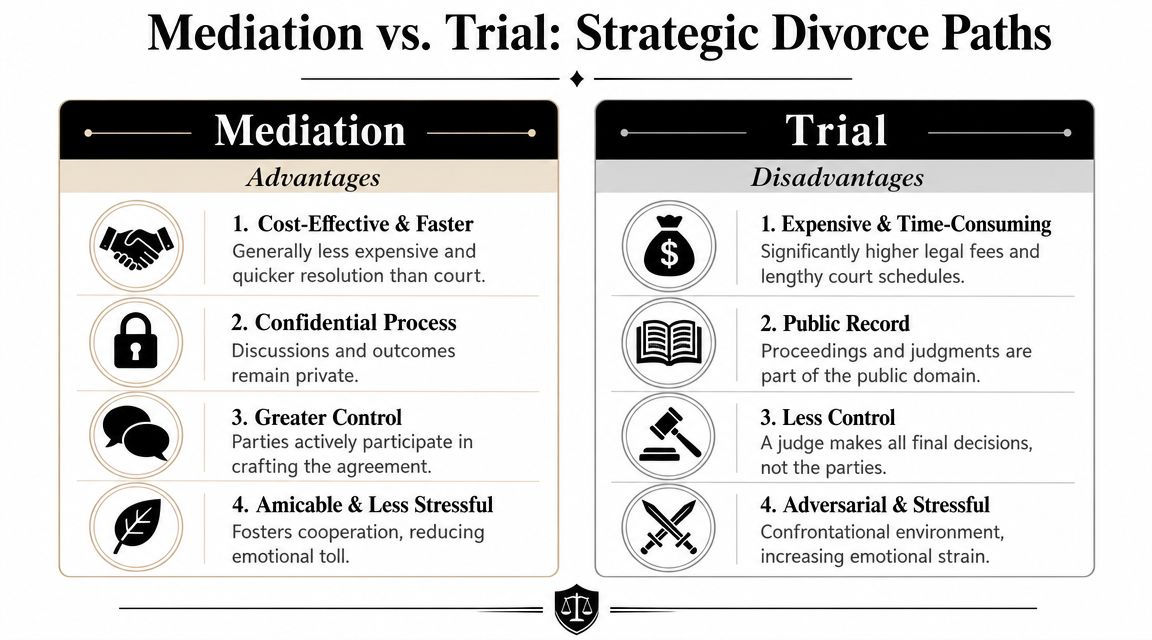
Why mediation often produces the better result
Mediation gives you a chance to make informed decisions with your lawyer instead of turning the final call over to a judge who has limited time and incomplete context. In a Montgomery County divorce, that matters when you're dealing with parenting schedules, house-related issues, reimbursement claims, or complex assets.
A mediated result can be especially valuable when the family needs flexibility. Judges issue orders. Parents have to live with them.
Here are the practical advantages mediation often offers:
- More control: You can shape details that a court may handle more bluntly.
- More privacy: Fewer family details have to be aired in open court.
- More creativity: You can trade issues in ways a court order may not.
- Less wear on the children: Reduced conflict usually helps parents co-parent better after the divorce.
If you're weighing that route, this overview of divorce mediation in The Woodlands, Texas explains how the process generally works.
Trial still matters, but mostly as leverage
There's a mistake people make on both extremes. One spouse says, "I refuse to settle." The other says, "I just want this over with." Both positions can produce bad agreements.
The stronger approach is to prepare as if trial may happen, then use that preparation to negotiate intelligently.
That means:
| If you prepare for trial | What it does in mediation |
|---|---|
| Organize financial proof | Prevents lowball offers |
| Build a parenting record | Supports a realistic schedule |
| Identify legal strengths and weaknesses | Narrows what should actually be contested |
| Understand likely court outcomes | Helps reject unreasonable demands |
A spouse who is ready for trial often settles better because the other side knows bluffing won't work.
This video gives a useful overview of practical divorce concerns that often feed into settlement strategy.
When trial is still the right call
Sometimes you do need a judge. Examples include cases involving serious credibility problems, hidden assets, coercive behavior, or parenting disputes that won't resolve safely or fairly.
Trial can also be necessary when one spouse uses mediation as delay instead of problem-solving.
Still, the key point stands. In most contested divorces, the path to a smart result runs through preparation, temporary orders, discovery, and negotiation. Trial is part of the system. It just isn't the only version of winning.
Your Action Plan Checklist and Next Steps
If you're trying to figure out what to do this week, keep it simple. Good divorce strategy starts with disciplined action, not emotional reaction.
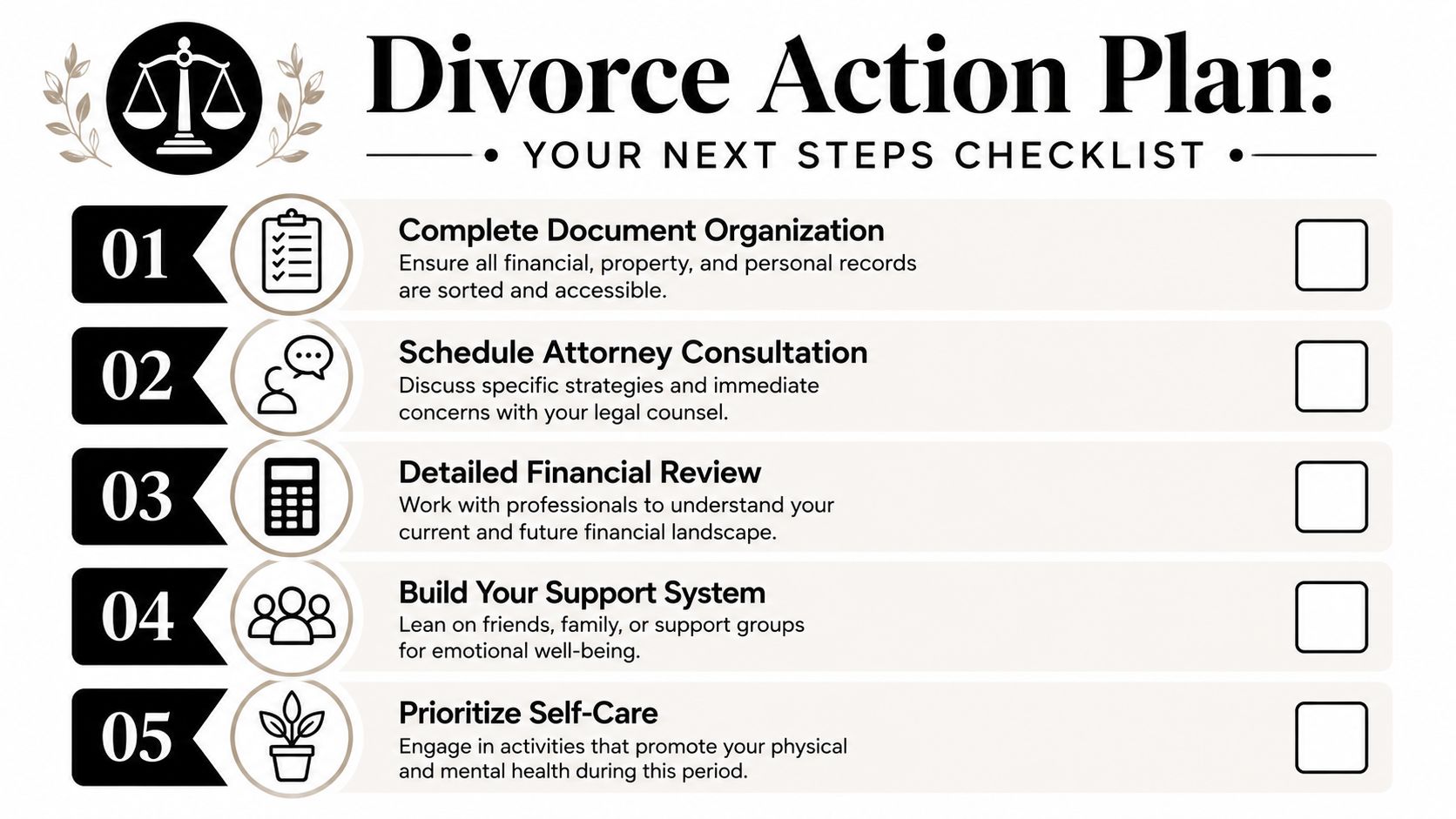
What to do next
The highest-yield path in Texas divorce litigation is to secure early control of temporary orders and then use discovery to document finances and parenting roles before settlement talks begin, as reflected in the Texas State Law Library filing guidance. With that in mind, here's a practical checklist.
- Gather core financial records: Pull recent bank statements, tax returns, retirement records, mortgage information, credit-card statements, and pay records.
- Create a property inventory: List the house, vehicles, accounts, business interests, valuable personal property, and debts.
- Write a parenting summary: Note school routines, medical providers, extracurriculars, and who has handled daily parenting responsibilities.
- Protect your communications: Assume texts, emails, and social media posts may be read by a judge.
- Change passwords lawfully: Secure your own accounts and devices, but don't access accounts you aren't authorized to use.
- Prepare for temporary orders: Decide what must be addressed immediately, including bills, possession, support, and house use.
- Get legal guidance early: A family-law attorney can help you separate urgent issues from emotional noise.
If you're trying to manage intake and communications during a stressful legal process, tools like My AI Front Desk legal AI can help law offices handle client contact more efficiently. For representation itself, one local option is The Law Office of Bryan Fagan, which handles divorce and family-law matters in The Woodlands and Montgomery County.
After the divorce is final
A lot of people think the case ends when the judge signs the decree. Legally, that may be the end of the divorce. Practically, it often isn't.
Under the Texas Estates Code, divorce can affect estate-planning and beneficiary issues, but you still need to review your documents and make updates where appropriate. Don't leave those tasks unfinished.
Post-divorce, make sure you address:
- Your will and estate plan: Review wills, powers of attorney, and related documents under the Texas Estates Code.
- Beneficiary designations: Check life insurance, retirement accounts, and payable-on-death designations.
- Titles and transfer documents: Complete deeds, vehicle title work, and account transfers required by the decree.
- Support and possession logistics: Calendar deadlines, exchange details, and reimbursement procedures.
- Credit and account cleanup: Close or refinance joint obligations when the decree requires it.
The divorce decree is a blueprint. If you don't carry out the transfer steps afterward, the paperwork on file may not match the result you thought you got.
Final perspective
To win a divorce case in Texas, the answer usually isn't aggression. It's disciplined preparation. It's strong temporary orders. It's good discovery. It's knowing when to mediate and when to let a judge decide.
And it's understanding that protecting your future in The Woodlands often means making strategic decisions long before the final hearing.
This article is for informational purposes only and isn't legal advice. If you're dealing with a divorce in Montgomery County, get advice based on your facts, your court, and your priorities.
If you want to talk through your options, the attorneys at The Law Office of Bryan Fagan work with clients in The Woodlands and throughout Montgomery County on divorce, custody, support, and property-division issues. A consultation can help you identify the right next move and avoid mistakes early in the case.