
The most popular advice behind “how not to pay child support” is often the most damaging: stop paying, wait for the other parent to agree, or assume a job loss cancels the order. In Texas, none of those steps changes what a court has ordered. If your income has fallen, seek a formal modification. Don't treat nonpayment as a substitute.
For parents in The Woodlands, Conroe, and elsewhere in Montgomery County, the practical route is to document the change, request a review through the proper process, and keep records of payments and communications. A new order can address future support, but a request alone doesn't erase unpaid amounts that have already accrued.
Why Child Support Cannot Be Unilaterally Stopped
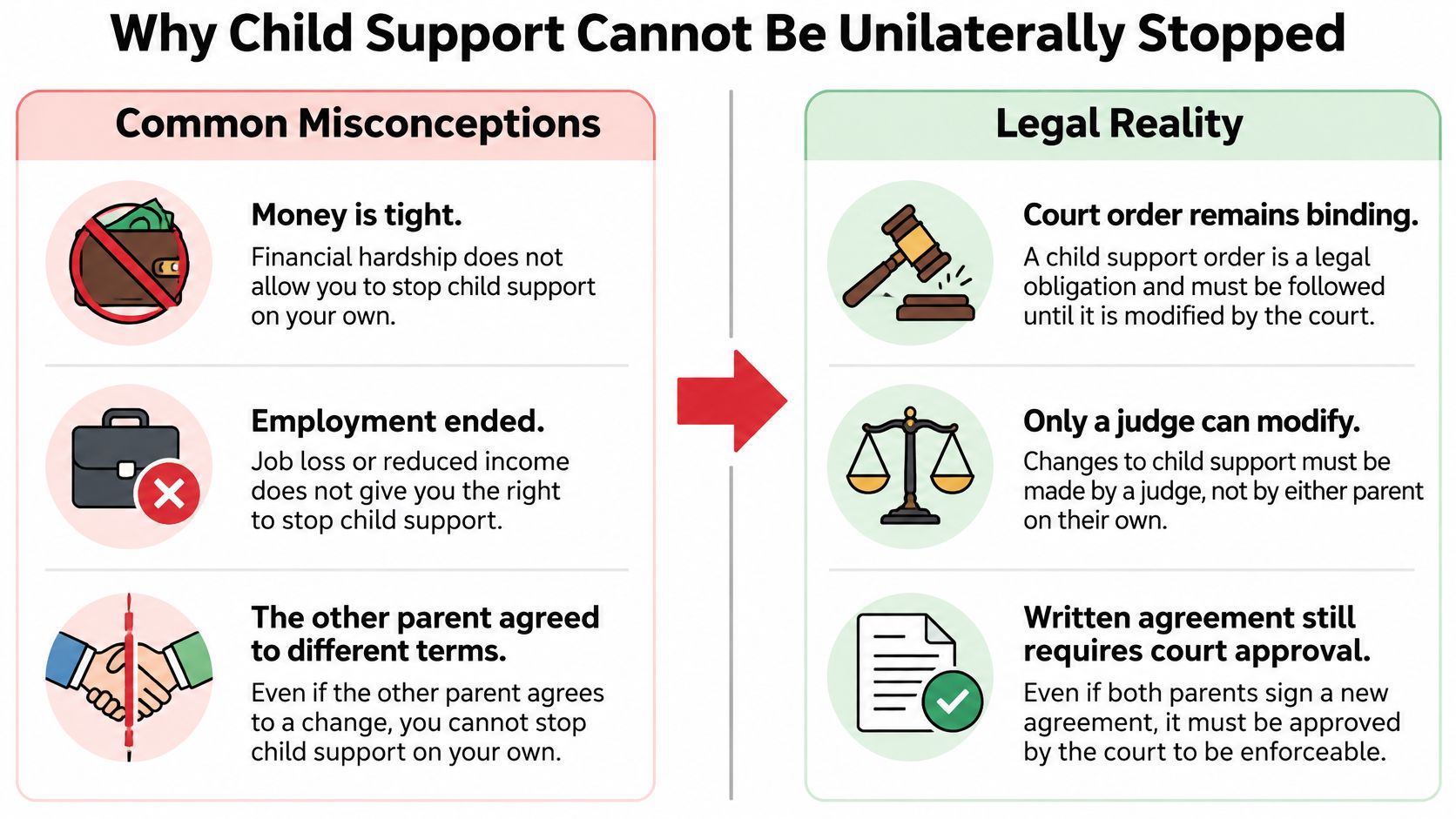
Stopping payment is the one response that never works. A strained budget, a layoff, or the other parent's verbal permission leaves the signed order untouched. The existing order stays enforceable until a court changes it, and every missed installment keeps accruing as arrears. The Texas Office of the Attorney General is explicit that losing a job or earning less does not, by itself, change the amount owed (Texas guidance on employment changes and child support).
Two things follow. First, unpaid support does not sit idle; the state can apply enforcement tools such as income withholding, license actions, or contempt proceedings against a growing balance. Second, relief is forward-looking. A new order can reduce future payments, but amounts already accrued are difficult to undo, so each month spent waiting can become permanent debt.
The lawful version of the shortcut people search for is a modification request. Texas Family Code Chapter 156 lets a parent ask a court to change an order when the legal criteria are met, including a material and substantial change in circumstances (Texas Family Code Chapter 156).
Take a parent in The Woodlands who loses a job and cannot find work at the same pay. If that parent files promptly, the review can address future payments while arrears stay small. If the same parent waits six months, six months of unpaid support pile up at the old amount, and that balance typically survives whatever the court decides later. The timing of the request matters as much as the reason for it.
| Approach | Legal effect | Immediate action |
|---|---|---|
| Request a modification | A court may change future support through a new order | Document the change and seek review |
| Stop paying without an order | The existing amount remains due, and arrears may grow | Resume payments as possible and get legal guidance |
| Make a private agreement | The agreement doesn't replace the court order by itself | Put the proposed change through the formal process |
This is general information, not legal advice. Each case depends on the existing order, the evidence, and applicable Texas law.
Assess Your Order and Build the Evidence File
Start with the signed order, not your memory of it. Confirm the monthly amount, due dates, income-withholding terms, medical-support provisions, and the date the order was entered or last modified. That date matters because Texas generally allows a modification request when the order was established or last modified more than three years earlier and the guideline-based amount differs by at least 20% or $100, or when a material and substantial change has occurred (Texas Family Code Section 156.401).
Write down what changed and when it changed. A layoff, reduced hours, a new disability, higher health-insurance costs, or responsibility for additional children can all matter, but the file has to show timing. A Conroe parent whose hours were cut in March should be ready to prove March, not describe a rough “slowdown” later in the year.
Build the record around documents that can be checked.
| Evidence | What it can show | Why it matters |
|---|---|---|
| Pay records and tax returns | Earnings and changes in income | Helps establish past and current resources |
| Termination or unemployment documents | When employment changed and why | Supports the timeline of the income change |
| Bank and benefit records | Deposits, benefits, and other resources | Provides a fuller account of available funds |
| Health-insurance information | Coverage and related costs | May be relevant to the support calculation |
| Necessary expense records | Documented household costs | Helps explain the financial circumstances |
| Payment receipts and transfer records | What you paid and when | Helps verify compliance and identify disputed amounts |
Keep every payment proof, including payments made while review is pending. If you pay by cash or an app transfer, preserve transaction details and ask the appropriate office how to document payment correctly. Accurate disclosure helps your case; unexplained deposits, inconsistent figures, hidden compensation, or a voluntary income cut can damage it.
Choose the Texas Review Process
Texas has two principal routes for seeking a support change: the Child Support Review Process (CSRP) and a court proceeding. The right route depends on the case and whether the parents can resolve the proposed change through the review process. In either route, keep using the current order as your guide until the required judicial action takes effect.
In a CSRP, the parents typically meet with a Child Support Officer. If they agree on a proposed result, it may be sent to a judge for signature. If they don't agree, the matter may proceed to a court hearing. A modification isn't complete until the judge signs a new order (how Texas's child support legal process works).
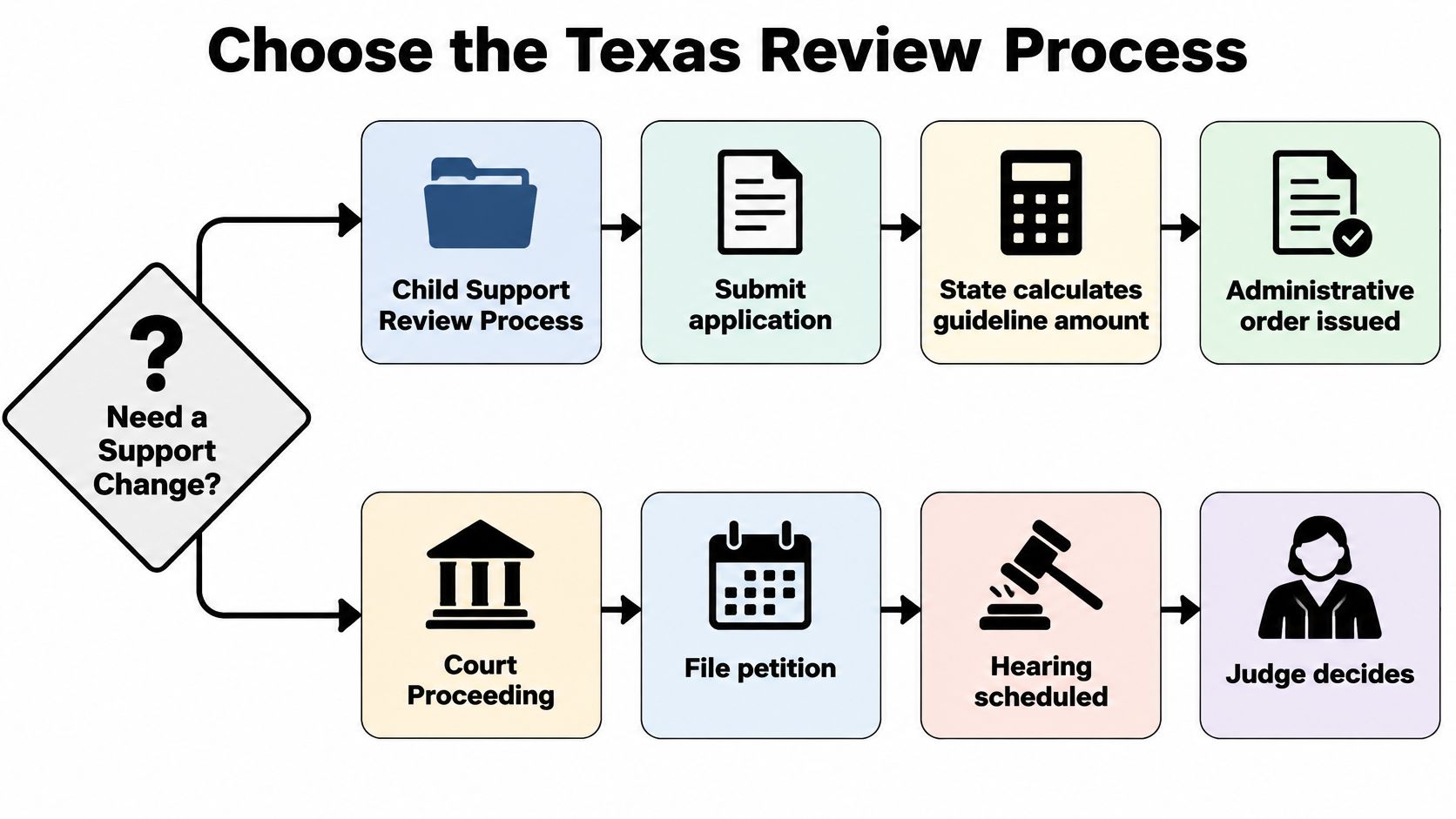
Parents may also seek a change by filing a modification action in court. That route involves filing the appropriate petition, providing required information, and following the court's process. For people in The Woodlands, Conroe, and nearby communities, the specific steps depend on the case and the appropriate local child-support and court systems. Don't assume an agreement reached in a private conversation is enough.
| Route | How it generally works | Key caution |
|---|---|---|
| Child Support Review Process | The parents work with a Child Support Officer; an agreed result may go to a judge | The current order remains in place until the judge signs a new one |
| Court proceeding | A parent asks the court to decide the requested change | Follow filing, disclosure, and hearing requirements |
For local context, Child Support Attorney in The Woodlands describes establishing, modifying, and enforcing child support in Montgomery County. Parents considering a contested request can also review information about a child support modification hearing.
Compare Modification With Evasion
A lawful modification request creates a record and asks the proper authority to change future support. Evasion relies on shortcuts: stopping payments, redirecting money without approval, hiding income, or treating a private agreement as if it replaces the court order. Those choices don't update the order and can leave the parent with an accumulating unpaid balance.
A Montgomery County parent is laid off, stops paying, and assumes filing a request will wipe out the missed installments. The request is still pending while the parent falls further behind. The better course is to preserve evidence of the layoff, keep paying as possible under the current order, and seek formal review promptly.
A lower monthly obligation may apply going forward, but it generally doesn't erase arrears that accrued before the new order.
That difference matters. A request for modification generally concerns future support. Amounts already due don't automatically disappear because a parent later qualifies for a lower monthly payment. Texas guidance for parents returning from incarceration also explains that accrued arrears aren't modified by a later change to the current obligation (Texas re-entry guidance on child support).
| Choice | How it appears | Likely legal consequence |
|---|---|---|
| Document a change and request review | Evidence-backed request through the proper process | A judge may set a different future amount |
| Stop paying while the request is pending | Unilateral withholding | The current order remains in effect, and arrears may grow |
| Rely on an informal agreement | The parents follow different terms privately | The written court order hasn't been replaced |
| Hide income or reduce earnings on paper | Incomplete or misleading financial disclosure | The court may question the disclosure and calculate support under applicable law |
If payments have already been missed, don't ignore notices or assume time will fix the balance. Review the order, collect payment records, and get advice about the available process. What happens if child support is not paid in The Woodlands addresses the local enforcement issue. Separately, Enforcement of Court Orders in The Woodlands concerns enforcement of divorce decree and custody order provisions in Montgomery County.
Handle Income, Low Income, and Incarceration
A support review depends on accurate financial information. For working parents, that includes more than a base wage. Texas counts wage and salary income as well as compensation such as commissions, overtime, tips, and bonuses when calculating resources. Report income completely and provide records that show what you receive.
Low income requires a calculation, not guesswork
Texas has a separate presumptive guideline schedule for monthly net resources below $1,000. The percentages are 15% for one child, 20% for two, 25% for three, 30% for four, and 35% for five. For six or more children, the schedule uses at least the five-child amount, subject to the applicable legal calculation under Texas Family Code Section 154.126.
Those figures don't make informal nonpayment lawful, and they don't guarantee what a court will order in an individual case. A review should account for legally defined net resources, applicable deductions, and health-insurance costs. Keep evidence of all income sources and expenses, then request a formal review rather than choosing an amount yourself. For more on the kinds of earnings involved, see what income counts for child support in Texas.
| Situation | Relevant consideration | Action to take |
|---|---|---|
| Working parent | Wages, commissions, overtime, tips, and bonuses may be relevant | Provide complete income records |
| Low-income parent | The applicable calculation may depend on net resources and qualifying deductions | Document income and expenses, then seek review |
| Parent without current income | A court may consider prior employment, ability to work, and the federal minimum wage | Provide evidence of the income change and work history |
| Incarcerated parent | Confinement doesn't automatically cancel support; a term exceeding 180 days can qualify as a material and substantial change | Seek the appropriate review and preserve the effective dates |
Incarceration calls for early attention, not silence. A parent or family member should ask about the appropriate review process and provide reliable information about confinement and expected release. The parent must still obtain relief through the required process; incarceration alone doesn't revise the existing order.
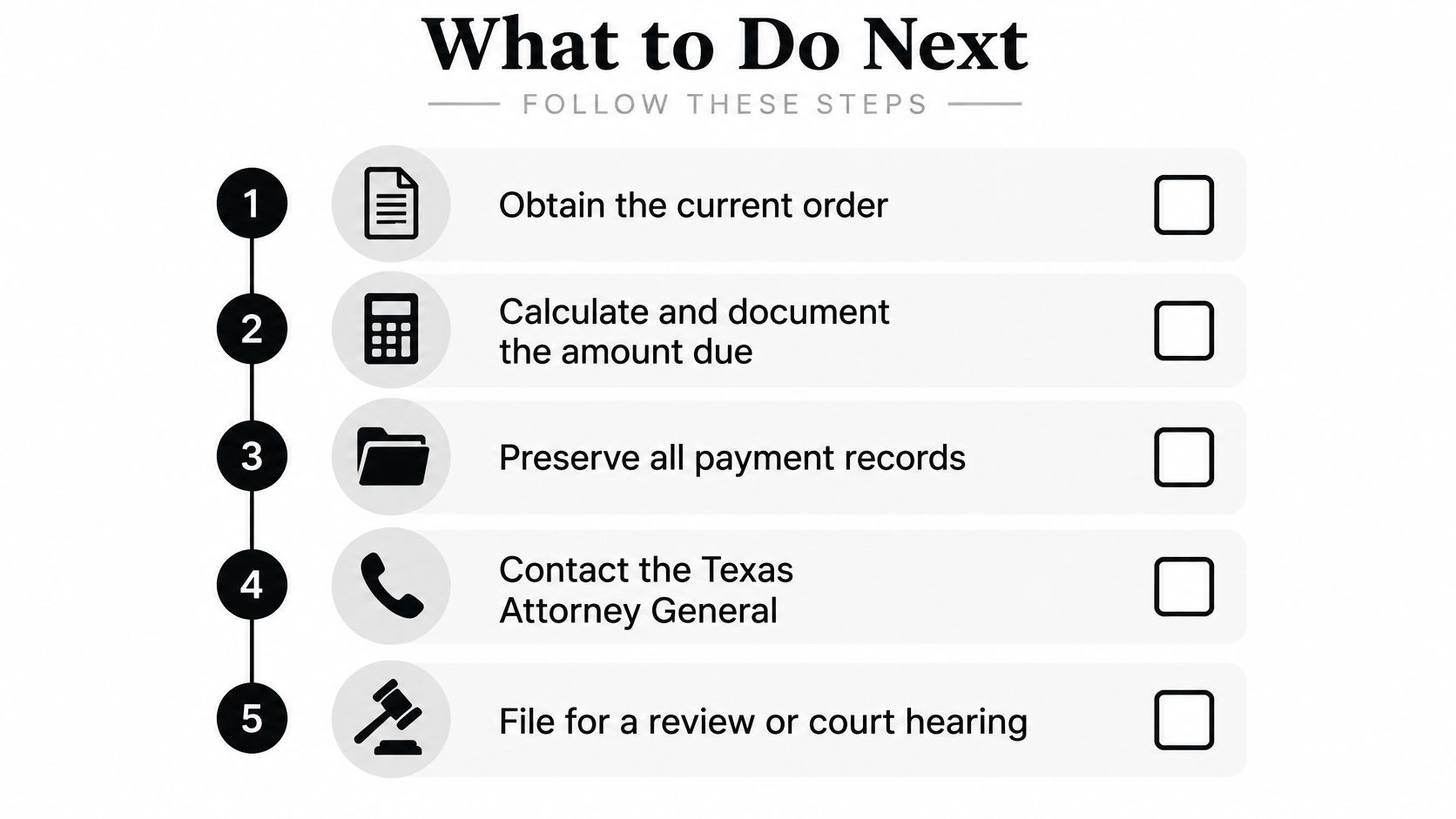
What to Do Next
Don't start by asking how to disappear from a support obligation. Start by finding out what the signed order requires and what evidence supports a change. Parents in Montgomery County who act early can put their request on a formal track and avoid relying on promises that don't alter the order.
What to do next checklist
| Checklist item | Reason it matters |
|---|---|
| Obtain the current order | Confirms the amount, due dates, and existing terms |
| Calculate and document the amount due | Helps identify missed payments and current obligations |
| Preserve all payment records | Shows what you've paid and when |
| Gather income and expense evidence | Gives the reviewer a factual picture of your finances |
| Identify the specific changed circumstance | Connects the request to the reason you're seeking a review |
| Contact the Texas child-support process or court | Starts the appropriate formal review route |
Unless and until a new order is signed, keep paying the existing amount as far as you can. Communicate directly with the other parent, but don't rely on an informal arrangement as a replacement for the court order. If you can't pay the full amount, keep a record of what you can pay and get guidance about the formal options.
A parent in Conroe who has just received a layoff notice, for example, can save the notice, collect recent pay records, and request a review instead of waiting until missed payments pile up. Families can also consult Montgomery County Family Courts: A Local Guide for information on how family law cases proceed in the courts serving The Woodlands.
This article is not legal advice. A local family-law attorney can assess your order, evidence, eligibility, deadlines, and enforcement history.
If your income has changed or you're concerned about unpaid support, consider scheduling a consultation to discuss the modification or enforcement process. The Law Office of Bryan Fagan serves families in The Woodlands and surrounding Montgomery County communities, and you can learn more at The Law Office of Bryan Fagan.