 Skip to content
A standard custody case in The Woodlands often costs $5,000 to $20,000, and many lawyers here bill $200 to $500 per hour. If the case turns high-conflict, needs experts, or goes to trial, the total can climb far beyond that range.
That's the part most parents are trying to get straight while sitting at a kitchen table in Alden Bridge, Sterling Ridge, or Creekside, looking at texts from the other parent and wondering whether they can afford to protect their time with their child. The hard truth is that custody costs in Montgomery County are tied less to the label on your case and more to what the case becomes.
A relocation fight, repeated emergency filings, discovery disputes, or a refusal to exchange basic information can push fees up fast. A focused case with realistic goals and early negotiation usually costs less. The difference is often not abstract. It comes from the number of hearings, the amount of attorney time, and whether the court needs outside professionals to weigh in.
This article is for educational purposes only and is not legal advice. Custody costs depend on your facts, the current posture of your case, and the court orders already in place.
The Financial Questions Every Woodlands Parent Asks
Most parents don't start by asking about legal theory. They ask practical questions.
Can I afford this?
Will I have to pay everything up front?
What happens if the other parent turns this into a war?
Is there any way to keep the case from swallowing my savings?
Those are the right questions.
A parent in Panther Creek might come in thinking the issue is simple: set a workable possession schedule and move on. Then the other parent asks to move farther away, challenges school placement, or accuses the first parent of being unreliable. The case that looked manageable starts collecting new moving parts.
What clients usually mean when they ask about cost
They're usually asking three different things at once:
- What will I pay to hire a lawyer
- What other bills come with the case
- What behavior makes the total number jump
That third question matters most in The Woodlands. In many Montgomery County custody cases, the bill increases because parents stop solving problems directly and start documenting every disagreement for court. Sometimes that's necessary. Sometimes it's expensive noise.
Practical rule: The more your case depends on proving disputed facts, the more you should expect the budget to rise.
Texas courts decide custody issues based on the best interest of the child. That basic standard appears in the Texas Family Code. If you're asking to change existing orders, the Texas Family Code also requires proof of a material and substantial change in many modification cases. That legal burden often drives cost because proof takes time, records, witnesses, and sometimes experts.
The real issue is predictability
Parents can handle a difficult situation better when they understand where the money goes. They struggle when every invoice feels like a surprise.
That's why the useful question isn't only “how much does a custody case cost the woodlands tx.” It's also: what actions make this case leaner, and what actions make it balloon?
Understanding Attorney Fee Structures in Montgomery County
A parent may walk into an initial consultation expecting to ask one question about price and leave with a harder one: what kind of case is this likely to become? In Montgomery County, fee structure matters because the billing model reacts to conflict. A disagreement over pickup times may stay manageable. A relocation request, emergency allegations, or a parent who sends 60 screenshots a week usually changes the budget fast.

Most Montgomery County custody cases are billed by the hour. That is the practical reality in disputed conservatorship, possession, and modification cases because no attorney can predict at the start how many hearings, settlement attempts, discovery fights, or emergency issues will appear. If you are comparing local representation, it helps to understand what a custody attorney in Montgomery County usually handles before you compare fee terms.
Hourly billing
Hourly billing is common because custody work rarely stays confined to one task. Time is spent reviewing messages and records, preparing pleadings, meeting with the client, negotiating with opposing counsel, appearing in court, and getting ready for mediation or temporary orders hearings.
That means client conduct affects fees in a direct way.
A parent who sends one organized email with school records, medical updates, and three clear questions will usually spend less than a parent who forwards every text exchange separately and asks counsel to read all of it in real time. The same is true when a case turns hostile. If the other side files repeated motions, refuses routine scheduling agreements, or raises accusations that require a documented response, hourly fees climb because the lawyer has to answer each problem with billable work.
Cases involving relocation are a common example. A proposed move can trigger school research, map and travel analysis, revised possession schedules, witness preparation, and a much more contested temporary orders process. High-conflict behavior does the same thing. The invoice grows because the legal team has more decisions to make, more facts to verify, and more paper to produce.
Retainers and how they function
A retainer is usually an advance deposit placed in the lawyer's trust account. The firm bills time and case expenses against that deposit as work is completed. If the matter becomes more contested than expected, the client may need to replenish the retainer to keep the case moving.
That point causes confusion.
Clients sometimes hear a relatively modest starting retainer and assume they have heard the full price. In practice, the initial retainer often reflects the first phase of work, not the entire dispute. Temporary orders, expedited discovery, enforcement claims, amicus involvement, or a contested modification can change the financial picture quickly.
Flat fees and where they actually fit
Flat fees are more common in narrow assignments than in true custody litigation. They may work for reviewing a draft agreement, preparing agreed paperwork, or handling a limited uncontested matter where both parents have already resolved the main parenting terms.
They are less useful once the case depends on what the other parent does next. If one side may seek a geographic restriction, challenge school choice, request supervised possession, or oppose a move, a flat fee often stops making sense because the amount of attorney time is no longer predictable.
Read the fee agreement like a working budget
The fee agreement should answer the questions that control cost, not just list an hourly rate. Ask for direct terms in writing.
| Billing issue | What to ask |
|---|---|
| Hourly rates | Which lawyers and staff bill on the file, and at what rates |
| Retainer use | Whether fees and case expenses are charged against the deposit |
| Replenishment | At what balance level you must add funds |
| Staff division | Which tasks are handled by a paralegal and which require attorney time |
| Scope | Whether the quote covers only the opening phase or expected work through mediation or hearing |
Clients who treat the fee agreement as a case-management document usually make better spending decisions. They know when to call, what to gather before a meeting, and which fights are worth paying to have.
Budgeting for Other Essential Custody Case Expenses
A parent may feel prepared for the retainer and still get caught off guard by the rest of the bill. In Montgomery County custody cases, the expenses outside attorney time often determine whether a case stays manageable or starts draining savings.
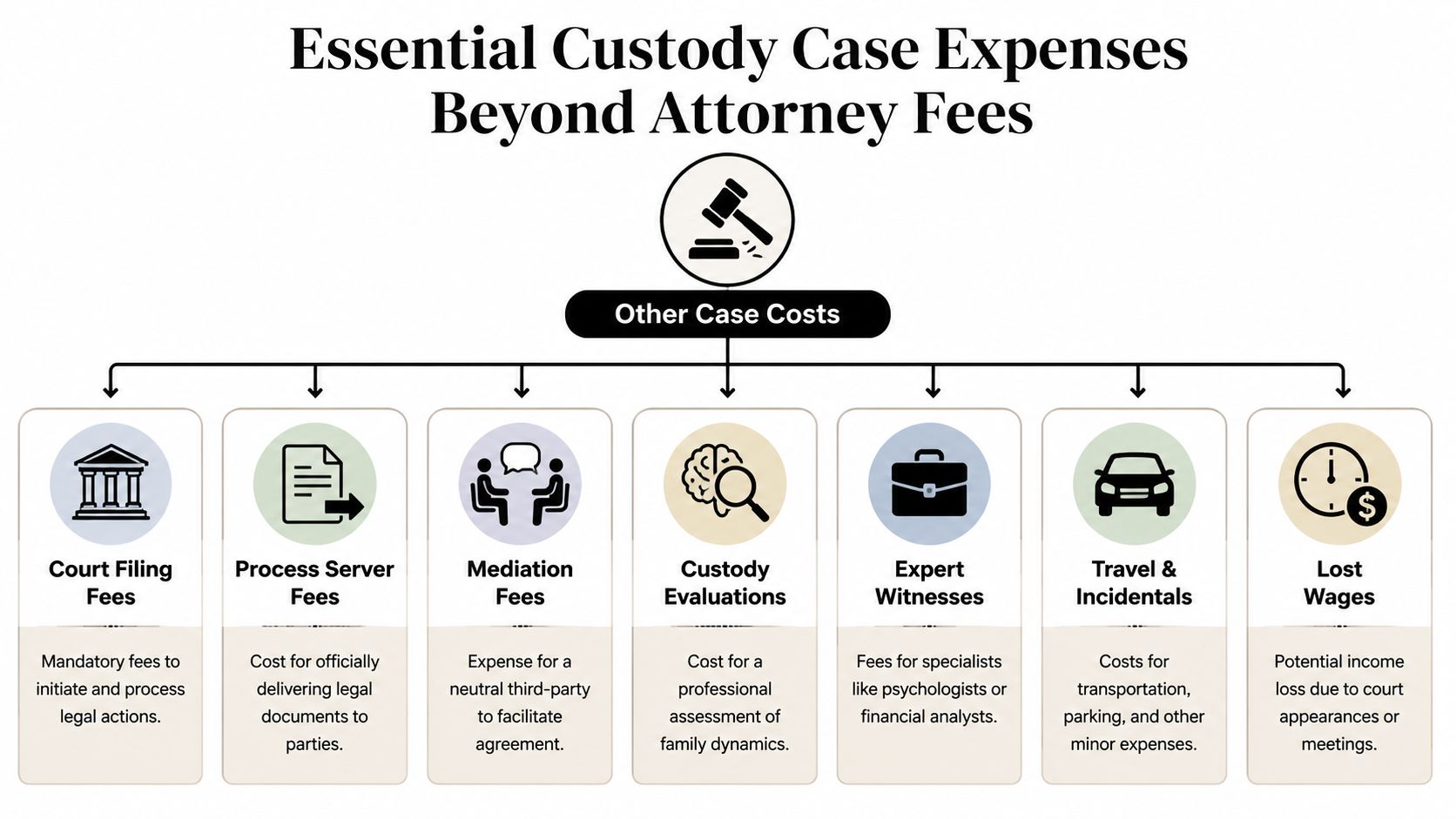
The routine costs most parents should expect
Every case has baseline case-opening expenses. Filing fees, issuance fees, service of process, certified copies, and mediation deposits often hit early, sometimes before the case has any real momentum.
Those costs usually do not decide whether a case is affordable. They do set the floor. Even parents who reach an agreement quickly still pay to get the case filed, served, documented, and finalized.
The costs that usually catch people off guard
The bigger financial jumps happen when the case needs proof from someone other than the parents. According to this breakdown of Texas custody case costs, expert witnesses such as psychologists may charge $200 to $400 per hour for an evaluation, and court-mandated mediation may cost $1,200 to $4,000 total.
In practice, those expenses show up for specific reasons, not at random. A relocation dispute may require school records, travel logistics, work schedules, and testimony about how the move affects the child's stability. A modification case may require evidence of a material and substantial change, which often means more records, more witnesses, and more preparation than a parent expected. Cases involving mental health concerns, alienation allegations, substance abuse claims, or repeated violations of temporary orders can also require outside professionals or more formal evidence gathering.
High-conflict conduct drives these costs faster than parents expect. If one parent refuses to exchange documents, ignores parenting schedules, or turns ordinary disagreements into repeated emergency filings, the case often moves toward the kind of proof-heavy dispute described in these high-conflict custody cases in The Woodlands.
The filing fee rarely breaks the budget. Paying to prove disputed facts usually does.
Why the Texas Family Code affects your spending
Courts do not change custody orders because a parent is frustrated or because communication is poor. The judge needs evidence tied to the legal standard that applies to the request.
That matters most in modification cases under Texas Family Code Chapter 156. If the issue is school choice, relocation, medical decision-making, or a request to change the primary conservator, the proof plan becomes part of the budget. School records, counseling records, social media evidence, third-party witnesses, subpoenaed documents, and professional evaluations all cost money to gather, organize, and present well.
Common non-attorney costs at a glance
| Expense category | Typical impact on budget |
|---|---|
| Filing and service | Paid near the start and usually unavoidable |
| Mediation | Adds expense early but can prevent a much larger hearing or trial bill |
| Psychological or custody-related experts | Often one of the largest added costs in fact-heavy disputes |
| Document collection and formal discovery | Increases when a parent will not share information voluntarily |
The practical question is not whether these expenses exist. It is which ones your case needs. Parents usually control costs better when they separate required spending from emotional spending and focus their money on the issues a Montgomery County judge will care about.
How Case Conflict Dramatically Impacts Your Total Cost
Conflict is the clearest cost driver in a custody case. Not emotion alone. Litigation conflict.
A parent can be upset and still keep the case efficient. A parent can also look calm while forcing unnecessary hearings, withholding records, ignoring reasonable proposals, or turning every scheduling issue into a court event. That kind of conduct raises legal fees fast.
Estimated Custody Case Costs in The Woodlands by Scenario
| Case Scenario | Estimated Total Cost Range | Key Cost Drivers |
|---|---|---|
| Standard custody case | $5,000 to $20,000 | Attorney time, filing, negotiation, hearings, overall complexity |
| Contested non-jury trial involving property and custody | $15,000 to $30,000 | Trial preparation, multiple hearings, evidence disputes, witness work |
| Jury trial involving property and custody | $30,000 to $50,000 or more | Expanded preparation, jury-related trial work, more formal evidence presentation |
The trial figures above come from this analysis of child custody lawyer costs tied to contested trials. If your case involves ongoing accusations, refusal to co-parent, or repeated litigation tactics, it helps to understand the patterns common in high-conflict custody cases in The Woodlands.
What actually makes the bill climb
The cost usually rises because conflict creates more work in layers:
- More hearings: Temporary orders, enforcement disputes, status conferences
- More preparation: Affidavits, exhibits, witness outlines, chronology building
- More evidence fights: Subpoenas, objections, records collection
- More professional involvement: Mediators, evaluators, possibly other experts
- More attorney communication: Damage control after avoidable disputes
A relocation dispute is a good example. If one parent raises the issue early, provides details, and approaches it through negotiation, the case may remain manageable. If that same issue comes up after a sudden move plan, school conflict, and emergency filings, the case usually becomes far more expensive.
A short real-world scenario
Sarah and Tom live in The Woodlands and share a child. Sarah wants to move closer to a new job opportunity and enroll the child in a different school near Creekside. Tom believes the move will disrupt his parenting time and the child's routine.
If they exchange records, discuss school logistics, and go to mediation with real proposals, they may resolve the dispute without full trial preparation. If they stop cooperating, accuse each other of bad motives, and force the judge to decide every interim issue, the budget changes dramatically.
That is how many cases move from manageable to punishing.
Parents often think the expensive part is “going to court.” In practice, the expensive part is all the work required before court when nobody narrows the issues.
What works and what fails
Here's the blunt version.
What works: identifying the one or two issues that matter, making targeted information requests, and preparing for mediation seriously.
What fails: filing to “send a message,” arguing over every exchange, and expecting the judge to solve communication problems that parents never tried to address in a structured way.
Proven Strategies to Reduce Your Custody Case Costs
Parents can't control every cost. They can control more than they think.
The most effective cost-saving strategy is usually not cutting legal corners. It's reducing unnecessary conflict while staying prepared to litigate the issues that matter.

Projections for 2026 indicate that using local resources like the Montgomery County Dispute Resolution Center and exploring flat-fee options for uncontested matters may help reduce costs that otherwise rise in high-conflict cases, based on this discussion of Texas child custody attorney fee trends.
Mediation usually costs less than unmanaged litigation
Mediation is often the best financial fork in the road. You still spend money to prepare for it, but that spending is usually directed toward resolution instead of endless escalation.
If your dispute centers on school choice, holiday scheduling, geographic restriction, or communication rules, mediation can be especially useful because those issues often have practical middle-ground solutions. Parents who arrive with a realistic proposal tend to get more value from the process than parents who treat mediation as a formality.
If you're considering that route, it helps to understand how divorce mediation in The Woodlands fits into broader family law planning.
Organization saves legal fees
Clients often underestimate how much billing comes from sorting, searching, and reconstructing events.
Do this instead:
- Create a timeline: Keep dates for moves, school changes, doctor issues, police calls, and missed exchanges.
- Group documents by topic: Medical, school, communications, prior orders.
- Use one summary email: Send your lawyer a concise issue list instead of multiple fragmented messages.
- Separate legal issues from emotional reactions: That saves attorney review time and sharpens strategy.
Support outside the courtroom can lower the temperature
Some custody disputes are really communication breakdowns with legal consequences. In those cases, counseling, co-parenting support, or structured communication tools can indirectly save money by reducing repeated flare-ups.
For couples trying to decide whether conflict can still be managed before it hardens into active litigation, this marriage counseling guide for Arizona couples offers a useful framework for recognizing when relationship stress needs structured support. It isn't Texas legal guidance, but the signs of escalating conflict are familiar.
Here's a practical video overview many families find helpful before mediation or contested hearings:
Choose the right level of representation
Not every case needs the same approach. Some parents need full litigation counsel because the risk is high. Others benefit from targeted drafting, settlement review, or mediation preparation.
Firms such as The Law Office of Bryan Fagan handle contested custody, modifications, and enforcement matters in Montgomery County, while some clients may also compare other local and regional family-law options depending on the scope of help they need.
Paying for the right task at the right time is smarter than paying for a full fight on every issue.
The Custody Case Timeline and Its Financial Impact
Custody cases rarely produce one bill for one event. Costs build in phases. Knowing that helps parents budget with more accuracy and less panic.
Filing and early orders
The first phase usually includes filing, service, initial strategy, and sometimes requests for temporary orders. The case gets framed during this stage.
If the other parent responds reasonably, early spending may stay focused. If one side seeks emergency relief, resists service, or demands immediate court involvement on multiple issues, costs start accelerating early.
Discovery and evidence gathering
Discovery is where many budgets begin to strain. Parents often assume they already know what the case is about. Then they learn they have to prove it with records, documents, and admissible evidence.
This phase can involve school records, medical records, employment issues, communication logs, and witness preparation. In modification disputes, that proof is often tied directly to the Texas Family Code requirement that the requested change be supported by legally sufficient facts rather than frustration alone.
Mediation and settlement work
Mediation tends to arrive after both sides understand the dispute more clearly. By then, each parent has enough information to evaluate risk.
That makes this phase financially important. Money spent preparing a serious mediation package often has a very different value from money spent reacting to avoidable hearing disputes. One can narrow the case. The other usually expands it.
Early settlement usually caps costs better than late settlement because less trial preparation has already been done.
Final hearing or trial
The last phase is the most expensive because it stacks on top of everything before it. Trial work usually means final witness prep, exhibit organization, legal briefing, and court time.
Even when a case settles shortly before trial, much of that preparation may already be complete. That's why two cases with the same final result can have very different totals. The one that settled after disciplined negotiation often costs much less than the one that settled only after months of brinkmanship.
What to Do Next Your Financial Planning Checklist
If you're trying to get control of the numbers, start with the facts you already have. The goal isn't to predict every dollar. It's to walk into a consultation prepared enough to get a realistic range.
Your next steps
- Gather existing orders: Bring divorce decrees, SAPCR orders, modification orders, and any enforcement paperwork.
- Collect key records: School information, medical records, important texts or emails, and calendars showing possession issues.
- Write your goals in plain English: Do you want a stable schedule, a geographic restriction, a modification, or enforcement of an existing order?
- List the actual conflict points: Relocation, schooling, missed exchanges, communication, decision-making, safety concerns.
- Set a working budget: Think in terms of what you can manage now and what happens if the case becomes contested.
- Prepare consultation questions: Ask about billing structure, likely case stages, mediation timing, and what facts would make the case more expensive.
- Focus on outcomes, not revenge: Courts care about the child's best interest. Budgets suffer when litigation becomes personal score-settling.
This article is for general education only and is not legal advice. A lawyer can only give case-specific advice after reviewing your orders, your facts, and the current procedural posture.
If you're facing a custody dispute in The Woodlands or anywhere in Montgomery County, a consultation can help you understand the likely cost drivers in your specific case and where you may be able to control them. The attorneys at The Law Office of Bryan Fagan work with families on custody, modification, enforcement, and high-conflict family law matters, and a meeting can help you build a realistic plan before costs spiral.
