 Skip to content
Ending a marriage in The Woodlands often starts the same way. One spouse has moved into the guest room, the conversations are short, and someone is up late searching, do i need a lawyer for divorce in the woodlands texas. The first shock usually isn't emotional. It's procedural. Where do you file, how long will it take, what happens to the house, and what do you do if children, stock awards, retirement accounts, or a family business are involved?
For many people in Montgomery County, the hardest part is that the divorce doesn't look dramatic from the outside. You may still be living in the same home in Sterling Ridge or driving the kids to school in Creekside Park. But behind that ordinary routine are legal decisions that can affect parenting rights, property rights, and your financial position long after the divorce is over.
Individuals typically have three practical paths. They can try to handle the case themselves, use mediation to reach an agreement, or hire an attorney to manage the process and protect their position. Which path makes sense depends less on pride and more on risk. If the facts are simple and both spouses are cooperative, one route may be workable. If the case involves children, contested assets, or a spouse who controls the finances, the calculation changes quickly.
Navigating Divorce in The Woodlands A First Look
A common local scenario goes like this. A couple in Alden Bridge agrees the marriage is over. They want to stay civil, keep costs down, and avoid a courtroom fight. Then the practical questions start. Who stays in the house for now? How will they handle the mortgage? What if one parent wants a different possession schedule? What if one spouse says a brokerage account is separate property and the other says it was built during the marriage?

Those questions matter because divorce in Montgomery County is rarely just about ending the relationship. It's about getting an enforceable result. A decree has to work in real life. It has to address schedules, decision-making, debt, property transfers, and next steps clearly enough that you don't end up back in court arguing over what it meant.
The three paths most people consider
Some spouses file on their own and hope the paperwork stays simple. Some use a mediator to help structure an agreement. Others hire counsel from the start because they know the issues are too important to leave to forms and guesswork.
Practical rule: The right question isn't whether you can file without a lawyer. It's whether you can afford the consequences of getting the details wrong.
In The Woodlands, that trade-off is sharper than many people expect. Local families often have more than a paycheck and a checking account to divide. They may have equity in a home, deferred compensation, business interests, bonus income, or children whose schedules already depend on two working parents and a carefully managed routine.
If your case is straightforward, you may not need full-scale litigation. If it isn't, legal representation stops being a luxury and starts looking like risk management.
Understanding Your Options DIY Pro Se Mediation and Litigation
The three main divorce paths in Texas are DIY or pro se, mediation, and lawyer-led litigation or negotiated representation. Each works in the right case. Each fails in the wrong one.
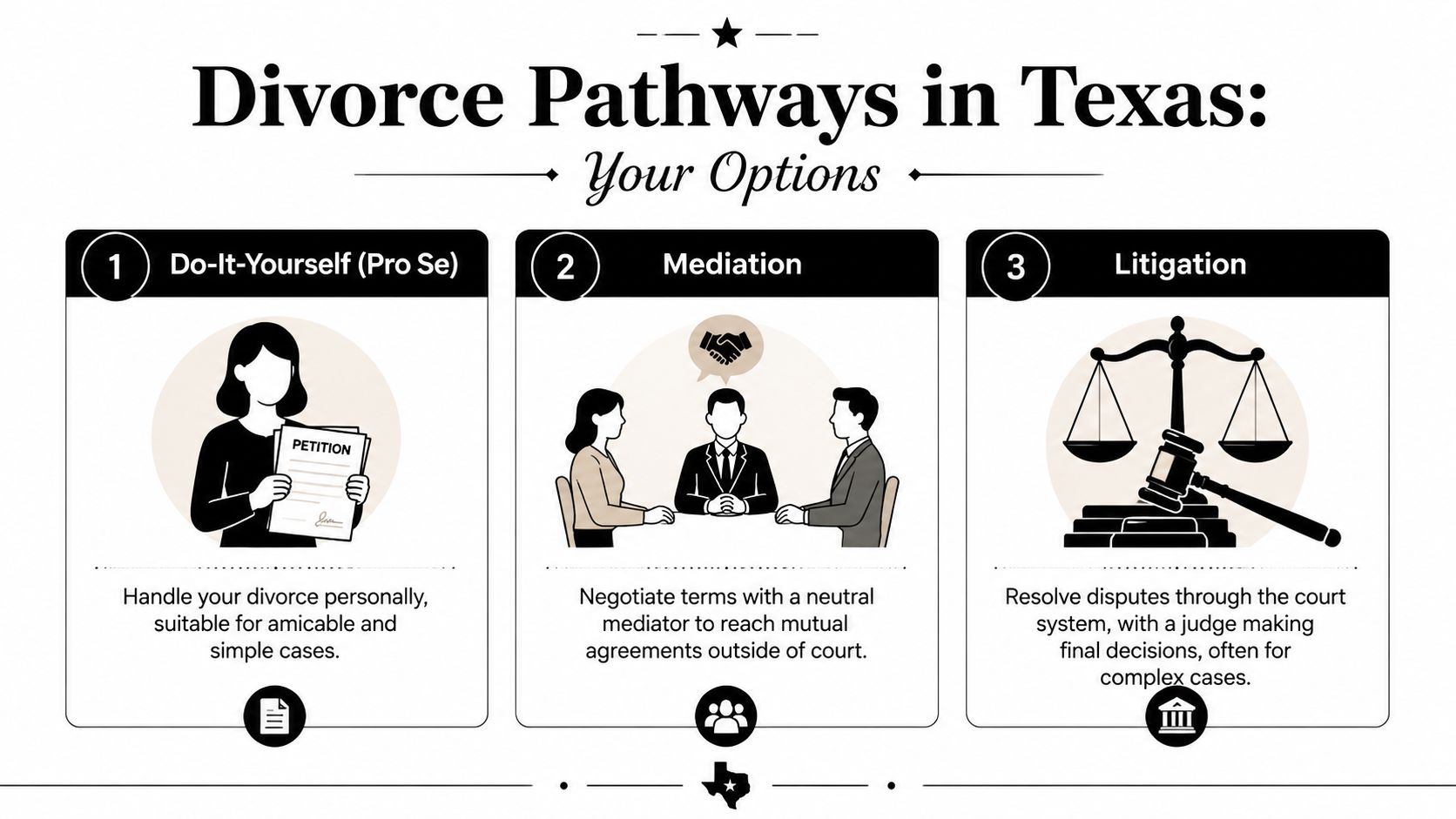
Comparing Divorce Paths in The Woodlands
| Factor | DIY (Pro Se) Divorce | Mediation | Hiring a Lawyer |
|---|---|---|---|
| Best fit | Very simple, fully cooperative cases | Couples who can negotiate but need structure | Cases with legal, financial, or parenting risk |
| Control over paperwork | You handle it yourself | Usually shared, with mediator facilitating | Attorney prepares and reviews filings and orders |
| Conflict level | Low only | Low to moderate | Moderate to high, or low conflict with high stakes |
| Complex assets | Poor fit | Sometimes workable if both sides disclose fully | Strong fit |
| Child-related issues | Risky if details are vague | Useful if both parents are realistic | Often necessary if disputes exist |
| Court advocacy | None | None from mediator | Yes |
| Main advantage | Lowest upfront spend | Can resolve disputes outside court | Protection, strategy, and enforceable drafting |
| Main problem | Procedural and drafting mistakes | Mediator cannot give either side legal advice | Higher upfront cost |
DIY works only in narrow situations
A pro se divorce can work when there are no real disputes, no meaningful asset complexity, and no hidden pressure behind the agreement. That means more than "we're getting along this week." It means both spouses understand the property, agree on the children if children are involved, and can follow court procedures without missing required steps.
DIY tends to break down when the facts are more layered than they first appear. Retirement accounts, reimbursement claims, restricted stock, and separate-property assertions can turn a "simple" agreement into a defective one very quickly.
Mediation can be efficient, but it has limits
Mediation is often a practical middle ground. A neutral mediator helps the parties negotiate and narrow disputes. In many cases, that keeps the temperature down and avoids unnecessary hearings.
But mediation only works when both spouses are negotiating from roughly equal footing. If one person doesn't know the finances, feels intimidated, or doesn't understand the legal effect of proposed terms, mediation can produce a signed deal that creates long-term problems.
If you're trying to prepare for mediation or organize records from hearings and conferences, tools that compare legal transcription services can help you think through how to preserve testimony and meeting notes accurately. That's not a substitute for legal advice, but it can be useful when records matter.
For readers considering a cooperative process, this overview of divorce mediation in The Woodlands explains how mediation fits into local family law practice.
Hiring a lawyer is about more than fighting
Many people assume hiring a divorce lawyer means preparing for war. In practice, good representation often does the opposite. It narrows issues, drafts cleaner proposals, catches bad assumptions early, and strengthens their position for settlement because the other side knows someone is tracking deadlines, evidence, and legal standards.
A lawyer's value isn't limited to trial. In many divorces, the most important work happens before anyone steps into a courtroom.
A lawyer-led case is usually the right path when any of these are true:
- Children are involved: Parenting plans need precision, not broad promises.
- The assets are substantial or mixed: Homes, retirement accounts, equity compensation, and business interests require careful characterization.
- One spouse controls the money: Disclosure issues can shape the entire case.
- Trust is low: Even an "agreed" case can unravel if one side delays, withholds, or changes positions.
Key Risk Factors That Demand Legal Representation
Some divorces are too risky for self-representation. That's especially true in The Woodlands, where a case may involve a custom home, investment accounts, a closely held business, or a compensation package that doesn't fit neatly into a standard form.

Under Texas law, property division and child-related provisions are not casual matters. Even in an uncontested divorce, legal representation can materially change the outcome because Texas courts still must review the decree, ensure any child-related provisions satisfy the child's best-interest standard, and confirm the property split is a “just and right” division under Texas community property rules, as discussed in this article on whether you have to go to court for divorce in The Woodlands. The Texas Family Code also frames these issues directly, including the best interest of the child standard in Texas Family Code Section 153.002 and the court's authority to divide the marital estate in a manner the court deems just and right in Texas Family Code Section 7.001.
Parenting disputes and uneven bargaining power
If you and your spouse disagree about conservatorship, possession, decision-making, school choice, counseling, or relocation, you need legal advice. These aren't side issues. They shape your daily life with your child for years.
The same is true if one spouse is more forceful, more informed, or more financially secure. An agreement reached under pressure can still become a signed order.
High-asset and mixed-property cases
In The Woodlands, many couples own property that doesn't divide cleanly. One spouse may claim the down payment on a home came from separate funds. A brokerage account may contain both premarital and marital contributions. A business may have grown during the marriage even if it started before it.
Those facts matter because Texas distinguishes between community property and separate property. A spreadsheet is not enough. The paper trail matters. So does the wording in the decree.
Short real-world scenario
A husband and wife in Panther Creek agree to an uncontested divorce. They own a home, several investment accounts, and one spouse received a year-end bonus after separation but before the divorce was finalized. They assume the house will be sold and the accounts split evenly, so they use a form decree.
The problem appears later. The decree doesn't clearly address the bonus, doesn't identify which accounts are community versus separate, and doesn't spell out who is responsible for a home-equity line used during the marriage. What looked simple on paper becomes a post-divorce enforcement and interpretation problem.
If a decree leaves room for argument, the argument usually happens at the worst possible time, after the divorce is final and the leverage has changed.
Hidden income, business records, and incomplete disclosure
If you suspect your spouse is understating income, delaying production of records, or moving money between accounts, don't treat that as a paperwork issue. It's a case strategy issue. Discovery, subpoenas, and document review may be necessary. Mediation without reliable information is often just educated guessing.
Family violence or intimidation
If there has been family violence, threats, stalking, coercive control, or serious intimidation, the priority changes from efficiency to protection. Safety, temporary orders, possession schedules, and communication boundaries need legal handling. In those cases, trying to stay "amicable" can expose you to avoidable harm.
What to Expect from The Woodlands Divorce Timeline
The local timeline matters because people often plan around a best-case scenario that isn't realistic once the file reaches court.
Texas imposes a mandatory 60-day waiting period before a divorce can be finalized, starting when the petition is filed, as explained by Hannah Law's discussion of divorce in The Woodlands. In practice, that minimum often stretches much longer when spouses disagree about custody, property division, support, or business assets. Uncontested cases may resolve relatively quickly, while contested divorces can take several months.
The filing stage in Montgomery County
For The Woodlands residents, the case typically proceeds in Montgomery County district court if venue and residency are proper. The first filing starts the clock, but it doesn't guarantee a fast finish. The court still has to review the final paperwork, confirm the case belongs in that court, and sign an enforceable decree.
Early case decisions can shape the whole timeline:
- Temporary arrangements: If the parties can't agree on who stays in the house, who pays what, or how the children will move between homes, temporary orders may be needed.
- Service and response: A delay here can push everything back.
- Information gathering: The more complicated the finances, the more likely formal discovery becomes necessary.
What slows cases down
The biggest delays usually come from disputes that require evidence, not opinion. A spouse may need account records, employment compensation documents, business records, appraisals, or a clear tracing analysis for claimed separate property.
A second source of delay is poor drafting. If the agreement doesn't address transfer steps, debt allocation, or parenting logistics clearly, the court may not accept it as written, or the parties may need revisions before finalization.
For a practical local overview, this guide on how long divorce takes in The Woodlands gives useful context about the process.
A realistic sequence
Most cases move through a sequence that looks something like this:
- Petition filed and the waiting period begins.
- Other spouse responds or signs a waiver, depending on the case posture.
- Temporary issues get handled if needed.
- Financial and parenting information is exchanged.
- Settlement efforts or mediation take place if the case is not ready for final hearing.
- Final decree is reviewed and entered, either by agreement or after a contested hearing or trial.
The court process rewards preparation. Parties who organize records early and resolve temporary issues quickly usually put themselves in a better position to settle cleanly.
The timeline in your case will turn on the facts. A calm, well-documented case can move steadily. A case involving children, business assets, or incomplete disclosure usually takes longer because the court needs enough information to enter orders that will hold up.
Typical Costs and Fee Structures for a Divorce Lawyer
Divorce in The Woodlands can appear affordable initially but may become costly when the actual work begins. This occurs frequently in Montgomery County cases involving a home with significant equity, bonuses or stock compensation, a family business, or a dispute over temporary parenting plans. The total legal cost typically corresponds to the level of procedure the case demands.
Most family lawyers here charge a retainer plus hourly fees. The retainer is deposited into a trust account, and fees are billed as documents are drafted, records are reviewed, hearings are prepared, and negotiations are handled. In a straightforward agreed case, that can stay fairly contained. In a case that needs temporary orders, formal discovery, business valuation work, or multiple rounds of decree revisions, the cost rises because the attorney is spending real time preventing expensive mistakes.
What tends to increase fees in Montgomery County
Local court procedure matters. A case that requires a hearing on temporary possession, support, use of the home, or payment of community debts will cost more than one that reaches settlement without court intervention. The same is true if one spouse has incomplete financial records or if separate property claims require tracing.
Cost drivers usually include:
- Temporary orders work: Preparing affidavits, exhibits, proposed orders, and hearing strategy.
- Financial investigation: Reviewing account statements, compensation records, retirement assets, brokerage accounts, and business documents.
- High-asset drafting: Building a decree that covers sale procedures, refinance deadlines, QDRO-related issues, reimbursement claims, and tax-sensitive transfers.
- Parenting disputes: Cases involving school choice, possession schedules, travel, extracurricular allocation, or decision-making rights often require more attorney time than parents expect.
- Cleanup work: Vague settlement terms often lead to redrafting, enforcement problems, or post-divorce litigation.
In The Woodlands, the decree itself is often where value is earned. A short agreement may look efficient, but if it fails to spell out who signs what, who pays which debt, how retirement funds are divided, or how parenting exchanges work, the savings disappear fast.
A better way to evaluate fees is to compare them against the cost of getting the order wrong. Dividing restricted stock incorrectly, missing a tracing issue, leaving debt language ambiguous, or signing off on a parenting plan that does not fit the child's actual schedule can create problems that are harder and more expensive to fix later.
For a local breakdown of divorce lawyer costs in The Woodlands, review the fee discussion in more detail. It also helps to ask practical questions during consultations about billing increments, replenishment of the retainer, paralegal rates, mediation preparation, and who drafts the final decree. Clients who spend time understanding client attorney expectations usually make better comparisons between lawyers because they know what service, communication, and case management should look like.
How to Prepare for a Divorce Consultation
The first consultation should answer two questions. Is this lawyer a good fit for your case, and are you ready to move in a way that protects your finances and your children?

In Texas, this decision often turns on procedure as much as conflict. Texas requires at least one spouse to have lived in the state for six months and in the county for 90 days before filing, and for The Woodlands that typically means Montgomery County district court, as explained in this overview of the divorce process in The Woodlands. A lawyer can also verify venue and look for issues involving military service or out-of-state domicile.
What to bring
Bring enough information to let the lawyer spot risk early.
- Basic case facts: Marriage date, separation status, children, current living arrangements.
- Financial documents: Recent tax returns, pay stubs, bank statements, retirement statements, mortgage information, and business records if applicable.
- Property list: Home, vehicles, brokerage accounts, restricted stock, debts, and anything either spouse claims is separate property.
- Existing orders or agreements: Prenups, protective orders, prior custody orders, or informal written agreements.
What to ask
Don't use the consultation only to tell your story. Use it to test how the lawyer thinks.
Consider asking:
- How would you handle temporary issues in my case?
- Do you see any immediate filing or venue problems?
- What parts of my asset picture concern you most?
- Would you push early mediation, targeted discovery, or both?
- What should I avoid doing right now?
If you're not sure what a good attorney-client fit looks like, this article on understanding client attorney expectations is a useful starting point.
Bring organized records, not boxes of loose paper. A lawyer can assess risk faster when the facts are readable.
What to do next
- Pick two or three local attorneys: Focus on family-law lawyers who regularly handle Montgomery County cases.
- Gather core documents first: Start with the records that show income, assets, debt, and the children's routine.
- Write down your goals: Keep it short. House, parenting schedule, support, business protection, or a fast resolution.
- List your worries separately: Hidden money, relocation, a spouse's volatility, or confusion about separate property.
- Do not sign a rushed agreement: Especially if you haven't had legal review.
Frequently Asked Questions About Divorce in The Woodlands
Can we use one lawyer for both spouses?
No single divorce lawyer should represent both spouses in a contested or potentially contested divorce. The reason is simple. Your interests may diverge even if you both want a peaceful outcome. One lawyer can draft documents for one side in an agreed case, but that lawyer does not become a neutral advisor for both people.
We live in Creekside Park but my spouse works in Houston. Where do we file?
Work location usually isn't the controlling issue. Residency and county filing rules matter more. If you live in The Woodlands and meet the local filing requirements, the case will typically be filed in Montgomery County. A lawyer should confirm venue before filing because filing in the wrong place can create delay and unnecessary expense.
Do I need a lawyer if we agree about the kids?
Maybe not, but agreement alone doesn't eliminate risk. Parenting orders need details about possession, decision-making, exchanges, holidays, communication, and dispute resolution. If those terms are vague, the conflict often shows up later when schedules tighten or one parent starts interpreting the order differently.
What if we own a business or one spouse has irregular compensation?
That's a strong sign you should get legal advice. Business income, bonuses, commissions, and equity compensation create valuation and characterization issues that don't fit generic forms well. Even when the case settles, the settlement has to be drafted in a way that can be implemented.
Can mediation solve a high-asset divorce?
Sometimes, yes. But only if both spouses have enough information to negotiate intelligently and the final deal is translated into strong written terms. In many high-asset cases, the most effective approach is not "mediation instead of lawyers." It's mediation with each spouse having legal advice before signing.
Is this article legal advice?
No. This article is general information, not legal advice, and it does not create an attorney-client relationship. Texas family-law outcomes depend on the specific facts, the court involved, and the wording of the orders.
If you're weighing whether to handle your divorce yourself or bring in counsel, a consultation can help you identify the risks before they become expensive problems. The attorneys at The Law Office of Bryan Fagan work with families in The Woodlands and across Montgomery County on divorce, custody, child support, and property division matters. If you'd like to discuss your situation privately, scheduling a consultation is a practical next step.
