 Skip to content
If you're reading this from a kitchen table in The Woodlands after another argument about pickup time, soccer practice, school choice, or a last-minute schedule change, you're not alone. Many parents start with one recurring disagreement and then realize the problem is bigger than a missed exchange or a rude text. The conflict starts shaping every decision, every conversation, and every week with the children.
That’s when a normal custody disagreement starts turning into something more serious.
In Montgomery County, high conflict custody cases often involve a pattern. The parents can’t communicate without hostility. One parent ignores the order. A child gets pulled into adult issues. Allegations start flying. A relocation threat appears. Remote work makes one parent think a move within or outside The Woodlands should be easy, while the other parent sees it as an attempt to disrupt school, routines, and access.
In communities like Panther Creek, Alden Bridge, Sterling Ridge, and Creekside, these cases can look polished from the outside. The parents may both be employed, both involved, and both able to present well in court. But judges don’t decide cases based on who seems more polished. They look at conduct, credibility, documentation, and whether a parent is helping or harming the child’s stability.
Introduction Is Your Custody Case Considered High-Conflict
A parent in Creekside Park might text the other parent about a school event. By the end of the day, the exchange has turned into accusations about medical decisions, threats to “go back to court,” and complaints sent through the child. That doesn’t mean every difficult co-parenting issue is high conflict. It does mean the case may be heading there.

High conflict custody the woodlands cases usually involve persistent conflict, not a single bad week. The legal problem is the repeated pattern. Courts and attorneys start treating a case differently when ordinary communication has broken down and the conflict is affecting parenting decisions or the child’s well-being.
Common signs the case is beyond ordinary disagreement
Some warning signs show up early. Others only become obvious after months of failed exchanges and repeated disputes.
- Constant hostility in communication: Every text, email, or app message becomes an argument.
- Repeated threats of court action: One or both parents use litigation as a routine tactic.
- Order violations: Missed exchanges, withheld visitation, refusal to share information, or unilateral decisions.
- Children used as messengers: A parent relays adult complaints through the child instead of communicating directly.
- Serious allegations: Claims involving abuse, substance misuse, neglect, or manipulation often push a case into a different category.
- School and medical conflict: Parents can’t agree on treatment, counseling, enrollment, or extracurriculars.
- Modification pressure: One parent wants to change the order because work, residence, or the child’s schedule has changed.
High conflict cases don’t improve because one parent writes a longer text. They improve when a parent gets disciplined, organized, and strategic.
What high conflict usually looks like in practice
A high conflict case often has two features at the same time. First, the parents have a hard time making even minor decisions together. Second, the conflict spills over into the child’s day-to-day life.
That can mean arguments over drop-off locations in The Woodlands. It can mean one parent trying to control every detail of the other parent’s household. It can also mean a parent who seems calm in court but creates chaos through constant messages, accusations, and pressure outside court.
Not every difficult ex is a legal emergency. But not every problem should be “worked out between you” either.
What does not work
In these cases, some instincts backfire.
- Writing emotional essays by text: Judges don’t reward volume.
- Arguing in front of the child: That hurts your credibility and your child.
- Posting online: Social media usually creates more evidence against the person posting than against the other parent.
- Ignoring small violations for too long: A pattern becomes harder to prove when nothing is documented.
If any of this sounds familiar, your case may need a more structured approach than ordinary co-parenting advice.
The Best Interest of the Child Standard in Montgomery County
In Texas custody law, the central rule is simple. The child’s best interest comes first. Texas Family Code § 153.002 makes that the primary consideration in conservatorship, possession, and access decisions.
That phrase sounds broad because it is. But in court, it becomes practical. A judge in Montgomery County isn’t deciding which parent “wins.” The judge is deciding what arrangement best supports the child’s emotional and physical welfare, long-term stability, and healthy development.
How judges apply the standard in real life
Parents often think the issue is fairness between adults. Court usually sees it differently. The focus stays on the child’s needs.
A judge may look at questions like these:
| Consideration | What it means in practice |
|---|---|
| Child’s stability | Which home better supports routines, school attendance, and consistency |
| Emotional needs | Which parent responds appropriately to the child’s age, stress, and adjustment needs |
| Decision-making | Whether the parents can handle school, medical, and extracurricular issues responsibly |
| Parenting conduct | Whether a parent encourages the child’s relationship with the other parent or interferes with it |
| Safety concerns | Whether there are credible concerns about harm, instability, or dangerous behavior |
These are often discussed through the lens of the factors Texas courts commonly consider in custody cases. Parents don’t need to memorize legal labels. They do need to understand how daily conduct becomes courtroom evidence.
What matters more than parents expect
A parent may believe the court will focus on who has the nicer house in The Woodlands or who earns more money. Usually, that’s not the deciding issue. Judges care more about follow-through, stability, judgment, and whether a parent protects the child from conflict.
That means practical habits matter:
- getting the child to school on time
- following medical advice
- using calm communication
- avoiding adult discussions with the child
- keeping routines consistent
Practical rule: In a high conflict case, the parent who looks organized, child-focused, and steady usually stands in a better position than the parent who looks angry, reactive, or controlling.
Children need legal stability and emotional support
The legal case is one part of the problem. The child still has to live through the conflict. That’s why many parents benefit from adding age-appropriate emotional support outside the courtroom. For younger children especially, simple tools like age-appropriate coping skills for kids can help reduce stress while the legal process moves forward.
That kind of support doesn’t replace legal action when legal action is needed. It does help parents keep the focus where the court wants it. On the child.
A Montgomery County perspective
In Montgomery County, judges see many parents who both love their children and still cannot co-parent effectively. The case often turns on which parent is more likely to reduce conflict, follow court orders, and support the child’s relationship with the other parent where appropriate.
That’s why “I’m the better parent” is rarely enough. The stronger position is usually, “Here is what I’ve done, here is what I can prove, and here is how this supports my child’s best interest.”
Legal Remedies and A Real-World Scenario
A parent in Panther Creek learns on a Thursday afternoon that the other parent plans to move the child to another part of the county and enroll the child in a different school the following week. The current order requires joint decision-making on education. The parent making the move says remote work changed everything and the child will “adjust.”
That’s not the time for a long argument by text. It’s the time to match the problem to the correct legal remedy.

A short real-world scenario
Assume the parents live in The Woodlands and already have final orders. The child attends school nearby, has established activities, and has a weekly possession schedule. One parent decides a new work arrangement gives them freedom to relocate and change the plan without agreement.
By Friday morning, the other parent has several urgent questions:
- Can the move be stopped right away?
- Is this a violation of the current order?
- Should the parent file enforcement, modification, or both?
- What proof will the judge want first?
The answer depends on timing, wording in the current order, and the level of immediate risk to the child’s stability or safety.
The legal tools that may apply
Temporary restraining orders and emergency relief can be used when immediate court intervention is needed to preserve the status quo or prevent imminent harm. In relocation or school-change disputes, the goal is often to stop unilateral action before the child is moved or the existing arrangement is disrupted.
Enforcement actions are used when a parent has violated an existing order. If the current order is clear and one parent ignored it, enforcement may be the right tool. These cases often turn on precision. The date, time, language of the order, and proof of violation all matter.
Later in the case, if circumstances have genuinely changed, a parent may seek modification. Under Texas Family Code § 156.101, a parent must prove a material and substantial change in circumstances to modify a prior custody order. That standard sits at the center of many high conflict cases in Montgomery County.
A change in work structure may matter. But saying “I work remotely now” does not automatically justify changing the child’s school, primary residence terms, or possession schedule.
What works and what usually fails
Parents often hurt their case by choosing the wrong fight. If the problem is a direct violation of the current order, enforcement may be stronger than immediately asking for broad new orders. If the facts have changed over time, modification may be appropriate. Good strategy starts with identifying which one the evidence supports.
What usually works:
- Moving fast when the issue is urgent
- Bringing the current order to the attorney immediately
- Preserving all communications about the move or school change
- Focusing on the child’s schedule, school, and stability instead of personal outrage
What usually fails:
- Threatening the other parent without filing anything
- Withholding the child in response
- Making unsupported allegations
- Treating a legal standard like a moral argument
For some families, the conflict also exposes deeper emotional issues in the household. If a child or parent is showing signs of trauma response, outside support such as Altura Recovery on trauma treatment can help a family stabilize while the court process unfolds.
The courtroom process also helps to hear explained clearly. This overview is a useful starting point:
Remote work has changed some custody fights
In The Woodlands, remote and hybrid jobs have changed how parents think about custody modifications. A parent may assume that because they no longer commute daily, the order should change too. Sometimes there is a valid basis to revisit the schedule. Sometimes there isn’t.
The key issue is not whether a parent’s life became more convenient. The issue is whether the circumstances changed in a way the court recognizes and whether the requested change serves the child.
Don’t file a modification because your life changed. File it only if the facts support that the child’s arrangement should legally change too.
The Two Arenas Mediation vs Montgomery County Litigation
Most high conflict custody cases in Montgomery County move through one of two arenas. Mediation or litigation. Many parents hope they can avoid court. Some can. Some can’t.
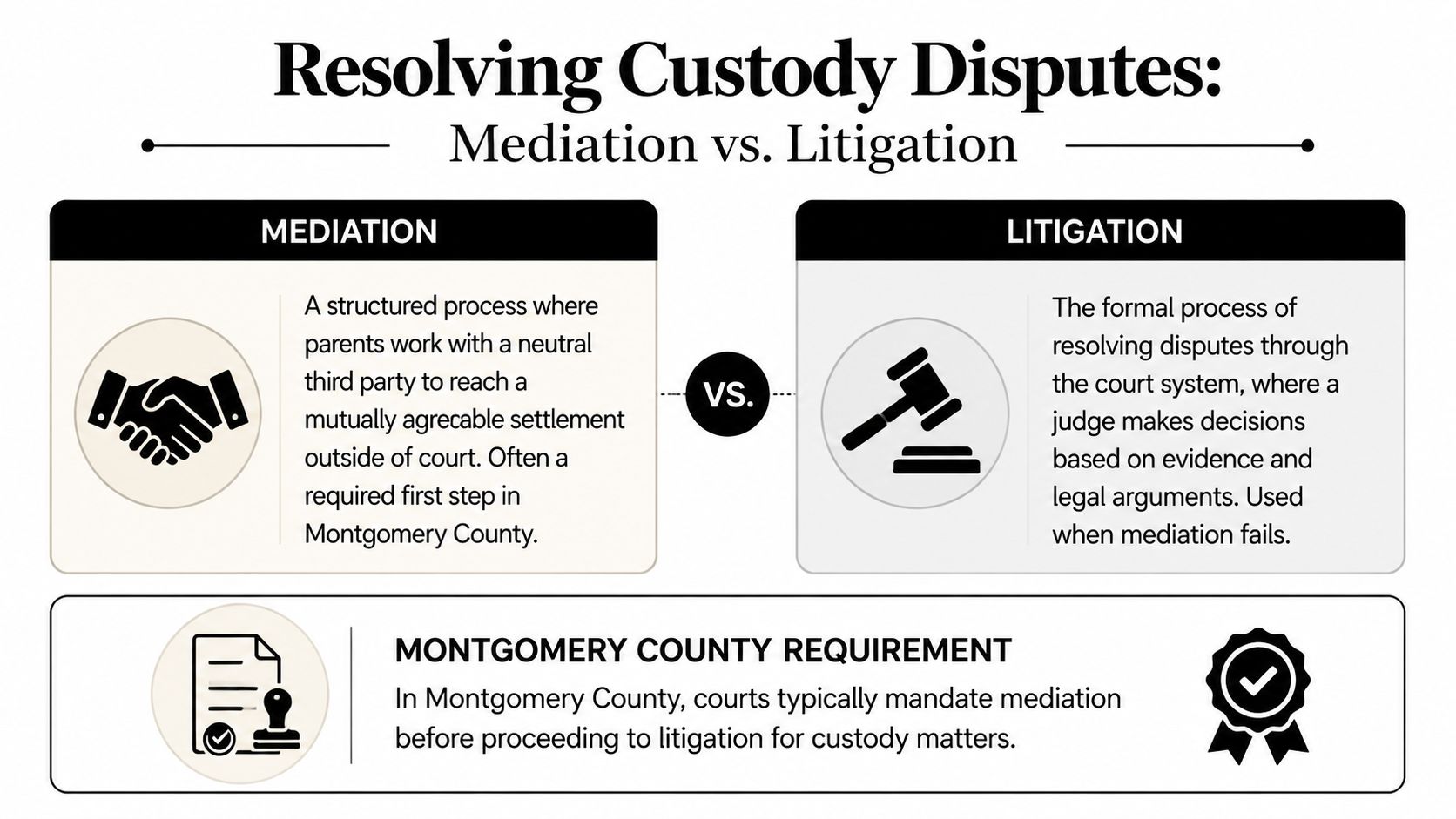
Mediation is often required before a final trial in custody matters. It gives parents a structured setting to try to resolve disputes with a neutral third party. Litigation is the formal court path, where a judge decides disputed issues based on evidence, testimony, and legal argument.
Mediation can work, but only under the right conditions
Mediation is useful when both parents have at least some ability to negotiate in good faith. It can offer more privacy, more control over the outcome, and more room to customize details than a trial setting.
Still, high conflict cases bring special problems into mediation:
- one parent may dominate the process
- one parent may refuse reasonable compromise
- old emotional injuries may control the discussion
- practical issues may get buried under blame
A mediated agreement can be very effective if the terms are specific and enforceable. A vague settlement in a high conflict case usually creates the next lawsuit.
Litigation is slower, more formal, and sometimes necessary
If one parent won’t cooperate, keeps violating orders, or uses negotiation only to delay, litigation may be the cleaner path. Court has rules. Deadlines matter. Evidence matters. A judge can impose structure where the parents cannot create it themselves.
That doesn’t mean trial is easy. It’s expensive in energy, time, and attention. It also gives control of the final outcome to the judge.
Parents who are considering settlement often benefit from learning more about divorce mediation in The Woodlands, Texas so they can understand what mediation is designed to do and when it may not be enough.
Mediation vs. Litigation in High-Conflict Custody
| Factor | Mediation | Litigation (Court) |
|---|---|---|
| Decision maker | Parents control the agreement if they reach one | Judge decides disputed issues |
| Privacy | More private than open-court proceedings | Formal court setting |
| Flexibility | High. Terms can be tailored in detail | Lower. Relief is shaped by legal rulings |
| Speed | Can resolve issues faster if both sides participate honestly | Often slower because of hearings, discovery, and docket timing |
| Suitability for severe conflict | Limited if one parent manipulates or refuses to negotiate | Often necessary when conflict blocks meaningful compromise |
| Enforcement strength | Strong if the agreement is clear and reduced to proper orders | Court orders are enforceable through the legal system |
Some parents go into mediation to solve problems. Others go in to perform reasonableness. Your attorney’s job is to tell the difference quickly.
The trade-off most parents miss
Many people think mediation is always better because it sounds calmer. That isn’t always true. In some high conflict cases, mediation only gives the more difficult parent another chance to stall, pressure, or distort the facts.
On the other hand, parents sometimes assume trial is the stronger option because it feels decisive. But if a carefully negotiated settlement can protect the child and give you enforceable terms, it may be the smarter result.
The right arena depends on the facts, the personalities, and the evidence.
Proving Your Case How to Use Evidence and Discovery
In high conflict custody litigation, the better story doesn’t usually win. The better proof does.
A parent may say the other side is manipulative, dishonest, or unstable. That may even be true. But if the evidence is scattered across a phone, mixed with emotional commentary, and missing dates, it won’t help much in court.
Start with evidence you already have
Most parents already possess useful evidence before they hire counsel. They just haven’t organized it in a way a judge can follow.
Focus first on records that show conduct over time:
- Messages and emails: Save complete threads, not selected screenshots that remove context.
- School records: Attendance, notices, teacher emails, and enrollment communications often matter.
- Medical information: Appointment records, recommendations, missed visits, and prescription issues may be important.
- Exchange problems: Keep a timeline of missed pickups, late returns, or refusal to produce the child.
- Photos and documents: Only keep what is relevant and authentic.
One category deserves special attention. Records from court-approved co-parenting communication tools are often given significant weight by judges because they provide a verifiable, unalterable log of interactions between parents. If your order requires a platform such as OurFamilyWizard, TalkingParents, or a similar tool, use it carefully. Assume every message may be reviewed later.
Write every app message as if a Montgomery County judge will read it next week.
Discovery is how lawyers get the rest
Once a case is filed and moving, formal discovery allows each side to request information from the other, frequently making high conflict cases more evidence-driven and less rumor-driven.
Here are the main tools, in plain English:
| Discovery tool | What it does |
|---|---|
| Interrogatories | Written questions the other side must answer under oath |
| Requests for production | Demands for documents, records, messages, photos, and other materials |
| Requests for admission | Statements the other side must admit or deny |
| Depositions | In-person or remote sworn testimony taken before trial |
Each tool serves a different purpose. Interrogatories can lock in a position. Production requests can uncover records. Depositions can expose inconsistencies and test credibility.
How to document in a way that helps your case
Parents often make one of two mistakes. They either save nothing, or they save everything in a disorganized pile. Neither approach works well.
Use a simple system:
- Create a case folder with subfolders for school, medical, communications, orders, and incidents.
- Keep a dated timeline of major events. Short, factual entries work best.
- Preserve original files whenever possible instead of forwarding or retyping them.
- Avoid commentary in your notes that sounds sarcastic, speculative, or vindictive.
- Match each claim to a document before repeating it to your lawyer or in court.
A strong entry in a case journal might say: “March 12, exchange set for 6:00 p.m. at agreed location. Other parent arrived at 7:05 p.m. No notice beforehand. Screenshot saved.” That is useful.
A weak entry says: “He ruined everything again because he only cares about control.” That may reflect your feelings, but it doesn’t prove a violation.
What not to do with evidence
Do not alter screenshots. Do not record selectively if it changes context. Do not coach the child to make statements. Do not flood your attorney with hundreds of pages of irrelevant material and expect the important facts to stand out on their own.
Evidence becomes persuasive when it is relevant, chronological, and connected to a legal issue. That’s what discovery is for. It turns conflict into facts the court can evaluate.
Your Team An Attorney and the Local Court System
High conflict custody cases aren’t handled by one person alone. Even when you are the parent at the center of the dispute, the case often involves a wider team. That may include your attorney, opposing counsel, a mediator, a therapist, school personnel, and in some cases an amicus attorney or another court-appointed professional.

Why local court knowledge matters
A lawyer with experience in Montgomery County family court understands more than statutes. Local practice matters too. Judges have expectations about preparation, tone, proposed orders, evidence presentation, and how parents should behave during the case.
That matters in hearings involving The Woodlands families because these cases often move fast once they become urgent. A local attorney is more likely to anticipate procedural issues and present the facts in a way the court can use.
If you’re preparing for contested proceedings, this overview of a child custody hearing in Montgomery County can help you understand the setting and stakes.
The role of an amicus attorney
In contentious cases, a judge may appoint an Amicus Attorney under Texas Family Code § 107.001. That lawyer serves as the “eyes and ears” of the court and advocates for the child’s best interests.
Parents sometimes misunderstand this role. The amicus attorney is not your lawyer. The amicus attorney is not the other parent’s lawyer either. The job is to gather information, evaluate the family situation, and help the court understand what arrangement best serves the child.
That can include reviewing records, speaking with parents, interviewing the child when appropriate, and contacting teachers, counselors, or other relevant adults.
Who should be on your side
A high conflict case often needs more than legal argument. It needs disciplined case management.
Your support team may include:
- An attorney: To identify the correct legal remedy, manage filings, prepare evidence, and advise on courtroom strategy.
- A therapist or counselor: To support you or your child without turning treatment into litigation theater.
- A parenting coordinator or app-based system: To reduce direct conflict and create better records where the court allows or orders it.
- Trusted third parties: Teachers, doctors, and caregivers may become important factual witnesses.
The strongest legal position usually comes from a parent who has support, follows advice, and stops reacting to every provocation.
One practical option for representation in these disputes is The Law Office of Bryan Fagan, which handles custody, modification, and enforcement matters for families in The Woodlands and Montgomery County. The more important point is this: choose counsel who understands local procedure, high conflict dynamics, and how to build a record the judge can trust.
What to Do Next A Checklist for Parents
When a custody case becomes high conflict, the first goal is to slow the chaos down. The second goal is to act in a way that protects your child and strengthens your legal position.
What to do next
- Secure your current order: Read every page. Check conservatorship terms, possession schedules, geographic restrictions, school provisions, and any communication rules.
- Back up communications now: Save texts, emails, app messages, voicemails, and call logs in one place before anything gets lost.
- Start a factual timeline: Record dates, times, missed exchanges, school disputes, medical issues, and major incidents without editorial comments.
- Stop discussing the case on social media: Posts, comments, screenshots, and indirect references create risk.
- Keep the child out of the conflict: Don’t ask the child to report on the other parent, carry messages, or choose sides.
- Collect school and medical records: These are often more persuasive than personal accusations.
- Use one clear communication channel: If the case involves an app, stick to it. Keep messages short and child-focused.
- Prepare for court-required parenting work: Many Texas courts, including those in Montgomery County, require parents to complete an approved parenting course during a custody case.
- Use a reliable scheduling system: Shared calendars help reduce avoidable disputes. Some parents find it helpful to stay in sync with family calendars while a formal order or temporary arrangement is being sorted out.
- Get legal advice early if there is urgency: If the other parent is threatening a sudden move, withholding the child, or violating a clear order, prompt legal review matters.
When the issue may be urgent
Some facts justify immediate action rather than watchful waiting. If there is an imminent relocation, a serious safety concern, or a direct violation of the current order, you may need to evaluate emergency relief quickly. This information about an emergency custody order in The Woodlands can help you understand the type of situation that may require immediate court involvement.
A final word before you act
Don’t assume the truth will “come out” on its own. In court, facts need proof. Deadlines matter. The way you behave during the case matters too.
This article is for informational purposes only. It is not legal advice, and reading it does not create an attorney-client relationship. Every family situation is different, and custody strategy should be based on the specific facts, the existing orders, and the local court involved.
If your custody dispute in The Woodlands has moved beyond ordinary disagreement and into repeated conflict, documentation problems, relocation threats, or enforcement issues, a confidential consultation can help you decide what to do next with a clear plan instead of guesswork.
If you're dealing with high conflict custody issues in The Woodlands or anywhere in Montgomery County, The Law Office of Bryan Fagan can help you evaluate your current order, identify the right legal remedy, and prepare for the next step. Scheduling a consultation is a practical way to get case-specific guidance without making assumptions about what the court will do.
