 Skip to content
If you're raising a child in The Woodlands or elsewhere in Montgomery County and the other parent hasn't helped financially, the first question is usually simple and urgent. Is it too late to ask for child support for the past?
A lot of parents wait because they were trying to keep the peace, hoping informal help would start, or just doing whatever it took to keep the household running. Then years pass. By the time they call a lawyer, they aren't just asking for support going forward. They're asking whether Texas will let them recover for the time they carried the load alone.
The answer depends on which problem you have. Some parents need retroactive child support, which applies when there has never been a child support order. Others need to collect arrears, which means a court already ordered support and the other parent didn't pay.
Those are different claims. They use different rules. They also call for different evidence and different timing.
In Montgomery County family court, that distinction matters early. If you're not sure where your case fits, start by figuring out whether a prior order exists at all. If there isn't one, the court is deciding whether to create a past obligation. If there is one, the court is enforcing a debt that already exists. Parents who need help sorting that out often begin with a Montgomery County child support attorney because the paperwork, proof, and strategy are not the same.
An Introduction to Claiming Past Child Support
A common local scenario looks like this. A parent in The Woodlands has been paying rent, groceries, school costs, and medical expenses for years. The other parent calls occasionally, may even see the child from time to time, but never consistently contributes money. There was no signed order. No wage withholding. No enforcement case. Just promises and long gaps.
That parent usually wants to know how far back can child support be claimed in Texas. The honest answer is that Texas gives courts a path to address past support, but the result turns on facts that can be proved.
Two very different paths
The first path is retroactive child support. That's the issue when no court ever ordered support before.
The second path is back child support, often called arrears. That's the issue when a valid order exists and the paying parent fell behind.
Practical rule: Before talking about how far back support can go, identify whether you're asking the court to create a past obligation or enforce an unpaid one.
That sounds technical, but it changes everything. In a retroactive support case, the judge looks backward and asks whether it is fair and appropriate to order support for an earlier period before the first order was entered. In an arrears case, the judge isn't creating a new obligation for the past. The judge is dealing with unpaid amounts that were already ordered.
Why families get confused
Parents often use phrases like "back child support" to describe both situations. Courts don't.
That confusion causes real problems. I've seen people gather the wrong records, file the wrong request, or wait too long because they assumed all unpaid support is treated the same way. It isn't. A Montgomery County court will want a clean timeline, including when the child was born, whether paternity was legally established, whether support was ever ordered, and what the other parent knew.
A clear timeline usually matters as much as a strong opinion. If you're missing dates, messages, or old financial records, the case gets harder. Not impossible. Harder.
Understanding Retroactive Child Support and the Four Year Rule
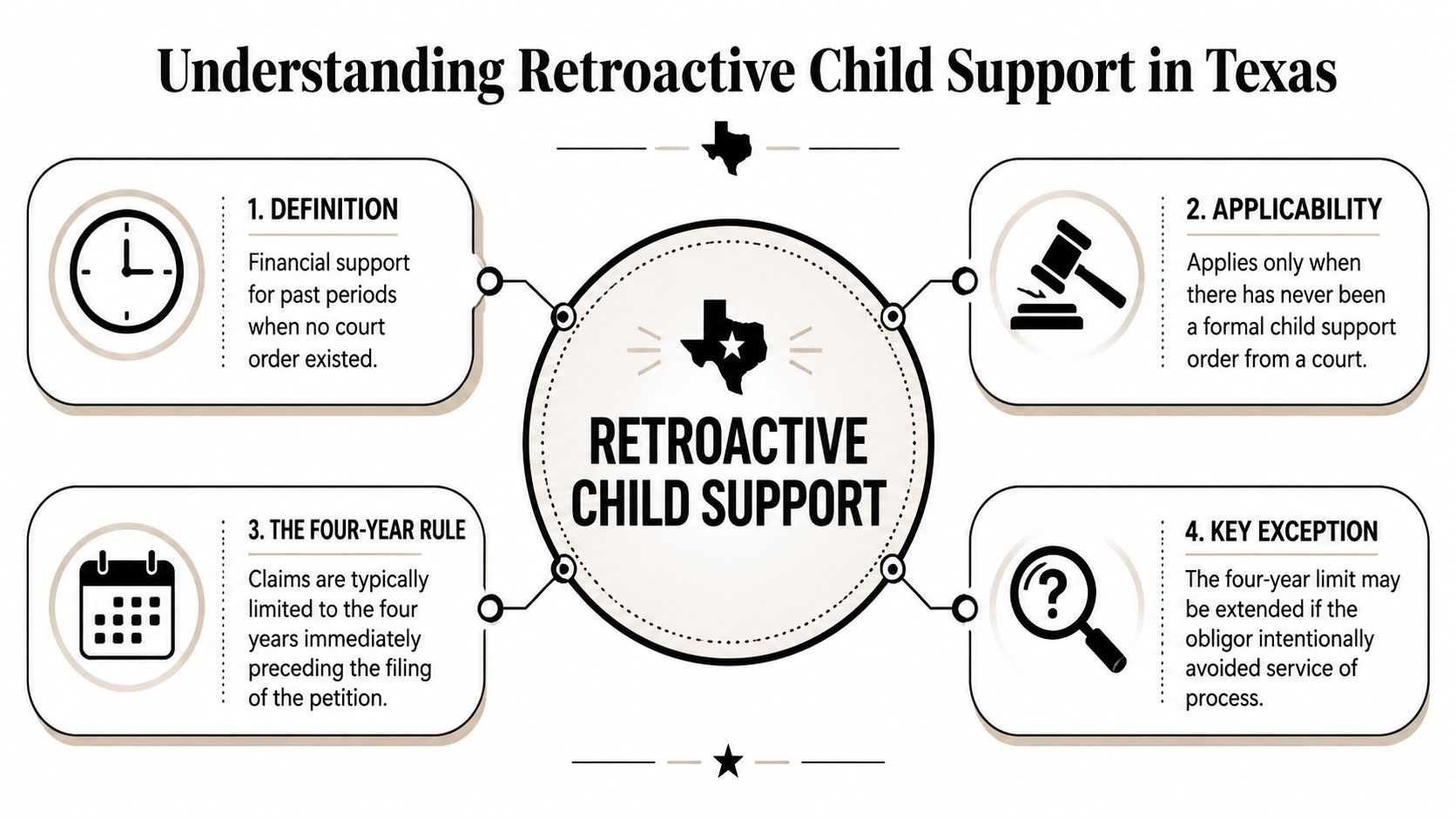
Retroactive child support applies when there has never been a prior child support order. In that situation, a Texas court can order support for an earlier period, but the court starts from a specific legal presumption in Texas Family Code § 154.131.
Under that statute, Texas creates a four-year presumption. The law presumes that awarding up to four years of retroactive child support is reasonable and in the child's best interest. That four-year period is the main benchmark courts use when looking at support before the first order.
What the four-year rule really means
A lot of parents hear "four years" and assume that's an absolute cap. It isn't.
The better way to think about it is this. Four years is the court's starting point, not always the ending point. If you want support beyond that period, you have to give the court a reason to move past the default presumption.
That reason usually comes from evidence, not frustration.
When a court may go back farther
The strongest cases for going beyond the four-year period usually involve facts showing the other parent knew about the child or knew about the duty to support, had the ability to pay, and still avoided paying. Courts also look seriously at conduct like hiding income, dodging legal action, or refusing support while having the resources to help.
One recurring issue is paternity.
If a father had no prior knowledge of the child's existence before a paternity action, the retroactive period is limited to the four years preceding the filing. If the parent knew of the child, the court may consider going back farther, potentially to the child's birth depending on the facts.
The judge isn't just counting missed months. The judge is weighing fairness, knowledge, ability to pay, and the child's best interest.
What usually works and what doesn't
What works is documentation that shows knowledge and ability. Think texts discussing the pregnancy or child, emails asking for support, social media posts acknowledging the child, employment records, and financial records that show the parent had resources during the years support wasn't paid.
What doesn't work is walking into court with only a general claim that "he always knew" or "she could have helped." In family court, broad accusations don't carry much weight without records behind them.
Retroactive Support vs Back Child Support Arrears
This is the point where many cases either become clearer or more confusing. The terms sound similar, but the legal treatment is different.
For unpaid ordered child support, Texas treats the balance as an enforceable debt, not as a request to backdate support. One Texas family law source explains that there is a 10-year enforcement window after the child turns 18 or the order ends, which makes timing critical when a parent is trying to collect arrears through enforcement tools rather than create a new retroactive award in the first place, as discussed in this explanation of retroactive child support and back child support in Texas.
Side by side comparison
| Attribute | Retroactive Child Support | Back Child Support (Arrears) |
|---|---|---|
| Basic issue | No earlier child support order existed | A court order existed, but payments weren't made |
| What the court is doing | Creating a past support obligation | Enforcing an existing unpaid obligation |
| Main focus | Whether support should be awarded for a pre-order period | Collecting the unpaid balance under the order |
| Key proof | Knowledge of the child, ability to pay, fairness factors, paternity | The order, payment history, amount unpaid, enforcement timeline |
| Typical timing question | How far back should the first order reach | Whether enforcement is still timely and practical |
| Practical tools | Petition for support, paternity action, evidence of past circumstances | Income withholding, contempt, and other enforcement remedies |
The trade-off that matters in real life
If there was never an order, you don't enforce. You prove why the court should create retroactive support.
If there was an order, you don't argue about whether support should have existed. You focus on the missed payments, the order itself, and the enforcement deadline.
That's why parents can weaken their position by calling everything "back support." A Montgomery County judge needs precision. Filing for enforcement when there was never an order doesn't solve the problem. Asking for retroactive support when a valid order already exists misses the appropriate solution.
Key takeaway: The same missed financial help can lead to very different legal strategies depending on whether a court order already existed.
What families in Montgomery County should do first
Pull every prior order, modification, and payment record you can find.
If you don't have copies, your lawyer can usually help track down the court file. That first document review often answers the biggest question right away. Are you building a retroactive support case, or are you enforcing arrears?
How to Pursue a Retroactive Child Support Claim in Texas
A retroactive support case usually turns on what happened before anyone ever got to court. In Montgomery County, the paperwork matters, but the timeline matters just as much. The judge will want to know when the other parent learned about the child, whether support was requested, whether the parent had the ability to help, and why no order was entered sooner.
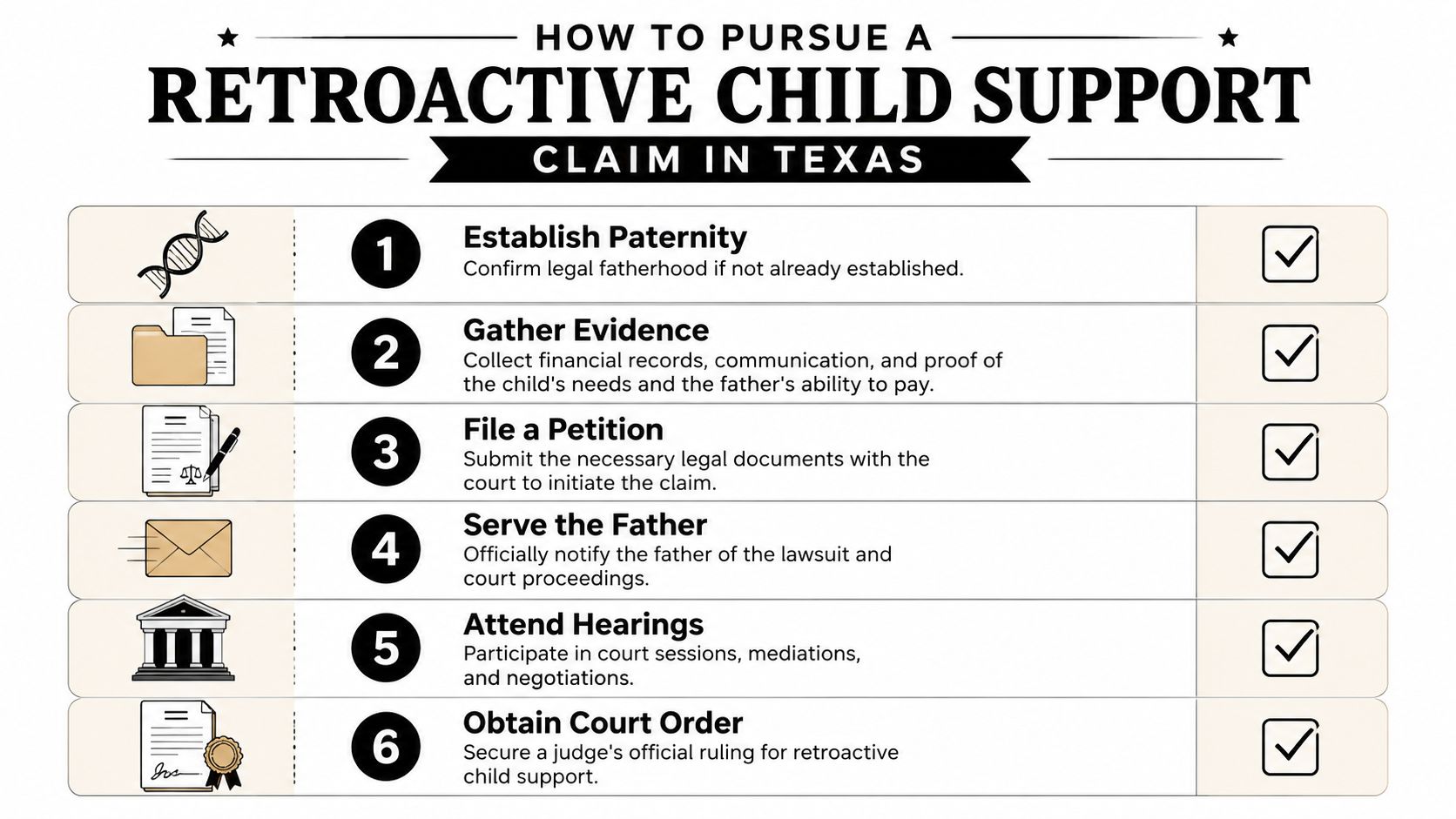
If there has never been a support order, start with paternity. Without legal parentage, the court cannot order child support. In some cases, an Acknowledgment of Paternity resolves that issue. In others, parentage has to be decided in the same suit.
Build the evidence before filing
Texas courts begin with a four-year presumption for retroactive child support. If you want the court to go back further, you need proof that gives the judge a sound reason to do it. The strongest cases usually show two things clearly. The other parent knew or should have known about the child, and had the financial ability to contribute during those earlier years.
That proof often includes:
- Messages showing knowledge of the child. Texts, emails, social media messages, or other communications about the pregnancy, birth, or requests for help.
- Income records or employment history. Pay stubs, tax records, business filings, LinkedIn history, or other reliable evidence showing earning ability.
- Requests for support. Messages asking for money for daycare, medical bills, school costs, or basic living expenses.
- Proof of what was paid. Partial help matters too. Judges want an accurate record, not a one-sided summary.
- A clear timeline. Dates of birth, separation, paternity discussions, prior filings, and major changes in income can shape how far back the court is willing to go.
Clients sometimes focus only on how many years they want to claim. The better approach is to ask what evidence exists for each year. That is often the difference between getting the default four years and persuading the court to consider a longer period.
The filing process in practical terms
Once paternity is established or included in the case, the next step is filing the right petition in the proper court. Then the other parent must be formally served. A missed service issue can delay the case and, in some situations, force you to start over on timing.
A video overview can help you understand how hearings typically unfold:
After service, the case may move through document exchange, negotiation, mediation, and a final hearing. If you are preparing for court locally, it helps to review what happens in a child support hearing in Montgomery County, Texas. Procedure affects bargaining power. A well-prepared file often leads to better settlement discussions before the judge ever rules.
What the court is really weighing
The practical difference between retroactive support and arrears matters here. Retroactive support asks the court to create an obligation for a past period when no order existed. Arrears enforcement deals with unpaid amounts under an order that is already in place, and that is where the longer enforcement window comes into play. These are different claims, different proof problems, and often different remedies.
In a retroactive case, a Montgomery County judge usually starts with the four-year presumption and then tests whether the evidence justifies going further back. Clean exhibits help. So does credibility. If one parent can produce old messages, school records, medical records, and income information that line up in time, the request carries more weight than a general statement that support was never provided.
Judges also look at fairness. If the other parent truly did not know about the child, that can limit how far back the court will go. If the parent knew, stayed employed, and still provided little or no support, the argument for more than four years gets stronger.
Good preparation is rarely dramatic. It is organized, specific, and consistent. That is what tends to persuade the court.
A Real World Scenario in Montgomery County
Sarah lives in Conroe. Her child is seven. The father has never paid formal support, and no prior order was entered. Sarah has handled everything herself, including housing, school needs, and medical appointments.
Years ago, she considered filing but didn't move forward. Now she wants to know whether she can still ask the court to go back to the child's birth.

How the judge would likely look at it
A Montgomery County judge would likely start with the four-year presumption for retroactive support. That gives Sarah a strong base position.
But Sarah wants more than that. To get there, she needs evidence that the father knew about the child and had the ability to provide support during the earlier years. She has old text messages discussing the pregnancy and the baby. She also has public employment information suggesting he worked steadily over time.
That doesn't automatically guarantee support all the way back to birth. It does, however, give the court something concrete to evaluate.
If a parent wants more than the default retroactive period, the case usually turns on old records that many people didn't realize would matter years later.
Why the evidence changes the outcome
If Sarah only testifies that the father knew, but can't back it up, the court may stay with the default period. If her records are clear, consistent, and tied to actual dates, the court has a stronger basis to go farther.
Now compare that to a different situation. Suppose Sarah had an old order already in place, and the father never paid. Then she wouldn't be asking the court for retroactive support at all. She would be enforcing arrears, and the timeline would be governed by the enforcement rules in Texas Family Code Chapter 157, including the 10-year limitations period for enforcing unpaid support after the child turns 18 or the order ends.
That's the practical split families need to understand. In one case, the judge asks how far back to create support. In the other, the judge asks whether an existing unpaid obligation is still enforceable.
For parents in this situation, a more focused discussion of retroactive child support in The Woodlands can help frame what records to gather before the first court setting.
Your Next Steps and When to Contact an Attorney
A parent often walks into my office with a stack of texts, a few cash app screenshots, and one hard question: how far back can the court go? The first step is sorting out which clock applies. If no child support order was ever signed, the court is dealing with retroactive support and starts with the four year presumption. If an order already exists and support was never paid, the issue is arrears, and enforcement usually turns on a much longer deadline.
That difference matters early, because the proof you need is not the same. In a retroactive support case, the judge may look closely at whether the other parent knew about the child, tried to avoid support, or was prevented from paying because facts were hidden. In an arrears case, the focus is usually the payment history, the order itself, and whether enforcement is still timely under the ten year window.
Start with the records, then build the timeline.
- Confirm whether a prior order exists. A divorce decree, SAPCR order, Attorney General order, or paternity order can change the case from retroactive support to enforcement.
- Lay out the key dates. Include the child's birth, separation, paternity testing, prior requests for support, court filings, and any periods of contact or no contact.
- Save communications that show knowledge or avoidance. Texts, emails, direct messages, and letters can matter if you are asking the court to go beyond the usual four year period.
- Pull payment and employment records. Bank statements, wage records, tax returns, and proof of informal payments help the court assess both ability to pay and what, if anything, should be credited.
- Get copies of old court papers. In Montgomery County, missing orders and incomplete clerk records can slow a case down fast.
- Do not rely on memory alone. Judges hear competing stories every week. Dates tied to documents carry more weight.
Legal help tends to matter most when the facts are disputed. That includes cases where paternity was never formally established, the other parent denies knowing about the child, records are scattered, or you believe the evidence supports retroactive support beyond four years. It also matters when an old order exists but nobody is sure what was paid, whether interest applies, or whether enforcement deadlines are approaching.
In practice, many of these cases are won or lost before the hearing. The work usually starts with identifying the right claim, finding the right records, and presenting them in a way a Montgomery County judge can follow without guesswork.
If you want examples of how family law matters are presented and explained to potential clients, reviewing Howard Family Law case studies can be a useful outside reference for how law firms frame practical outcomes and client concerns.
This article is for informational purposes only and does not create an attorney-client relationship. Child support cases in Montgomery County turn on specific facts, prior orders, filing dates, and the quality of the available evidence.
If you're in The Woodlands, Sterling Ridge, Creekside, Conroe, Magnolia, or elsewhere in Montgomery County, a consultation can help you determine whether you are asking the court to create past support, enforce unpaid support, or address both issues at the same time.
If you want guidance specific to your facts, schedule a consultation with The Law Office of Bryan Fagan. A focused review of your timeline, prior orders, and available records can clarify what may be recoverable and what steps make sense next.
