 Skip to content

You're home after an arrest, looking at release papers while trying to work out whether you can drive to work tomorrow. Your family needs answers, your next court date may seem far away, and the word felony makes everything feel urgent.
If you're looking for a felony DWI lawyer in The Woodlands, TX, start with the paperwork, not assumptions about the outcome. You may need to protect a driver-license hearing deadline before your criminal court appearance. Those are separate problems, and each needs attention.
What Makes a DWI a Felony in Texas
Say a Woodlands driver is stopped on I-45 and has older DWI convictions on record. The driver assumes the new case will resemble the earlier ones, then learns that prosecutors are considering a felony charge. The important question isn't how long ago those cases happened, but whether the convictions legally qualify for enhancement.
Under the Texas Penal Code's intoxication-offense provisions, an ordinary first DWI under §49.04 is generally a Class B misdemeanor with a minimum confinement term of 72 hours, while two qualifying prior intoxication-related convictions can raise a new DWI under §49.09 to a third-degree felony carrying 2 to 10 years in prison and a fine up to $10,000. Qualifying convictions can come from Texas or another jurisdiction.
Texas DWI charge classes and punishment ranges
The charge names below are starting points for reviewing the accusation. A sentencing range isn't a prediction of the sentence a particular person will receive.
| Classification | Statutory basis | What triggers it | Punishment range |
|---|---|---|---|
| Class B misdemeanor | Penal Code §49.04 | Ordinary first DWI without aggravators | Statutory misdemeanor punishment, including the minimum confinement described above |
| Class A misdemeanor | Penal Code §§49.04 and 49.09 | A qualifying prior conviction or another applicable misdemeanor enhancement, not a blanket recent-conviction rule | Class A sentencing rules and any applicable DWI minimum confinement |
| State-jail felony | Penal Code §49.045 | DWI with a child passenger | State-jail felony sentencing rules |
| Third-degree felony | Penal Code §49.09 | Qualifying repeat intoxication-related convictions | Third-degree sentencing range described above, subject to any further valid enhancement |
| Second-degree felony | Penal Code §§49.07 and 49.09 | Intoxication assault causing serious bodily injury to an on-duty firefighter or emergency medical-services worker in the statutory circumstances | Second-degree felony sentencing rules |
| First-degree felony | Penal Code §§49.07 and 49.09 | Intoxication assault causing serious bodily injury to a peace officer or judge in specified circumstances | First-degree felony sentencing rules |
| Second-degree felony | Penal Code §49.08 | Intoxication manslaughter | Second-degree felony sentencing rules, subject to applicable enhancements |
The child-passenger offense is a separate statute, not merely ordinary DWI with a higher punishment. Injury cases also require careful classification: ordinary intoxication assault and enhanced protected-victim allegations aren't interchangeable.
Find the allegation that changes the case
Blood alcohol concentration alone doesn't decide felony status. Prosecutors must establish the facts supporting the particular charge, whether those involve prior convictions, a child passenger, serious bodily injury, or death.
The charging instrument is the formal accusation. Its enhancement paragraphs identify prior convictions or other allegations prosecutors intend to use to increase exposure. A lawyer must compare those allegations against actual judgments rather than accept a criminal-history summary as the complete answer.
Bring the charging paperwork, available prior judgments, release documents, and any crash-related records to counsel. Those documents help identify the correct classification and reveal which allegations still need proof.
Your First 72 Hours After a Felony DWI Arrest
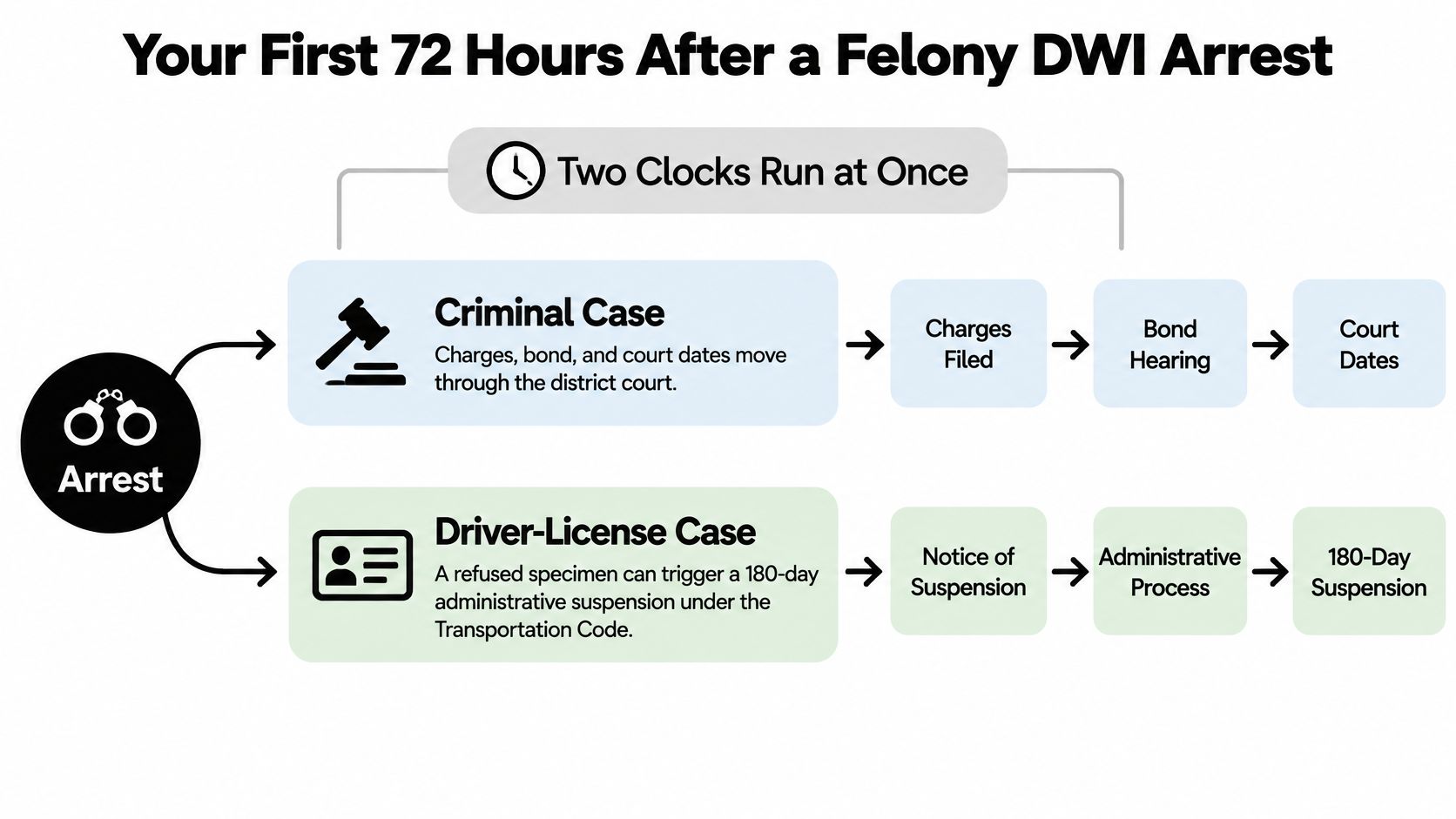
Two clocks run at once: the criminal prosecution and the administrative driver-license proceeding. Your criminal court date doesn't tell you when you must respond to a license notice.
A refused specimen can trigger a 180-day administrative suspension under Transportation Code §724.035, while a failed test can produce separate consequences under Transportation Code Chapter 524. The administrative process is independent of whether the criminal charge ultimately produces a conviction.
The parallel tracks look like this:
What to do next
- Write a private timeline for counsel: Record what you remember about the stop, arrest, testing requests, and statements while your memory is fresh.
- Create one paperwork folder: Collect the citation, magistrate paperwork, specimen notices, tow records, and bond conditions so counsel can identify both proceedings.
- Confirm the hearing-request deadline immediately: Use the notice's deadline instructions to establish the exact due date with counsel, because missing it can forfeit the administrative challenge before the criminal case reaches a meaningful setting.
- Keep incident details off messages and social media: Don't discuss the facts in texts or co-parenting apps, and preserve existing communications rather than deleting them.
- Follow every release condition: Read interlock, testing, reporting, and no-alcohol terms carefully so an avoidable violation doesn't complicate release.
- Contact local counsel before the first setting: Give the lawyer the license notice promptly rather than waiting until the court appearance approaches.
Protect transportation and release arrangements
Tell counsel immediately if you drive to work, take children to school, or care for a parent. A workable plan may require temporary rides, changes to family schedules, or evaluation of restricted-driving options.
If your family is arranging release, our guide to Montgomery County Bail Bond Board-approved sureties can help you understand that part of the process. A surety arrangement doesn't replace reading the judge's release conditions.
Immediate priority: Don't wait for a criminal court date to find out whether a driver-license response is already due.
Bring the complete folder, your driver's license information, your written timeline, and any prior-case paperwork to the first consultation. Keep envelopes and electronic notices too, because delivery information may matter when counsel evaluates a deadline.
How a Felony DWI Case Moves Through Montgomery County
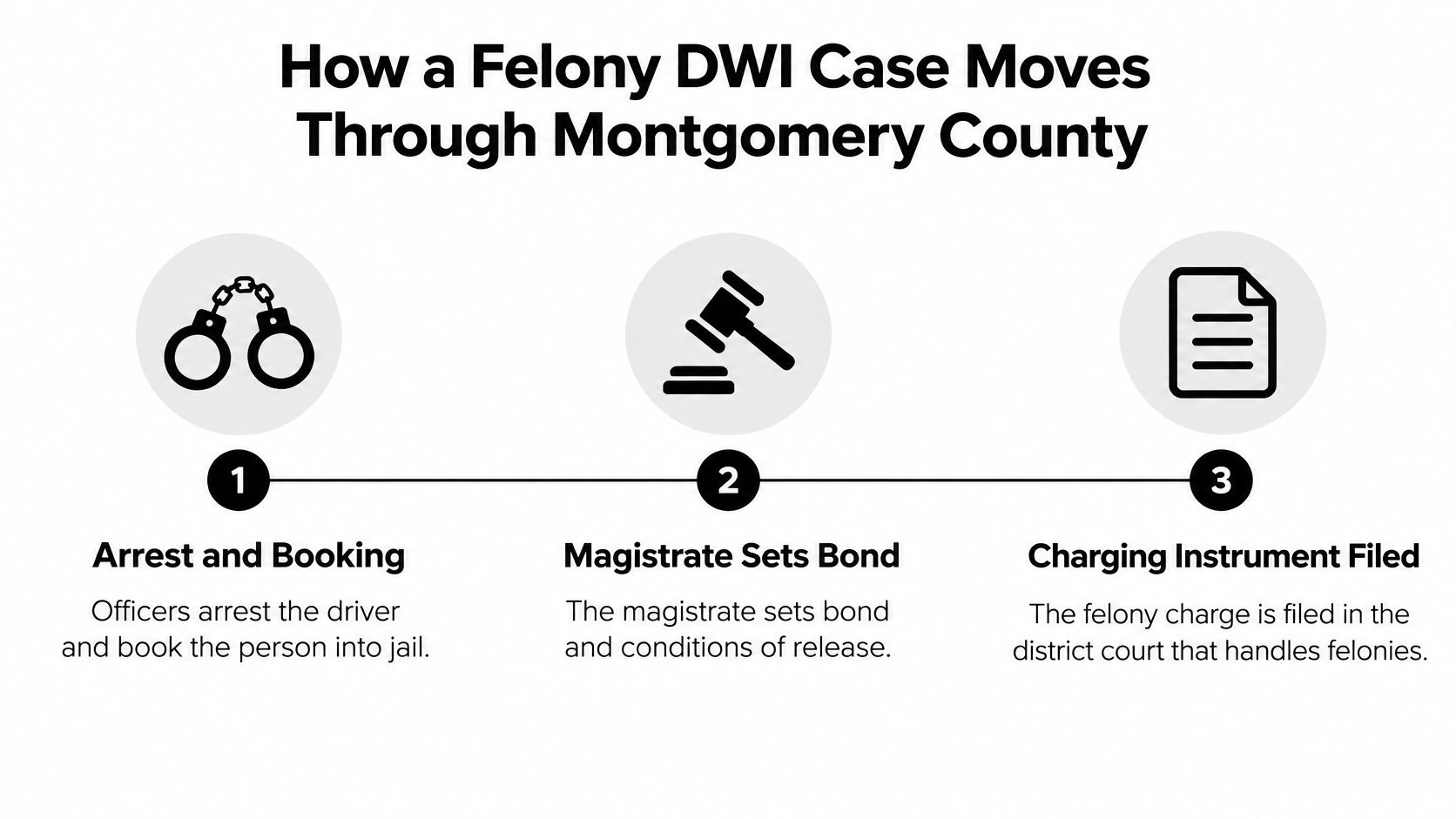
A typical case begins with arrest and booking, followed by a magistrate addressing bond and release conditions. Later, the formal felony accusation proceeds through a district court, where counsel addresses the charge, obtains evidence, and evaluates resolution or trial.
This visual shows the opening stages:
Felony DWI milestones in Montgomery County
| Stage | Where it happens | What the reader does | What counsel is doing |
|---|---|---|---|
| Arrest and booking | Montgomery County Jail, Conroe | Request counsel and note the specimen-request details | Seek booking and available vehicle-camera records |
| Magistrate bond setting | Magistrate proceeding | Read conditions and arrange compliance | Identify conflicts involving work and childcare |
| Charging instrument filed | Montgomery County district court | Bring all charging paperwork to counsel | Examine enhancement allegations and prior judgments |
| Arraignment | Assigned district court | Follow appearance instructions and arrive on time | Address the plea and procedural requirements |
| Discovery and pretrial settings | Assigned district court | Answer counsel's information requests promptly | Review video, laboratory materials, and expert needs |
| Plea negotiations | Counsel's communications with the district attorney | Review any offer before deciding | Compare proposed terms against litigation risks |
| Trial | Assigned district court | Prepare with counsel; discuss whether to testify | Challenge the State's proof and present the defense |
Felony proceedings belong in district court, not municipal court. Confirm the building, courtroom, and appearance requirements from your actual notice; don't assume every Conroe county office or court function is at the same address. Conroe is north of The Woodlands, so plan your route and work arrangements accordingly.
When parenting issues overlap
For parents, the Texas Family Code's best-interest framework makes child safety relevant to custody and possession disputes. An arrest isn't automatically proof of unsafe parenting, but alleged injuries, repeated incidents, or failure to follow court orders can require careful attention.
Keep records of safe caregiving and coordinate criminal and family-law advice without treating them as the same case. TxDOT's impaired-driving safety campaign addresses the public-safety concern, but it doesn't determine an individual parent's custody outcome.
The following video provides additional context:
There isn't a reliable completion date at arrest. Outstanding laboratory materials, expert review, contested motions, and court scheduling can prolong proceedings; ask what remains outstanding and what the next setting is intended to accomplish.
Defense Options in a Felony DWI Case
A useful defense assessment separates whether the State can prove DWI from whether it can prove the alleged felony enhancement. Problems with either may change the available strategy, but they require different evidence.
The Texas Penal Code's DWI enhancement provisions make qualifying prior convictions central to repeat-offense felony classification. That makes the prior-case records substantive evidence, not background paperwork.
Examine the investigation and specimen evidence
Counsel should compare the officer's account against video, dispatch information, testing records, and the sequence of events. The questions include whether the stop had a lawful basis, whether probable cause supported arrest, and whether the specimen request or collection had valid legal authority.
Laboratory review requires more than reading the reported result. Collection, labeling, storage, transfers, testing procedures, and the connection between the specimen and the accused all deserve examination.
- Stop and arrest: Identify the specific facts the officer relied on, rather than assuming the stop was lawful or unlawful.
- Specimen procedure: Examine consent warnings, any warrant, collection records, and laboratory documentation.
- Expert review: Determine whether a qualified specialist can identify a meaningful reliability issue, not merely offer a general criticism of testing.
A numerical alcohol result isn't the only possible evidence of intoxication. Prosecutors may also rely on alleged loss of normal mental or physical faculties, so disputing the test number doesn't necessarily answer the entire accusation.
Test the enhancement and causation allegations
For each alleged prior conviction, counsel should examine identity, authenticity, finality, and statutory qualification. If the State can't establish a necessary prior, the punishment analysis and negotiating position may change substantially.
Where intoxication assault is alleged, counsel must also assess the injury evidence and the claimed causal connection. A crash and an accusation of intoxication don't eliminate the State's obligation to prove the charged offense.
A realistic defense plan identifies what can be challenged, what evidence is unfavorable, and what each available outcome would require.
A motion to suppress may seek exclusion of unlawfully obtained evidence, but not every case presents a winning suppression issue. Negotiation may instead focus on an appropriate reduction or treatment-related resolution. Our overview of Montgomery County specialty court program eligibility can help frame questions, without assuming a particular charge or applicant qualifies.
Driving, Interlocks and Occupational Licenses After Arrest
A suspended license doesn't always end every lawful driving option. It also doesn't give you permission to drive because your employer needs you or your children need transportation.
The route forward requires checking the suspension source, eligibility, and any required court or licensing steps. Don't resume driving based on an informal assurance.
Read the interlock requirement literally
Under Transportation Code §521.246, specified circumstances require restrictions to an ignition-interlock-equipped vehicle, including an existing interlock order or certain intoxication-related conviction suspensions. Counsel needs to compare the criminal order with the DPS record.
An interlock restriction controls the vehicle you may operate. Borrowing a family member's vehicle doesn't avoid the restriction if that vehicle lacks the required equipment.
Build a usable occupational-license request
The Transportation Code's court-ordered suspension provisions address a verified petition for occupational driving relief and conditions associated with that relief. Counseling, rehabilitation, interlock requirements, or substance testing may be part of the applicable order.
Prepare practical information for counsel:
- Suspension source: Bring the DPS notice and any court order so the correct process can be identified.
- Necessary travel: List work locations, school transportation, caregiving destinations, and the relevant schedules.
- Compliance arrangements: Identify the vehicle, installation logistics, and any treatment or testing obligations.
For a Sterling Ridge parent, a request based only on commuting may not adequately describe necessary school transportation. Explain the full schedule so counsel can seek appropriate authorization and determine what must appear in the order.
Driving rule: Follow the signed order and applicable licensing requirements, not what you hoped the order would allow.
Insurance and employment questions deserve separate attention. Ask your insurer what documentation it needs and give counsel any employer driving requirements rather than assuming occupational relief answers both.
If community supervision later becomes part of the outcome, use our guide to Montgomery County community supervision reporting requirements to prepare questions about coordinating those obligations with driving restrictions.
How a Felony DWI Lawyer in The Woodlands Helps
The value of representation is concrete work: identifying deadlines, obtaining records, testing allegations, and helping you make informed decisions. Reassurance without a document-based plan won't tell you whether an enhancement is supportable or what transportation arrangements you need.
Careful review begins with the actual accusation and supporting records:

Ask for identifiable work products
A lawyer should be able to explain what has been requested, what remains unavailable, and which decisions depend on that missing material. That conversation is more useful than an unsupported prediction about dismissal.
- A deadline calendar: Identify the administrative response date, court appearances, and release-condition obligations.
- An evidence-preservation plan: Seek relevant recordings and records before retention practices make them unavailable.
- An allegation review: Match enhancement claims to judgments and identify unresolved identity or qualification issues.
- A decision framework: Explain the evidence supporting a motion, negotiation position, or trial recommendation.
Local familiarity helps with practical execution. Knowing the assigned Montgomery County court's procedures can assist with preparation, while clear appearance instructions help clients manage work leave and travel to Conroe.
Coordinate the legal issues without confusing them
If custody or support litigation is pending, criminal counsel and family counsel should coordinate about disclosures, parenting arrangements, and compliance records. They should also recognize that advice useful in one proceeding may have consequences in the other.
The Law Office of Bryan Fagan serves The Woodlands and Montgomery County, handles criminal defense in and out of court, and offers a free consultation bookable through the website or by phone. Our practice also includes family law, estate planning, wills, trusts, and civil law.
Attorneys Lawrence Eulette and Craig Goralski practice at our Woodlands office at 25211 Grogans Mills Rd, Suite 275. When contacting our office, identify any pending family case and bring the related orders so the consultation can address the overlap without assuming either proceeding controls the other.
Choosing Local Counsel and Taking the Next Step
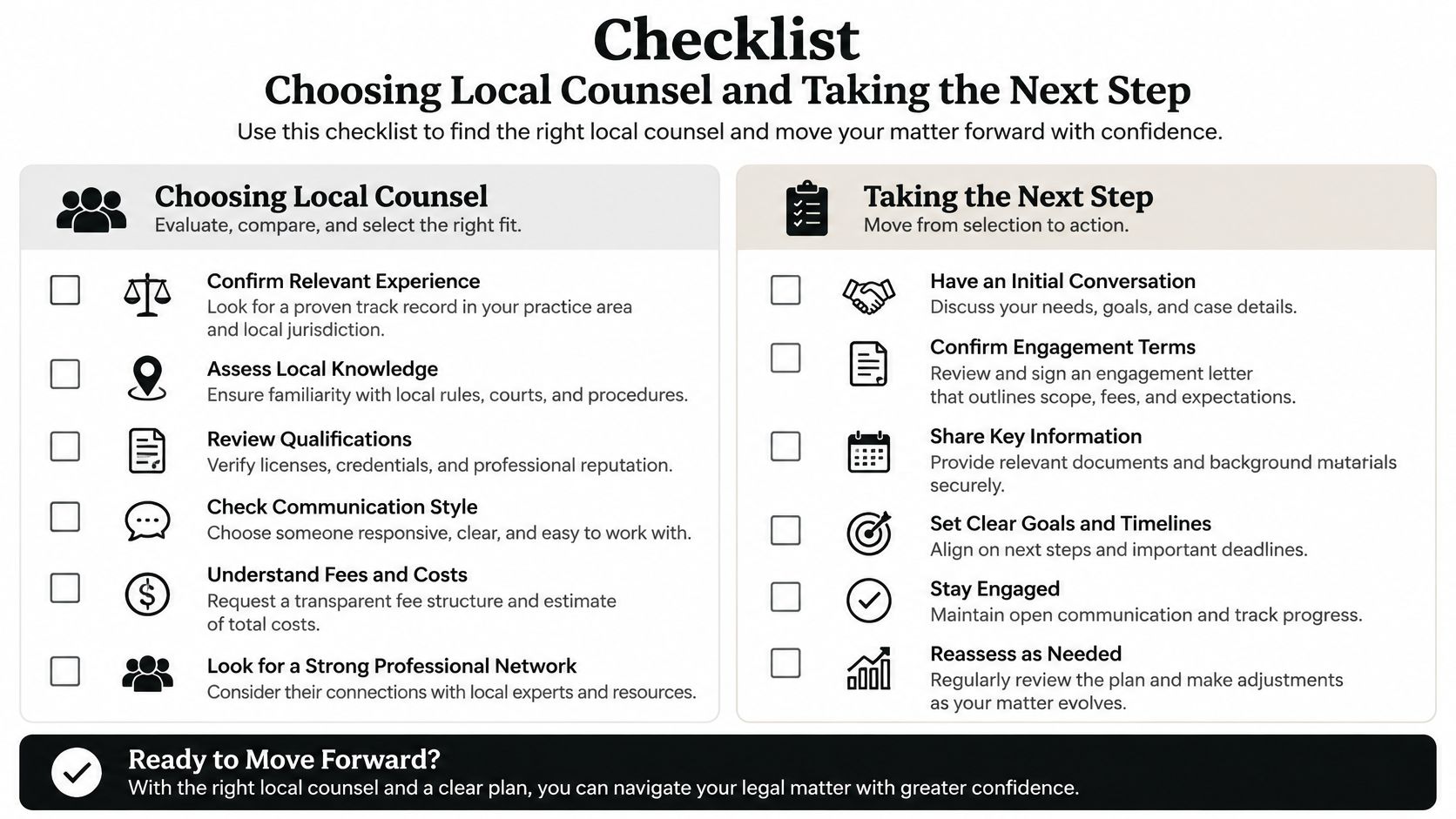
Compare lawyers on the quality of their analysis, not on promises about outcomes. A useful first meeting should leave you understanding what needs immediate action, which facts remain unverified, and who will communicate with you.
Felony DWI experience matters specifically. Familiarity with ordinary misdemeanor cases isn't a substitute for examining enhancement records, serious-injury allegations, and the consequences of a felony prosecution.
Use this checklist to organize the decision:
Compare clarity rather than certainty
| Look for | Be cautious about |
|---|---|
| An explanation of both proceedings and immediate obligations | Advice to ignore license paperwork until court |
| A plan for obtaining and evaluating evidence | Outcome predictions before records are reviewed |
| Candor about unfavorable facts | Claims that every testing issue produces dismissal |
| Clear fees, responsibilities, and communication expectations | Uncertainty about who handles daily casework |
Ask direct questions: Who will handle my case day to day? How will you evaluate the prior convictions? What is my license-hearing deadline? What must I do about bond conditions this week? Request a clear explanation of what the fee covers and how updates will arrive.
Arrive prepared to make a decision
Bring the citation, magistrate paperwork, specimen notices, tow records, prior DWI judgments you have, and your written arrest timeline. Include pending custody orders and work-driving requirements when relevant.
Waiting for the first court date may feel easier, but it doesn't stop administrative deadlines or preserve recordings. The first decision isn't necessarily whether to plead or go to trial; it's how to protect your options while counsel evaluates the accusation.
This is general educational information, not legal advice. The appropriate response depends on your records, notices, court orders, and individual circumstances.
The Law Office of Bryan Fagan offers a free consultation to discuss a felony DWI allegation, driver-license concerns, and related family-law issues. Call 281-819-1726 or visit The Law Office of Bryan Fagan to schedule through the online form, and bring your release paperwork and license notices so the immediate priorities can be identified.
