
A missed alimony check has a way of turning into a week of calls, emails, and second-guessing. If you live in The Woodlands or anywhere in Montgomery County, you may be staring at a divorce decree, a payment history that suddenly went dark, and a practical question that matters more than the legal label, what can be done now.
For many people, the answer starts with contempt for unpaid alimony Montgomery County. That remedy can be powerful, but it only works when the order, the payment history, and the evidence line up in a way a judge can use. This guide is written for people who need a straight answer, not courtroom jargon, and it is educational only, not legal advice.
When Alimony Stops Coming in The Woodlands
A spouse in Panther Creek opens the bank app and sees the deposit never came through. The first reaction is frustration, then the practical questions start, rent, bills, and whether a demand letter will move the other side. If the same payment is missing again the next month, the matter has usually shifted from a nuisance to enforcement.
That is where contempt enters the conversation. It can force payment, but only when the decree supports contempt and the evidence shows a real violation. A lot of people assume the court will punish nonpayment because the order says support is owed. Texas courts do not work that way.
The strongest contempt cases start with records, not anger.
In Montgomery County, the path is rarely just file something and wait. You need to know whether the obligation is court-ordered maintenance or a separate contractual promise, because the enforcement tools are different. You also need to know whether the missed payments are recent enough to be actionable, because statutes of limitation can shape enforcement strategy in Texas family courts, and the order still has to support the remedy.
A Woodlands resident looking for next steps can review Spousal Support Lawyer in The Woodlands and compare that with The Law Office of Bryan Fagan when deciding who should handle the file. If the decree, the arrears, and the payor's finances are all messy, that detail work matters more than slogans.
What Texas Law Calls Unpaid Alimony
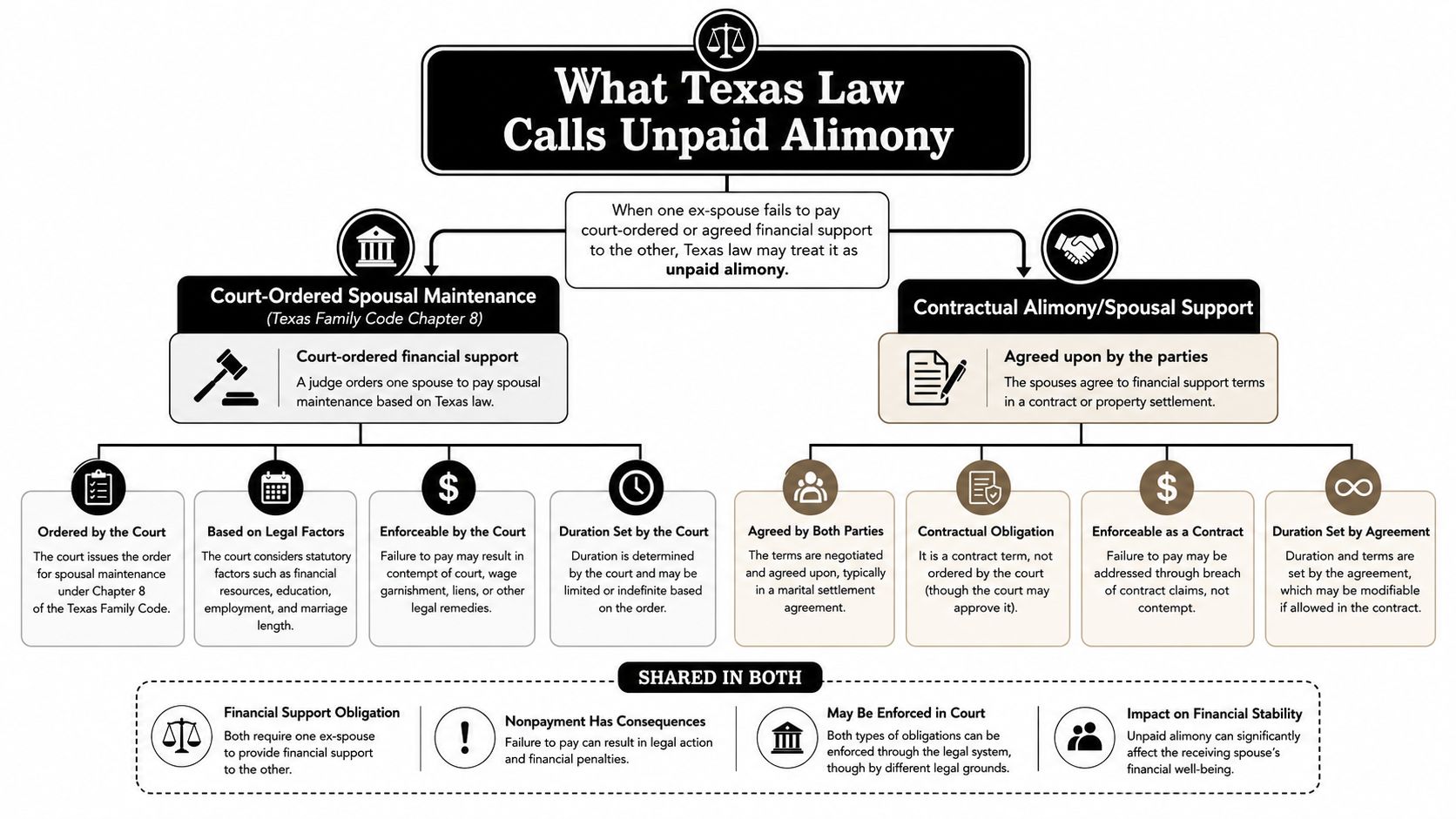
A missed alimony payment is not just a collection problem in Texas family court. The first question is whether the order is court-ordered spousal maintenance under Texas Family Code Chapter 8, or whether it is contractual alimony, a negotiated promise inside the divorce paperwork. That label controls whether contempt is available, how much pressure the court can apply, and what proof the judge will expect.
Court ordered maintenance and contractual alimony are not the same
Court-ordered maintenance comes from the statute, not just from the parties' agreement. The Texas Family Code sets the framework for when maintenance can be awarded, how long it can last, and when enforcement tools like contempt can be used. Contractual alimony, by contrast, is a private obligation the spouses agreed to, so the enforcement path may run through contract principles and decree enforcement rather than Chapter 8 contempt in the same way.
A client in The Woodlands usually feels the distinction only after the payments stop. The decree language controls the remedy, and the court reads that language closely. If the order uses maintenance language, the judge analyzes the statutory structure. If it uses alimony language in a negotiated property settlement, the enforcement strategy changes even though the money is still owed.
The local Montgomery County family courts guide helps explain where these disputes are heard, while the Texas Family Code, Chapter 8 is the starting point for the legal label itself. If the obligation was drafted as maintenance, contempt may be available. If it was drafted as contractual alimony, the claim usually needs a different enforcement theory, and the record has to match that theory from the start.
The label controls the remedy
A Montgomery County judge will care more about the decree's wording than the label the former spouses use in conversation. Spousal maintenance is a court-ordered support obligation. Contractual alimony is a bargained-for promise, and that difference can change whether contempt is realistic or whether the case belongs in a different enforcement track.
The practical problem is that people often use “alimony” as a catchall term. The court does not. If you are trying to enforce a decree and the language is muddy, the order itself becomes the first exhibit that needs a close read. A clear label helps, but a clear payment history and clear proof of the missed obligation matter just as much.
For a deeper look at the court-ordered side of the issue, see Texas court-ordered spousal maintenance in The Woodlands, then compare it with the separate contractual promise described in the decree.
The Elements a Judge Must See in Contempt
A contempt request is not just a complaint that someone stopped paying. The judge wants a clean chain of proof. In Texas practice, the moving party generally needs a valid written order, notice of that order, a clear duty to pay, and willful noncompliance despite ability to pay. If one of those pieces is weak, the case can stall.
The order and the notice have to be real
The court cannot enforce a vague understanding between former spouses. It requires the decree or a later order, and it needs proof that the payor knew about it. That is why certified copies and service records matter so much. If the order was never properly served or the language does not clearly require monthly payment, the contempt motion becomes harder to sustain.
Ability to pay is often the turning point
People often lose cases they thought were simple. Nonpayment by itself is not enough if the payer can show they lacked the ability to comply. Maryland's contempt framework, useful as a comparative reminder, says the petitioner must prove nonpayment by clear and convincing evidence, while the alleged contemnor can defend by proving inability to pay and reasonable efforts to obtain funds by a preponderance of the evidence. That burden-shifting idea is a good mental model for Texas litigants too, because the ability-to-pay fight often decides the result. See the Maryland appellate discussion in the unpublished opinion PDF."
If the judge believes the payor had a real inability to pay, contempt gets much harder to win.
That's why evidence of income, work history, bank activity, and asset transfers matters so much. It's also why the defense isn't just “I didn't pay.” It's “I couldn't pay more, and I tried.” Neutral court-help materials make the same point, and they also stress gathering texts and emails before filing, because willfulness matters as much as the balance itself. If you want a plain-English framework for that evidence problem, the Ohio Legal Help court-order enforcement guide explains why simple nonpayment isn't the whole story.
For clients who want a local enforcement lens, Enforcement of Court Orders in The Woodlands is a useful reference point for how family-law enforcement thinking shows up in Montgomery County practice.
Building the Evidentiary Ledger Before You File
Contempt motions often fail because the paper trail is sloppy. Judges do not want a guess about what was owed. They want a ledger that shows month by month what the decree required, what was paid, what was missed, and what remains collectible.
Start with the decree, not with the frustration
Pull a certified copy of the divorce decree and any later enforcement or modification order. Then build a payment ledger that tracks every installment by date. If there were partial payments, note them. If there were lump-sum credits or offsets that the parties agreed to, document those too. The point is to show the court the exact balance, not an emotional approximation.
In Montgomery County practice, the cleanest way to present an arrears claim is to turn the order into a month-by-month record before you file. That means listing the required payment for each period, then matching it against what came in. If the record is old, make room for missed months, partial months, and any later credits so the judge can see the running balance without having to reconstruct it during the hearing.
Gather the money trail and the behavior trail
Bank statements, pay stubs, W-2s, business receipts, and tax returns can show whether money was flowing while payments were missing. If the payer opened a new business, made asset transfers, or maintained a lifestyle that does not fit the inability-to-pay story, that evidence can matter. Emails and texts can also show excuses, admissions, or a pattern of ignoring requests.
Practical rule: the best contempt file is chronological, not persuasive in the abstract.
The ability-to-pay defense lives or dies on documents. A payor who says, “I could not pay,” needs something more than a statement at the podium. A recipient who says, “He could pay and chose not to,” needs records that connect income, spending, and missed support. That means sorting the file by date, keeping the decree at the center, and preserving anything that shows what the payor had available when the payment came due.
Sample Evidentiary Ledger for Unpaid Alimony
| Month | Order Amount | Amount Paid | Balance Owed | Status |
|---|---|---|---|---|
| October | Monthly maintenance amount | 0 or partial | Difference | Missed |
| November | Monthly maintenance amount | 0 or partial | Difference | Missed |
| December | Monthly maintenance amount | 0 or partial | Difference | Missed |
The table above is a template only. The actual ledger needs the decree amount and the payment history, and those numbers should be pulled from records before anything gets filed.
From Motion to Show Cause Hearing in Montgomery County
A contempt case usually begins with a motion to enforce or motion for contempt, then moves through service, scheduling, and the hearing itself. In Montgomery County, the filing has to be clean because procedural mistakes can delay the case before the judge ever reaches the merits.
Filing and service are where many cases wobble
The motion should identify the order, the missed installments, and the relief requested. It also needs proper service on the other party, because a show-cause hearing without valid notice is a problem waiting to happen. Missing certifications, incomplete exhibits, or a sloppy proof of service can force a reset.
Once the motion is on file, the court sets the matter for hearing. Some dockets may involve an associate judge first, while others bring the matter before a visiting judge or the assigned judge depending on the court's schedule and local practice. The exact sequence varies, but the function stays the same, the court wants a chance to hear evidence, ask about the arrears, and test whether nonpayment was willful.
What the hearing usually feels like
At the hearing, the judge typically asks direct questions. What was paid, what was owed, what income existed, and why didn't the money get there? If the payor claims inability, the court will want documents, not just a speech. If the recipient claims willful refusal, the court will want a ledger and proof of notice.
The Montgomery County filing experience is easier to understand when you compare it with the local divorce-enforcement workflow outlined in Enforcement of Divorce Decree in Montgomery County. The important part is not the label on the motion, it's the accuracy of the paperwork and the credibility of the payment history.
A hearing goes better when the paper trail answers the judge's questions before the judge asks them.
Sanctions and Remedies a Judge Can Order
Contempt is not one remedy; it's a gateway to several. The court can choose a response that pushes compliance, liquidates the arrearage, or both, depending on what the judge believes the payor can do.
Coercive tools versus collection tools
A coercive remedy is designed to make future payment happen. A collection remedy is designed to capture money that should already have been paid. In family court, those goals often overlap, but they are not identical.
Real-world remedies can include payment plans, conditional orders, wage withholding, and, where appropriate, liens on property or other collection steps tied to the decree. In some cases, failure to appear can lead to bench warrant issues, and a noncompliant payor can face more aggressive pressure to resolve the matter. The Texas Family Code also matters here, because maintenance enforcement sits inside the statutory framework rather than floating free of it.
Why ability to pay affects the sanction
A judge is much more likely to craft a compliance order if the payor has some ability to cure the arrears. If the court believes the person cannot pay, jail or harsh coercion becomes a much harder sell. That's why the evidentiary ledger from the earlier section is so important. It helps the court decide whether the remedy should push compliance or confirm that the arrears exist.
In Montgomery County, the practical goal is usually to get the money flowing again while preserving a record that can support later collection. That's why bank records, wage evidence, and asset information matter so much. If the payor has a paycheck, a business, or property, the remedy options widen. If not, the court's influence on the situation narrows.
What to Do Next and When to Call a Lawyer
A missed maintenance payment gets serious fast when the records are thin and the parties start arguing about excuses instead of numbers. A Woodlands client once described the problem this way, the ex stopped paying after launching a new venture, but the monthly bill kept coming. That kind of fact pattern can matter, because it gives the court something concrete to compare against the claim of inability.
What to do next
- Pull certified records. Get the decree and any later orders from the clerk.
- Build a payment ledger. List each missed month, each partial payment, and the balance.
- Gather income proof. Save pay stubs, tax returns, bank statements, and business records.
- Save communications. Keep emails, texts, and written admissions about missed support.
- Review the defense. Think carefully about any real ability-to-pay issue before filing.
- Talk to counsel first. A lawyer can help decide whether contempt is the right tool or whether another enforcement method fits better.
For many Montgomery County residents, the right next move is a focused enforcement consultation, not a rushed filing. If you want a local overview of support representation, the resource for Alimony Lawyer in The Woodlands, Texas is a useful place to start.
This article is not legal advice. Every decree, payment history, and defense issue is different, and contempt cases turn on details that a general guide can't resolve.
The Law Office of Bryan Fagan helps people in The Woodlands and Montgomery County evaluate support enforcement, build the payment record, and decide whether contempt is the right path. If unpaid maintenance is causing problems in your case, visit The Law Office of Bryan Fagan to schedule a consultation and get case-specific guidance for your next step.