 Skip to content
In Texas, a child can't independently choose which parent to live with before age 18. At age 12, a judge must interview the child in chambers if a party asks in a custody case, but the child's preference is only one factor and the court still decides based on the child's best interest.
If you're in The Woodlands or Montgomery County, you may be dealing with a very personal version of this question. Your son or daughter says, "I want to live with you now," and you're trying to figure out whether that changes anything legally.
It matters. But it doesn't decide the case by itself.
A lot of parents search for can a child choose which parent to live with Texas age because they want a simple rule. They usually hear some version of "once the child turns 12, they can pick." That's not how Montgomery County courts operate.
What judges care about is the difference between a child's wish and a judge's order. Those are not the same thing. A child's opinion can be important. A court order is what controls until a judge changes it.
My Child Wants to Live With Me What Happens Now
When a child tells you they want to move in with you, most parents feel two things at once. Relief, because the child wants closeness. Panic, because you know the other parent may fight it.
The first step is to slow down.
Your child's statement is emotionally important, but it isn't self-executing. If there's already a custody order in place, that order still controls until the court signs a new one. That is the practical reality many families in Montgomery County learn the hard way.
What parents often get wrong
Parents often assume one of these things is true:
- "My child is old enough to decide." In Texas, the child doesn't make the final legal choice before adulthood.
- "If my child refuses to go back, the order is basically over." It isn't.
- "The judge will automatically do what a teenager wants." Sometimes a teen's reasoning carries weight. Sometimes it doesn't.
Practical rule: Treat your child's preference as evidence, not as the final answer.
That difference matters in real life. If you tell your child, "You can stay with me now because you're old enough," you may accidentally create a bigger legal problem. Judges usually want to see that the adults are following the order while using the proper court process to request a change.
What the court wants to know
Under the Texas Family Code, the court's guiding standard is the best interest of the child. Section 153.002 is the core rule family judges apply in custody disputes. That means the judge isn't just asking, "What does the child want?" The judge is asking, "What arrangement serves this child's welfare?"
A child may want to move because of school, friends, stress in the home, conflict with a stepparent, or a better routine. Those reasons may matter a great deal. Other reasons carry less force, especially if they sound like the child is choosing the house with fewer rules.
What you should do first
If your child raises this issue, focus on facts.
- Listen carefully. Ask why they want the change.
- Stay calm. Don't promise outcomes you can't control.
- Keep notes. Write down what the child says, when they said it, and what seems to be driving the request.
- Follow the current order. Unless the court changes it, that order still matters.
If you're in The Woodlands, Magnolia, Conroe, or another Montgomery County community, the smart move is to look at the current court order before making any informal changes at home.
The Texas Age 12 Rule for Child Custody
The Texas rule that causes the most confusion is the age 12 rule.
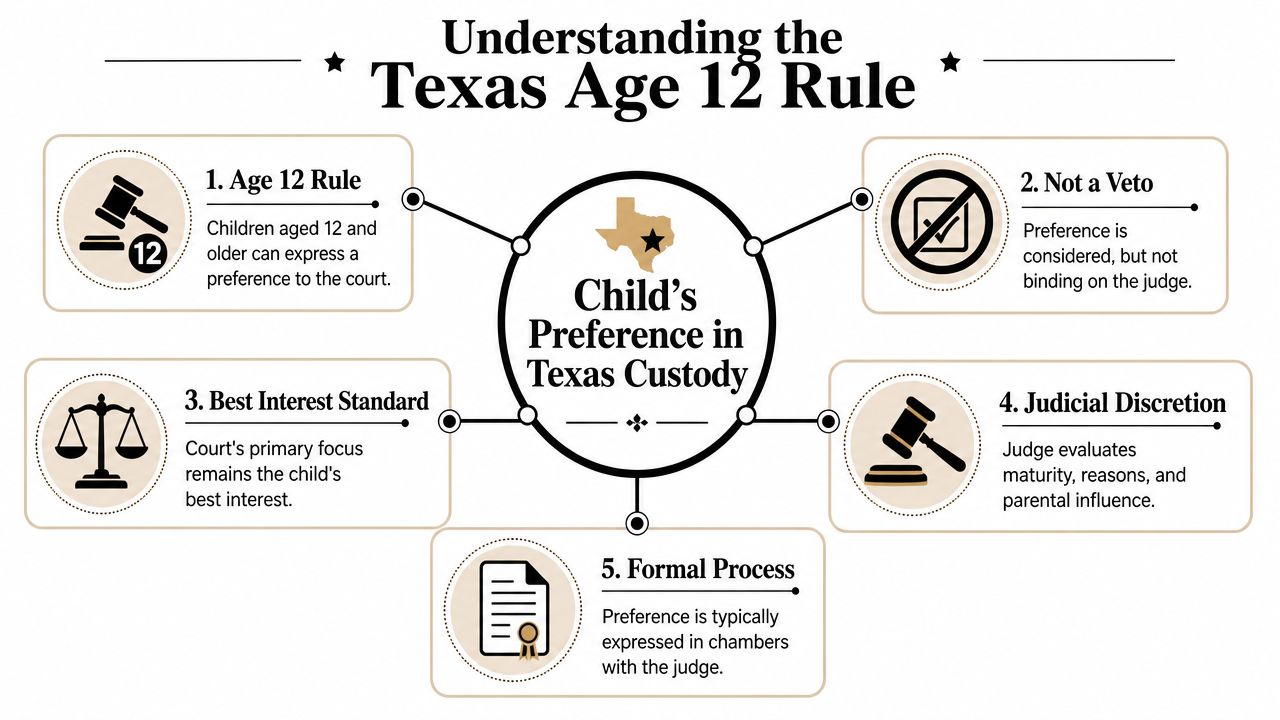
Under Texas guidance discussing Family Code Section 153.009, a child in Texas does not get to independently choose which parent to live with before age 18, but at age 12 a judge must interview the child in chambers if a party requests it in a custody case. Children under 12 may be interviewed only at the judge's discretion. The court still decides based on the child's best interest.
What "in chambers" means
"In chambers" usually means the judge speaks with the child privately rather than putting the child in open court like an adult witness. For many families, that's a relief. It lowers pressure and helps the judge hear from the child more directly.
Still, parents shouldn't think of this as a voting booth.
A better comparison is a judge gathering one important piece of information. The interview helps the court assess the child's maturity, reasoning, and circumstances. It does not hand the child legal authority over the case.
The age-12 milestone gives a child a voice. It doesn't give the child control of the final order.
Why the rule matters in Montgomery County
This rule often changes the tone of negotiations. Once a child is old enough for the court interview, both parents may take the child's stated preference more seriously in mediation and settlement talks.
That doesn't mean the case is over. It means the child's voice is now part of the record in a more direct way.
For parents in The Woodlands, this can affect how they prepare for a hearing, whether they pursue a modification, and how carefully they document the child's school, routines, and home life.
What parents should avoid
If your child is approaching or past 12, don't coach them.
Judges are experienced. They look beyond a child's conclusion and listen for the reasons behind it. A memorized script usually doesn't help. In some cases, it hurts.
A better approach is to help your child feel safe telling the truth without pressure from either parent. The court is trying to understand the child's lived experience, not reward whichever parent had the most persuasive conversation at home.
How Montgomery County Courts Weigh a Child's Wishes
In a Montgomery County courtroom, a child's preference is one ingredient in a larger decision. It isn't the whole recipe.
A judge may listen to a child's wish and still deny the requested change. That often surprises parents. They assume the interview itself means the court is leaning toward the child's preferred home. Usually, the judge is still comparing the full picture.
What gives a child's preference more or less weight
The court often looks at the quality of the child's reasoning.
A preference usually carries more weight when the child sounds thoughtful, consistent, and grounded in daily life. A preference may carry less weight when the child seems impulsive, heavily influenced, or focused on avoiding supervision.
Here is a practical way to think about it:
| Child's Age | Potential Weight in Court | Common Judicial Considerations |
|---|---|---|
| Younger child | Usually more limited | Maturity, communication ability, whether speaking with the child is even helpful |
| Child age 12 or older | Often more direct because the court can hear the preference | Reasons for the request, consistency, school needs, emotional stability |
| Older teen | Preference may carry substantial practical importance | Independence, long-term routine, whether the request reflects mature judgment |
The reasons matter more than the slogan
A child who says, "I want to live with Dad because he lives closer to school and my weekly routine is more stable there," presents a different picture than a child who says, "Mom checks my homework and Dad doesn't."
Judges tend to look closely at:
- Daily stability. Which home better supports school attendance, sleep, activities, and structure.
- Emotional health. Whether the child is reacting to conflict, stress, or a genuine need for change.
- Parental influence. Whether one parent appears to be pushing the child to take sides.
- Consistency. Whether the child's view has stayed steady over time or changes with each argument.
For a broader look at custody decision-making, see how judges decide child custody in Texas.
A mature explanation usually matters more than a dramatic one.
What judges often notice quickly
Parents sometimes focus only on the child's age. Judges often focus first on the child's environment.
If one parent is better at reducing conflict, keeping routines stable, supporting school, and encouraging the child's relationship with the other parent, those facts can matter as much as the child's stated preference. Sometimes more.
That is why two children of similar ages can get very different outcomes in otherwise similar-looking cases.
A Real-World Custody Scenario in The Woodlands
A family in Creekside Park can illustrate how this often plays out.
Ethan is 14 and lives primarily with his mother under an existing court order. His father also lives in The Woodlands. Ethan tells his father he wants to move because Dad's house is closer to school, swim practice, and the friends he sees most often during the week.
His father is encouraged. His mother is upset. Both of them think Ethan's age settles the issue.
It doesn't.

What happens after Ethan speaks up
Ethan's father cannot directly tell him to pack a bag and stay. If there's an existing order, the legal path is to ask the court for a modification.
The mother may respond by saying Ethan is just chasing convenience. She may argue that his father has fewer rules and that the request isn't really about stability at all. The father may argue the opposite. He may say Ethan's training schedule, school commute, and weekday routine would improve.
Many families in Montgomery County realize the case isn't about one sentence from the child. It's about proving what arrangement serves the child.
Where a Guardian ad Litem or amicus attorney may fit
In some contested cases, the court may appoint a Guardian ad Litem or an amicus attorney to help investigate the situation. That person may speak with the child, the parents, and other adults who know the family's day-to-day reality.
A school coach may describe attendance and scheduling issues. A teacher may offer context about stress, grades, or consistency. The court may use that information to test whether the child's preference matches the practical facts.
The child's statement starts the conversation. Independent investigation often shapes how the judge sees it.
Why this scenario matters
Ethan may be sincere. He may also be partly motivated by comfort, convenience, or conflict in one home. Most children have mixed reasons. Judges know that.
The key point is simple. Even when a teenager gives a reasonable preference, the court still has to decide whether changing the current arrangement is in that child's best interest. In a place like The Woodlands, where school zoning, activities, and travel time can affect a child's daily life, those practical details can become central to the case.
Changing Custody Based on Your Child's Preference
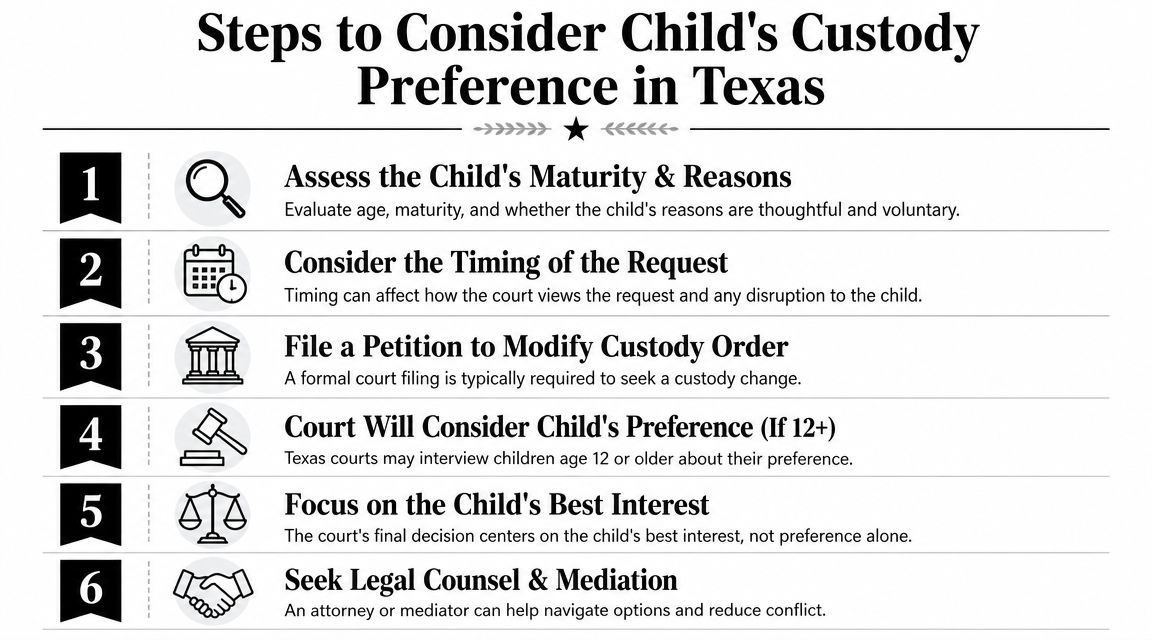
If a custody order already exists, a child's request to switch homes usually means you're talking about a modification case, not a brand-new custody decision.
That procedural difference matters. It is often the main obstacle for parents and teens who think a child's preference should be enough by itself.
A child's wish doesn't change the order by itself
According to Texas commentary on custody changes involving teen preference, a change in a child's preference, especially for an older teen, can be a valid reason to seek a custody modification, but it still requires a proper legal motion and a court's best-interest review. That same discussion notes that a 16- or 17-year-old can't unilaterally ignore an existing custody order before age 18.
That point answers one of the biggest practical questions parents ask in Montgomery County. If your teen wants a change, you still need the court process.
What the process usually looks like
A typical path includes several moving parts:
Review the current order. You need to know exactly what the existing conservatorship and possession terms say.
File the correct request. In many cases, that means a petition to modify the parent-child relationship.
Gather evidence. School records, counseling records when appropriate, schedules, messages, and witness testimony may all matter.
Address the child's preference properly. If the child is old enough, the court may hear that preference through the formal process rather than through arguments between parents.
Prepare for mediation or hearing. Many custody disputes in this area involve negotiation before a judge makes a final ruling.
If you want a closer look at strategy in these cases, this guide on how to win a custody modification case in Texas is a useful starting point.
This overview may also help you picture the process:
What to do next
If your child has asked to live with you, use this checklist:
- Read your current order carefully. Check who has the right to determine the primary residence and what the possession schedule requires.
- Write down the child's reasons. Use the child's actual words as closely as you can.
- Look for concrete facts. School commute, attendance, extracurricular demands, family conflict, and household routine often matter more than general complaints.
- Don't pressure your child. Let the child speak candidly without rehearsing answers.
- Keep communication civil. Angry texts with the other parent often become exhibits later.
- Talk with counsel early. The Law Office of Bryan Fagan is one option for families in The Woodlands and Montgomery County who need help with custody modifications and enforcement issues.
When to Consult a Family Law Attorney
Some families can resolve this issue through agreement. Many can't.
If the other parent denies there's a problem, accuses you of coaching the child, or refuses to discuss any change, legal advice becomes much more important. The same is true if your child is older and unhappy, but the current order remains in place.
Situations that usually call for help
You should strongly consider speaking with a family lawyer if any of these apply:
- There is already a court order. Modification cases are procedural. Good intentions won't replace the required filings.
- Your child is near adulthood but not there yet. Parents often assume an older teen can easily stop following the order. That assumption creates risk.
- The other parent is escalating conflict. Cases involving alienation claims, manipulation, or repeated disputes need careful handling.
- You need evidence organized properly. Courts respond better to clear facts than emotional summaries.
For parents looking locally, this page about how to find a custody attorney in Montgomery County, TX may help you evaluate your options.
The practical takeaway
The short answer to can a child choose which parent to live with Texas age is no, not as it is commonly understood. A child's voice matters. A judge's order controls.
That gap between preference and order is where most mistakes happen. Parents act too quickly, rely on myths about the age-12 rule, or assume an older teen can rewrite the case by refusing to comply. Courts in Montgomery County usually want a lawful, measured process that keeps the child's welfare at the center.
This article is for general educational information only. It is not legal advice, and reading it doesn't create an attorney-client relationship.
If you're facing this issue in The Woodlands, Spring, Magnolia, Conroe, or elsewhere in Montgomery County, getting specific advice early can help you avoid expensive missteps and reduce stress on your child.
If your child is asking to change homes and you need a practical assessment of what a Montgomery County judge is likely to do, you can schedule a consultation with The Law Office of Bryan Fagan.
