
Most online guides tell you to file for legal separation first, get your terms in writing, and decide about divorce later. That advice falls apart in Texas. If you live in The Woodlands or elsewhere in Montgomery County, there's no formal separation decree to file for, and moving out on its own doesn't change your legal status.
That doesn't mean separation has no value. It means the benefits of legal separation in Texas come from separate pieces, each with its own tool and its own limits. Once you see which piece does which job, you can choose the arrangement that actually protects your money, your children, and your options.
Seven Benefits of Legal Separation at a Glance
In Texas, living apart does not create a court-issued separation status. The practical benefits come from three different pieces: written agreements, temporary orders in a filed case, and the fact that the spouses remain married. That distinction helps explain why a benefit described as automatic elsewhere may depend here on a signed agreement, an employer's plan rules, or a court order.
| Benefit | What it can protect | Texas tool or rule | Main catch |
|---|---|---|---|
| Financial order | Support, bills, and property arrangements | Written agreement under Texas Family Code §§ 4.102 and 4.104; temporary orders in a filed case under § 6.502 | Informal promises can be difficult to enforce |
| Health coverage | A spouse's access to an employer plan while the marriage continues | Plan terms; COBRA may apply after a qualifying event | Coverage generally ends at final divorce, and COBRA can cost the full premium |
| Child arrangements | Parenting schedules, support, and decision-making | Court orders in a filed case addressing conservatorship and support | A court order is needed for enforceable terms |
| Tax filing options | The choice between joint and separate returns | IRS filing rules; filing status is determined on the last day of the tax year | The right choice depends on each spouse's situation |
| Inheritance rights | A spouse's potential inheritance when there is no valid will | Texas Estates Code § 201.002 | Wills, trusts, and beneficiary forms still need review |
| Time to consider reconciliation | Space to assess counseling and revised arrangements | Agreement terms and a set review date | A review date does not ensure reconciliation |
| Personal or religious reasons | A marriage that remains legally intact | Personal or faith-based choice | Neither spouse can remarry while still married |
How to Read This Table
Start with the benefit you need, then look across to the tool or rule that could provide it. The final column identifies the limitation to check before relying on that protection. Each benefit depends on its own mechanism, rather than on a general legal-separation status.
For instance, an agreement can set out how spouses will handle bills, but an informal promise may not be enforceable. Parenting terms are different: a court order can establish enforceable arrangements in a filed case. Health coverage depends on the employer plan, and coverage generally ends when the divorce is final. A table can point you to the right question, but the plan documents and court orders determine what applies.
Practical rule: Ask which signed agreement, plan term, or court order creates the benefit you want.
The sections that follow explain the Texas tools behind these benefits and the limits to check, including insurance, taxes, and arrangements for children.
How Legal Separation Works in Texas
Texas doesn't provide a formal legal-separation decree comparable to a divorce decree, so a couple in The Woodlands generally remains legally married until a divorce or annulment. Separation alone doesn't end the legal relationship. Texas Family Code § 2.501(a) continues the spouses' duty to support one another while the marriage exists.
The concept map below shows the starting point every Texas plan has to work from.

Path One Is a Written Agreement
Spouses can use a partition or exchange agreement under Texas Family Code §§ 4.102 and 4.104 to divide or recharacterize community property without divorcing. For example, you could agree in writing that future income or specified assets will belong separately to each spouse. That's a real financial boundary, and it's often the first tool couples reach for.
The agreement has limits you shouldn't overlook. It doesn't terminate the marriage, and it doesn't automatically change every beneficiary designation, debt, or inheritance consequence. If support between spouses becomes part of the discussion, a Spousal Support Lawyer in The Woodlands handles spousal maintenance and alimony representation in The Woodlands, which is a separate question from dividing property by agreement.
Path Two Is a Filed Case With Temporary Orders
A pending Texas divorce can provide court-enforceable temporary protections under Texas Family Code § 6.502(a). After notice and a hearing, the court may order support payments, address temporary possession or use of property, and preserve assets while the case is pending. Temporary support isn't automatic, since the court needs evidence that it's necessary and equitable.
Think of it this way. An informal separation is a handshake deal between two people who may stop cooperating. A filed case gives you a referee who can enforce the terms.
The short video below walks through how couples approach this choice before anyone moves out.
Choose your path before the move, not after. Moving out without written terms can complicate later requests about the home, support, and property.
Money and Tax Protections During Separation
A spouse who loses access to a household account after moving out may have trouble paying ordinary bills, even while the marriage continues. Put financial arrangements in writing, especially if one spouse earns less or depends on shared funds. A longitudinal study found women's income was about 80% of men's one year after marital dissolution and only 85% four years later. The figures make it important to consider how a separation affects the lower earner's access to money.
A separation that keeps the marriage but deepens the weaker earner's economic dependence works against that person. Clear terms can help both spouses understand who pays which expenses and how each can access financial records.
Safeguards to Put in Writing
- Temporary support terms: State the amount, due dates, and an end date or review date.
- Access to records: Confirm that both spouses can view bank, credit card, and retirement account records.
- Debt responsibility: Identify who will make each payment. Review how debts are handled in divorce before assuming a private agreement changes what a creditor can collect.
- Housing costs: Record who stays in the home and who pays the mortgage, insurance, and utilities.
- Retirement and beneficiaries: List current designations so each spouse knows what is in place.
Three Filing Options to Compare
The IRS generally treats spouses as married for the tax year unless a final divorce or separate-maintenance decree exists by the last day of that year. In general, filing status turns on circumstances on that final day. Under applicable state law, a legally separated taxpayer may be treated as unmarried for filing-status purposes. Since Texas has no formal separation decree, confirm how the rules apply to your circumstances rather than assuming that living apart changes your status.
Married filing jointly may produce a lower combined tax bill. Married filing separately means each spouse reports their own income, deductions, and credits, and may limit exposure to the other spouse's tax liability. Head of household may be available if a qualifying child and household-cost requirements are met, including the required period of living apart.
Compare both returns using projected wages, mortgage interest, dependents, and credits before choosing a filing status.
The IRS also provides separation-of-liability relief in certain cases. It may allocate understated tax from a joint return based on each spouse's income and assets when the spouses are legally separated, divorced, or no longer living together. Ask a CPA and an attorney to review your facts together, since Texas has no separation decree and state law can affect which filing status applies.
Health Insurance and Retirement Coverage Rules
Before relying on continued coverage, check the plan document. It defines who qualifies as a spouse and what happens when spouses live apart. Federal guidance says a spouse generally remains covered during legal separation but loses eligibility when the divorce becomes final. Employer plans can set different terms, so the document, not the label “legal separation,” determines eligibility.
| Coverage type | During legal separation | After final divorce | Key deadline or action |
|---|---|---|---|
| Employer group health plan | Coverage depends on the plan's spouse definition | Eligibility generally ends | Check the plan document |
| COBRA continuation | May be available after a qualifying event | Can continue temporarily at the beneficiary's cost | Elect within the applicable window; federal rules allow a plan to charge the full premium plus up to 2% for administration |
| Federal employee plan (FEHB) | Spouse generally stays covered | Eligibility ends at final divorce | Former-spouse coverage requires separate action and deadlines |
| Marketplace coverage | Subsidies depend on household income | Losing employer coverage can open a special enrollment period | Enroll within the applicable window |
| 401(k) or pension | Division requires plan-approved paperwork | The same requirement applies after divorce | Use the plan's model order; a generic court order may not work |
Compare COBRA and Marketplace Costs
COBRA can let an eligible spouse continue employer coverage, generally at that person's cost. The premium may include the full plan cost rather than only the employee share shown on a pay stub. Compare that amount with available Marketplace coverage. Subsidies depend on household income, and losing employer coverage may open a special enrollment period.
Set the separation date only after checking the coverage end date, election deadline, and cost. Include the children's coverage in the same discussion, since their insurance arrangements may need to be addressed separately.
Retirement Accounts Need Plan-Specific Drafting
For an employer-sponsored retirement plan, a domestic-relations order can name a spouse or former spouse as an alternate payee. The plan administrator may require a Qualified Domestic Relations Order (QDRO) to divide the benefits. A court order that does not meet the plan's requirements may not be enough. Ask the administrator for its model order before finalizing terms, and review how divorce affects retirement accounts in The Woodlands.
Texas has no formal legal-separation decree that automatically settles these issues. Written agreements and, when a case is filed, temporary orders can address practical arrangements, while the spouses remain married until divorce is final. That distinction matters: coverage follows the plan's rules, and retirement division follows the plan's order requirements.
Child Custody and Support Benefits for Parents
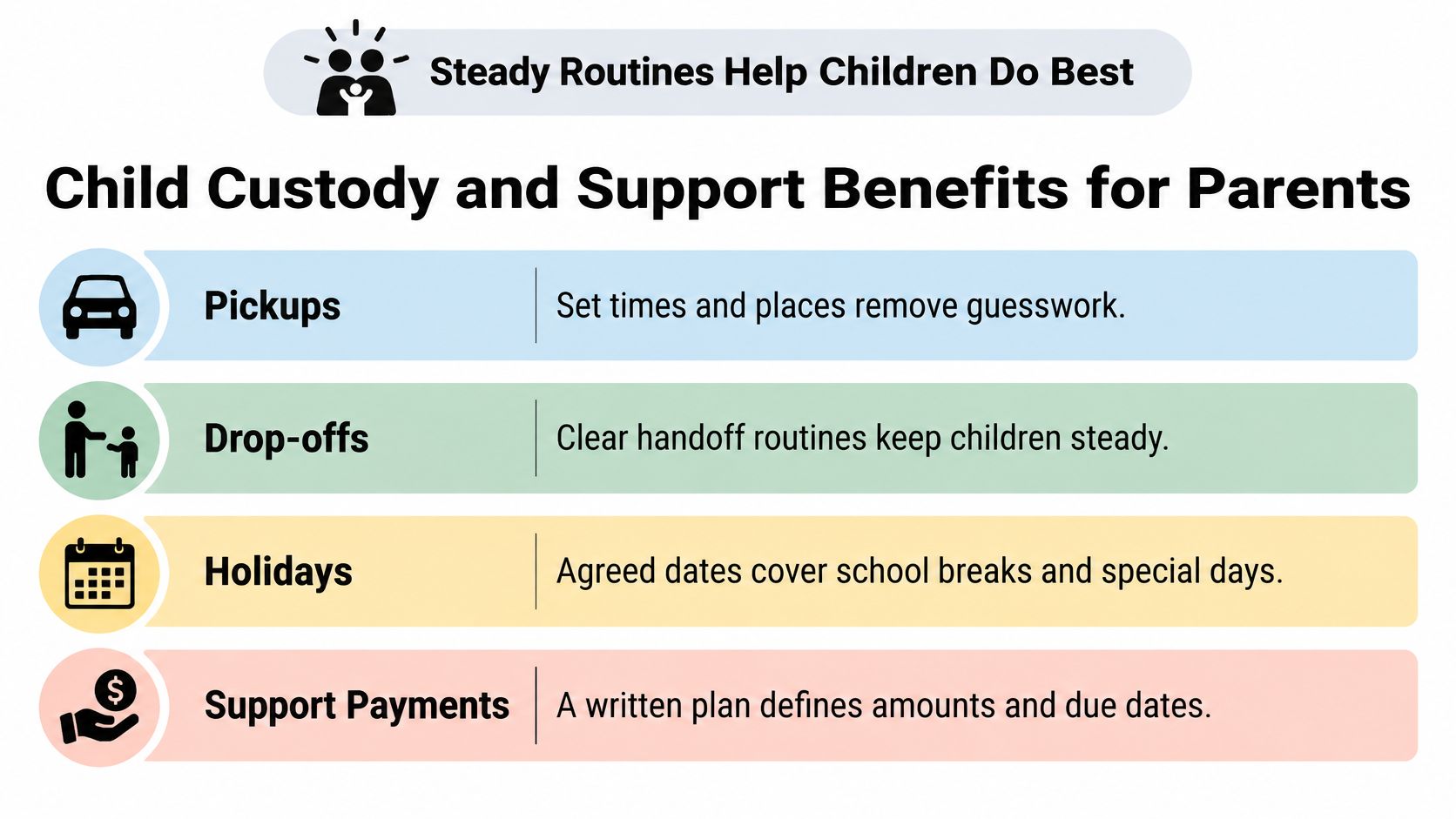
Texas has no formal legal-separation decree. Parents can still use written agreements to set expectations, while court orders in a filed case provide enforceable terms. A schedule can spell out pickups, holidays, school nights, and expenses, replacing repeated negotiations with clear arrangements for families in Panther Creek, Creekside, and across Montgomery County.
Put exchange times and locations on a shared calendar, then include them in the court order. That gives both parents a consistent reference when plans change. An informal agreement alone may be difficult to enforce if one parent stops following it, so file for court orders when enforceability matters.
The chart highlights four routine details a parenting plan can address.
What Courts Look at and What Support Covers
Texas courts decide conservatorship based on the best interest of the child under Texas Family Code § 153.002. Keep records of caregiving, school involvement, and everyday routines so you can describe the child's needs with specific examples. To work out dates and exchange times, compare your draft with an example Texas custody schedule.
Child support and medical support are separate terms to address in the order. Texas uses guideline percentages based on the paying parent's net resources and the number of children. The correct amount depends on the circumstances, and courts may deviate from the guidelines for specific reasons. Include health coverage and medical expenses in the written order rather than leaving them to a side conversation.
A parenting plan also needs to account for each household's ability to meet the child's needs. Set out how housing and expenses will be handled alongside the schedule, so support arrangements complement the day-to-day plan.
Safety note: If there's family violence or a safety concern, don't rely on an informal agreement. Ask a family law attorney about filing for protection in a court case right away.
Legal Separation Versus Divorce Side by Side
Texas has no formal legal-separation decree. Instead, the practical differences come from three things: whether the marriage remains intact, whether a court case provides temporary orders, and whether the spouses have a written agreement. Each tool addresses different needs, so living apart alone does not create the protections of a court order.
| Factor | Living apart while legally married | Final divorce decree |
|---|---|---|
| Marital status | Still legally married | Single after the decree is final |
| Remarriage | Not allowed | Allowed after the decree |
| Temporary orders | Available only through a filed case | Available during a pending case |
| Statutory waiting period | None for living apart | A minimum waiting period applies before a decree can be granted |
| Residency requirement | Not applicable | Texas and county residency rules apply before filing |
The Inheritance Row Surprises People
If someone dies without a valid will, leaving a spouse and children, Texas Estates Code § 201.002 gives the surviving spouse one-third of the separate personal estate, and the children inherit the other two-thirds. The spouse also receives a life estate in one-third of the separate land. If there are no children or descendants, the spouse generally receives all separate personal property and one-half of the separate land.
Living apart doesn't remove a spouse from your estate. A separated spouse in Sterling Ridge should not assume that moving out has the same legal effect as a divorce.
Beneficiary Forms Do Not Update Themselves
Texas Estates Code § 123.151 generally makes a former spouse's payable-on-death designation ineffective after divorce, unless an exception applies. Informal separation does not trigger that rule. Other provisions, including Texas Estates Code § 123.052 on revocable trusts and former-spouse designations, also depend on dissolution of the marriage.
Review life insurance, retirement accounts, payable-on-death accounts, trusts, and deeds against what you want. Moving out does not update a beneficiary form.
The timelines differ too. Divorce has a statutory waiting period under Texas Family Code § 6.702 and residency requirements. Informal separation has no waiting period, but it also does not end the marriage. In practice, separation leaves spouses married, while divorce ends that status and changes the rules tied to it, including estate, tax, and insurance rules.
When Separation Fits and When It Backfires

Living apart can leave room for reconciliation, but separation does not mean a couple is likely to reunite. In a 2025 analysis of adults who separated after age 50, approximately 7% of women and 11% of men reconciled within 10 years. Separation is best treated as a planning period, not a promise that the marriage will resume. For couples in Texas, that planning depends on specific tools: a written agreement, temporary court orders in a filed case, and the rights that continue because the marriage remains intact.
A Short Scenario From Alden Bridge
Consider a fictional couple in Alden Bridge with two children. One spouse is covered by the other's employer health plan, and neither knows whether divorce is the right choice. Before either moves out, they check the plan's definition of spouse and sign a written agreement that sets a parenting schedule, assigns mortgage and children's expenses, and establishes a review date.
The agreement makes their expectations clear. If they reconcile, the children have had a predictable schedule during a difficult period. If they do not, both spouses have a record of who was expected to pay each bill and when. A verbal understanding offers less clarity if they later disagree about a payment. A written agreement can set terms between spouses, while a court's temporary orders require a filed case.
Signs It Fits or Backfires
- It fits when both spouses want time for counseling and can set clear terms for money and parenting.
- It fits when continued health coverage is available during a defined trial period. Confirm the plan rules, since separation itself does not guarantee coverage.
- It fits when faith or personal reasons make divorce unwanted for now.
- It backfires when a safety concern calls for court protection rather than an informal arrangement.
- It backfires when one spouse wants to remarry soon. Separation does not end the marriage.
- It backfires when retirement accounts need division or one spouse remains in the home without written terms.
A separation works better with specific responsibilities and a review date than with an open-ended move apart. Without those terms, disagreements over expenses, parenting, or the home can undermine the breathing room the couple hoped to gain.
Common Questions About Legal Separation in Texas
How Long Do Separations Usually Last
Historical U.S. research using 1987–1988 National Survey of Families and Households data found slightly more than one-quarter of temporary separations lasted longer than five months. Repeated separation-and-reconciliation cycles were also common. Plan around a review date rather than assuming a short trial.
Can My Spouse Make Me Leave the House
Not on the strength of an informal arrangement. In a pending divorce, the court can address temporary possession of the home after notice and a hearing under Texas Family Code § 6.502. Without a filed case or written terms, neither spouse has a simple right to force the other out.
Do We Need a Lawyer and a CPA
Usually, yes, if retirement, taxes, or insurance are involved. Retirement and coverage terms often need plan-specific documents, and filing status depends on state law and year-end circumstances. A family law attorney and a CPA can prevent gaps that cost far more later.
What If We Reconcile After Signing
Put the reconciliation in writing. Then review any agreement, beneficiary forms, and insurance elections together so old separation terms don't unexpectedly control new decisions.
Where Are These Cases Filed
Montgomery County family cases are generally filed in the county's district courts. Local filing rules and procedures matter, even when spouses agree on most terms.
Confirm These Steps Before You Act
Texas has no formal legal-separation decree. Before making changes, identify which tool fits each need: a written agreement can set expectations, and temporary orders in a filed case can address disputes. You remain married unless a divorce is finalized, so some rights and obligations continue.
What to Do Next
- Gather documents: Collect recent tax returns, pay stubs, bank and retirement statements, and a list of debts. These provide a shared starting point for decisions.
- Pull the health plan document: Check the plan's definition of a spouse and note coverage and notice deadlines. Separation alone may not end coverage, but final divorce can.
- Review estate documents: Check wills, trusts, life insurance, payable-on-death accounts, powers of attorney, and deeds. Remaining married can affect inheritance rights, so review beneficiary choices and documents before acting.
- Model both tax options: Ask a CPA to compare filing choices using projected income and dependents.
- Sign written terms: Use the safeguards outlined in the money section, and make clear who will move out.
- Decide on a filed case: If you disagree about the home, support, or assets, ask whether temporary orders in a divorce case could address those issues.
- Set a review date: Put it on the calendar so the arrangement leads to a decision rather than continuing by default.
Montgomery County family and probate matters are handled in local courts. Residents of Panther Creek, Alden Bridge, Sterling Ridge, and Creekside should account for local filing procedures and paperwork. Early legal advice can help when children, substantial assets, a planned move, or an approaching coverage deadline are involved.
The Law Office of Bryan Fagan serves residents of The Woodlands. If you want to discuss which Texas agreements or court filings fit your circumstances, you can schedule one consultation to review your options with a Montgomery County family law attorney.
This article offers general information about Texas family law, not legal advice, and reading it does not create an attorney-client relationship. Your circumstances, plan documents, and court orders can change the analysis. Seek advice about your situation before acting.
The Law Office of Bryan Fagan can discuss written agreements and court filings for separation in The Woodlands. Schedule a consultation to consider your next step.