
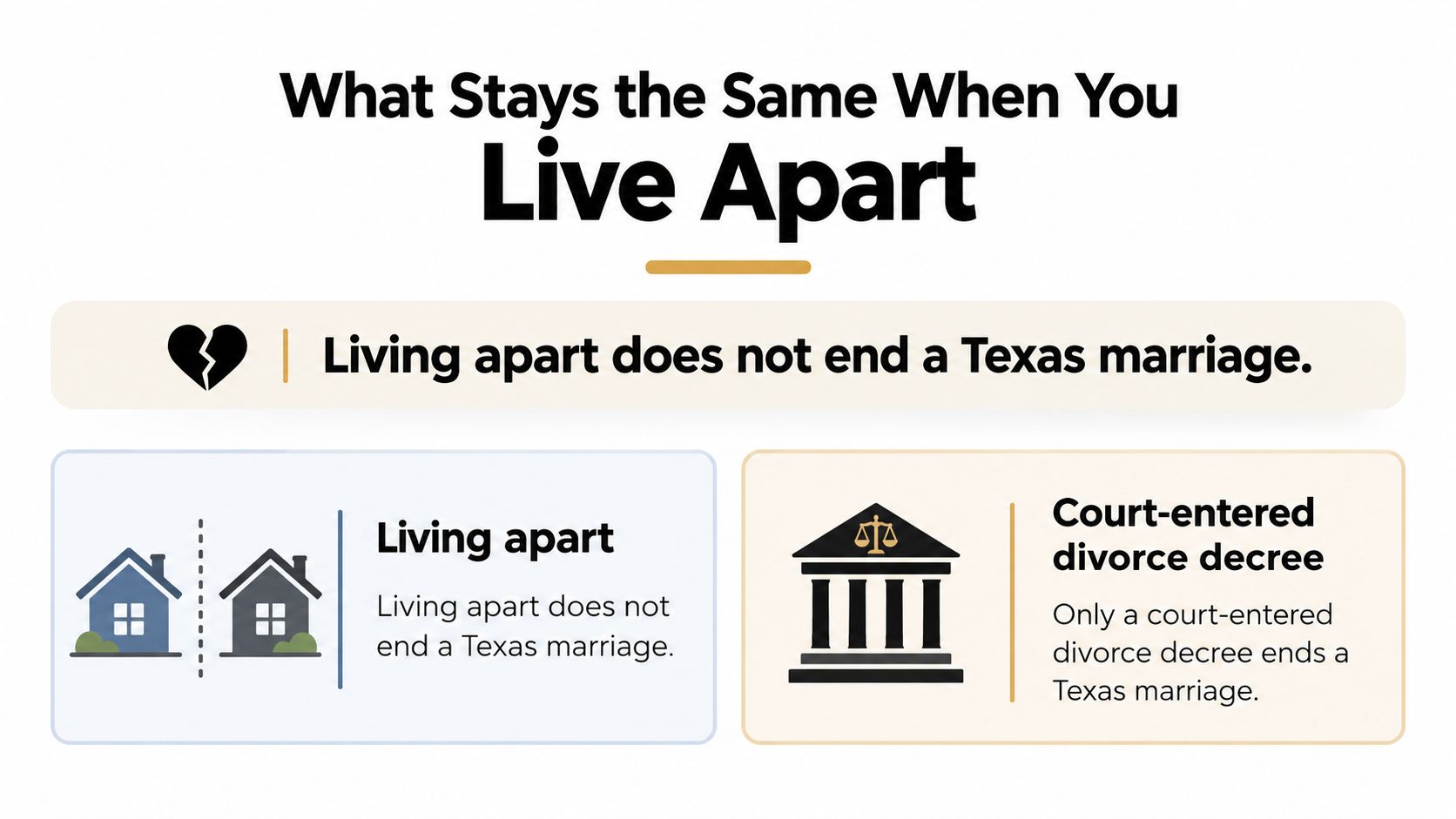
Living apart does not end a Texas marriage. If both spouses are living, only a court-entered divorce decree ends the marriage, and Texas generally requires at least 60 days after filing before a divorce can be finalized.
You may already have another address, separate grocery bills, and a parenting schedule worked out by text. For couples in The Woodlands who are married but living separate, the uncertainty often starts with ordinary questions: Is this paycheck mine? Can we sell the house? Does the other parent have to follow our agreement?
Separate households can be a thoughtful choice, a temporary arrangement, or a response to relationship breakdown. What matters legally is documenting money, obtaining appropriate parenting orders, and reviewing rights that continue while you're married.
What Stays the Same When You Live Apart
Consider this hypothetical scenario: Maria and Daniel lived in Panther Creek before moving into separate apartments in March after years of conflict. Daniel assumed their marriage was effectively over, then discovered that their legal relationship still affected earnings, debts, their home, and inheritance.
Their mistake wasn't moving out. It was assuming that a change of address changed their marital status.
National figures help explain why this situation deserves attention. The share of ever-married American women currently separated or divorced rose from less than 1% in 1900 to 20% in 2022, according to Bowling Green State University's analysis of marital-status trends. That measure combines separation and divorce, so it shouldn't be described as the divorce rate.
What changes when a Texas marriage ends
The distinction is easier to see when legal status and everyday living arrangements are separated.
| Issue | Still Married, Living Apart | After Final Divorce Decree |
|---|---|---|
| Legal marital status | Still married | Divorced, subject to applicable remarriage restrictions |
| Property earned during separation | Generally community property | Marital estate divided in a just and right manner |
| Custody orders | Exist only if a court orders them | Addressed in the decree when applicable and potentially modifiable |
| Child support | Court-order enforcement requires an order | Set in the decree or a support order |
| Spousal maintenance | Support requires an applicable court order, not merely separate homes | Ordered or denied under applicable eligibility rules |
| Inheritance without a will | Surviving spouse may inherit | Former spouse generally loses spouse-based inheritance rights |
| Homestead rights | Protections may continue | Depends on the decree and applicable protections |
| Tax filing status | Generally married filing jointly or separately, subject to exceptions | Generally single or head of household if eligible, based on year-end status |
Tax eligibility and spousal support need individual review. The table is an orientation, not a promise that every filing category or support remedy applies to you.
Practical rule: Don't treat a separate address as permission to ignore a spouse's possible rights in property, parenting decisions, or an estate.
A useful starting assumption is that the marriage still matters unless an applicable law, valid agreement, or court order changes the particular issue. Keep the distinction between living arrangements and legal rights in mind before signing documents or making major financial decisions.
Why Texas Has No Legal Separation Status
Think of marriage like a lease that keeps running until it's formally ended. Moving out changes where you sleep, but it doesn't cancel the agreement.
The analogy has limits, but it explains the central misunderstanding: Texas generally doesn't offer a standalone legal separation process that creates a middle marital status. Spouses can seek particular court orders without obtaining that status.
Separate living can reflect genuine strain without creating a new legal category.
The path from separation to divorce
The residency and waiting rules described in TexasLawHelp's explanation of Texas divorce requirements under Family Code Chapter 6 apply independently of whether spouses share a home.
- Confirm state residency. Either spouse generally must have lived in Texas for at least six months.
- Confirm county residency. Either spouse generally must have lived in the filing county for at least 90 days.
- File the petition. For an appropriate Montgomery County case, file in the district court.
- Address service. The other spouse must receive legally sufficient notice through the applicable process.
- Observe the waiting period. Generally, at least 60 days after filing must pass before finalization, although a family-violence exception may apply.
- Resolve and finalize the case. Present an agreed decree or litigate unresolved issues so the judge can enter the final decree addressing property and, when applicable, children.
The Woodlands spans Montgomery and Harris counties, so verify the county of residence rather than relying on a neighborhood name. An apartment in Panther Creek or a house in Creekside isn't itself a filing and doesn't start the divorce waiting period.
For high-conflict disputes, a Contested Divorce Attorney in The Woodlands provides advocacy in The Woodlands and Montgomery County courts. Whether you need contested representation depends on the disagreements, not on having separate residences alone.
For additional context on the issue, the following video accompanies this discussion.
How Texas Classifies Property and Debt While Apart
Living apart doesn't switch your earnings to separate property. Texas generally presumes property acquired during marriage is community property, meaning property belonging to the marital estate rather than automatically to the spouse whose name appears on the account.
Separate property generally includes assets owned before marriage and property received individually by gift or inheritance. A spouse claiming separate ownership generally must establish it with clear and convincing evidence, a demanding proof standard.
A court divides the community estate in a just and right manner, not automatically 50/50, under Texas Family Code Chapter 7's property-division provisions. That makes reliable acquisition and funding records important even when spouses agree on their move-out date.
Usual Texas classification of common property and debts
| Property or Debt | Usual Texas Classification | Records to Keep |
|---|---|---|
| Paycheck earned during separation | Generally community property | Pay stubs and deposit records |
| Home bought before marriage | Generally separate property, with possible community reimbursement issues | Deed, closing statement, and mortgage history |
| Inheritance received by one spouse | Generally separate property | Probate or inheritance documents and account tracing |
| Retirement contributions made during marriage | Generally community property | Plan statements organized by date |
| Credit card debt incurred during separation | Potential marital-estate issue; responsibility needs individual analysis | Statements showing purchases and their purpose |
| Business started during separation | Generally community property, subject to funding and characterization issues | Formation papers and capital records |
Debt requires particular care. Property classification and responsibility to a creditor aren't interchangeable questions, so don't assume that every purchase binds both spouses personally or that a divorce allocation resolves every creditor issue.
A review of debts and divorce can help you identify which account agreements and spending records to bring to a consultation.
Build a record that explains the money
Start a dated ledger showing opening balances, deposits, withdrawals, and transfers. Save original statements as well as your notes, and label transfers so someone reviewing the records can follow where the money came from.
For a hypothetical Woodlands business owner launching a consulting firm while separated, formation papers establish timing, while capital records identify the source of startup funds. Those records help assess ownership; neither a new business account nor the owner's separate address decides the answer.
Similarly, payments made during marriage toward a home owned before marriage can raise a community reimbursement claim, meaning a request to account for qualifying contributions without automatically changing ownership of the house.
Separate bank accounts organize spending. They don't, by themselves, prove separate ownership.
If spouses want to alter property characterization, ask about a properly documented partition or exchange agreement. An informal understanding that each person keeps their own paycheck isn't a dependable substitute.
Custody and Child Support Without a Divorce
You don't have to wait for divorce to ask a Texas court to address children and support. The immediate distinction is between an arrangement parents follow voluntarily and an order a court can enforce.
| Arrangement | Enforceable as a Court Order? | Main Risk |
|---|---|---|
| Verbal agreement on schedule or support | No | Disputes with no reliable record |
| Text or email agreement | Evidence only, not an order | Disagreement over terms or missed payments |
| Written agreement signed by both spouses | Not a court order unless approved and entered by a judge | Limited order-enforcement options if never made an order |
| Agreed temporary order signed by a judge | Yes, subject to enforceability requirements | Requires a filed proceeding and judicial approval |
| Contested temporary order | Yes, the court sets the terms | Cost, time, and conflict |
A signed agreement can be useful, but a parent's signature isn't the same as a judge's order. Likewise, contempt, a court's power to address certain violations, isn't automatically available for every disputed term.
Ask for an order that fits the problem
Texas courts can address parenting through a suit affecting the parent-child relationship, a case concerning parental rights, responsibilities, possession, or support. Texas uses conservatorship for the allocation of parental rights and duties, rather than treating custody as only a question of where a child sleeps.
The overview of Texas separation, child support, and Family Code rules explains that parents can seek child-related orders while remaining married. Montgomery County family cases are heard at the county courthouse in Conroe, and the correct filing depends on existing cases and orders.
Before filing, review how to file for custody and gather the documents needed to explain the arrangement you're requesting.
Record what actually happens
Keep a shared record if it's workable and safe, or maintain your own accurate log. Useful entries include:
- Parenting time: Actual overnights, exchanges, missed visits, and agreed changes.
- School transportation: Who handles pickups, drop-offs, and schedule disruptions.
- Child-related expenses: Medical bills, insurance coverage, and extracurricular costs.
- Support payments: The date, amount, payment method, and stated purpose of each transfer.
These records should describe events plainly rather than become a running argument. Save receipts and messages that support the entries.
Move toward formal orders when conflict, relocation, income changes, or safety concerns make voluntary compliance uncertain. Ask for clear terms covering exchanges, payments, and responsibilities rather than relying on an expectation that everyone will remember the same conversation.
For example, consider a hypothetical Alden Bridge parent who sends support through an app but keeps no ledger. If the parents later disagree about whether transfers covered support, school costs, or reimbursements, the app history may show money moved without clearly showing why.
Protect Your Rights Before You Move Out
Separation alone doesn't remove inheritance rights. That can reassure spouses who intentionally remain married, but it can also surprise someone who assumes moving out removed their spouse from the estate.
Under Texas Estates Code Chapter 201's intestacy rules, Section 201.002 generally passes a deceased spouse's community-property interest to the survivor when there are no surviving children or descendants who aren't also the survivor's children or descendants.
If the deceased spouse leaves a child or descendant who isn't also the survivor's, the deceased spouse's undivided one-half community-property interest generally passes to the deceased spouse's descendants. Separate-property rules can provide the survivor one-third of personal property and, in some circumstances, a life estate in one-third of the land, meaning a right to use that interest during the survivor's lifetime.
Preserve records before making changes
Use this action plan before signing documents or reorganizing household finances.
Gather account statements and property records. Note balances as of the separation date and save deeds, retirement statements, loan records, and documents identifying inherited property.
Start a dated parenting and expense log. Record actual parenting time, school and medical expenses, and support transfers with receipts or confirmation records.
Put parenting and support arrangements in writing. If reliable compliance matters, discuss converting the agreement into an appropriate temporary court order rather than treating signatures as sufficient protection.
Pause major transactions for review. Have a lawyer review proposed deeds, refinances, home-equity loans, sales, and large withdrawals before you commit.
Review your estate and emergency documents. Check your will, beneficiary designations that may control outside the will, powers of attorney, health-insurance eligibility, and instructions for hospitalization.
Avoid unexplained financial changes. Before taking on new joint debt or transferring marital funds, document the purpose and seek advice when ownership or responsibility is disputed.
For a Sterling Ridge or Alden Bridge homestead, moving out doesn't necessarily eliminate signature requirements. Texas homestead protections generally require the other spouse's participation in a sale or encumbrance, subject to exceptions, and Texas Estates Code Chapter 102 preserves important surviving-spouse homestead protections.
Plan for a longer separation
If you expect separate households to continue, assign responsibility for mortgage payments, insurance premiums, repairs, and emergency communication. Confirm who will keep the records and how each spouse can access information about shared obligations.
A postnuptial agreement review in Montgomery County may be appropriate when spouses want a formal agreement addressing property. Ask how the proposed agreement interacts with estate documents and any existing court orders.
Before signing: Make sure you understand whether a document changes ownership, borrowing obligations, access to the home, or what happens at death.
What to do next
These tasks are manageable over a weekend:
- Save financial records: Download current bank, retirement, mortgage, and credit statements into a secure folder.
- Create a household timeline: Note the move-out date, major transfers, and changes in parenting routines.
- Collect existing documents: Locate court orders, wills, beneficiary confirmations, deeds, and insurance information.
- Prepare consultation questions: Identify the decisions you need help with before signing, borrowing, or moving funds.
This is general information, not legal advice. Reading it does not create an attorney-client relationship. Individual advice is especially important when documents conflict, safety is uncertain, or substantial property is involved.
Special Cases That Change the Answer
Not every couple living apart has the same legal or practical problem. An informal marriage, an intentional separate-home arrangement, and a long-term caregiving plan require different questions.
Informal marriage and intentional separate homes
For informal, or common-law, marriage, the analysis starts with whether the couple agreed to marry, lived together as spouses, and represented themselves as married. Under the Texas rules referenced earlier, a proceeding to prove that marriage generally faces a presumption against marriage if it isn't commenced within two years after separation and the end of cohabitation.
By contrast, some spouses deliberately maintain separate residences without considering themselves separated. A National Center for Family and Marriage Research profile published in 2025 found that 12.5% of newlyweds lived apart for reasons other than separation in 2023.
To clarify the arrangement, consider:
- Financial practices: Separate spending systems and responsibility for shared bills.
- Public descriptions: Whether spouses describe themselves as married, separated, or reconciling.
- Written plans: Agreements about parenting, housing, and ongoing obligations.
- Expressed intentions: Whether either spouse has communicated an intention to end the marriage.
Older spouses, substantial assets, and safety
For older spouses, separate homes may support independence or reduce conflict. NPR's reporting on couples living apart together discusses potential well-being benefits, but that doesn't make separate living the right choice for everyone.
Older couples and high-asset families should coordinate caregiving, medical decision-making, emergency contacts, taxes, insurance, business records, and estate plans. A written hospitalization protocol can identify who should be contacted and where decision-making documents are kept.
Safety takes priority over an orderly documentation plan. Separate housing may be protective, and the family-violence exception noted earlier may affect divorce timing; no single address, payment, or statement decides every legal issue.
The Law Office of Bryan Fagan helps families in The Woodlands, Panther Creek, Alden Bridge, Sterling Ridge, Creekside, and Montgomery County address divorce, parenting orders, property division, and probate concerns. Visit The Law Office of Bryan Fagan to schedule a consultation and review your records before signing an agreement or making a major move.