 Skip to content
You're sitting at the kitchen table in an Alden Bridge rental, staring at a marriage certificate from a Las Vegas ceremony eight weeks ago. The wedding felt exciting at the time. Now you can't live together, the lease is in both names, and a new car loan was co-signed at a dealership along I-45. The question sounds simple: can a quick wedding be legally undone, or do you need a divorce?
That's the practical issue behind annulment vs divorce in The Woodlands, TX. The drive down Woodlands Parkway to the Montgomery County Courthouse may be straightforward, but the legal path can be layered. This guide gives you a decision process based on the facts that matter, including the 72-hour marriage-license rule, residency, evidence, children, property, and the danger of continuing to live together after discovering a possible annulment ground.
A Woodlands Couple at the Crossroads
The couple in that Alden Bridge rental may assume that a short marriage should qualify for an annulment. That assumption causes trouble. Marriage length alone doesn't decide the issue. An annulment depends on whether Texas law recognizes a specific defect in the marriage and whether the spouses took actions that removed the right to seek that remedy.
Their shared lease still matters, but it doesn't decide whether the marriage was valid. Neither does the co-signed car. Those facts affect practical separation, debt, and property questions. They don't automatically turn a divorce into an annulment.
The first question is what happened at the time of the ceremony. Was one spouse unable to consent because of intoxication? Was there fraud, force, or duress? Did the ceremony occur less than 72 hours after the marriage license was issued? Was a prior divorce concealed? Did one spouse lack mental capacity, or was there a qualifying underage-marriage issue? Texas sources describe annulment as a narrow remedy tied to those kinds of facts, not a fast exit for a relationship that failed (Texas Law Help's annulment requirements).
The practical rule: A bad marriage isn't automatically an invalid marriage.
For this couple, the next move isn't to pick a form from a website. It's to preserve the timeline. Find the marriage license, ceremony date, license-issuance date, messages about consent or deception, lease records, loan documents, and proof of when the spouses began living together. If an alleged defect became known after the ceremony, record that discovery date as accurately as possible.
A Montgomery County lawyer should also examine whether the couple's facts support an annulment or whether divorce offers a more predictable result. The court may still need to address property, debt, and children even when someone seeks to undo the marriage. The goal is a clear filing strategy, not a dramatic label.
What Annulment and Divorce Mean in Texas
A Woodlands spouse who regrets a rushed wedding often asks for an annulment first. That request only fits when a legal defect affected the marriage's formation. An annulment asks a court to declare the marriage legally defective from the beginning. Divorce ends a marriage Texas recognizes as valid. That distinction controls the evidence, deadlines, and orders the judge may issue.
Texas law recognizes several annulment grounds, subject to specific statutory requirements:
- Underage marriage: A marriage involving an underage person may qualify under defined conditions.
- Intoxication: A spouse may argue that intoxication prevented meaningful consent at the ceremony.
- Impotence: The condition must meet statutory requirements and generally must not have been known before marriage.
- Fraud, duress, or force: Deception, threats, or coercion may support the claim.
- Mental incapacity: A spouse may have lacked the capacity to understand the marriage or consent to it.
- Concealed divorce: A spouse may have hidden a qualifying recent divorce from a third party.
- The 72-hour license rule: The ceremony may have occurred less than 72 hours after the marriage license was issued, unless an exception applies.
The Texas Family Code also addresses marriages that may be void, including certain bigamous or prohibited relationships. Those cases differ from a routine voidable-marriage annulment. The petition must identify the legal theory. A short marriage, disappointment, or regret does not supply one (Texas Family Code annulment provisions).
Cohabitation creates a serious trap in Montgomery County. For fraud, duress, force, intoxication, and concealed-divorce claims, voluntarily living together after discovering the problem, or after coercion ends, can defeat the claim. A couple that kept sharing a home in The Woodlands may weaken an annulment case even if the original defect appears credible.
Divorce follows Chapter 6 of the Texas Family Code. A spouse may seek divorce for insupportability, commonly called no-fault divorce, or plead a recognized fault ground. Texas guidance describes divorce as generally available after a 60-day waiting period, while annulment requires proof of a qualifying defect (Texas annulment and divorce comparison).
Your facts should answer the practical question. Was there a specific defect at the ceremony? Can you prove it with messages, records, witnesses, or other evidence? Did you voluntarily live together after learning about it? Did the 72-hour license rule or another statutory timing requirement apply? Children, a house, retirement accounts, or substantial debt also make a prompt case review more important because an annulment may still require orders addressing those issues.
If the ceremony was defective and the evidence remains preserved, consult a Woodlands annulment lawyer promptly. If the marriage was valid and the relationship failed, divorce is usually the practical route. A Divorce Lawyer in The Woodlands, TX can address divorce representation for clients in The Woodlands and Montgomery County. Do not keep cohabiting while waiting for advice if separation after discovery affects your potential claim.
Side-by-Side Comparison of the Two Paths
The choice becomes clearer when you compare the legal jobs each case asks the court to perform. An annulment requires you to prove why the marriage was defective. Divorce requires the court to dissolve a valid marriage and resolve the related financial and parenting issues.
| Criterion | Annulment | Divorce |
|---|---|---|
| Eligibility | Requires a qualifying statutory ground tied to the marriage's formation | Generally available through insupportability or a recognized fault ground |
| Timing | Some grounds have short filing or discovery windows | Available after Texas and county residency requirements are met |
| Venue | Texas jurisdiction may exist when the parties married in Texas or either party is domiciled in Texas | Generally requires one spouse to have lived in Texas for 6 months and the filing county for 90 days |
| Evidence | Requires proof of the specific defect and compliance with any cohabitation limitation | Requires proof of a valid marriage and grounds for dissolution, with disputes often focused on property, children, or fault |
| Property and debt | A judge may still need to address property and debts connected to the relationship | The court divides the marital estate and allocates debts in the divorce case |
| Children | Parenting, possession, support, and conservatorship issues can still require orders | The court addresses those issues as part of the divorce or related parent-child proceeding |
| Remarriage | A final order changes civil marital status, but the legal effect depends on the order and facts | A final decree dissolves the marriage and permits remarriage under applicable law |
The venue distinction matters for a Woodlands spouse. Texas law provides different jurisdiction rules for annulment and divorce. The Texas statute states that a divorce generally requires the six-month Texas residency and 90-day county residency framework, while an annulment suit may be maintained if the parties married in Texas or either party is domiciled in Texas (Texas Family Code Section 6.301).
Property doesn't disappear because a judge grants an annulment. The shared lease, the car loan, bank accounts, furniture, and other obligations may still require practical resolution. A lender also isn't automatically bound by a family-court order allocating a debt between spouses. If both names are on the car loan, the lender may continue looking to both borrowers.
Children make the supposed shortcut even less attractive. A court can still need to decide conservatorship, possession, child support, and other parent-child issues. An annulment doesn't erase a parent's responsibilities.
A divorce also provides a more familiar structure for a valid marriage. It may involve temporary orders, mediation, discovery, property division, and a final decree. That process can feel heavier, but it offers a predictable legal mechanism when an annulment claim is uncertain.
Filing in Montgomery County and What to Expect
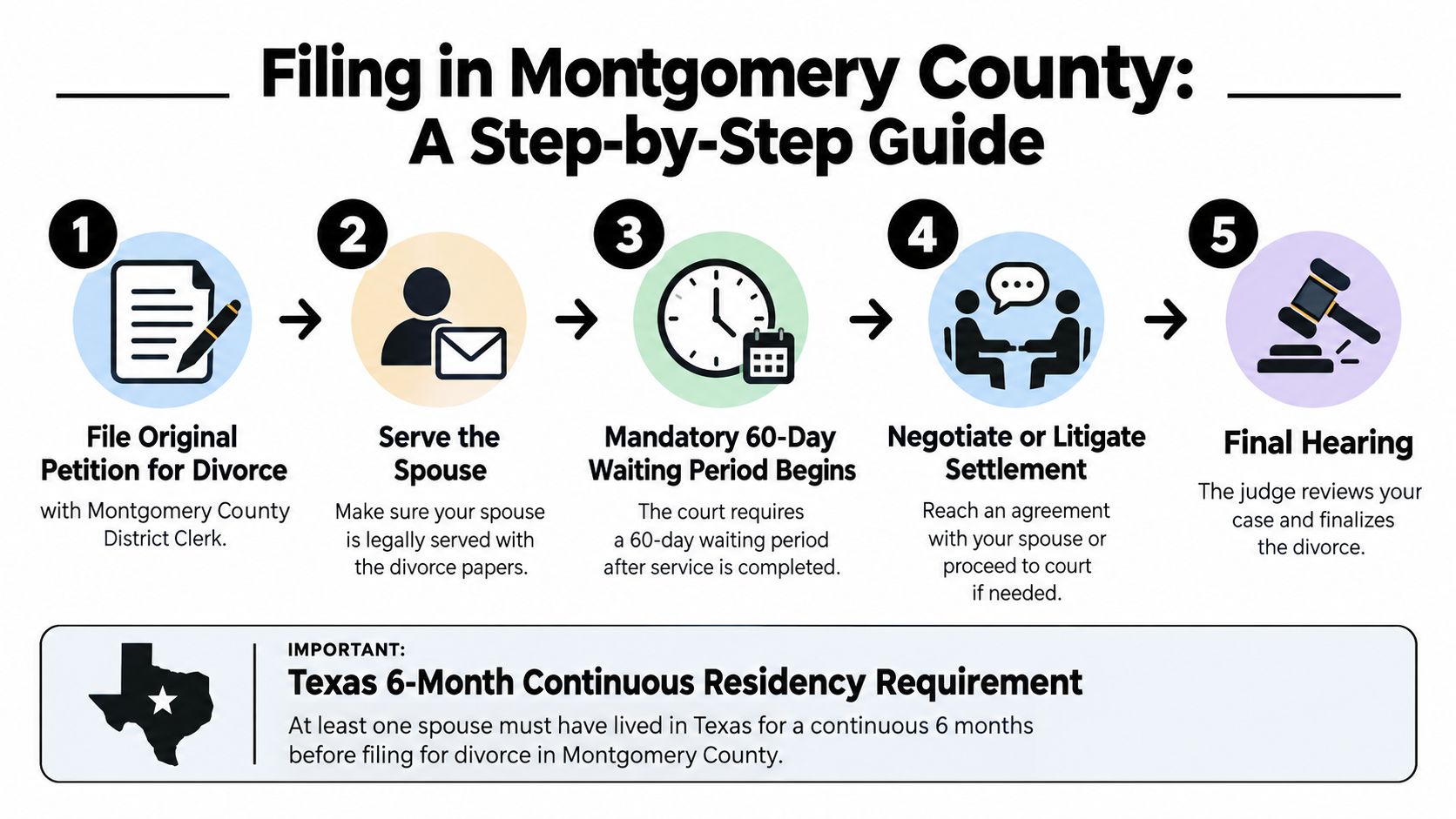
For most Woodlands spouses, a divorce begins with an original petition filed in the appropriate Montgomery County district court. Texas generally requires one spouse to have lived in Texas for 6 months and in the filing county for 90 days before filing for divorce, as described in the Texas jurisdiction statute linked above. The case is commonly filed through the Montgomery County District Clerk, with family matters heard in the county's district courts.
After filing, the petitioner must provide legal notice to the other spouse unless that spouse signs a valid waiver or files an answer. Service isn't a courtesy email. It's a formal step, and mistakes can delay the case or create problems with the final judgment.
Texas imposes a 60-day waiting period after the divorce case is filed in ordinary circumstances. Certain statutory exceptions may apply, so don't assume the waiting period always controls the hearing date. The parties may negotiate, mediate, or litigate temporary and final issues during the case.
A suit for annulment also proceeds through a court petition and final order. The petition must plead a specific Family Code ground, and the court must have jurisdiction. The 72-hour rule deserves careful checking. The question is not merely whether the wedding happened quickly. You need the license issuance date, ceremony date, and any applicable exception. A concealed-divorce claim also involves the prior divorce timing, lack of knowledge, and what happened after discovery.
Local filing details that affect the case
Expect a filing fee set by the clerk, though the precise amount can change. A person who cannot afford court costs may ask about a declaration of inability to pay. If the case requires serving a non-spouse co-respondent, such as someone whose legal interests are implicated by a particular claim, ask counsel and the clerk about the correct process rather than improvising.
Uncontested hearings still require a properly prepared final order, evidence, and scheduling. A spouse who agrees with the result may sign documents, but the judge must still receive what Texas procedure requires.
Military families in The Woodlands and Montgomery County need an additional review. The Servicemembers Civil Relief Act can affect service, default judgments, and the timing of proceedings when a spouse is on active duty or cannot participate. A nearby military assignment doesn't automatically resolve those issues. The filing resource for divorce in The Woodlands can help identify the local filing questions to raise before submitting documents.
Costs, Timelines, and Realistic Budgets
No responsible lawyer can quote a universal annulment or divorce price without knowing whether the case involves children, property, service problems, temporary orders, discovery, or a contested hearing. The available facts support a qualitative comparison, not invented dollar ranges. An agreed divorce with no property or children disputes is usually more predictable than an annulment claim that requires proof of fraud, incapacity, intoxication, or another specific ground.
Court filing fees are separate from attorney fees and other case expenses. Costs may include service, copies, records, mediation, experts, and additional hearings. If a spouse is unable to pay court costs, the spouse can ask the clerk or court about the process for seeking a waiver.
| Path | Typical Cost Range | Realistic Timeline | Best Fit |
|---|---|---|---|
| Annulment | Fact-dependent, often higher than a straightforward agreed divorce when proof is disputed | Depends on evidence, service, hearings, and any statutory deadline | A marriage with a provable qualifying defect |
| Agreed divorce | Court costs plus agreed legal assistance and document preparation | Often more predictable, subject to the statutory waiting period and court scheduling | Valid marriage with agreement on property, debt, and children |
| Contested divorce | Can rise substantially with discovery, temporary orders, experts, or trial preparation | Usually less predictable because disputes drive the schedule | Disagreement over property, parenting, support, or fault |
An annulment can cost more than expected because the central issue is often contested. The petitioner may need testimony, messages, medical or financial records, witnesses, or evidence about when the defect became known. A court can deny the annulment, leaving the spouse to pursue divorce after spending time and money on the first case.
The financial question isn't just “Which filing is cheaper?” It's “Which result can I prove with reasonable confidence?” A divorce may feel less satisfying if you believe the marriage should never have existed, but it can offer a clearer path to resolving the car, lease, bank accounts, and parenting arrangements.
Mediation can reduce the amount of attorney time when both spouses are willing to negotiate. It doesn't make an annulment ground easier to prove, but it may help resolve related property or parenting disputes. For a practical discussion of budgeting issues, review the cost discussion for divorce in The Woodlands, then ask for a case-specific estimate rather than relying on a generic figure.
Real Scenarios from The Woodlands and Nearby Communities
A couple marries in a ceremony held less than 72 hours after the marriage license was issued. They immediately regret the decision, never live together as spouses, and preserve the license and ceremony dates. That fact pattern may support an annulment inquiry, assuming no statutory exception applies and the petition satisfies the applicable requirements. The key isn't the regret. It's the timing and the absence of cohabitation after the ceremony.
Now consider a five-year marriage in The Woodlands with two children and a home in Panther Creek. The spouses disagree about custody, possession, support, and the home. A divorce is the practical vehicle because the problem is the relationship, not necessarily the validity of the ceremony. The useful objective may be an agreed divorce or a carefully managed contested case, depending on safety, parenting, and financial disputes.
A third couple marries after one spouse allegedly misrepresents age, a prior divorce, or finances. The marriage unravels within a year, but the spouses lived together after the alleged deception became known. An annulment lawyer would need to examine the exact ground, the evidence, the discovery date, and whether the continued living arrangement was voluntary cohabitation that bars relief.
These examples show why online checklists can mislead. The same label, “fraud,” can describe very different facts. A serious misrepresentation before marriage isn't automatically enough. The court may focus on whether the alleged deception caused consent, when it was discovered, what evidence supports it, and what the spouses did afterward.
The cohabitation problem in everyday terms
Suppose a spouse learns about the alleged defect on a Monday but stays in the shared home for months, continues presenting the relationship as a marriage, and maintains ordinary married life. That conduct can create a major obstacle for a voidable annulment claim. Texas Bar practice materials emphasize the fact-sensitive nature of these threshold questions, including the rule that voluntary cohabitation after discovery can defeat relief (Texas Bar annulment practice materials).
A concealed-divorce case has its own narrow requirements. The prior divorce must fall within the statutory period before the marriage, the petitioner must not have known and reasonably could not have known, and the spouses must not voluntarily cohabit after discovery. The facts need to be documented quickly because memories, messages, and living arrangements change.
How to Decide and What to Do Next
Use this decision flow before you drive to the courthouse or file anything online.
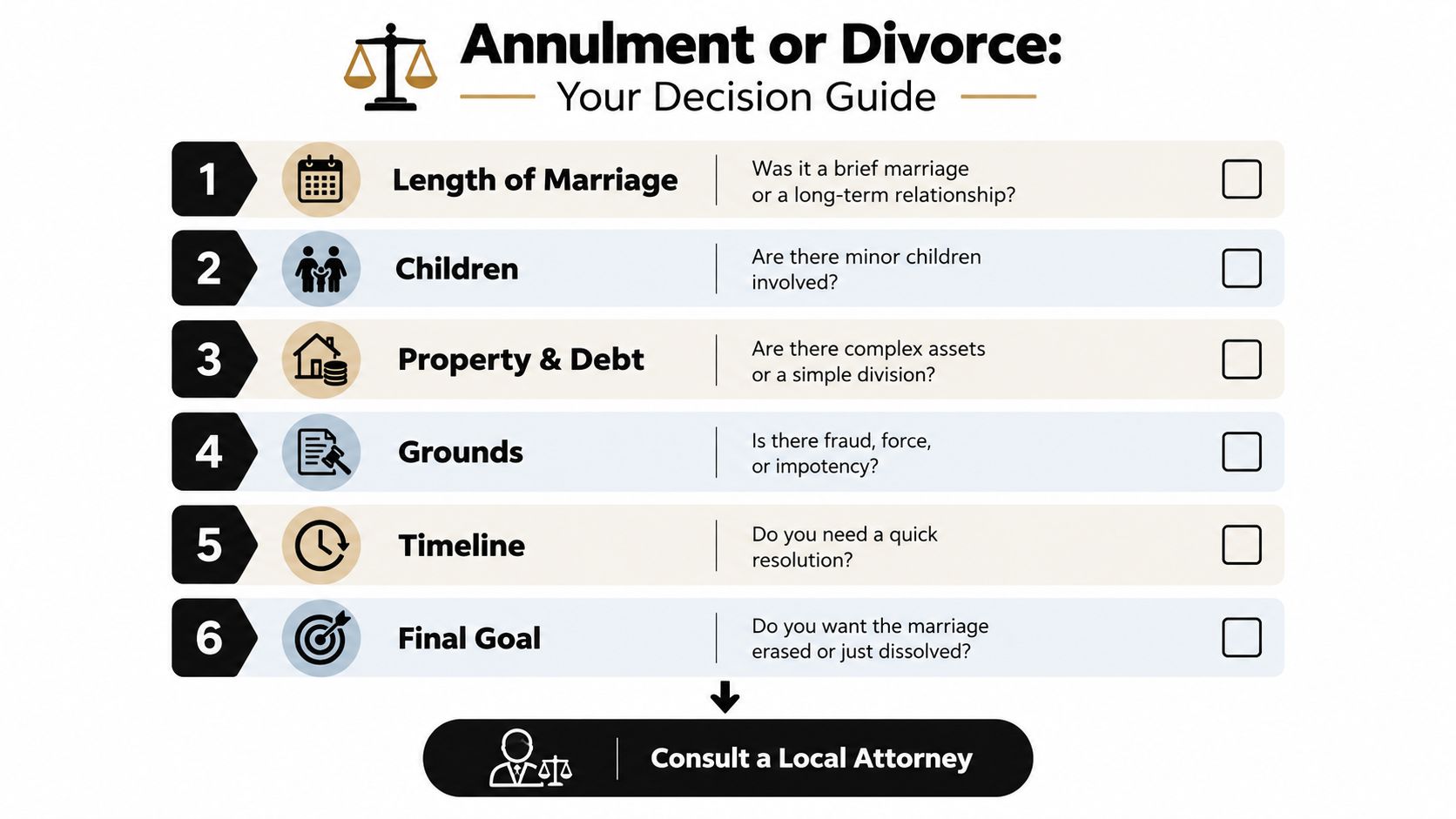
Start with six questions
How long have you been married? A short marriage may prompt an annulment review, but duration doesn't create eligibility. Focus on the ceremony, the defect, and what happened afterward.
Are children involved? If you share children, expect parenting and support issues regardless of whether you pursue annulment or divorce. Choose the path that gives the court a workable framework for protecting the children's interests.
What property and debt exist? List the lease, car loan, bank accounts, credit cards, real estate, retirement interests, and personal property. A marriage certificate may be challenged, but creditors and practical obligations still need attention.
What is your legal ground? Identify the exact allegation. Fraud, force, duress, intoxication, impotence, mental incapacity, concealed divorce, underage marriage, and the 72-hour license rule each require different facts and evidence.
What is your timeline? If a statutory deadline or discovery-based limitation may apply, delay can damage the claim. A divorce has its own waiting and residency requirements, but it generally doesn't require proof that the ceremony was defective.
What outcome do you need? If your priority is a civil declaration that the marriage was invalid, investigate annulment. If your priority is a reliable order dividing property, assigning debt, and resolving parenting issues, divorce may be the stronger choice.
The cohabitation bar deserves a separate warning. If you believe the marriage is voidable because of fraud, duress, force, intoxication, or concealed divorce, continuing to live together after discovery may undermine the case. Get advice before making statements or signing documents that could affect the timeline.
What to do next
- Gather records: Locate the marriage license, certificate, ceremony records, lease, loan documents, messages, and relevant financial records.
- Write the timeline: Record the ceremony date, license date, cohabitation dates, discovery date, and separation events.
- Stop guessing about the 72-hour rule: Compare the license issuance time and ceremony time with the statutory requirement and any exception.
- Protect evidence: Save original messages and documents. Don't edit or delete communications.
- Confirm venue: Check the Texas residency and Montgomery County filing requirements for divorce, or the jurisdiction rules for annulment.
- Get a case review: Ask a local family lawyer to test the annulment theory against the evidence and cohabitation facts.
This article is not legal advice. Texas family-law outcomes depend on the specific facts, current statutes, court procedure, and evidence in your case. For a confidential consultation about annulment or divorce in The Woodlands and Montgomery County, contact The Law Office of Bryan Fagan, which handles family-law matters for local families and can discuss how the facts affect your filing strategy. Visit The Law Office of Bryan Fagan to take the next step before filing.
