 Skip to content
You're home from a late-night stop, your car is impounded, and you're trying to understand how a second DWI could affect your job, license, family, and freedom. If the arrest happened near The Woodlands or elsewhere in Montgomery County, don't treat it like a repeat of your first case. Texas treats a second DWI as a substantially more serious matter, and the first decisions you make can affect both the criminal charge and your driving privileges.
This guide explains what to do immediately, how prior convictions can affect bond, why the administrative license case has its own deadline, and what to look for when choosing a second DWI lawyer in The Woodlands, TX. This is general information, not legal advice. Your case requires a review of the arrest records, testing evidence, prior conviction, and current bond conditions.
What a Second DWI Really Means in The Woodlands
You're driving home on I-45 near Woodlands Parkway after a late evening. A Montgomery County deputy stops you, says they smell alcohol, asks you to perform field sobriety tests, and uses a portable breath-testing device. Soon, you're in handcuffs, your vehicle is being towed, and you're wondering how a prior DWI from years ago suddenly became the center of the case.
That second charge feels heavier because it is. A first DWI may have involved serious consequences, but a second case puts the State's prior-conviction theory directly into the center of the prosecution. An old conviction from another Texas county can resurface in the criminal-history review, and prosecutors can use it to seek enhanced treatment.
Practical rule: Don't assume the age or location of the first DWI makes it irrelevant. The record must be examined, not guessed about.
The Woodlands sits within Montgomery County's local criminal-justice system, where magistrates and prosecutors review prior exposure when setting release conditions and evaluating the case. Your lawyer should determine what the State can prove about the earlier case, including the court, judgment, conviction date, and identity of the person convicted.
Two cases begin at the same time
A second DWI creates a two-track problem:
- The criminal case concerns the alleged offense, the prior conviction, evidence, court appearances, and potential county-jail exposure.
- The Texas Department of Public Safety administrative license case, commonly called an ALR case, concerns whether your driving privileges will be suspended after a failed or refused chemical test.
The ALR process moves independently from the criminal prosecution. The Texas Department of Public Safety requires prompt action, and the request for an ALR hearing generally must be made within the deadline shown on the paperwork you received. Missing that deadline can eliminate an opportunity to contest the administrative suspension.
The stakes are different from a first arrest because the State may seek a Class A misdemeanor treatment for the new charge. A conviction can affect commuting, employment, childcare, professional licensing, and insurance. If you're researching how a first case differs, review this first-offense DWI information for The Woodlands, but don't assume the same strategy applies to a second offense.
The First 72 Hours After a Second DWI Arrest
The first three days are not the time to explain, negotiate, or post online. They're the time to preserve your options.
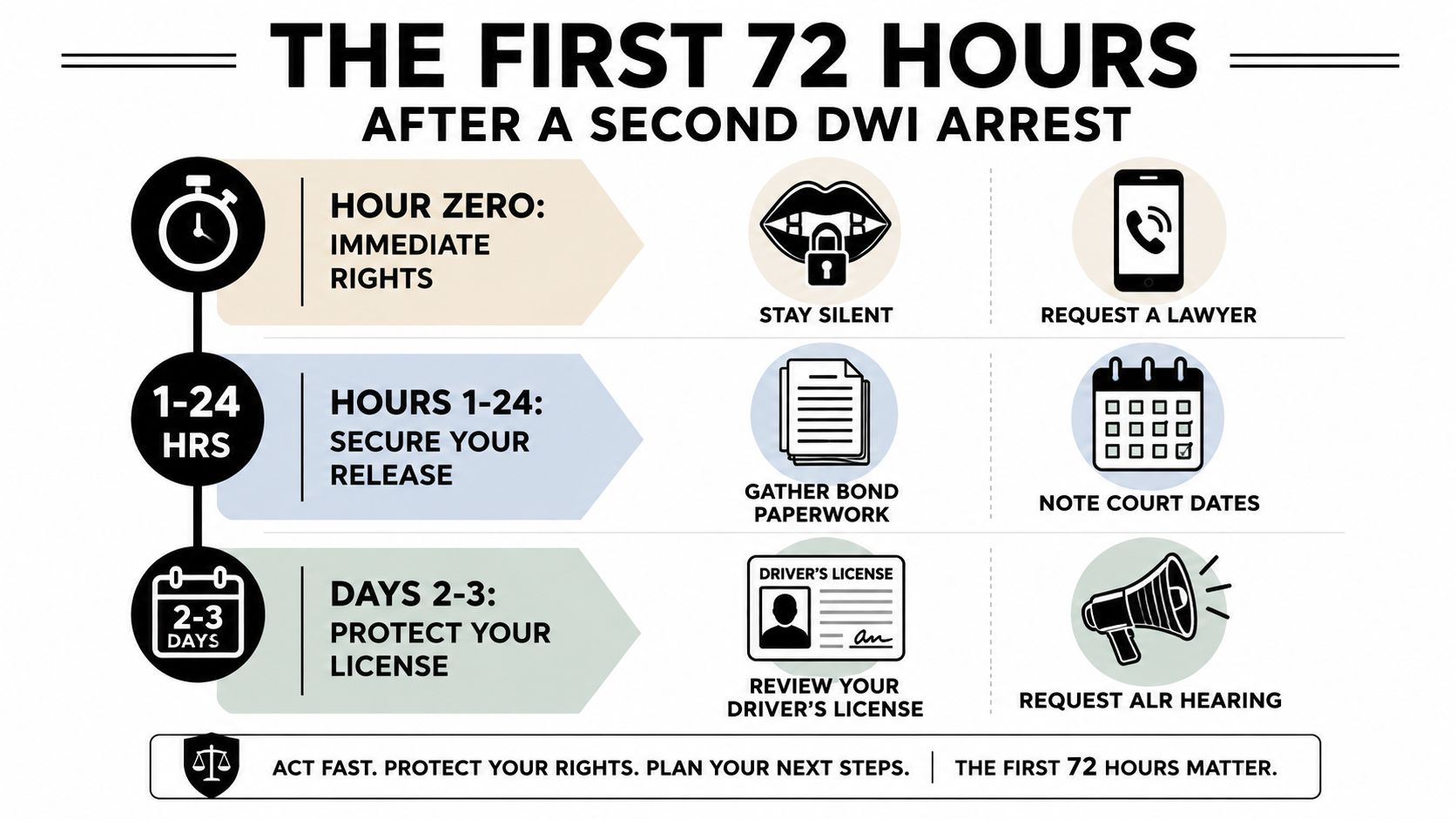
Hour zero
Say as little as possible beyond identifying information and your request for counsel. Don't try to persuade the officer that you were safe to drive, explain what you drank, or debate the field sobriety instructions. Your statements may become evidence, and explanations given under stress rarely help.
Ask for a lawyer clearly. Don't give a written statement to the arresting or requesting officer after release, even if someone suggests that a short explanation will resolve the matter.
Hours 1 through 24
Collect every document you received. Put these items in one folder:
- Bond paperwork: Review every condition, not just the court date.
- ALR paperwork: Find the exact deadline for requesting a hearing.
- Arrest materials: Preserve the incident report, property receipt, tow information, and testing paperwork.
- Court information: Record the cause number, court assignment, and next appearance.
Montgomery County magistrates often impose an ignition interlock condition as part of bond for a subsequent DWI offense. That condition can affect whether you're legally permitted to drive while the criminal case is pending. Don't assume posting bond means you can drive without checking the written conditions.
Days two and three
Prepare a clean timeline for your consultation. Include where you were before the stop, when you drove, what the officer asked, whether testing occurred, when you were released, and what restrictions were imposed. Bring records from the prior DWI, if you have them, but don't alter, discard, or annotate official documents.
Avoid social-media posts, direct messages about the arrest, and conversations with anyone who may later become a witness. Don't drive to the lawyer meeting if your license or bond conditions prohibit it. Arrange lawful transportation.
If your family is also dealing with unrelated court proceedings, the Montgomery County Family Courts: A Local Guide addresses how family-law cases proceed in courts serving The Woodlands. Keep those matters separate from the DWI discussion, and tell counsel if custody, support, or employment obligations create immediate practical problems.
Texas Penalties and How Montgomery County Applies Them
Under Texas penalty guidance, a second DWI is generally treated as a Class A misdemeanor. The Texas Department of Transportation states that a second offense can carry a fine of up to $4,000, one month to one year in jail upon conviction, and driver-license loss for up to two years. Those figures come from TxDOT's impaired-driving guidance.
The classification matters because it changes the seriousness of the case. A prior DWI can affect charging, bond, negotiations, sentencing exposure, and the way prosecutors evaluate proposed resolutions. It also means that a lawyer must audit the prior conviction instead of accepting the enhancement listed in the complaint.
| Penalty | First DWI, Class B | Second DWI, Class A |
|---|---|---|
| Charge classification | Class B misdemeanor | Generally Class A misdemeanor |
| Jail exposure | Depends on the applicable first-offense statute and facts | One month to one year upon conviction |
| Fine | Depends on the applicable first-offense statute and facts | Up to $4,000 |
| License consequence | Administrative and criminal consequences may apply | License loss for up to two years under TxDOT guidance |
| Bond conditions | Case-specific | Subsequent-offense conditions may include ignition interlock |
Why the prior record deserves a separate audit
Texas DPS tracks DWI recidivism as a separate public-safety measure. In a 2025 quarterly report, DPS reported an arrest recidivism rate of 31.09% and a conviction recidivism rate of 28.98%. In the subsequent quarterly report, the figures were 30.52% for arrest recidivism and 28.75% for conviction recidivism. These figures are reported in Texas DPS's 2025 DWI recidivism report.
That enforcement environment helps explain why a Montgomery County magistrate may focus on the prior when setting bond. An ignition interlock, SCRAM monitoring, or a deep-lung air device may become part of the release discussion. The specific condition depends on the facts and order, but the risk is immediate.
A lawyer handling a second DWI should also review the prior conviction's documentation, date sequencing, and jurisdiction. The Texas DPS reporting materials explain that repeat-offender analysis tracks prior arrests and prior convictions, making record accuracy central to enhancement disputes. A local resource on DWI representation is available through this Montgomery County DWI attorney page.
Choosing Between a General Lawyer and a Local Second DWI Specialist
Not every lawyer offers the same service after a second DWI arrest. The right comparison isn't just the firm's advertised fee. Ask who will handle the ALR hearing, who reviews the prior conviction, who appears at bond proceedings, and who knows the working practices of the Montgomery County courts.
| Capability | General Practitioner | Flat-Fee Traffic Attorney | Local Second DWI Specialist |
|---|---|---|---|
| Prior-conviction audit | May review the record at a basic level | Often depends on the defined fee scope | Treats the prior record as a central issue |
| ALR hearing | May refer or handle selectively | May limit administrative work | Typically builds the ALR strategy into the case plan |
| Bond preparation | Depends on availability and criminal-law experience | May provide limited bond assistance | Focuses on conditions such as ignition interlock |
| Local court familiarity | Varies widely | May handle traffic matters more than repeat DWIs | Regularly studies local procedures and courtroom practices |
| Evidence review | Broad, but not always DWI-specific | May focus on efficient resolution | Examines stop, testing, video, and procedural defects |
| Fee structure | Usually customized | Often packaged | Customized to the disputed issues and expected work |
A general practitioner may be appropriate if that lawyer regularly handles criminal cases and personally appears in Montgomery County. A flat-fee traffic lawyer may be economical for a straightforward traffic matter, but a second DWI isn't merely a ticket dispute. The lawyer must address the criminal enhancement, ALR deadlines, bond conditions, and chemical-testing evidence.
A local specialist is more likely to know how prosecutors approach repeat-offense negotiations and how receptive a particular courtroom may be to interlock-based release proposals. That knowledge doesn't guarantee an outcome, and the ignition interlock bond condition can apply regardless of which type of lawyer you hire. It does affect how quickly counsel can identify a defective prior record or challenge the State's enhancement theory.
The local lawyer should also be able to explain whether they personally appear in the relevant Montgomery County courts, including the 359th and 410th District Courts, rather than relying on vague claims about “court experience.” A criminal defense lawyer resource for The Woodlands can help you understand the broader local representation, but your consultation should focus on the specific lawyer assigned to your case.
Questions to Ask Before You Hire a Second DWI Lawyer
Take this checklist to the consultation. A confident lawyer won't be offended by detailed questions. A vague answer is information, especially when the issue concerns your prior conviction or your license deadline.
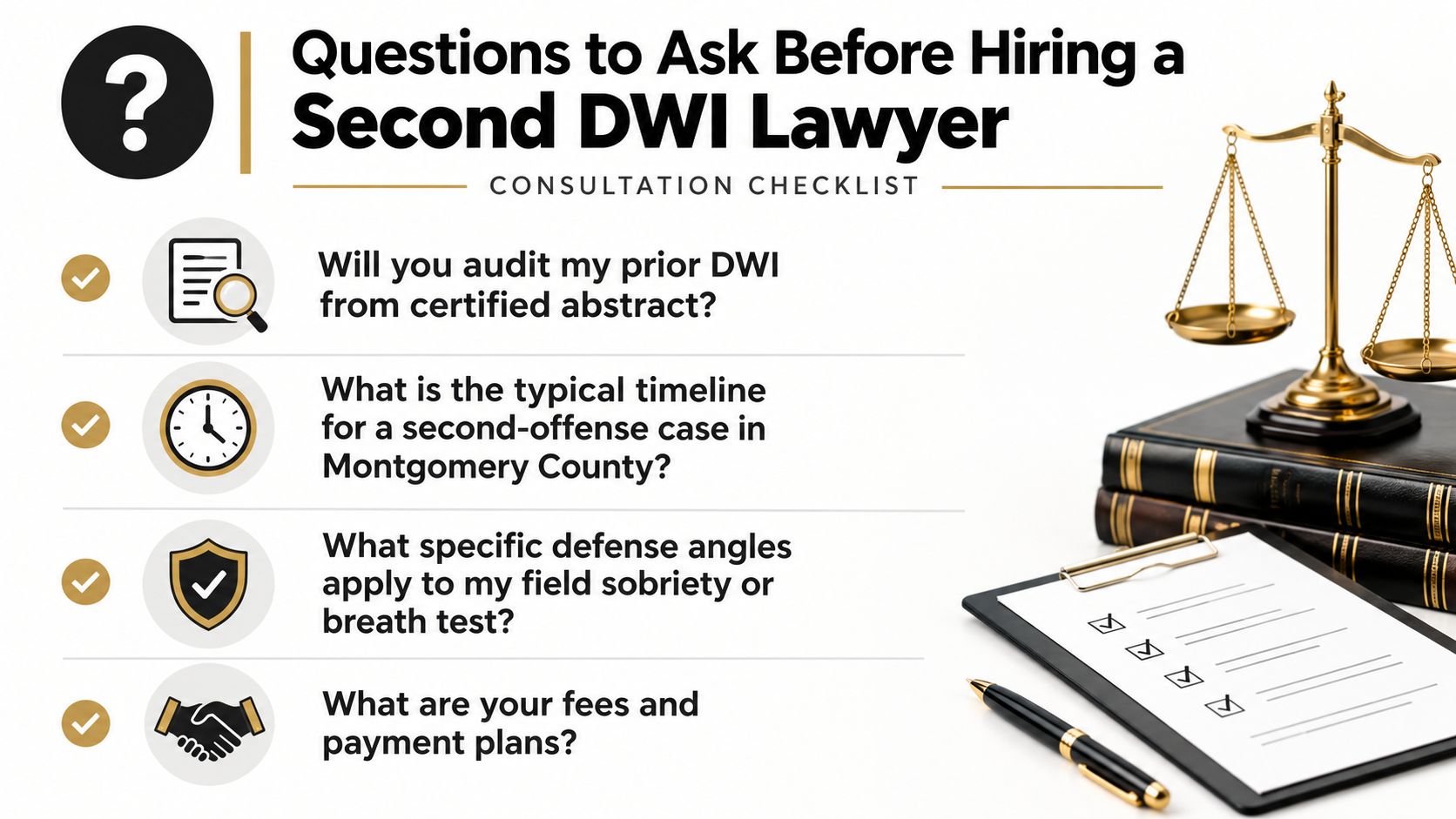
Questions about the prior DWI
Ask whether the lawyer will obtain and review a certified abstract of judgment, the charging instrument, and the final disposition. Ask how they'll confirm the jurisdiction, conviction date, identity, and legal basis for using the prior. An attorney should be able to explain what happens if the record is incomplete or inconsistent.
Also ask:
- Who handles the ALR hearing? Confirm that a licensed attorney, not an unlicensed non-lawyer, will prepare and present the administrative challenge.
- What must happen first? Ask which deadlines and bond requirements require immediate action.
- What evidence will you review? The answer should address video, field sobriety testing, breath or blood testing, officer reports, and dispatch records where relevant.
- What is included in the fee? Get a written explanation of court appearances, motions, negotiations, trial preparation, expert expenses, and ALR work.
- What payment arrangements are available? Ask directly, and make sure the agreement identifies separate costs.
If family obligations are affected, tell the lawyer early. For example, a parent managing support responsibilities may also need information about Child Support Attorney in The Woodlands, which concerns establishing, modifying, and enforcing child support in Montgomery County.
Local experience questions
Ask how many second-DWI cases the lawyer has personally handled in the Montgomery County courts relevant to your case. Ask how the lawyer evaluates local prosecutorial practices without promising a particular plea result. Ask whether they have challenged an ignition interlock bond condition and what facts would support a request for different terms.
Watch for red flags. Guaranteed outcomes are not credible. A lawyer who never visits clients in custody may not be prepared for urgent bond issues. A firm that automatically sends ALR hearings to non-lawyers isn't offering the level of attention a second DWI requires.
The Criminal Case Timeline and Common Defense Angles
The criminal case usually begins with arraignment, where the charge is addressed and the court confirms the next steps. Counsel then obtains discovery, reviews the State's evidence, investigates the stop and arrest, and evaluates whether motions should be filed. The case may resolve through negotiations, proceed to a hearing, or move toward trial.
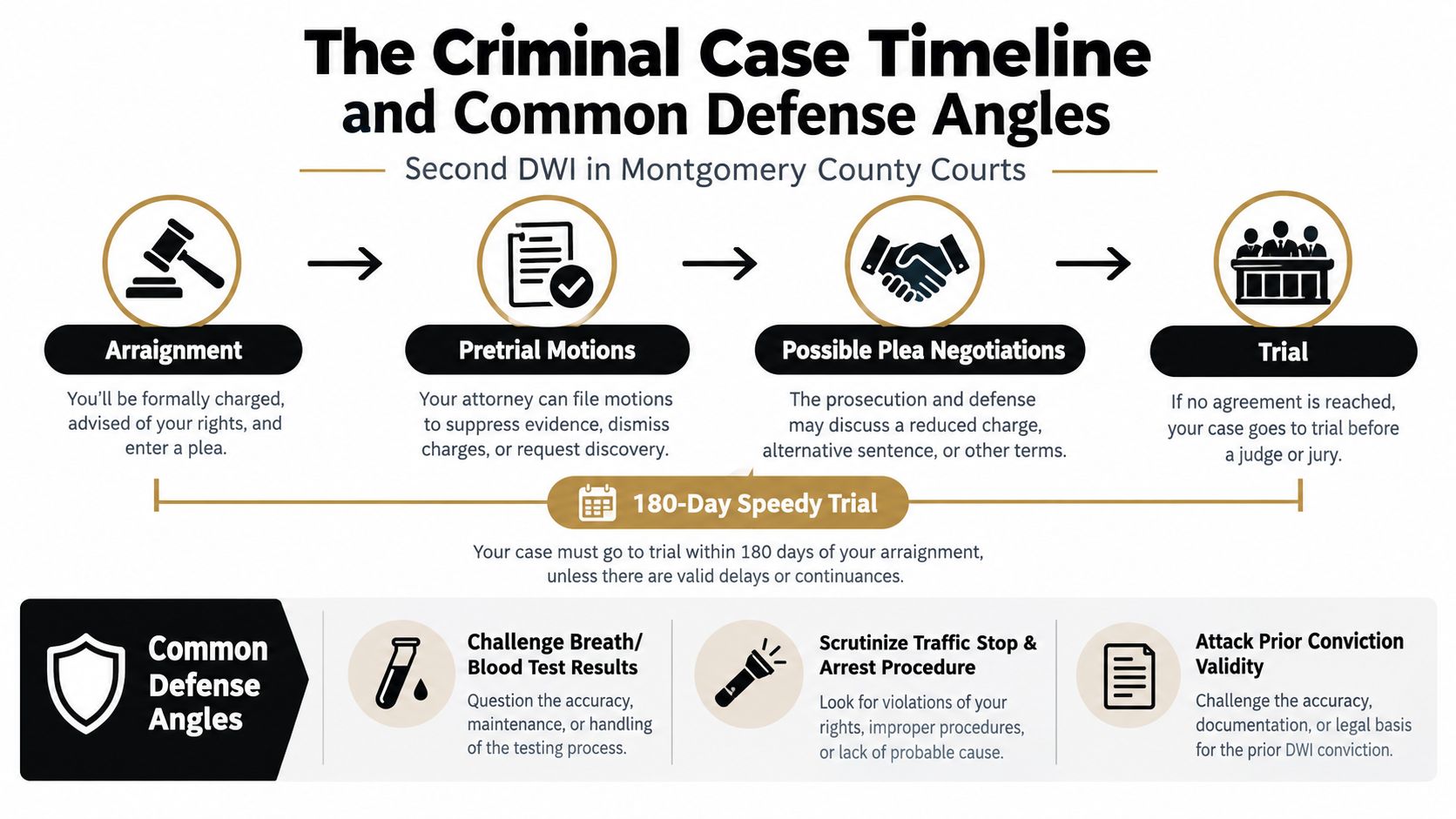
Texas law recognizes a speedy-trial right, and lawyers may evaluate the 180-day speedy-trial window as part of case management. That doesn't mean every case ends within that period or that the deadline automatically dismisses a prosecution. Your lawyer must examine delays, the reasons for them, and how the law applies to your specific record.
The prior-conviction challenge
The first defense angle is often the State's enhancement theory. Counsel should compare the complaint with certified court records and verify whether the prior belongs to you and qualifies for the charge level alleged. A defect may affect the classification or reduce the State's ability to prove a second offense.
Texas DPS explains in its DWI reports and statistical information that the agency tracks prior arrests and convictions separately. That distinction matters in practice. An arrest is not the same as a conviction, and a lawyer should identify which type of prior record the prosecution is relying on.
The stop, testing, and administrative record
The second angle concerns the traffic stop and field sobriety procedure. Counsel may examine whether the officer had a lawful basis for the stop, whether instructions were given correctly, whether the observations were recorded accurately, and whether the arrest followed the required procedures.
The third angle concerns breath or blood evidence. The lawyer should review collection, preservation, testing, chain of custody, and the legal basis for obtaining the sample. The ALR outcome may provide useful information about the evidence and witnesses, but it doesn't automatically decide the criminal case.
Ignition interlock conditions can also affect negotiation timing. If the bond order requires installation, counsel must address compliance immediately while continuing to challenge the evidence and enhancement theory.
Your Next Steps and Quick Answers
Don't wait for the criminal case to “settle down.” The most important tasks are time-sensitive and practical.
What to do next
- Call a Montgomery County second-DWI lawyer within 24 hours. Early counsel can address release terms, evidence preservation, and the ALR deadline.
- Calendar the 15-day ALR request deadline shown on your paperwork. Missing it can cost you a hearing opportunity.
- Gather every arrest document. Include bond conditions, reports, testing records, tow paperwork, and prior-case documents.
- Stay off social media. Don't post explanations, apologies, photographs, or comments about the arrest.
- Arrange lawful transportation and review SR-22 insurance options. Don't drive if your license or bond order prohibits it.
Quick answers
Does a decade-old prior still count? It may. Texas-focused legal analysis states that the bond statute has no five-year limit for a subsequent offense, so an old prior can still affect immediate release conditions. Sentencing and charge-enhancement questions require a separate record review.
Does refusing a breath test help? Don't assume it does. Refusal can trigger an administrative suspension and may be used as evidence, so the decision must be evaluated in context.
How long will a Montgomery County case take? It depends on discovery, testing, motions, court settings, negotiations, and whether the case proceeds to trial. A lawyer should give you a case-specific estimate rather than promise a fixed timeline.
What happens after an ignition interlock condition? You'll need to follow the bond order, use an approved device or provider as required, and keep proof of compliance. Violating the condition can create additional legal problems.
This article isn't legal advice. If you're facing a second DWI in The Woodlands, speak with counsel before making statements, missing an ALR deadline, or violating a bond condition.
The Law Office of Bryan Fagan can help you understand how a second DWI may affect your license, bond conditions, and related family responsibilities in The Woodlands and Montgomery County. Visit The Law Office of Bryan Fagan to request a confidential consultation and discuss the next steps for your situation.
