 Skip to content

You're checking threatening messages while trying to work out tomorrow's school pickup. You need protection, but you also need to know whether someone will help with the paperwork, whether you'll have to face the other person in court, and what happens tonight if the offices are closed.
For residents of The Woodlands, Montgomery County Women's Center protective order help can be a starting point for legal screening and safety planning. The practical task is to separate immediate safety needs from filing, representation, and hearing preparation. Those services don't always come from the same person or office.
Where to Get Protective Order Help and Who Appears With You
Start with the Montgomery County Women's Center, particularly if you need both survivor support and help understanding your legal options. Its legal-services contact is 936-441-4044, extension 38, with listed hours Monday through Friday, 8:00 a.m. to 5:00 p.m., and crisis walk-ins accepted.
Before choosing the County Attorney route, understand the participation requirement. In Montgomery County, a protective order case filed through the County Attorney's Office requires at least one preparation appointment and one court appearance. You must be willing to testify in open court, a commitment to discuss before arranging transportation, childcare, or time away from work.
The Montgomery County victim-assistance booklet identifies local application pathways, including the Women's Center, County Attorney, Lone Star Legal Aid, private attorneys, and the District Clerk. A referral to one of these offices doesn't, by itself, establish who will represent you.
Local protective order help options
| Option | What It Offers | Who Files and Appears | Cost |
|---|---|---|---|
| Montgomery County Women's Center | Legal advice, pro se help, court representation, safety planning | Advocates help with paperwork and court preparation; confirm whether an attorney accepts representation and files for you | Free for family or sexual violence victims |
| Montgomery County Attorney's Office | Files protective order cases through its process | Preparation appointment and court appearance; you must be willing to testify in open court | No applicant filing or service fee; confirm any separate expenses |
| Lone Star Legal Aid | Filing assistance | Ask intake whether it will prepare documents, file, and provide hearing counsel; applicant participation remains necessary | Ask intake to confirm eligibility and any charges before proceeding |
| District Clerk's Office | Receives application and copies | Applicant files; clerk does not represent you | No fees charged to applicants for filing or service |
| Private family-law attorney | Representation that can coordinate protection with custody and property issues | Attorney handles agreed representation and appears with you; you may still need to testify | Attorney fees set by the engagement agreement; ask at consultation |
| Self-representation | Forms and clerk procedure on your own | You file and appear yourself | No filing fee |
Protective-order advocacy is central to MCWC's work. Its annual report describes its origins in the merger of the Montgomery County Rape Crisis Coalition and Family Violence Outreach, alongside its ongoing protective-order legal work.
Private counsel may be useful when safety issues overlap with existing family litigation. Protective Orders in The Woodlands concerns domestic violence and family safety matters.
Confirm what help is available after hours
Public listings describe a 24-hour crisis hotline, while service-directory information also shows weekday hours of 8 a.m. to 8 p.m. and weekend closures; the TexasLawHelp directory entry is a reason to verify current availability, not assume crisis and legal intake hours match.
Ask specifically about overnight crisis support, shelter access, and the next legal appointment. If you're in immediate danger, call 911 instead of waiting for civil paperwork.
For example, Maria, a hypothetical mother in Alden Bridge, asks the Women's Center to help prepare her application, books a County Attorney preparation appointment during lunch, and asks a family attorney how custody will be handled separately. Before committing to any route, she asks: Who files the paperwork? Who appears with me? What happens if I cannot testify?
Safety Planning Before You File
Your first question may be whether you can safely get through tonight. A legal appointment won't solve an unsafe place to sleep, a monitored phone, or a child's exposed pickup routine.
If danger is immediate, contact emergency services and describe what's happening. Say whether weapons, injuries, children, or an existing order are involved, and tell the dispatcher that you need information about emergency protection. Don't wait to finish an application.
Make contact without exposing your plans
If your phone or accounts may be monitored, use a safer device, such as a trusted person's phone. A public library computer may offer another contact option, but don't save passwords or documents on it, and consider whether shared email or cloud accounts could expose your activity.
Ask the person helping you how they can safely respond. Specify whether they may leave voicemail, send a text, identify their organization, or call only at an agreed time.
- After-hours access: Ask which crisis service is staffed now and what to do if your call isn't answered.
- Shelter and transportation: Explain whether you have a safe destination and a way to reach it.
- Access needs: Request language assistance or disability accommodations before an appointment.
- Children's safety: Give the advocate school, daycare, pickup, and authorized-collector details.
Prepare an exit that fits your household
Choose a safe exit route and a trusted person who knows where you plan to go. If you can do so without increasing danger, keep identification, medication, keys, a charger, and copies of important documents somewhere accessible outside the shared home.
Tell your advocate about confidential-address concerns before filing. Don't place a shelter location or another sensitive address into paperwork without discussing how it should be handled.
Safety first: Don't confront the other person to collect evidence, announce your filing plans, or retrieve belongings when doing so could put you at risk.
For a parent in Panther Creek, school coordination might mean asking administrators to review authorized pickup arrangements and existing court orders. A request to the school doesn't itself change custody rights, so ask what documentation the school needs.
Who Qualifies and Which Order Type Fits
Texas protective orders address qualifying conduct, including family violence, sexual assault or abuse, stalking, and trafficking. Eligibility turns on the conduct and the applicable legal route, not whether the situation involves a divorce. Describe your relationship to the person accused of harm and the specific events that make protection necessary.
Emergency protection, temporary ex parte protection, and final protection are different proceedings. Texas Family Code Chapters 83 and 85 address temporary and final family-violence orders, respectively. An emergency magistrate's order follows a different procedural route.
Protective order types, duration and next steps
| Order Type | Who Issues It | How Long It Lasts | What You Must Do Next |
|---|---|---|---|
| Emergency protective order | Magistrate, usually after an arrest | Until the expiration stated in the signed order | Confirm terms and service status |
| Temporary ex parte order | Judge, before the other side responds | Until the final hearing, subject to the signed expiration and any extension | Attend the hearing |
| Final protective order | Judge, after a hearing | Up to two years in most cases; the signed order controls | Keep copies; confirm what it covers |
The most important distinction is between requesting an order and receiving one. Under the Texas court protective-order guidance, you don't have temporary protection merely because you applied: a judge must sign a document titled “Temporary Ex Parte Protective Order.” The request requires the appropriate affidavit or declaration, and the applicant generally must attend the later hearing to seek final relief.
Read the restrictions, not just the title
Suppose a Woodlands resident obtains temporary protection because of threats connected with a child's school pickup. That parent still needs to attend the hearing and establish the basis for a final order. The temporary paperwork isn't a substitute for presenting the case.
Before relying on any order, check:
- Order identity: Confirm its exact type, signature, expiration, and hearing information.
- Protected people and places: Check whether children, home, workplace, school, and daycare are included.
- Restricted conduct: Read the contact, third-party communication, weapon, and stay-away provisions.
- Notice and service: Ask the responsible office what has occurred and what remains outstanding.
A broad expectation of safety isn't the same as a written restriction. If something important is missing, raise it promptly with counsel rather than assuming the order includes it.
Build Your Evidence File Before You File
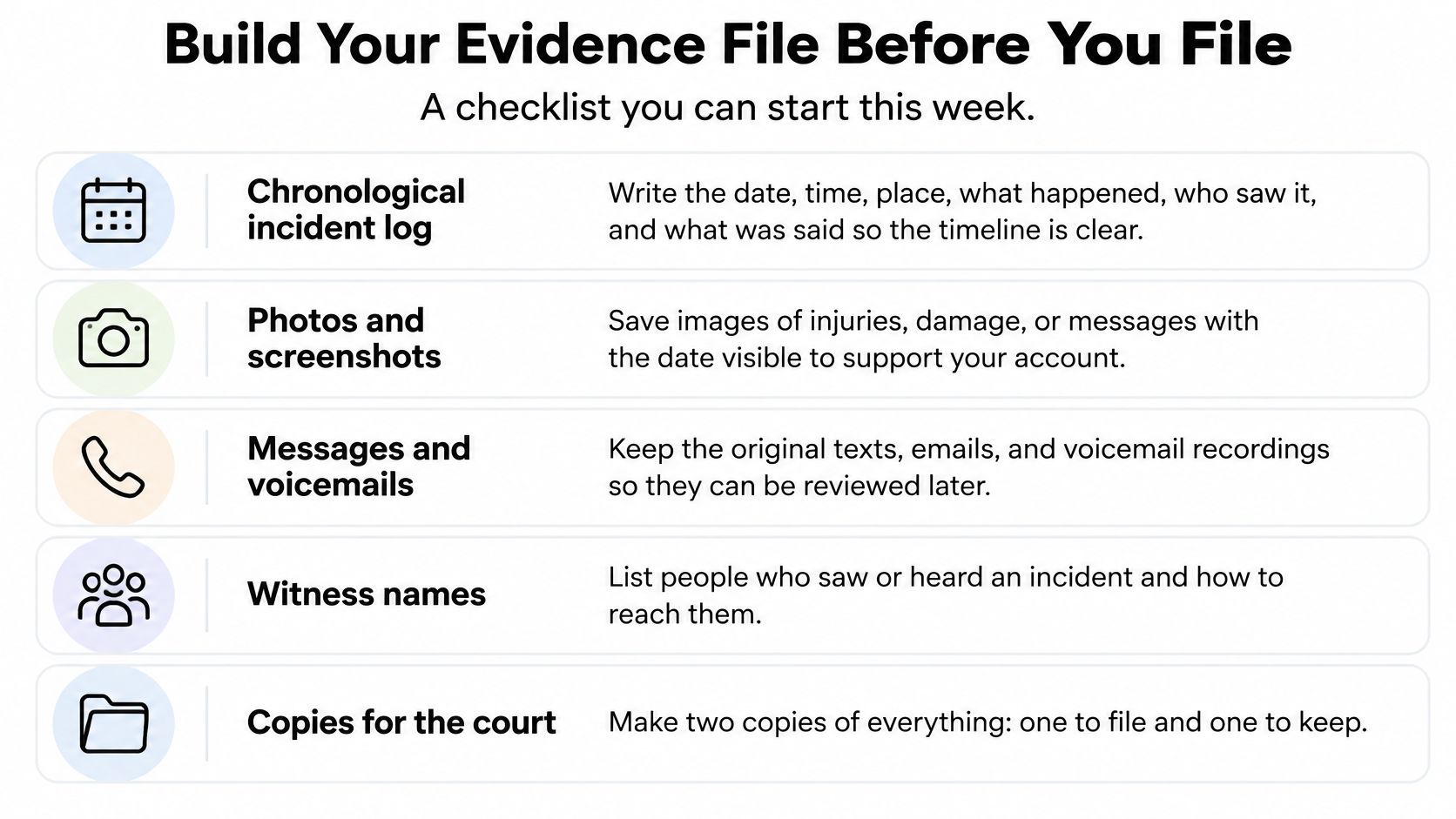
Start with a chronological incident log, not a folder of disconnected screenshots. The person preparing your application needs to understand what happened, when it happened, and which protections you want the judge to order.
The Women's Center legal-services page confirms free services for victims of family or sexual violence, including potential advice, pro se assistance, direct representation, and protective-order matters. It lists 936-441-4044, extension 38, Monday through Friday, 8:00 a.m. to 5:00 p.m., with crisis walk-ins accepted; screening is the place to clarify what assistance your case will receive.
Gather material that answers concrete questions
- Incident log: Record the date, time, place, conduct, witnesses, and words used so the sequence is understandable.
- Messages and recordings: Preserve original texts, emails, and voicemails with identifying information and dates so they can be reviewed in context.
- Photographs: Save injury or property-damage images and record when they were taken so you can explain what they show.
- Official records: Gather available medical records, police records, and report numbers to help locate corroborating documentation.
- Witness details: List names, contact information, and what each person personally saw or heard.
- Children and weapons: Identify schedules, schools, daycare, and known weapon access so the requested protection addresses actual risks.
- Requested protections: Write down the contact, residence, work, school, and child-related restrictions you want considered.
Make the evidence usable
A Panther Creek parent preserving threatening texts should retain the conversation, not just an isolated sentence. Pair the screenshots with a log explaining the date, surrounding event, and why the message caused concern.
Vague allegations make preparation harder. Replace a general statement about harassment with the conduct you can describe accurately, without guessing or exaggerating. Explain gaps if you don't remember an exact date.
Our guide to presenting evidence in court offers additional preparation considerations. Ask counsel which materials need witnesses or other groundwork before the judge can consider them.
Keep originals secure, maintain a backup outside the shared home, and bring organized copies to your appointment. Don't risk your safety obtaining a missing document.
How to File Your Application at the Courthouse
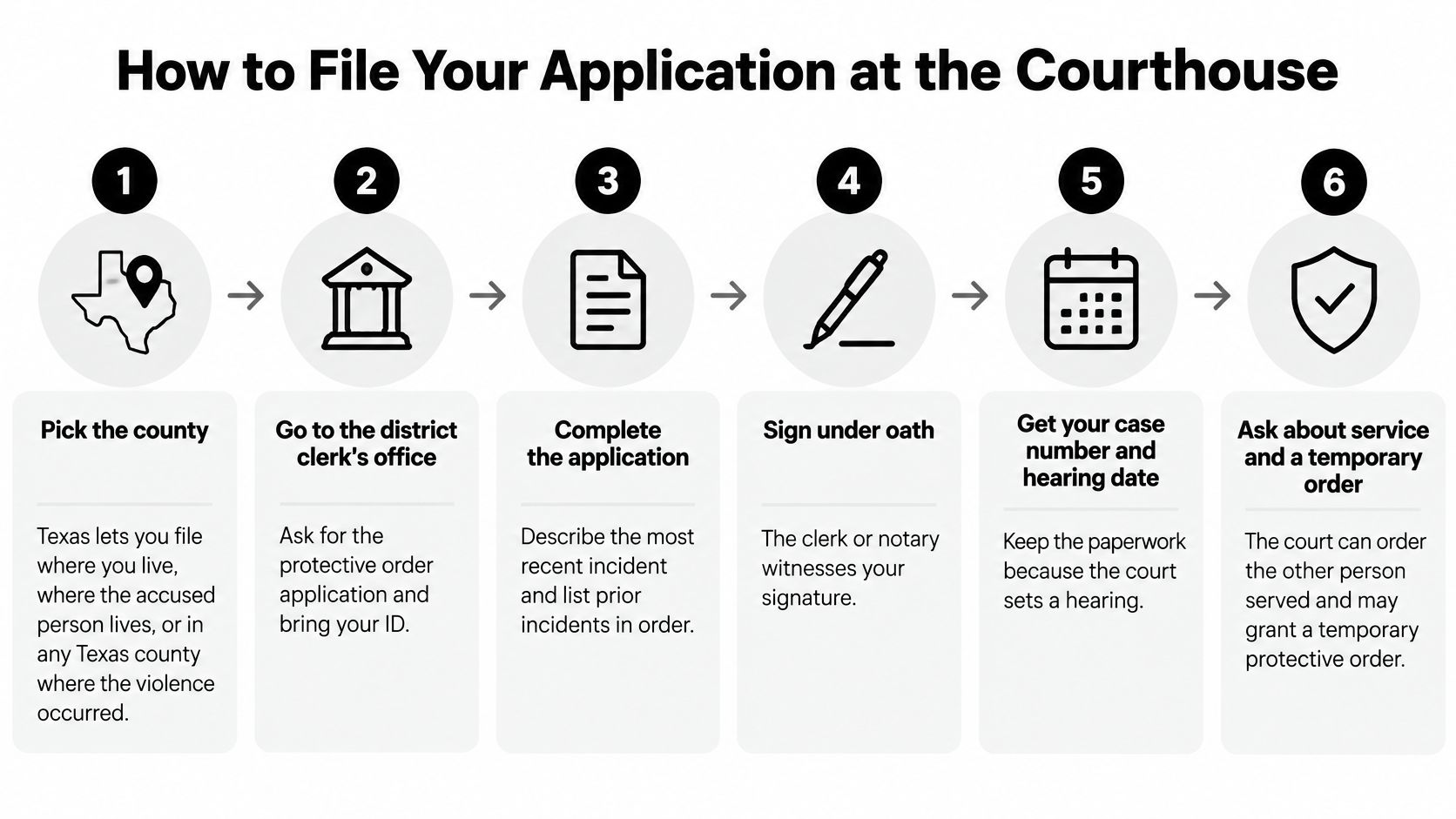
A protective-order case begins with an application filed with the court clerk under Texas Family Code Chapter 82. If an office or attorney is handling your case, confirm who will submit it before making a separate filing.
Prepare and submit the packet
Choose a proper county. The Texas Office of Court Administration instructions allow filing where you live, where the accused person lives, or in a Texas county where the qualifying violence or crime occurred, and direct applicants to provide at least two copies of the application and required documents. A Montgomery County filing may therefore be appropriate for a Woodlands resident even when the incident happened elsewhere.
Complete the standardized application. Identify each applicant, the respondent, the parties' counties of residence, their relationship, and the requested protections, with applicable child-support case information. Address confidentiality through the proper request rather than omitting required information.
Provide a safe contact address. Tell the filing office if disclosure could expose your location and ask how confidentiality is handled. Distinguish the address used to contact you from any location that needs protection.
Prepare the respondent's identifying and location information. Don't leave the address blank without discussing the problem with the filing office or attorney. Explain what you know and what you don't, because locating the respondent affects service.
Request temporary relief when needed. Ask for consideration of a temporary ex parte order and complete the required affidavit or declaration. Follow the form's signing instructions rather than signing a sworn document prematurely.
Obtain the case number and hearing information. Keep the filed papers and confirm how service will be arranged. Applicants aren't charged a protective-order filing fee, and you shouldn't attempt personal delivery to the respondent.
Complete the post-order information. If an order is granted, provide the clerk with the TCIC Protective Order Data Entry Form and check identifying details carefully. Accurate information supports law-enforcement verification and enforcement.
Arrive ready for the counter and security
Review Montgomery County courthouse security and what to bring before traveling. Ask the filing office about current submission procedures rather than assuming every application is accepted through the same counter or method.
A complete packet should contain the application, required declaration or affidavit, organized supporting documents, necessary copies, and information needed for service. Keep confidential material clearly identified and ask how to submit it safely.
At the counter: Before leaving, establish what was filed, whether a judge signed temporary relief, who handles service, and when you must return.
What Happens at Your Hearing and After
On hearing day, bring the evidence file in the order you expect to discuss it. Confirm witness arrangements with your attorney, and tell court staff or your advocate if waiting near the respondent raises a safety concern.
The other person may attend and challenge your account. The judge decides based on the evidence properly presented, not because an application was filed.
Give an account the judge can follow
Answer the question asked, use dates when you know them, and distinguish what you personally observed from what someone told you. If you don't know or can't remember, say so rather than filling the gap.
A witness who heard a threat should explain what they heard. A witness who saw an injury afterward should describe that observation, not claim to have witnessed an incident they didn't see.

An attorney can organize and present your case, but representation doesn't automatically remove the need for your testimony.
Put the signed order into practice
During the first week, distribute copies to appropriate people who need to act on covered restrictions, such as workplace security or school administrators. Keep accessible copies where doing so won't disclose a confidential location or create another safety risk.
Confirm service and notice status with the responsible office. Our explanation of Montgomery County Sheriff Civil Division service of process can help you identify questions to ask; don't assume filing, signing, database entry, and service are the same event.
If a violation creates immediate danger, call emergency services, explain that a protective order exists, and describe the prohibited conduct. Preserve related messages or other evidence without engaging the respondent. Law enforcement can check order information, but a signed order doesn't automatically produce an arrest in every reported situation.
A protective order is a civil remedy. It may include child-related protections, but it doesn't automatically resolve divorce, long-term custody, possession, support, or property disputes.
If circumstances change or expiration approaches, ask an attorney about modification, extension, or further relief before the order lapses. Keep the signed order and hearing notice together so you can quickly establish both the restrictions and the next court obligation.
Your Next Steps Before the Hearing
Choose the assistance route you can safely follow through with, not just the office whose name sounds most familiar. A prepared application matters, but so do reliable communication, attendance, and knowing whether anyone has accepted responsibility for representing you.
You don't need a perfect evidence file before asking for help. You do need to flag urgent risks, approaching hearings, and any reason you may be unable to participate.
What to do next
Save safe contact information. Keep the Women's Center legal-services number, 936-441-4044, extension 38, somewhere the other person can't access, if that's necessary for your safety. Use 911 for emergencies, and establish whether callbacks or messages are safe.
Finish the household safety plan. Identify an exit route, essential medication and documents, and a trusted contact. Decide where you and the children can go if circumstances change before the hearing.
Organize the evidence and backup. Bring the material you have to intake instead of postponing contact while searching for missing records. Keep a separate list of documents or witnesses that may require follow-up.
Check your actual court papers. Identify the signed order, covered people and places, expiration, and scheduled hearing. Ask about anything you don't understand before relying on a restriction.
Confirm the appointment and filing responsibilities. Schedule the County Attorney preparation appointment if using that route, or establish who will file through another authorized channel. Ask whether an attorney will attend, what testimony is expected, and what to do if you cannot appear.
Arrange transportation and childcare. Make a backup plan and ask about accommodations early. Tell the office promptly if work, disability, language, or safety barriers could prevent attendance.
Bring the overlapping family issues to the consultation
Existing custody orders, pending divorce papers, and upcoming exchanges can affect what needs coordinated legal attention. Bring those documents along with your protective-order papers so an attorney can identify conflicts and explain available options without relying on an incomplete account.
This is general information, not legal advice. Every case depends on its facts and local court practice. Speak with an attorney about your situation, particularly if you have an approaching hearing or an existing order affecting your children.
The Law Office of Bryan Fagan offers a free consultation to discuss protective-order concerns and related family-law issues for families in The Woodlands, Panther Creek, Alden Bridge, Sterling Ridge, and across Montgomery County. Visit The Law Office of Bryan Fagan to complete the online contact form, or call (281) 819-1726 to schedule a consultation and discuss your next steps.
