
When a marriage ends in The Woodlands, the financial details can be just as overwhelming as the emotional ones. One of the biggest questions people ask is about spousal maintenance—what most people call alimony. Here in Texas, getting it is not a sure thing. In fact, a Montgomery County court starts by assuming maintenance isn't needed, putting the burden on the spouse asking for it to prove they truly need help.
This guide uses plain English to walk you through how spousal maintenance works in The Woodlands and Montgomery County.
What Spousal Maintenance Means in The Woodlands

In Texas, spousal maintenance is a court order for one ex-spouse to make payments to the other after the divorce is final. The entire purpose is temporary. Think of it as a short-term bridge to give the receiving spouse support to meet their "minimum reasonable needs" while they get the training or education needed to support themselves.
It is crucial to understand the difference between court-ordered maintenance and contractual alimony. A judge orders spousal maintenance and it is subject to strict legal caps. Contractual alimony, however, is a private agreement negotiated between spouses. This agreed-upon support can be much more flexible with amounts and timelines, and we often see it in a handling a high asset divorce in The Woodlands.
Eligibility: The 10-Year Rule and Its Exceptions
Before a judge in Montgomery County can even consider awarding maintenance, the requesting spouse has to clear a major hurdle. The Texas Family Code sets a baseline eligibility rule: the marriage must have lasted for 10 years or longer.
But there are a few key exceptions where a judge can award support even if the marriage was shorter:
- The paying spouse has a conviction or received deferred adjudication for an act of family violence.
- The spouse asking for support has a physical or mental disability that prevents them from earning a living.
- The requesting spouse is caring for a child of the marriage who has a disability requiring substantial care.
If you don't meet the 10-year rule or one of the exceptions, a judge simply cannot order spousal maintenance.
Real-World Scenario: A Homemaker in Alden Bridge
Imagine Sarah and Tom, a couple divorcing after a 15-year marriage in The Woodlands. Tom built a career as an engineer while Sarah was a homemaker, raising their kids. Now, with the children nearly grown, Sarah has no recent job experience.
She asks for spousal maintenance, showing that without it, she can't cover her minimum reasonable needs—like rent, food, and transportation. To prove her case, she shows the court she lacks enough property from the divorce to support herself and that she has tried to find a job but can't earn enough. Because their marriage was over 10 years and she can document her financial shortfall, a Montgomery County judge is likely to find her eligible for temporary support.
Spousal Maintenance Duration Limits in Texas
The length of maintenance payments in Texas is directly tied to the length of the marriage. This highlights the state's goal of providing temporary, not permanent, aid. Here is a breakdown of the maximum duration a judge can order, based on the Texas Family Code.
| Length of Marriage | Maximum Duration of Maintenance Payments |
|---|---|
| 10 to 20 years | 5 years |
| 20 to 30 years | 7 years |
| Over 30 years | 10 years |
These are the absolute longest a court can order maintenance, except for specific disability cases. The structure gives a spouse a reasonable time to transition without creating a lifelong dependency. To see how these durations factor into the final amount, you can learn more about how Texas support calculations work.
What to Do Next
If spousal maintenance may be part of your divorce, start preparing now.
- Gather Financial Records: Collect at least two years of bank statements, tax returns, and pay stubs for both you and your spouse.
- Create a Budget: Make a detailed list of your monthly living expenses to show your "minimum reasonable needs."
- Document Your Job Search: If you are asking for support, keep a log of every job application, interview, and training course.
- Read the Law: Familiarize yourself with Chapter 8 of the Texas Family Code, which covers spousal maintenance.
Disclaimer: This article is for informational purposes only and does not constitute legal advice. The laws regarding family law are complex, and you should consult with a qualified attorney about your specific situation.
Navigating the rules of spousal maintenance can feel like a maze. If you have questions about your rights in a Woodlands divorce, our team can provide clear answers. To discuss your case, schedule a consultation with our team.
How Montgomery County Courts Calculate Maintenance Payments
Once a judge agrees that a spouse is eligible for maintenance, the next question is always: "How much will I get?" or "How much will I have to pay?"
Unlike child support, which uses a rigid formula, spousal maintenance is more subjective. A Montgomery County judge starts with a legal "ceiling" and then weighs many factors to land on a final amount.
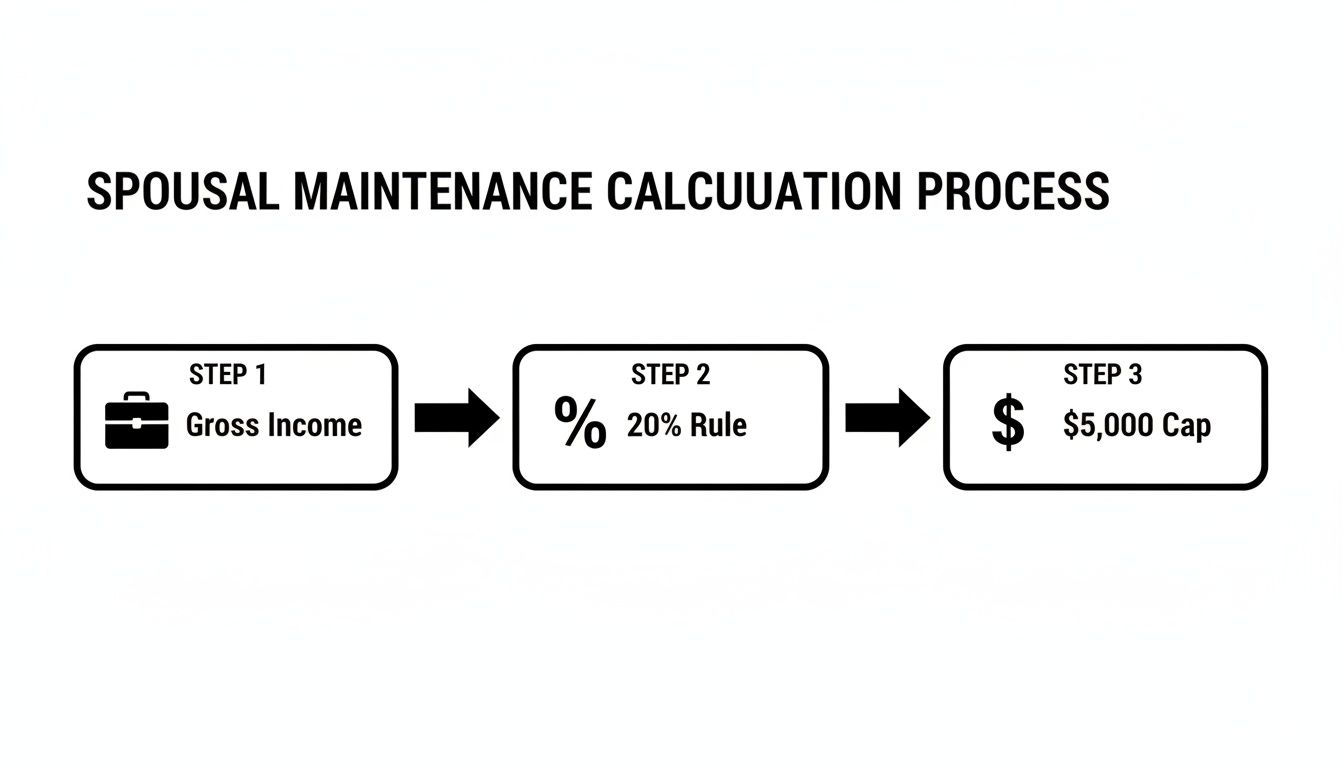
Texas law sets two hard limits on court-ordered spousal maintenance to ensure payments provide support without being overwhelming. A judge cannot order payments that are more than the lesser of these two figures: $5,000 per month or 20% of the paying spouse's average monthly gross income.
The Statutory Caps are a Ceiling, Not a Target
That $5,000 or 20% rule is a firm boundary, not a goal. Texas law is designed to give a spouse a temporary leg up, not create long-term dependency.
For example, if a spouse in The Woodlands earns a gross monthly income of $10,000, the maximum maintenance a judge could order is $2,000 (20% of $10,000), since that is less than the $5,000 cap. This rule, found in Chapter 8 of the Texas Family Code, is applied consistently in our local courts.
If you are dealing with a high-income earner making $40,000 a month, 20% of their income is $8,000. However, the judge is legally capped at ordering $5,000 a month. Even then, a judge is not required to award the full $5,000. The actual amount will come down to a deeper look at the couple's circumstances.
Factors a Judge Considers Beyond the Numbers
After determining the maximum possible payment, a Montgomery County judge dives into the specific details of your marriage. They use a list of factors from the Texas Family Code to decide the final amount and duration.
A judge will evaluate things like:
- The financial state of each spouse after the community property is divided.
- The education, job skills, and earning potential of both spouses.
- The age, health, and work history of the spouse asking for maintenance.
- The length of the marriage.
- Any marital misconduct, like adultery or cruelty.
- The contributions one spouse made as a homemaker.
The judge weighs all these pieces to craft an order that is fair and tailored to your family's situation. This is especially true in a complex contested divorce in The Woodlands.
Real-World Scenario: A Nurse's Income
Let's say Maria is a nurse in The Woodlands earning a gross monthly income of $8,000. Her husband, who was a stay-at-home-dad, is requesting spousal maintenance. The absolute maximum a judge could order Maria to pay is $1,600 per month (20% of $8,000). The judge will then look at all the other factors—like the property division and the husband's efforts to find work—to decide on the final, fair amount, which may be less than $1,600.
What to Do Next
If you are facing a potential spousal maintenance case, prepare now.
- Gather Income Information: Collect your spouse's recent pay stubs and tax returns to find their average monthly gross income.
- Calculate the Cap: Do the math—20% of that gross income—to understand the absolute maximum payment allowed.
- Assess the Factors: Honestly review the list of factors above and how they apply to your marriage.
- Create Your Budget: Put together a detailed monthly budget showing your "minimum reasonable needs" to justify your financial request.
Disclaimer: This article is for informational purposes only and does not constitute legal advice. The laws regarding family law are complex, and you should consult with a qualified attorney about your specific situation.
Understanding how maintenance is calculated will help you set realistic expectations. If you need help analyzing your finances for a spousal maintenance case in The Woodlands, our experienced team is here to help. To discuss your case, schedule a consultation with our team.
Modifying or Ending Spousal Maintenance Payments

A divorce decree might feel final, but spousal maintenance orders can sometimes be changed. Life in The Woodlands doesn't stand still—careers change and financial situations shift. Texas law allows either ex-spouse to ask a court to revisit and potentially change the maintenance payments.
However, you must prove that a “material and substantial change” has occurred in either your circumstances or your ex-spouse's since the original order was signed by a Montgomery County judge.
What Qualifies as a Material and Substantial Change
"Material and substantial" means a major life event, not a minor hiccup. A judge will compare the financial reality today to what it was when the maintenance order was created.
Examples that might justify a modification include:
- The paying spouse involuntarily loses their job or takes a significant, long-term pay cut.
- The receiving spouse gets a new job or promotion with a much higher salary.
- Either person develops a serious disability that impacts their ability to work.
If you and your ex are on good terms, you might work out a new arrangement through divorce mediation in The Woodlands, which is less adversarial than a court battle.
Automatic Termination of Spousal Maintenance
While most changes require a court filing, the Texas Family Code outlines a few situations where the duty to pay spousal maintenance ends automatically.
The obligation to pay stops immediately if the receiving spouse remarries or if either party dies. This happens by law, without needing a new court order.
Another event that can end maintenance is cohabitation. If the spouse receiving payments begins living with a new romantic partner in a permanent, marriage-like relationship, the paying spouse can ask the court to terminate support. This is not automatic; you must file with the court and provide proof.
Real-World Scenario: A Job Loss in Montgomery County
Imagine Mark, who lives in Creekside Park and was ordered to pay his ex-wife $1,500 per month in maintenance. A year after the divorce, the company he works for has massive layoffs, and Mark loses his job. The only new position he can find pays 40% less.
This is a classic example of a material and substantial change. It's a major, long-term shift in his finances. Mark can file a Petition to Modify with the Montgomery County court that issued his divorce decree. He'll need to show his termination letter and new pay stubs to prove his case. A judge would likely reduce his monthly payment to align with his new income.
What to Do Next
If you believe your circumstances have changed enough to modify your maintenance order, be proactive.
- Gather Your Proof: Collect all documents supporting your claim, such as termination letters, new pay stubs, or medical records.
- Do Not Stop Paying: You must follow the current court order until a judge officially changes it. Stopping on your own can lead to serious consequences.
- File a Petition to Modify: Work with an attorney to formally file a petition in the Montgomery County court that handled your divorce.
- Prepare for a Hearing: Your attorney will help you prepare to present your evidence and arguments to the judge.
Disclaimer: This article is for informational purposes only and does not constitute legal advice. The laws regarding family law are complex, and you should consult with a qualified attorney about your specific situation.
Life changes, and your court orders can, too. If your financial situation has significantly changed and you need to modify or end spousal maintenance payments, our team can help you understand your options. To discuss your case, schedule a consultation with our team.