
When you’re facing divorce, one of the first questions you ask is, "How long is this going to take?" If you live in The Woodlands, the quickest, most direct answer is: at least 61 days.
That number comes from a mandatory waiting period in Texas law. But in reality, that's the absolute best-case scenario. The true timeline for your divorce depends almost entirely on one thing: how much you and your spouse can agree on. This guide will walk you through the timelines for different types of divorces in Montgomery County.
The Realistic Divorce Timeline in The Woodlands

Understanding a realistic divorce timeline is crucial. It helps you manage your expectations, both emotionally and financially. While everyone hopes for a quick resolution, the path is often more complicated than a simple two-month wait.
The single biggest factor that dictates the speed of your divorce is whether it is uncontested or contested.
Uncontested Divorce: This is the fast track. It means you and your spouse agree on all major issues—dividing property, handling debts, and creating a parenting plan. The only real delay is the legally required waiting period.
Contested Divorce: This is where things slow down. If you disagree on even one issue, your divorce is contested. Every point of conflict, from who keeps the family home in Alden Bridge to the details of a child custody schedule, adds time and expense.
The Mandatory 60-Day Waiting Period
Let’s talk more about that 60-day rule. No matter how perfectly you and your spouse agree, a Texas judge cannot finalize your divorce in less than two months.
The Texas Family Code requires a 60-day "cooling-off" period. This clock starts the day after the Original Petition for Divorce is filed with the court. The law gives couples a moment to pause, reconsider, or work through the details of their separation without feeling rushed.
In Texas, including communities in The Woodlands and across Montgomery County, every divorce must wait 60 days from the filing date before a judge can sign the final decree. This statutory requirement is meant to encourage thoughtful negotiation. It means no divorce can be finalized faster, even in the most straightforward cases. For residents in neighborhoods like Panther Creek or Alden Bridge, this 60-day period is often just the beginning. You can learn more about Texas divorce statistics to see the bigger picture.
Uncontested vs. Contested Divorce Timelines in Montgomery County
To give you a clearer snapshot, here’s a look at the two paths side-by-side. An uncontested divorce might wrap up shortly after the 60-day mark, while a contested divorce can stretch to a year or more.
Here’s a quick comparison of typical timelines we see in Montgomery County courts:
| Factor | Uncontested Divorce | Contested Divorce |
|---|---|---|
| Typical Timeline | 2–4 months | 6–18 months (or longer) |
| Key Characteristic | Full agreement on all issues | Disagreement on one or more major issues |
| Court Involvement | Minimal; one final hearing | Multiple hearings, potential for trial |
| Average Cost | Significantly lower | Substantially higher due to legal fees |
| Emotional Stress | Lower and more predictable | High and unpredictable |
Understanding which path your case will likely follow is the first step in preparing for the road ahead.
The Uncontested Divorce: Your Fastest Path Forward

An uncontested divorce is the fastest and most affordable way to finalize a divorce in Montgomery County. It happens when you and your spouse have already agreed on every single issue, from who gets the house to who takes the credit card debt.
Because you’ve done the hard work of negotiating upfront, the legal process becomes a formality. The one thing you can’t bypass is the state-mandated 60-day waiting period. The Texas Family Code requires this, so even with perfect cooperation, a judge cannot sign your Final Decree of Divorce until at least 60 days have passed. But if everything is in order, you can be officially divorced on day 61.
How an Agreed Divorce Works
Because you aren't fighting in court, an uncontested divorce sidesteps the most time-consuming and expensive stages. It boils down to a few key steps.
- Filing the Petition: One person files an Original Petition for Divorce, which starts the 60-day clock.
- The Other Spouse Cooperates: Instead of being formally "served" papers, the other spouse signs a Waiver of Service. This tells the court they’ve received the petition and agree to participate, saving time and money.
- Drafting the Final Decree: Your attorneys help create the Final Decree of Divorce. This is the legally binding blueprint of your entire settlement. For a deeper dive, you can learn more about uncontested divorce in our guide.
- The Final "Prove-Up" Hearing: After the waiting period, one of you attends a short, informal hearing. You'll answer a few simple questions, and the judge will sign the decree, making it official.
Real-World Scenario: We worked with a couple from Sterling Ridge whose kids had gone off to college. They wanted to part ways amicably. We helped them value their home and retirement accounts and draft a detailed Final Decree. Because they cooperated on everything, their divorce was finalized just 62 days after they filed. It’s a perfect example of how communication can lead to a quick, dignified outcome.
What to do next
- Talk to Your Spouse: Have an honest conversation to see if you are both on the same page about cooperating.
- Gather Financials: Collect statements for everything you own and owe—bank accounts, mortgages, car loans, and retirement funds.
- Outline Your Terms: Make a list of your assets and debts and discuss how you think they should be divided.
- Speak with an Attorney: Even in a friendly split, have an experienced attorney review your agreement to protect your rights and ensure the decree is drafted correctly.
Disclaimer: This article provides general information and is not a substitute for legal advice. The law is complex and changes frequently. For advice specific to your situation, you should consult with a qualified attorney.
Why Contested Divorces Take Significantly Longer
If an uncontested divorce is a straight road, a contested divorce is a trek through the woods with no clear path. This is where the answer to "how long does a divorce take in The Woodlands?" shifts from a few months to a year or more.
A divorce becomes contested the moment you and your spouse disagree on any major issue. This turns a straightforward legal process into a complex web of hearings, evidence gathering, and intense negotiation. The more you disagree, the longer and more winding the road becomes.
Common Areas of Disagreement That Extend Timelines
The biggest delays almost always trace back to a few core disagreements. Each one introduces new legal hurdles that can add months to your timeline.
- Child Custody and Visitation: Arguments over who the children live with, the possession schedule, and decision-making rights are emotional and can stall a case indefinitely.
- Child Support Calculations: Disputes often erupt over a spouse's true income, especially if one person is self-employed, owns a business, or earns irregular income.
- Division of Complex Assets: Splitting a checking account is simple. Splitting a family-owned business in The Woodlands, stock options, or multiple properties is not. These situations often require experts like business valuators or forensic accountants.
- Spousal Maintenance (Alimony): Whether one spouse is eligible for post-divorce financial support—and how much—is a frequent and significant battleground.
Procedural Hurdles in a Contested Divorce
When you and your spouse can’t agree, the court system has a structured process to force a resolution. Unfortunately, that structure is what takes so much time.
These steps often include:
- Temporary Orders Hearings: If you can't agree on who stays in the house or the temporary custody schedule, you'll go before a judge who will make a ruling for the duration of the divorce.
- The Discovery Process: This is the formal evidence-gathering phase, governed by the Texas Family Code. It involves written questions, requests for documents, and questioning witnesses under oath (depositions). This stage alone can easily take six months or more.
- Mediation: Montgomery County courts require nearly all contested cases to attend mediation before they will grant a trial date. While mediation is designed to help you settle, it requires significant preparation. If it fails, you're back on the path to trial.
To learn more about the specifics, you can read about what to expect in a contested divorce and how to prepare.
What to do next
- Secure Financial Documents: Immediately start gathering and copying all financial records you can access: tax returns, bank statements, pay stubs, and loan applications.
- Document Custody-Related Issues: Keep a simple, factual journal of important events related to your children. Note who handles doctor's appointments, attends school functions, and manages daily care.
- Avoid Social Media: Do not post anything about your spouse, your case, or your personal life. Everything you post can and will be used against you.
- Consult with an Attorney Early: Don't wait. An experienced family law attorney can help you map out a strategy from the beginning, potentially saving you from costly mistakes.
Disclaimer: This article provides general information and is not a substitute for legal advice. The law is complex and changes frequently. For advice specific to your situation, you should consult with a qualified attorney.
A Step-by-Step Look at the Montgomery County Divorce Process
The legal process isn't a straight line—it's a series of stages. The time spent in each one varies from case to case. To understand the timeline, you need to know what those stages are. Let's walk through the journey of a typical divorce in Montgomery County.
Everything starts when one spouse files an Original Petition for Divorce. This officially opens your case and starts the 60-day mandatory waiting period required by Texas law.
Stage 1: Filing the Petition and Serving Papers
After filing the petition, your spouse must be formally notified. This is a legal requirement known as service of process. Usually, a constable or private process server delivers a copy of the petition to your spouse.
Once served, your spouse has a deadline to file an Answer with the court. This formal document acknowledges the lawsuit and confirms they will participate.
Stage 2: Temporary Orders and Getting Rules in Place
Life doesn't pause during a divorce. Bills still need to be paid, and kids have their routines. That’s why we have Temporary Orders. These are legally binding rules a judge puts in place to govern your lives until the divorce is final.
To get these orders, we often have a Temporary Orders hearing. A judge will decide on pressing issues, like:
- Who stays in the family home in The Woodlands?
- What will the temporary custody schedule be?
- How will household bills be managed and who will pay temporary support?
These orders bring stability. However, this stage can easily add one to two months to your timeline.
Stage 3: The Discovery Process
If your case is contested, you move into the discovery phase. This is often the longest part of a divorce. It's the formal process where both sides exchange all relevant information and financial documents, guided by rules in the Texas Family Code. The point is to get everything out in the open—no hidden assets, no surprise debts.
Discovery is where the heavy lifting happens. It's a detailed process of uncovering the full financial story, which is critical for a fair division of your community estate. In the high-net-worth cases we often see in The Woodlands, this phase is non-negotiable and can last six months or more.
This timeline gives you a visual idea of how a contested case moves from disagreement to a final resolution.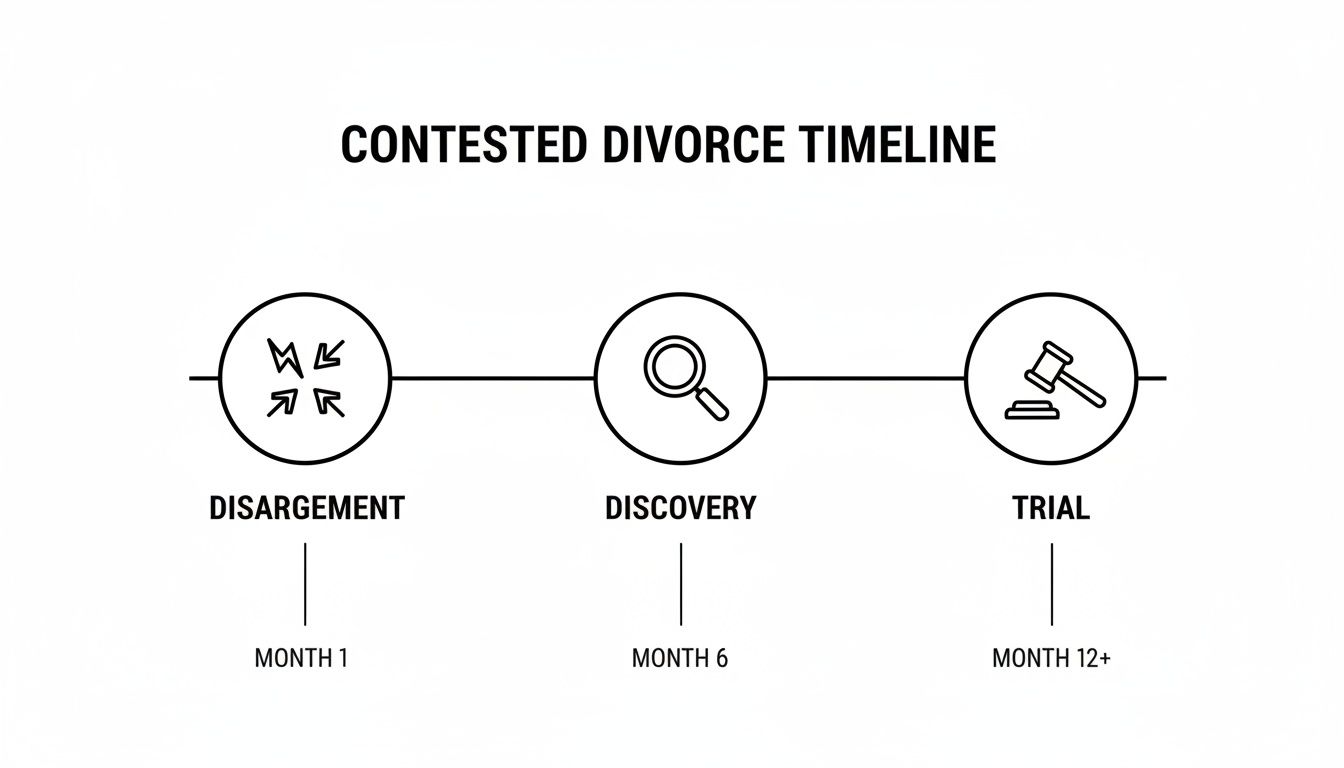
As you can see, discovery often becomes the central and most time-consuming phase.
Stage 4: Mediation and Trying to Settle
Before you can go to trial, Montgomery County courts require you to try and work things out through mediation. This is a structured negotiation session with a neutral third-party mediator.
The good news is that mediation is incredibly effective. Most cases settle here, avoiding the expense and stress of a trial. Reaching an agreement in mediation is the best way to shorten the divorce timeline. You can learn more about how divorce mediation works.
Stage 5: Trial and Finalizing Your Divorce
If mediation doesn't work, the last resort is a trial. We present evidence and make legal arguments to a judge, who then makes the final decisions. Preparing for and getting a trial date can add several more months to your divorce.
Once every issue is resolved, your attorneys will draft the Final Decree of Divorce. A judge signs it, and at that moment, your marriage is legally dissolved.
What to do next
- File Your Petition: Start the legal process by filing the Original Petition for Divorce to get the 60-day clock ticking.
- Prepare for Temporary Orders: Think about what you need to maintain stability during the divorce (e.g., use of the house, temporary custody) and discuss it with your attorney.
- Engage in Discovery Honestly: Respond to information requests from the other side promptly and completely to keep the process moving.
- Go to Mediation with a Goal: Prepare for mediation with a clear understanding of your goals and a willingness to find a middle ground.
Disclaimer: This article is for informational purposes only and does not constitute legal advice. The law is complex and subject to change. For advice tailored to your specific circumstances, you should consult with a qualified attorney.
Going through these stages can be overwhelming. If you live in The Woodlands and need to understand how this process applies to you, the attorneys at the Law Office of Bryan Fagan are here to help.
Actionable Steps to Shorten Your Divorce Timeline

You have more control over your divorce timeline than you might think. By being proactive and strategic, you can shorten the process, saving time, money, and emotional energy.
The golden rule for a faster divorce is to reduce conflict. The goal isn't to "win" every battle, but to reach a fair and final resolution as efficiently as possible.
Prepare Before You File
Getting your financial house in order before you file for divorce can shave weeks or even months off the process.
Start gathering key documents now:
- Financial Records: At least two years of bank statements, tax returns, pay stubs, and credit card statements.
- Asset and Debt Information: Property deeds, vehicle titles, mortgage statements, car loan info, and details on all retirement and investment accounts.
- Business Documents: If you or your spouse own a business, collect profit and loss statements, balance sheets, and recent tax returns.
This preparation gives your attorney a clear financial picture from day one and cuts down on lengthy requests for information.
Embrace Communication and Compromise
It may be the last thing you want to do, but keeping a business-like line of communication open with your spouse can be a game-changer. If you can agree on small issues, you build momentum toward resolving bigger ones.
Think of compromise as a strategic tool. Is fighting over a piece of furniture worth another month of legal fees? Focusing on the big-picture goals—like a fair property split and a stable co-parenting plan—is essential for moving forward.
Real-World Scenario: A couple in Creekside Park was stuck for months, deadlocked over who would keep a set of custom furniture. The legal bills were getting high. Their attorneys helped them realize the cost of fighting would soon exceed the furniture's value. They agreed to sell it and split the proceeds, a compromise that broke the logjam and allowed them to finalize their divorce weeks later.
Be Responsive to Your Attorney
Your family law attorney is your guide, but they can only move as fast as you empower them to. When your lawyer requests a document or asks for your thoughts on a settlement proposal, respond as quickly as possible.
Delays in communication create a domino effect. If you take two weeks to find a bank statement, that could delay a settlement offer. Staying prompt enables your legal team to keep your case moving.
What to do next
- Start Your Financial "Go-Bag": Create a folder and begin gathering all the financial documents listed above.
- Identify Your Non-Negotiables: Make a private list of what is most important to you (e.g., keeping the house, a specific custody schedule). This helps you know where to stand firm and where you have room to compromise.
- Choose a Cooperative Mindset: Approach negotiations with the goal of finding a resolution, not seeking revenge. This can dramatically change the tone and speed of your case.
- Stay Off Social Media: Do not post anything about your divorce, spouse, or finances online. A single angry post can destroy goodwill and be used as evidence against you.
Disclaimer: This article provides general information and is not a substitute for legal advice. The law is complex and changes frequently. For advice specific to your situation, you should consult with a qualified attorney.
If you want to take control of your divorce timeline, our team at The Law Office of Bryan Fagan is ready to help you build a strategy. Schedule a consultation to discuss your case and learn how we can assist you.
Your Path Forward After a Woodlands Divorce
When you boil it all down, the answer to "how long will my divorce take?" really comes down to one thing: agreement. While the law sets a floor, you and your spouse hold the real power to decide whether your divorce is over in a few months or drags on for years.
The Texas Family Code mandates a 60-day waiting period. That means, under the absolute best-case scenario, no divorce can be finalized in less than two months. But that timeline is really only achievable for couples who walk into the process with a complete, uncontested agreement already worked out. For most families here in Montgomery County, that's just not the reality.
Why the Timelines Vary So Much
It’s the arguments that stretch the clock. Every contested issue—from disagreements over who gets the kids and when, to fights about how to divide a complex estate with property in Creekside or Sterling Ridge—adds another layer of time. These conflicts are what trigger the more drawn-out stages of divorce, like discovery, temporary orders hearings, and painful negotiations that push a final resolution further and further away.
Real-World Scenario: We once worked with a Conroe couple who started their divorce disagreeing on absolutely everything. After nearly a year of intense, expensive legal battles, they hit a wall. The constant conflict was damaging their finances and, more importantly, hurting their kids. By finally deciding to change their approach and commit to mediation, they found the common ground they needed to finalize their divorce. It’s a powerful reminder that it's never too late to choose a more cooperative path.
Ultimately, your best tools for getting through this efficiently are cooperation, solid preparation, and a genuine willingness to compromise. Getting a firm grasp on how the Montgomery County court system works is the first, most crucial step in taking control of this challenging chapter in your life.
What to do next
- Take an Honest Look: Can you and your spouse realistically reach an agreement on your own? Your answer will give you a good idea of whether you're headed for a straightforward uncontested divorce or a more complex contested one.
- Start Gathering Documents: Don't wait. Begin collecting all your financial records—bank statements, tax returns, retirement account info. Being proactive here saves a massive amount of time later.
- Figure Out Your Priorities: Know what your non-negotiables are and, just as importantly, where you have room to be flexible. This focus is what makes for productive negotiations.
- Get Professional Guidance: Don't try to navigate this alone. Talking to an experienced family law attorney will help you understand your rights, protect your interests, and build a smart strategy for your unique situation.
Disclaimer: This article provides general information and is not a substitute for legal advice. The law is complex and changes frequently. For advice specific to your situation, you should consult with a qualified attorney.
If you are ready to create a clear strategy for your case, our team at The Law Office of Bryan Fagan is here to help you understand your options. We invite you to schedule a consultation to discuss your path forward.
Common Questions About Divorce Timelines in The Woodlands
Even with a roadmap of the divorce process, you probably still have some specific questions. That’s completely normal. Let’s tackle some of the most frequent concerns we hear from our clients in Montgomery County.
Can we finalize our divorce in less than 60 days in an emergency?
Unfortunately, the answer is almost always no. The 60-day mandatory waiting period is a firm rule in the Texas Family Code, often seen as a required "cooling-off" period.
There is a very narrow exception for situations involving family violence. A judge can waive the waiting period if there is an active protective order or a documented history of family violence. It is important to understand this is extremely rare and reserved for the most severe circumstances.
Does it matter who files for divorce first?
In the grand scheme of things, it doesn't really change the outcome. The person who files is the "Petitioner," and their spouse is the "Respondent."
The only minor "advantage" to filing first is procedural: you get to present your side first during court hearings. It does not give you any extra legal rights. The judge's decisions will always be based on the facts and what the law considers fair, not who filed the paperwork first.
What's the ballpark cost for a simple, uncontested divorce in Montgomery County?
When both spouses agree on everything, the cost is dramatically lower. You are mainly looking at court filing fees and attorney's fees to professionally draft and review your Final Decree of Divorce.
For a truly simple, uncontested divorce, the cost is often a predictable flat fee, usually starting in the low thousands. This provides peace of mind compared to a contested case, where hourly legal fees can easily spiral into tens of thousands of dollars.
What if my spouse refuses to sign the divorce papers? This is a huge source of anxiety, but it absolutely cannot stop the divorce. If your spouse has been properly served but refuses to respond or sign the final papers, the process simply moves forward as a "default" divorce. After the required time has passed, you can ask a judge to finalize the divorce based on what you requested. By refusing to participate, your spouse essentially gives up their right to have a say.
What to do next
- Jot Down Your Questions: Make a list of every single question you have. No question is too small.
- Confirm Your Residency: Double-check that you meet the Texas residency rules (living in the state for six months and in Montgomery County for the last 90 days).
- Talk to an Attorney: The best way to get answers for your specific situation is to discuss them with a local family law attorney who handles cases in The Woodlands.
Disclaimer: This article provides general information and is not a substitute for legal advice. The law is complex and changes frequently. For advice specific to your situation, you should consult with a qualified attorney.
Getting clear, straightforward answers is the first step toward moving forward with confidence. If you have questions about your divorce timeline in The Woodlands area, schedule a consultation with our experienced team at https://thewoodlandstxlawyers.com.