
You’re standing at the designated exchange spot in The Woodlands, watching the minutes tick by. Your phone is silent. Your ex is a no-show, and your child is confused and disappointed. When a court order is ignored, it’s not just frustrating—it’s chaotic. But let's be clear: in Texas, a signed custody order is a direct command from a judge, not a set of optional guidelines.
When the other parent fails to follow it, they are in violation of that order. While your first instinct might be to fire off an angry text, the most powerful response is a methodical one. For parents in The Woodlands, Conroe, and across Montgomery County, the path to resolution lies in building a case a family court judge can act upon.
This Is a Common—And Solvable—Problem
If you're in this situation, you're far from alone. Enforcing possession orders is a critical process governed by Chapter 157 of the Texas Family Code. This law gives you the power to ask a judge to step in.
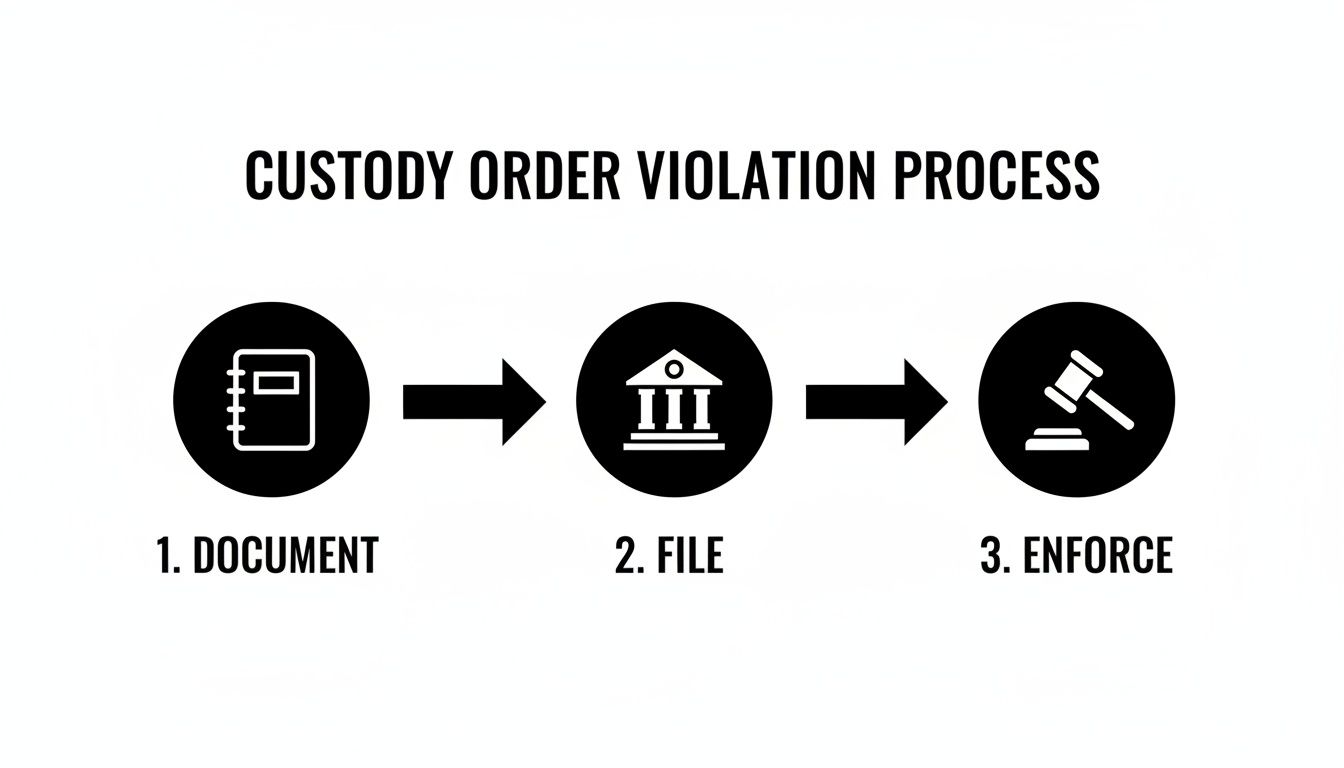
The system works when you know how to use it. The key takeaway is that getting results requires a deliberate legal strategy, not just an emotional reaction. A vague complaint of "he's always late" is easy for a judge to dismiss. A detailed log showing a pattern of lateness is much harder to ignore.
Real-World Scenario: A Pattern of Violation in Alden Bridge
Imagine a mom living in the Village of Alden Bridge in The Woodlands. Her court order says the father has possession of their son every other Friday starting at 6:00 PM. For the past few months, the father has been consistently late—sometimes by hours, sometimes not showing up at all. His excuses are always vague and sent via last-minute texts. The mom feels powerless, and her son is caught in a cycle of anxiety and letdown.
This is more than just an inconvenience; it's a pattern of non-compliance. By keeping a simple log of every incident—date, time, what happened, and screenshots of the texts—she is building the exact evidence a judge in Montgomery County needs to see for a Motion to Enforce.
Navigating this is draining. The legal fight is one thing, but the emotional toll is another. It's crucial to take care of your own well-being during this time. Many people find support and guidance by learning more about healing after divorce and finding healthy ways to cope.
What to Do Next: Immediate Actions for a Violation
When a violation happens, your immediate actions are critical. Here’s a quick reference for what to do right away to protect your rights in Montgomery County.
- Review Your Order: Confirm the exact provision that was violated. A judge needs to see a specific rule was broken.
- Document Everything: In a notebook or app, write down the date, time, and a factual, unemotional description of what happened (e.g., "Ex was 45 minutes late for 6 PM pickup. No text.").
- Communicate in Writing: Send a calm, factual text or email. "Per the order, pickup was at 6 PM. It is now 6:45 PM. Please let me know your ETA." This creates a clean paper trail.
- Do Not Retaliate: Withholding the child on your end—even if you feel justified—is also a violation and will hurt your credibility with the judge.
Disclaimer: This article provides general information and is not a substitute for legal advice from a qualified attorney. The information contained here does not create an attorney-client relationship.
Building Your Case: How to Document Custody Violations for a Montgomery County Court

When the other parent ignores the custody order, it's incredibly frustrating. While your anger is completely justified, it won’t persuade a judge. A Montgomery County family court operates on facts, not feelings. Your job is to build a case that presents a clear, undeniable record of non-compliance.
This means turning your frustrating experiences into the kind of organized evidence a judge can act on. A vague claim like "She's always late" is easy to dismiss, but a detailed log showing a pattern of tardiness is a different story altogether.
Start a Meticulous Custody Log Today
The single most important tool you have is a dedicated log. It doesn’t need to be fancy—a simple notebook, a spreadsheet, or a notes app on your phone will do. What matters is your consistency.
For every single violation, no matter how small it seems, write it down immediately. Be sure to include:
- Date & Time: The exact date and time the incident happened (or was supposed to happen).
- What Happened: A factual, emotion-free description. For example, "Possession exchange was scheduled for 6:00 PM. He did not arrive until 7:45 PM. No communication was received explaining the delay."
- Witnesses: Was anyone else there? Note the name of a friend, grandparent, or neighbor who saw what happened.
- Impact on the Child: Briefly and factually describe your child's reaction. "Jane kept asking when Dad was coming and seemed anxious."
This log does more than just list mistakes; it builds a powerful timeline. It demonstrates that you're not dealing with isolated incidents but a consistent pattern of behavior—a key factor judges look for under the Texas Family Code.
Preserve Your Digital Evidence the Right Way
Text messages, emails, and app communications are often the smoking gun in these cases. But you have to capture them correctly for them to be credible and admissible in court.
- Screenshot Everything: When you screenshot a text, make absolutely sure the date and time stamp are visible at the top of the screen. A text without that context is nearly worthless as evidence.
- Get Official Logs: Your cell phone provider can give you official call and text logs. These documents show dates, times, and numbers, and they can be invaluable for corroborating your claims.
- Use a Co-Parenting App: I strongly recommend using a dedicated co-parenting app. Tools like OurFamilyWizard or AppClose are designed for this. All communications are time-stamped, logged, and cannot be altered, creating a pristine, court-ready record.
Real-World Scenario: Joint Decisions in Sterling Ridge
Let’s say you live in The Woodlands community of Sterling Ridge. The other parent, who lives in Conroe, consistently misses the kids' scheduled video calls. On top of that, they just signed your daughter up for a new soccer league without ever discussing it with you, a clear violation of your joint decision-making rights under the order.
Instead of just getting mad, you open a spreadsheet. You log every single missed call. You screenshot the text exchanges where you politely reminded them about the call an hour beforehand. You document the date you discovered the unilateral soccer enrollment. When you finally file a Motion to Enforce, your attorney can walk into court with organized evidence showing a clear pattern of disregard for the court's order.
What to Do Next: Your Evidence Checklist
The moment a violation happens, take a deep breath and switch into evidence mode.
- Log it immediately. Open your notebook or spreadsheet and record the date, time, and a factual description of what just happened.
- Screenshot any related texts or emails. Check that the date and time are visible.
- Send a polite, clarifying message. Something simple like, "Just confirming you are not picking up the kids for your 6 PM possession today?" creates a clean record.
- Never retaliate. It's tempting to withhold possession yourself, but doing so will only hurt your credibility with the court.
Disclaimer: This article provides general information and is not a substitute for legal advice from a qualified attorney. The information contained here does not create an attorney-client relationship.
By taking these disciplined steps, you are actively building a strong case to enforce your custody order and protect your child’s routine. If you feel your order is being violated, the next step is to discuss the specifics with an experienced attorney in The Woodlands.
Filing a Motion to Enforce Your Custody Order
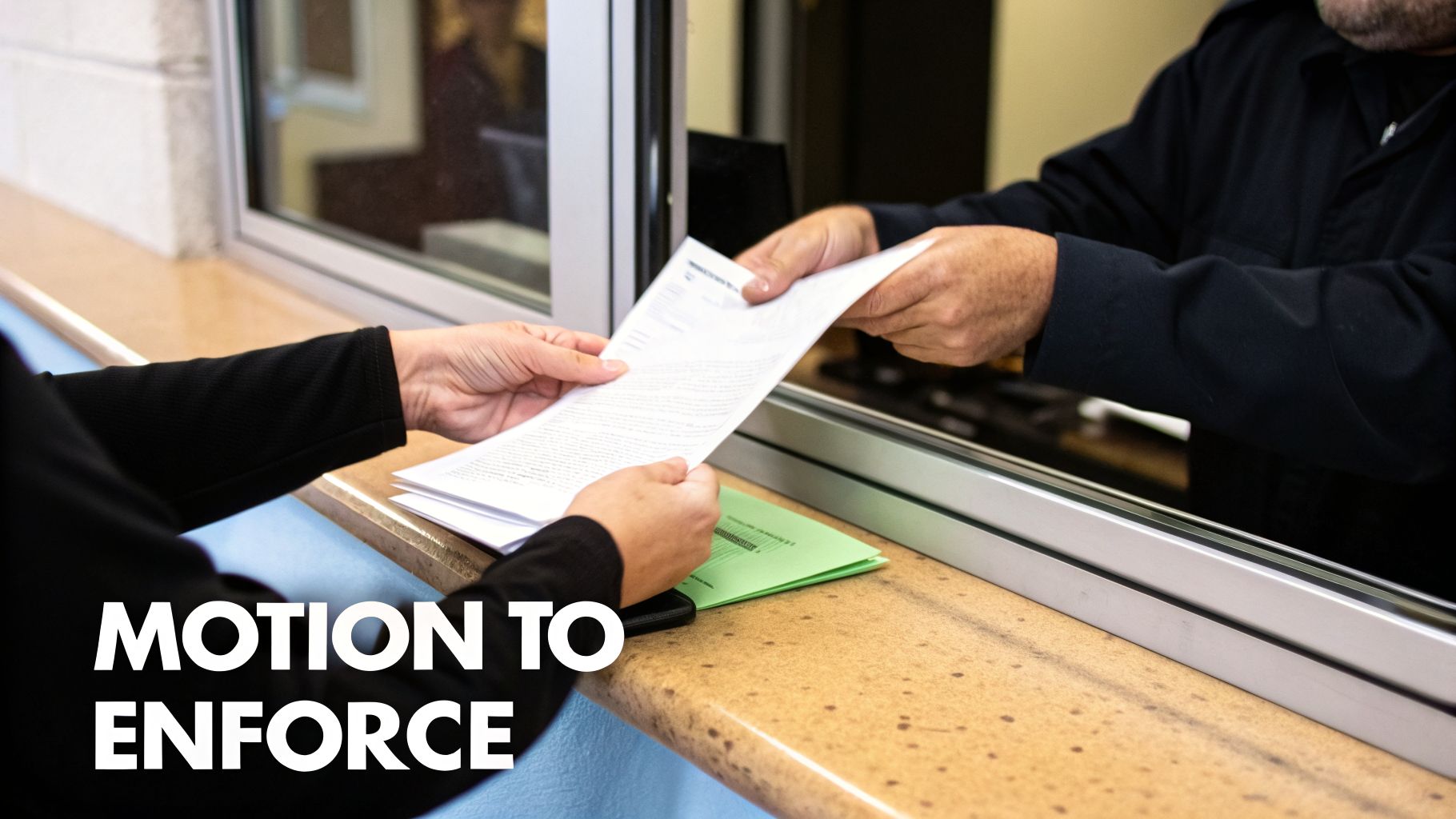
When you've documented the violations and your polite requests have gone nowhere, it's time to stop asking and start telling. Your next move is to file a formal Motion to Enforce with the same Montgomery County court that issued your original custody order.
Think of this as a lawsuit that officially asks the judge to step in and compel the other parent to follow the rules. It sends a clear message that you’re serious about upholding the court's authority and protecting your child's need for stability. This isn't about payback; it's about getting things back on track.
What Your Motion Must Contain
A judge in Conroe can't do anything with a vague complaint. Your Motion to Enforce has to be laser-focused. The Texas Family Code, Chapter 157, is very clear on this.
For every single violation you claim, your motion absolutely must state:
- The exact date it happened.
- The specific time of the violation.
- The precise location where it took place.
- A straightforward, factual summary of how the parent violated the order.
You also have to point to the exact part of your court order that was ignored. There's no wiggle room here—this level of detail is the bedrock of a strong enforcement case.
Real-World Scenario: A Parent in Alden Bridge Takes Action
Let's look at a real-life example. A dad in the Village of Alden Bridge had an order stating the mother had to return their daughter one full week before the Conroe ISD school year started. For two summers straight, she brought their daughter back just one day before school, causing the little girl major anxiety and making her miss orientation activities.
The father had documented it all. He filed his Motion to Enforce at the courthouse in Conroe. In front of the judge, he laid out his evidence, showing not just the violations but the real, negative impact on his child. The judge found the mother in contempt, ordered her to pay the dad's legal fees, and gave him an extra week of possession the following summer to make up for the time he lost.
For more on what to expect in the courtroom, check out our guide on preparing for a child custody hearing in Montgomery County.
What to Do Next: Your Filing Checklist
Ready to move forward? Here’s a quick checklist to get you organized:
- Organize Your Evidence: Pull together your log of violations, text message screenshots, emails, and any other proof you have.
- Pinpoint the Violations: Go through your custody order with a highlighter and mark the exact clauses that were broken.
- Draft the Motion: The motion must clearly list each violation with the required date, time, location, and details as required by the Texas Family Code.
- File and Serve: Once filed with the Montgomery County District Clerk, the motion must be formally served on the other parent by a sheriff's deputy or private process server.
Disclaimer: This article provides general information and is not a substitute for legal advice from a qualified attorney. The information contained here does not create an attorney-client relationship.
Filing a Motion to Enforce is a technical legal procedure where every detail counts. If you’re dealing with a difficult ex in The Woodlands area, this is often the most effective way to restore order. To discuss your specific case, you can schedule a consultation with our office.
What a Montgomery County Judge Can Actually Do
So, you've filed your Motion to Enforce and have your evidence lined up. What happens next? Many parents I talk to in The Woodlands think it's an all-or-nothing situation, with jail time being the only real "win." The reality is quite different. A Montgomery County family court judge has a whole toolbox of remedies, and jail is usually the last tool they reach for.
The court’s main objective isn't just to punish the other parent. It's to stop the violations, restore your rightful time, and make sure the order is followed from here on out. The most common outcomes are practical and financial, designed to make things right for you and your child.
First Things First: Getting Your Time Back
The first order of business for almost any judge is making you whole. If your ex kept the kids for an extra day after a holiday or torpedoed one of your weekends, the court will almost certainly grant you makeup possession time.
This isn't just a slap on the wrist. The judge will award you the exact amount of time you lost, often letting you pick a future date that works for you. It's a clear signal that the possession schedule is the law of the land, not a set of suggestions.
Making the Other Parent Pay for Your Legal Bills
Enforcing your order isn't free. You've got filing fees, service costs, and attorney's fees piling up. Here’s the good news: if the judge rules in your favor, the Texas Family Code is on your side. The law essentially requires the non-compliant parent to foot the bill.
This provision exists so you aren't punished financially for simply standing up for your rights. This single rule levels the playing field. You shouldn't have to choose between your savings and your court-ordered time with your child.
Real-World Scenario: A Case in Creekside Park
I saw a case not long ago that illustrates this perfectly. A mom living in the Village of Creekside Park was having constant issues with her ex, who lived in Spring. He wouldn't let her have her scheduled phone calls with their son and kept changing the holiday exchange spots at the last minute, creating chaos.
She documented everything—the texts, the missed calls, the pattern of behavior. We filed a Motion to Enforce, and at the hearing in Conroe, she laid it all out for the judge. The judge found the father in contempt. The result? The mother was awarded two extra weekends to make up for the lost time. More importantly, the judge ordered the father to write her a check for every single dollar she had spent on legal fees and costs to bring the action. That’s how the system is supposed to work.
When the Judge Needs to Bring Down the Hammer
What happens when makeup time and financial penalties aren't enough? If a parent continues to willfully disobey the court's order, a judge can find them in contempt of court, unlocking more serious consequences:
- Fines: A judge can levy a fine of up to $500 for each individual violation.
- Community Supervision (Probation): The judge might place the other parent on a type of probation, which can last up to ten years.
- Jail Time: This is the ultimate consequence. For the most flagrant and repeated violations, a judge has the power to sentence a parent to up to 180 days in the Montgomery County jail for each violation.
Understanding these remedies is crucial for knowing what to expect. If you want to dig deeper into the specifics of visitation schedules, our guide on the Texas Standard Possession Order is a great place to start.
What to Do Next: Your Courtroom Checklist
- Define Your Goal: What do you want the judge to do? Focus on specific, reasonable requests like makeup weekends, reimbursement of fees, or clear instructions for future exchanges.
- Total Your Costs: Keep a running tally of every expense. This includes your attorney's invoices, court filing fees, and any other money you've had to spend.
- Formulate a Clear "Ask": When you get to court, you need to be able to tell the judge exactly what you want. For example: "Your Honor, I am asking for three makeup weekends and for my attorney's fees of $4,500 to be reimbursed."
- Strategize with an Attorney: Talk through the likely outcomes. An experienced local attorney can give you a realistic idea of what the judge in your court is likely to order based on your specific facts.
Disclaimer: This article provides general information and is not a substitute for legal advice from a qualified attorney. The information contained here does not create an attorney-client relationship.
Now you have a much clearer picture of what’s possible in the courtroom. If you're tired of being denied your rights and are ready to take the next step, schedule a consultation so we can discuss the best strategy for your case.
Handling Emergency Custody Situations
It’s one thing for your co-parent to be a few minutes late. It's another thing entirely when they don’t show up at all, your child isn't returned, and your calls go straight to voicemail. That feeling of rising panic is something no parent should ever experience.
When a parent takes a child and disappears or flat-out refuses to bring them back as the court order dictates, you’ve moved past a simple violation. This is a crisis that may be considered parental kidnapping. It requires you to act fast and act smart. Your first move should be to call the police. Your second should be to call an experienced family law attorney in The Woodlands.
The Most Powerful Emergency Tool: The Writ of Habeas Corpus
In these terrifying situations, Texas law gives us an incredibly powerful and fast-acting remedy: the Writ of Habeas Corpus. Don't let the old-fashioned name fool you. This is an emergency court order that essentially tells a judge, "My child is being illegally withheld, and I need the court's help right now."
A standard motion to enforce a custody order can take weeks to get in front of a judge. A Writ of Habeas Corpus is designed for speed. Its only job is to cut through the red tape, force the person holding your child to appear in court, and get your child returned to you immediately.
This specific action is laid out in the Texas Family Code for exactly this kind of emergency. The moment you realize your child has been wrongfully taken, the clock starts on getting them back safely. You can explore our guide on obtaining an emergency custody order in The Woodlands to understand more about these urgent legal steps.
Real-World Scenario: A Panther Creek Parent's Nightmare
Let’s put this into perspective. Imagine you live in the Village of Panther Creek, and your order states your child comes home every Sunday at 6:00 PM. But Sunday night comes and goes. The other parent won't answer their phone, and a quick check of their social media suggests they’ve taken your child out of state without your consent.
This is the exact moment for decisive action. After calling the police, you call your attorney. An attorney can immediately file a Petition for Writ of Habeas Corpus with the Montgomery County court, even after hours if the situation demands it. A judge can then issue the writ, which empowers law enforcement—wherever your child might be—to find them and ensure their safe return.
What to Do Next: An Emergency Checklist
If your child is not returned at the court-ordered time and you believe they've been wrongfully withheld, follow these steps immediately.
- Call the Police: Report the failure to return your child. This may be considered parental kidnapping. Make sure you get a police report number.
- Contact an Attorney: Let your lawyer know what’s happening right away. They need to start preparing the Writ of Habeas Corpus immediately.
- Grab Your Custody Order: You'll need a signed copy of your order to show both law enforcement and your attorney to prove you have the right to possession.
- Document Everything: Write down the exact time the exchange was missed, a log of all calls or texts you sent, and any other relevant details.
Disclaimer: This article provides general information and is not a substitute for legal advice from a qualified attorney. The information contained here does not create an attorney-client relationship.
An emergency custody situation is a parent’s worst nightmare, but you do not have to face it alone. If you are dealing with this level of non-compliance in The Woodlands or Montgomery County, we encourage you to schedule a consultation with our office.
Enforcing Your Order: Common Questions and Answers
When you're dealing with a co-parent who won't follow your custody order, your mind starts racing with questions. It's a stressful, frustrating situation, and getting clear answers is the first step toward regaining control. Let's walk through some of the most common concerns I hear from parents here in The Woodlands and Montgomery County.
What if the Other Parent Moves Away?
One of the first questions parents ask is what happens if their ex moves out of state. It’s a valid fear, but take a deep breath. Your Montgomery County custody order doesn’t just disappear at the state line.
Thanks to a law called the Uniform Child Custody Jurisdiction and Enforcement Act (UCCJEA), which Texas and nearly every other state have adopted, your order remains in full effect. It allows you to register your Texas order in the new state and enforce it there. You don't have to start the legal process all over again.
Can I Stop Paying Child Support if I'm Denied Visitation?
This is a tempting thought, but the answer is an emphatic no. In the eyes of the Texas family court, child support and possession (visitation) are two entirely separate legal obligations.
Withholding child support—no matter how justified you feel—puts you in violation of the court order. It's a move that will seriously damage your credibility with a judge and could land you in your own legal hot water. As the Texas Family Code clearly lays out, one parent's violation never excuses the other's.
Real-World Scenario: When "Minor" Violations Aren't Minor
I once worked with a mother in The Woodlands whose ex was consistently bringing their child home several hours late every Sunday. It wasn't an emergency, but it threw their whole evening into chaos—disrupting dinner, homework, and bedtime, which left the child anxious. She was hesitant to take action, thinking the issue was "too small" for court.
Instead of jumping straight to a motion, we started by having our office send a firm, formal letter to the other parent. It detailed the pattern of violations and reminded him of the potential legal consequences. The lateness stopped immediately. It was a perfect example of how the right professional step can resolve an issue and create a crucial paper trail without the cost and stress of a full-blown court battle.
What to Do Next: A Practical Checklist
When violations start happening, it's time to get organized. Here’s what you should be thinking about:
- Know Your Order: Pull out your signed custody order and get reacquainted with the exact terms for possession schedules, exchanges, and decision-making.
- Keep Meticulous Records: Document every single violation in one log. Be factual and consistent.
- Look for the Pattern: Are these isolated incidents, or are they forming a consistent pattern? Even small, repeated violations can significantly impact your child's stability.
- Get a Professional Opinion: It's always wise to consult with an attorney to weigh your options. Sometimes a formal letter is all it takes; other times, you need to go straight to filing a Motion to Enforce.
Disclaimer: This article provides general information and is not a substitute for legal advice from a qualified attorney. The information contained here does not create an attorney-client relationship.
Enforcing a custody order can feel like an uphill battle, but you don’t have to fight it alone. If you need help protecting your rights and your child's well-being in The Woodlands or Montgomery County, we are here to help. To get clear answers and discuss the specifics of your case, schedule a consultation with our office.