 Skip to content
You're at home in The Woodlands. Maybe it's Alden Bridge, Panther Creek, or Sterling Ridge. The kids are in the next room, dinner is half-finished, and someone from CPS is at the door or on the phone asking questions you weren't ready for.
Most fathers have the same first reaction. Panic. Then anger. Then the urge to explain everything right away.
That urge can hurt you.
A CPS investigation doesn't automatically mean you're an abusive parent, and it doesn't automatically mean your child will be removed. But it does mean the state is now collecting information that can affect custody, possession, and your standing in Montgomery County family court. If there's already a divorce, SAPCR, modification, or enforcement dispute in the background, the risk goes up fast.
For fathers, the local reality matters. In The Woodlands and broader Montgomery County, CPS cases often overlap with existing custody conflict. A calm, documented, lawyer-led response usually works better than emotional explanations, off-the-cuff texts, or trying to “clear things up” alone.
The Knock at the Door What CPS Involvement Means for Fathers
It starts fast. You are home in The Woodlands after work, your child is nearby, and a CPS investigator calls or shows up asking to come in and ask questions.
That first contact changes the case.
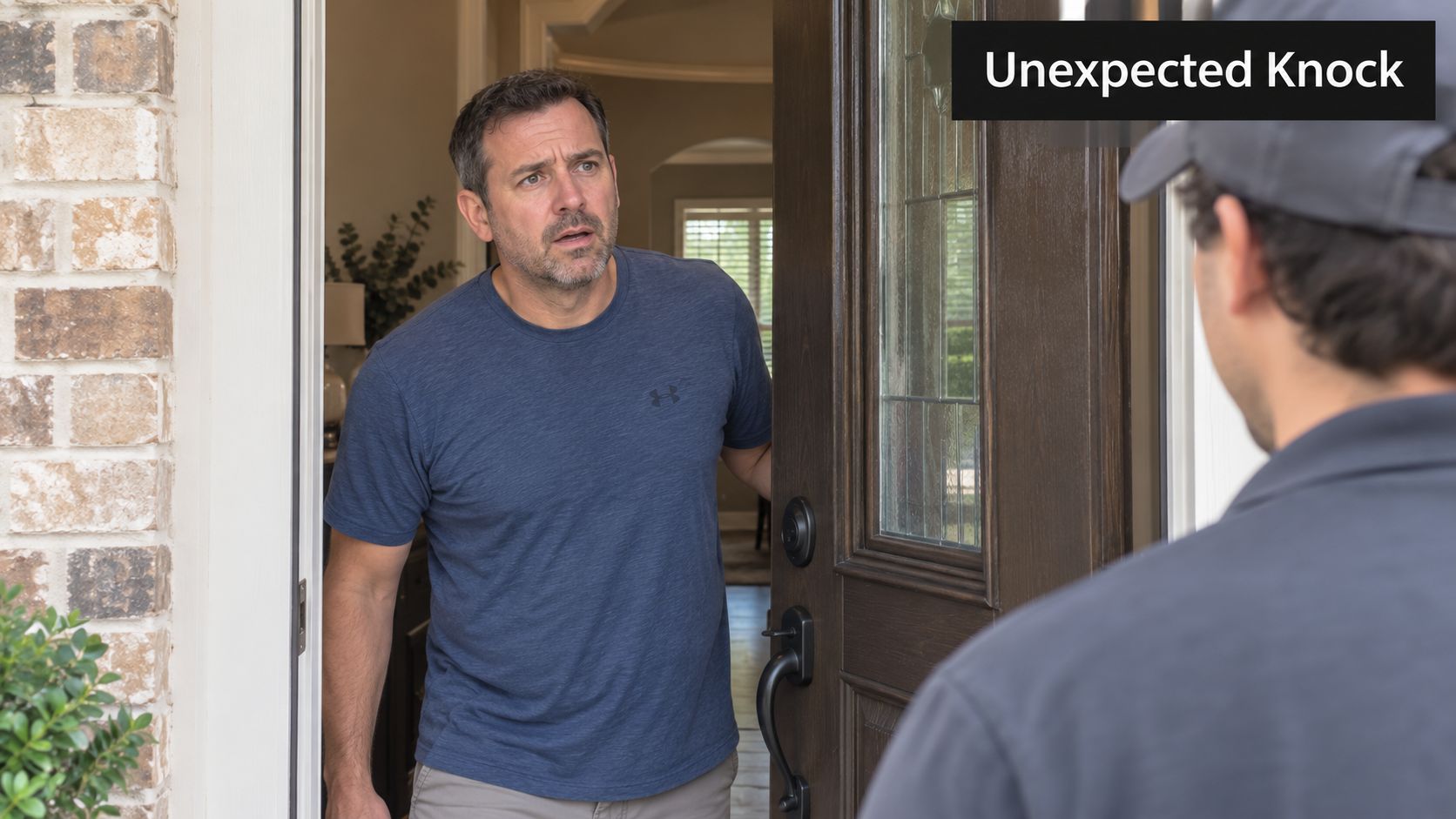
For fathers, the danger is rarely just the allegation itself. The danger is how quickly an informal conversation becomes a written record, how easily a co-parent folds that record into a custody dispute, and how fast Montgomery County courts can be asked to act if CPS claims the child is unsafe. If removal is being discussed, the stakes and timeline change again, and a father needs to understand how a CPS removal hearing in The Woodlands can affect possession, access, and the court's first impression of him.
A CPS investigation is not a finding that you abused or neglected your child. It is the start of evidence collection by people who may later testify, write affidavits, or give records to the court. In Montgomery County, that matters because many fathers are not walking into a clean, isolated agency inquiry. They are walking into a case that overlaps with a divorce, modification, SAPCR, or a tense co-parenting history.
A short local scenario
A father in Panther Creek gets an evening visit after his child tells someone at school that dad grabbed him too hard during discipline. The father has no criminal history, stable employment, and a standing possession order. He also makes a common mistake. He tries to solve the problem on the spot.
He talks too much on the porch. He guesses at dates. He hands over text messages without context. He agrees to broad requests because he thinks cooperation alone will end the issue.
Later, those choices become the file.
That is one of the procedural traps fathers run into in Montgomery County. A decent father can damage his position with loose statements long before any judge hears the full story.
What is at stake
CPS contact can affect far more than one interview. It can influence temporary orders, school access, pickup rights, and later arguments that the current custody arrangement should be changed. Texas courts can modify conservatorship and possession orders under Texas Family Code Section 156.101 when a parent claims circumstances have materially and substantially changed or the child's present environment is not in the child's best interest.
That legal standard matters for fathers in The Woodlands because CPS records often get used for two different purposes at once. CPS may be deciding whether to close its investigation, and the other parent may be building a story for family court. Those are separate tracks, but they often feed each other.
I have seen fathers focus only on convincing the investigator they are a good dad. That is too narrow. The better question is whether every statement, message, and document helps or hurts if it lands in a Montgomery County courtroom.
Practical rule: Do not treat first contact with CPS like an informal chance to clear things up. Treat it like the opening move in a case that may affect both your home and your custody order.
What CPS contact does and does not mean
It means the state is gathering information about your parenting, your home, and your child.
It means timing matters, especially if there is already conflict with the other parent.
It can mean requests for interviews, a home visit, records, safety plans, drug testing, collateral contacts, or access to your child.
It can also mean pressure. Pressure to talk before you are ready. Pressure to sign paperwork you do not fully understand. Pressure to agree to terms that seem temporary but can later be used to argue you admitted a safety problem.
For fathers, there is also a local advantage in acting early. Montgomery County judges and opposing counsel tend to look closely at who documented concerns, who stayed measured, and who followed court orders while the investigation was pending. Fathers who respond with discipline, records, and a clear legal strategy usually stand in a stronger position than fathers who react with anger, silence, or improvisation.
Fairness does not fix a bad record. Procedure does. Documentation does. Early decisions do.
Your First 48 Hours A Father's Immediate Response Plan
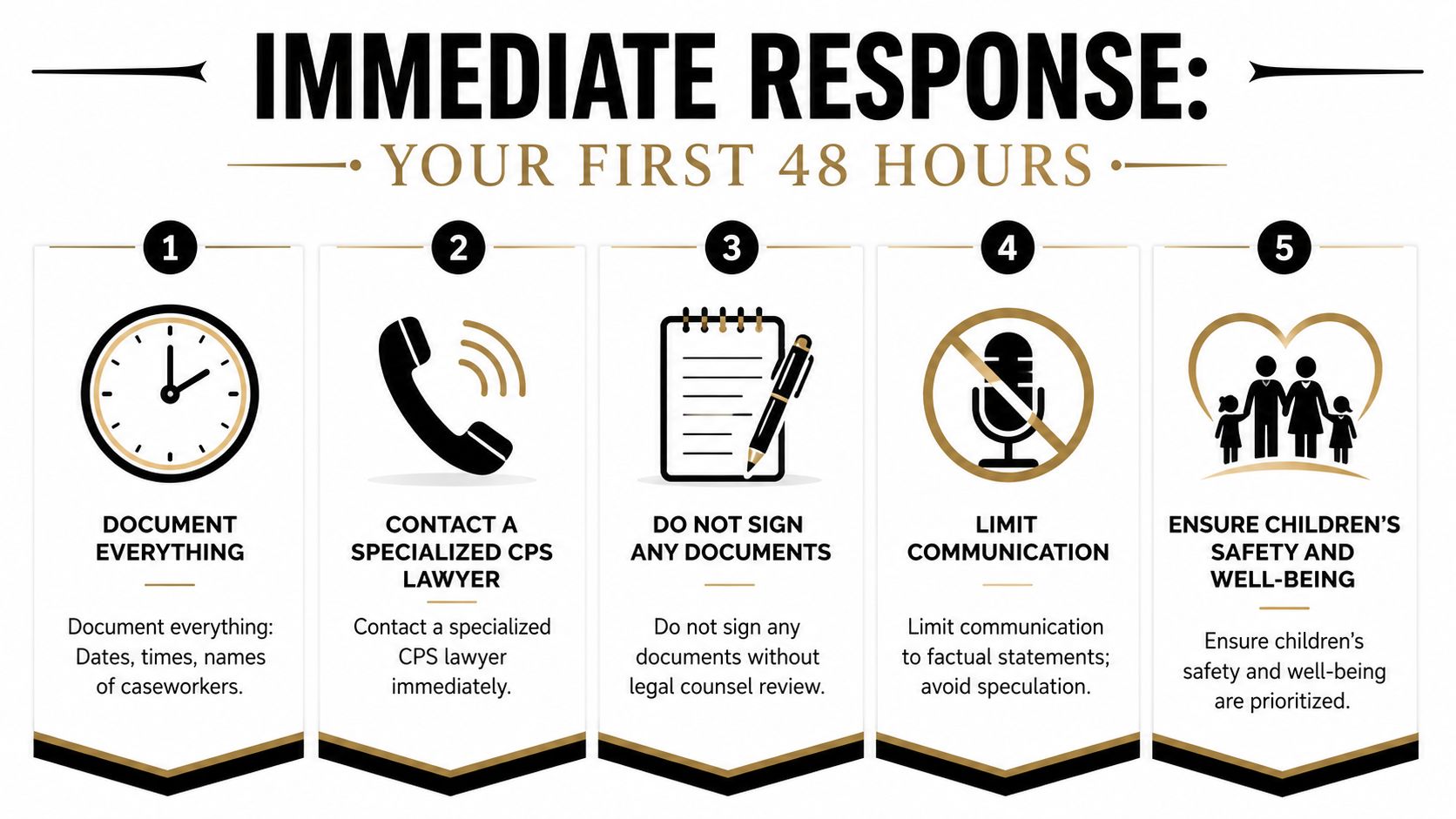
The first two days matter more than most fathers expect. If you handle those hours well, you can protect the record, reduce avoidable damage, and give your lawyer room to work. If you handle them badly, you may spend months trying to fix what one rushed conversation created.
One of the most important early moves in Texas CPS matters is building a documented discipline protocol and controlling contact through counsel. In high-conflict Montgomery County cases, the legal framework described in the Texas Children's Commission judicial funding guide notes that private CPS-defense attorneys for fathers typically require this to be prepared within 48 hours of initial contact to help prevent emergency temporary orders. The same source describes a method that includes controlling investigator contact through counsel and tying each allegation to a specific date, witness, and event.
What to say right away
You don't need to be rude. You do need to be careful.
Use short, neutral language:
- Ask for identity. Request the caseworker's full name, office, phone number, and supervisor.
- Ask the subject of the investigation. You're entitled to know the general nature of the allegations.
- Set boundaries calmly. Tell the investigator you want counsel before any detailed interview.
- Keep your tone flat. Don't argue facts at the doorstep.
A father who starts debating, guessing, or volunteering background information often hands CPS statements that can later be framed against him.
What not to do
Some mistakes show up again and again in The Woodlands CPS cases:
- Don't speak alone if detailed questioning starts. A lawyer can help prevent speculation and overexplaining.
- Don't sign papers on the spot. Safety plans, releases, and written statements can carry consequences you don't see yet.
- Don't coach your child. That can create a second problem.
- Don't delete messages. Preserve everything.
- Don't contact the other parent in a rage. Angry texts become exhibits.
If you don't know an answer, don't fill the silence. “I need to review that and respond through counsel” is often the safer answer.
What to do next
Keep this checklist simple and immediate:
- Write down the basics. Date, time, who contacted you, what was said, and whether they asked to enter the home or interview your child.
- Call a lawyer who handles CPS and custody overlap. If removal is being discussed, ask about a CPS removal hearing in The Woodlands.
- Start a clean evidence folder. Save texts, emails, school notices, medical records, and calendar entries.
- Draft your parenting timeline. Include exchanges, school involvement, doctor visits, extracurriculars, and any prior allegations.
- List discipline methods used in your home. Be precise and factual.
- Identify related court orders. If there's an existing decree or possession order, Enforcement of Court Orders in The Woodlands may become relevant if one parent is violating custody provisions in Montgomery County.
- Keep the child stable. Show up, stay sober, follow routines, and avoid scenes.
Why fathers lose ground early
The danger isn't only the allegation itself. It's the way fathers respond under stress. They assume honesty alone is enough. It isn't.
The strongest early response usually looks boring on paper. Controlled communication. Organized records. No dramatic texts. No surprise admissions. No guessing. A good cps lawyer for fathers in The Woodlands doesn't just prepare for court. He helps shape the first record before it hardens.
The Montgomery County CPS Investigation Process
After the first call or visit, the case usually turns on paperwork, timing, and consistency. Fathers in Montgomery County often expect one decisive interview. What usually decides the case is much less dramatic. It is the record CPS builds from home visits, collateral interviews, school and medical contacts, and your own statements.
That local point matters. In Montgomery County, a CPS case can stay administrative for a while, then spill into family court fast if the investigator believes there is an immediate safety issue or if the other parent uses the investigation to press for a possession change. Fathers lose ground when they treat those tracks as separate. They are not.
Mark learned that early. After talking too much at the door, he stopped trying to persuade the investigator with explanations and started proving his role with records. He pulled school emails, pickup confirmations, medical notices, and texts with the child's mother. That shifted the issue from opinions about him to documents tied to dates and events.
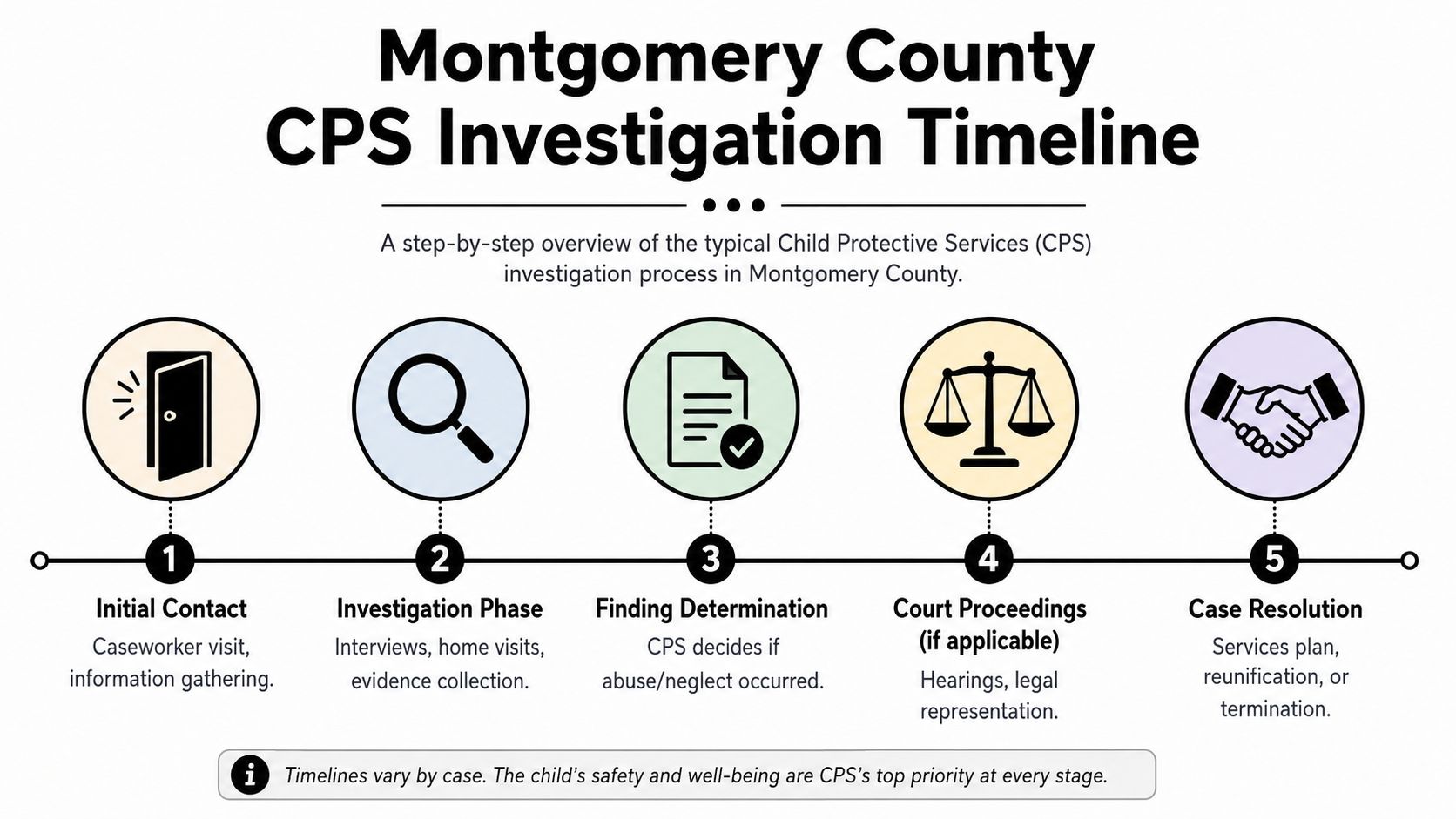
What the process usually looks like
In Montgomery County, the investigation often moves through the same broad stages, but the pressure points for fathers are different at each one.
| Stage | What matters most for fathers |
|---|---|
| Initial contact | Whether you identify the allegation clearly, limit unnecessary statements, and document who contacted you |
| Investigation phase | Home conditions, child interviews, collateral witnesses, your texts and emails, and whether your timeline stays consistent |
| Finding stage | Whether CPS can match allegations to specifics, corroboration, and a believable sequence of events |
| Court involvement | Temporary orders, safety plans, requests for access limits, removal disputes, and how quickly you respond through counsel |
| Resolution | Closure, services, monitored follow-up, or a related custody fight in family court |
If court gets involved, the cast changes quickly. You may see a CPS attorney, an attorney ad litem for the child, and a judge who has little patience for emotional speeches. In that setting, fathers do better when their records are clean and their conduct matches what they claim.
The written record carries more weight than fathers expect
One of the most common mistakes I see in The Woodlands is a father relying on conversations no one can prove later. He says he asked for time with the child. He says he offered to take the child to the doctor. He says he told the mother about school involvement. If none of that is documented, CPS and the court may treat it as a disputed memory, not a fact.
That does not mean sending ten messages where one would do. It means building a disciplined paper trail.
For example:
- After an oral discussion: send a short text confirming the exchange time or the topic discussed.
- After being denied access: send a calm message asking for a makeup period.
- After a school event: save the notice, sign-in, email, or app record showing you were involved.
- After medical contact: keep appointment notices, discharge paperwork, and follow-up instructions.
Use a simple rule: brief, factual, child-focused messages usually help you more than long explanations.
Procedural traps fathers hit in Montgomery County
These are the problems that keep showing up:
- No usable communication log. The father remembers the contact. CPS sees no supporting record.
- Cash support with no memo or context. A payment made in good faith can become a later argument about unreliability or control.
- Showing up without notice. Even if your intent is good, an unannounced appearance at school, daycare, or the other parent's home can be framed as instability.
- Inconsistent dates. Once your timeline drifts, the investigator may doubt the rest of your account.
- Signing a safety plan without understanding the downstream effect. In practice, that document can influence possession, access, and later family court arguments if you agree to restrictions that do not fit the facts.
The local advantage for fathers is this. Montgomery County judges and lawyers tend to focus less on labels and more on whether your actions show steady parenting. Under Texas Family Code § 153.073, parents have rights tied to education, healthcare, and other major parts of a child's life. In a CPS case, those rights matter most when you can show you used them responsibly and consistently.
If you want a broader breakdown of the local procedure, this guide on how to fight CPS in Montgomery County gives a useful overview. Keep your records in one secure place, and safeguard your sensitive files so you are not forwarding private school or medical records carelessly while the case is active.
How Mark corrected course
Mark stopped debating and started documenting. He built a dated timeline, matched each event to a text, school notice, or appointment record, and cleaned up future communication so every important point was confirmed in writing.
The investigation did not disappear. But the file stopped being driven by accusation alone, and that is often the first real win for a father in Montgomery County.
How a Specialized CPS Lawyer Defends Fathers' Rights
A father usually calls my office after one of two things happens. CPS has asked for an interview, or the other parent is already using the investigation as a custody weapon. At that point, the risk is not just what CPS believes. The risk is what gets written down first, what gets filed first, and what a Montgomery County judge sees before your side is organized.
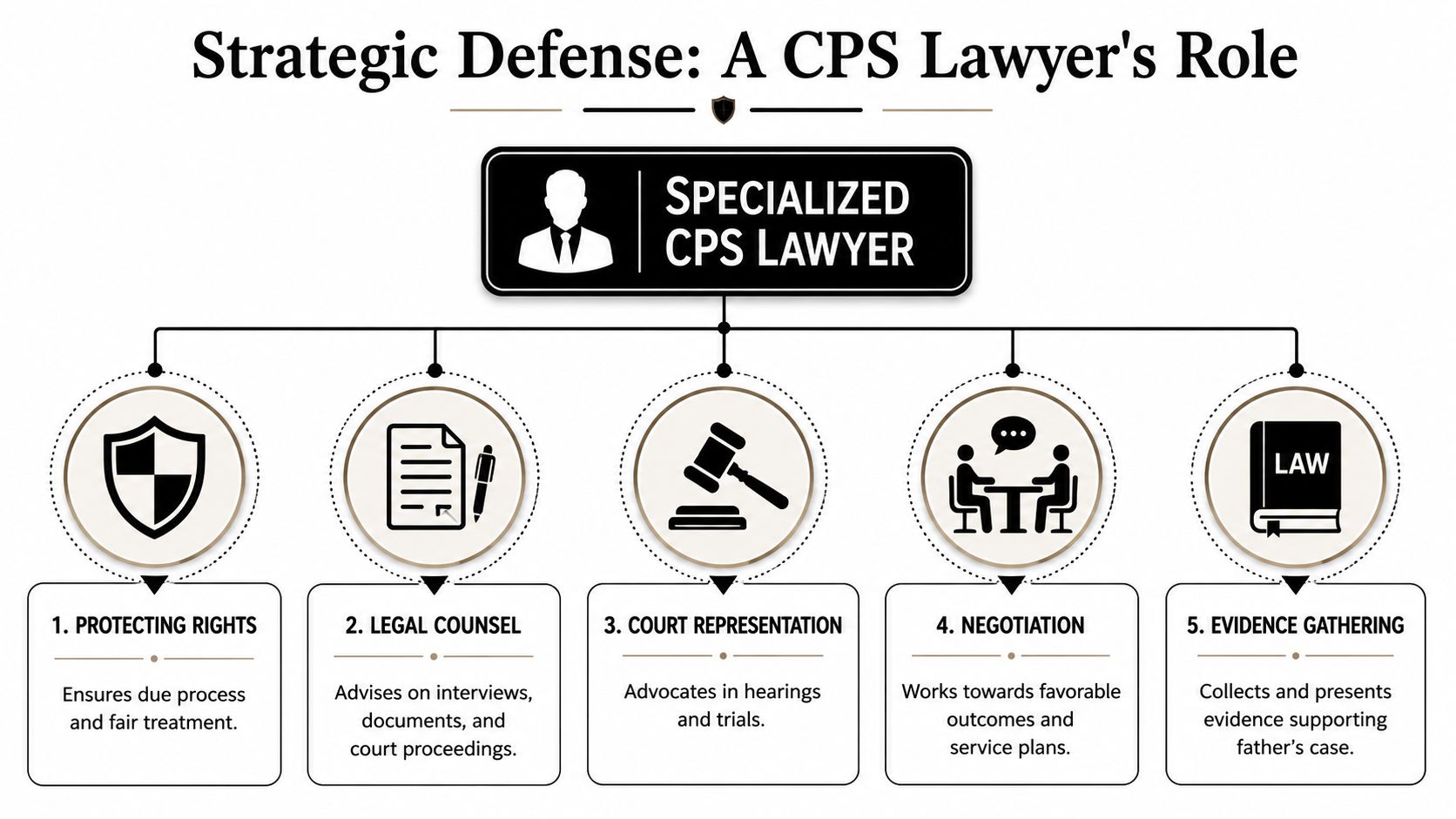
A specialized CPS lawyer protects fathers by taking control of the procedure early. In Montgomery County, that matters because CPS issues rarely stay inside one file. They can spill into a SAPCR, a modification, temporary orders, or a dispute over who gets to make school and medical decisions. A lawyer who handles both CPS defense and custody litigation knows how one statement in the investigation can damage you in family court later.
What a specialized lawyer does
The first job is to slow the case down enough to get accurate facts in front of the right people. Fathers often hurt themselves by trying to sound cooperative while answering broad questions with no context, no records, and no plan. Counsel sets boundaries on communication, identifies what must be provided, and cuts off the kind of loose conversation that later shows up in an affidavit.
The second job is to test the accusation the way a trial lawyer would. That means pinning down dates, comparing the allegation to school attendance, medical records, work logs, text messages, and prior orders, and spotting when the story changes. In Montgomery County, weak details matter. If the claim is vague, inconsistent, or tied to a custody fight, your lawyer should force that issue early instead of letting the file drift on assumptions.
The third job is to present the father as a functioning parent with records to back it up. Judges here tend to respond better to proof than outrage. If you have been handling pickups, attending ARD meetings, paying support, scheduling doctor visits, or staying involved in counseling, those facts need to be organized fast and presented in a way the court can use.
Where fathers gain or lose ground
A specialized lawyer is also watching for procedural traps that many fathers miss under stress.
- Informal safety plans can create restrictions that later get treated like admissions.
- Recorded or poorly handled interviews can freeze a bad fact pattern before documents are collected.
- Temporary hearings can shape possession and decision-making long before the full case is resolved.
- Parallel custody filings by the other parent can turn a CPS allegation into a long-term parenting order if you do not answer quickly.
That is why timing matters. A lawyer should be preparing for the next hearing, the next investigator contact, and the related family-law consequences at the same time. For a closer look at how that works in practice, see this CPS investigation lawyer resource for The Woodlands.
Defense also means document control
Many CPS cases turn on paperwork before they turn on testimony. Fathers often have useful proof but keep it scattered across phones, email, school portals, and old court files. A specialized lawyer helps decide what matters, what needs context, and what should never be handed over casually or out of order.
Keep your records dated, labeled, and in one secure place. If you are sending school reports, counseling records, medical information, or screenshots electronically, use a system that helps safeguard your sensitive files so private family information does not spread further than it has to.
The Law Office of Bryan Fagan handles family law disputes in Montgomery County, including contested custody, modification, and CPS-related proceedings. That local overlap matters. A father does not need a lawyer who only reacts to the allegation. He needs one who understands how to protect his position in both the CPS case and the court orders that may follow.
Why specialized representation changes the case
The right lawyer does not make the case louder. He makes it more precise.
He looks for the missing date, the unsupported claim, the witness who was never interviewed, the school record that cuts against the accusation, and the custody angle no one is saying out loud. He also knows when cooperation helps and when it hands the other side a cleaner record than the facts deserve.
For fathers in The Woodlands, that is often the difference between defending a bad allegation and living under an order shaped by it.
Finding the Right CPS Lawyer in The Woodlands
A father usually starts looking for a CPS lawyer after a bad phone call, a home visit, or a notice he does not fully understand. In Montgomery County, that search cannot be casual. The lawyer you hire needs to know how a CPS investigation can spill into temporary orders, a pending SAPCR, or a custody modification before you have time to correct a mistake.
Courtroom skill matters. Local procedure matters just as much.
A good fit is a lawyer who can explain, in plain English, what happens in Montgomery County if CPS pushes for immediate action, what the court is likely to focus on first, and how your role as a father will be documented from the start.
Questions worth asking in a consultation
Use the consultation to test for judgment, not just confidence. Ask questions that force the lawyer to get specific.
- How much of your practice involves CPS defense tied to custody disputes or existing family court orders?
- How often are you handling cases in Montgomery County courts, not just nearby counties?
- If CPS seeks emergency relief, what filings or hearing requests do you consider first?
- Do you want all CPS contact routed through your office once you are hired?
- What documents should I gather in the first 24 to 48 hours?
- How do you use Texas Family Code § 153.073 to show a father's actual involvement in school, medical care, and day-to-day parenting decisions?
- If there is already a divorce, SAPCR, or modification pending, how do you keep the CPS case from shaping the custody record by default?
Vague answers are a warning sign. So is a lawyer who talks in generalities about “fighting for fathers” but cannot explain the local sequence of hearings, orders, and deadlines.
Red flags fathers should notice
Some problems show up fast.
- Promises of a guaranteed result. No honest lawyer can promise that in a CPS case.
- Heavy sales talk, light process. You need a plan for records, witnesses, communication, and hearings.
- No urgency about documents. These cases often turn on timelines, school records, medical notes, text messages, and prior orders.
- No clear answer about Montgomery County emergency practice. That gap can hurt a father early.
- No discussion of the custody side of the case. CPS allegations often become exhibits in later family court hearings.
Many fathers hesitate because they are trying to choose counsel while under pressure, short on sleep, and worried about saying the wrong thing. This piece on understanding client's journey to a law firm captures that part well. The decision usually starts with urgency and uncertainty, not perfect clarity.
Local knowledge changes the quality of the defense
In The Woodlands, Conroe, Magnolia, and the rest of Montgomery County, fathers benefit from a lawyer who already knows the local court rhythm and the procedural traps that come with CPS cases. One lawyer may know family law in a broad sense. Another knows how a CPS allegation can affect possession, temporary restrictions, school access, and the tone of a later custody hearing in this county. That difference shows up quickly.
The right lawyer should be able to tell you, without hedging, how he handles a case where CPS is pressing hard but the evidence is thin, when to push for a hearing, when to slow the record down, and how to keep a temporary crisis from becoming a long-term order. He should also understand a point many fathers learn too late. A CPS case is not only about defending against the allegation. It is also about protecting your credibility in front of the same local system that may decide conservatorship and possession later.
Hire the lawyer who can give you a concrete first-week plan, spot the Montgomery County pressure points, and explain the trade-offs before you make them.
Your Questions Answered and Your Next Step
Fathers usually ask the same hard questions once the panic settles.
Can CPS force me to take a drug test
Sometimes CPS will request one. Whether you should agree, refuse, or ask for conditions depends on the facts, the stage of the case, any court involvement, and what your lawyer knows about the allegations. Don't make that call casually at the door or over the phone.
What if the allegation is completely false
False allegations happen. But “false” doesn't defeat a case by itself. You still need evidence, a clean timeline, controlled communication, and a strategy for disproving the claim. Courts and investigators respond better to organized records than outrage.
A false allegation can still do damage if the father reacts in a way that makes him look evasive, explosive, or inconsistent.
Can I refuse to let CPS into my home
That choice can have consequences, and the right response depends on whether CPS has a court order, whether removal is being threatened, and what the allegation involves. This is one of those moments where quick legal advice matters. A broad principle is not enough.
How do I protect my relationship with my child during the investigation
Stay steady. Keep routines. Show up for school, medical care, and parenting time when allowed. Communicate in writing and keep it child-focused. Don't put the child in the middle, and don't use the child to gather evidence.
What if there's already a custody order
Then every move should be made with that order in mind. Existing possession terms, conservatorship rights, and prior enforcement issues can shape how CPS allegations are framed in court. In many cases, the custody file and the CPS file start affecting each other almost immediately.
Final point
This article is for informational purposes only. It is not legal advice, and reading it does not create an attorney-client relationship. Texas CPS cases are fact-specific, and the right response depends on the exact allegation, the existing court orders, and what has already been said or documented.
If CPS has contacted you in The Woodlands or elsewhere in Montgomery County, don't wait for the case to define itself. Get the facts organized. Stop improvising. Get legal advice tied to your situation.
If you need to talk through a CPS investigation, emergency custody issue, or related family court problem in Montgomery County, you can schedule a confidential consultation with The Law Office of Bryan Fagan. A consultation can help you sort out what matters now, what can wait, and how to protect your relationship with your child without making the case harder than it already is.
