
Dealing with a child support matter in The Woodlands or anywhere in Montgomery County can feel overwhelming. You just want what's best for your child, but the legal system is complex. A child support attorney in Montgomery County acts as your guide, helping you navigate the local courts in Conroe, The Woodlands, and surrounding communities.
This guide uses plain English to explain how child support works in Texas, so you can make informed decisions for your family.
Understanding Child Support in Texas
In Texas, child support is not something parents can just agree on with a handshake. The process is governed by specific rules in the Texas Family Code. These rules are designed to be consistent, but they can feel confusing if you're handling it alone.
A local attorney knows the procedures of the Montgomery County courts, the judges, and the common issues families face. Their job is to guide you through the three main stages of a child support case:
- Establishment: Creating the first official, court-ordered support amount.
- Modification: Adjusting the support order when a major life change occurs, like a job loss or promotion.
- Enforcement: Taking legal action when payments are late or stop altogether.
An experienced lawyer translates legal jargon into clear advice, making sure you understand your rights and responsibilities every step of the way.
How Texas Calculates Child Support
The first question most people ask is, "How is the amount calculated?"
Texas uses a formula based on the paying parent's (the "obligor") "net resources." The guidelines start with percentages: 20% for one child, 25% for two, 30% for three, and so on, up to 40% for five or more children.
"Net resources" isn't just a paycheck. It includes wages, bonuses, and other income, with specific deductions allowed. For the many self-employed professionals in The Woodlands and Montgomery County, this can get complicated. An attorney's help is vital to ensure the income calculation is fair and accurate. You can learn more about how child support is determined from legal professionals in Montgomery County.
A Real-World Scenario: Modifying Support After a Job Loss
Let's imagine a father in The Woodlands who works in the energy sector and is suddenly laid off. His income disappears, but his child support order from the Montgomery County court remains. The financial pressure is immense.
He hires an attorney who immediately files a Petition to Modify Child Support. The attorney gathers proof of the job loss and his active job search, presenting a clear case for a "material and substantial change in circumstances," as required by the Texas Family Code. Because of this quick action, the court grants a temporary order lowering his payments, giving him the breathing room he needs while he gets back on his feet.
What to Do Next: A Quick Checklist
If you are facing a child support issue, getting organized is the most powerful first step.
- Gather Financial Records: Collect your last two years of tax returns, recent pay stubs, and any paperwork showing other income.
- List Child-Related Expenses: Make a list of what you spend on health insurance, daycare, and any special costs like tutoring or medical needs.
- Create a Timeline: Jot down key dates, such as when you or the other parent changed jobs or when a child's needs changed.
- Schedule a Consultation: Talk to a qualified attorney who can review your specific situation and explain your options.
Disclaimer: This article provides general information and does not constitute legal advice. Child support laws are complex, and your situation requires personalized guidance from a qualified attorney.
Having these documents ready will make your first meeting with a family law attorney in Montgomery County incredibly productive.
How Texas Calculates Child Support Payments
When a Montgomery County court decides on child support, the amount isn't arbitrary. It all comes down to a specific formula laid out in the Texas Family Code. The starting point for everything is calculating the paying parent’s net monthly resources.
Think of "net resources" as more than just a paycheck. It’s a broad term that captures all sources of income a parent brings in. This includes things like:
- Wages, salaries, and tips
- Commissions, overtime, and bonuses
- Income from self-employment
- Money earned from rental properties
- Dividends and interest from investments
To get from total income to "net" resources, the court subtracts a few key items. These deductions usually include federal income taxes (based on a single person claiming one deduction), union dues, and—most importantly—the actual cost of health insurance for the child. What's left over is the magic number used for the final child support calculation.
Handling Variable Income and High Net Worth
In a community like ours, where many people are self-employed or work in oil and gas, income is often anything but steady. Bonuses, commissions, and fluctuating business profits are the norm. This is where having a sharp child support attorney becomes absolutely critical to paint a fair and accurate financial picture for the court.
For example, a judge might average a parent's income over the last one or two years to smooth out the peaks and valleys. This prevents a one-time, massive bonus from skewing the support amount sky-high, just as it prevents a slow business quarter from making it seem like the parent earns far less than they actually do.
Texas law also sets a "cap" on the income used for the standard calculation. The cap is currently $9,200 per month. If the paying parent earns more than this, the guideline percentages are only applied to that capped amount.
However—and this is a big deal for high-earning families in The Woodlands—a judge can order more support if it's proven to be in the child's best interests. This often comes down to demonstrating the child's established needs and the lifestyle they are accustomed to. For high-net-worth parents, this is a major point of negotiation where a seasoned lawyer can make all the difference.
The infographic below shows the three main legal phases your attorney will guide you through.
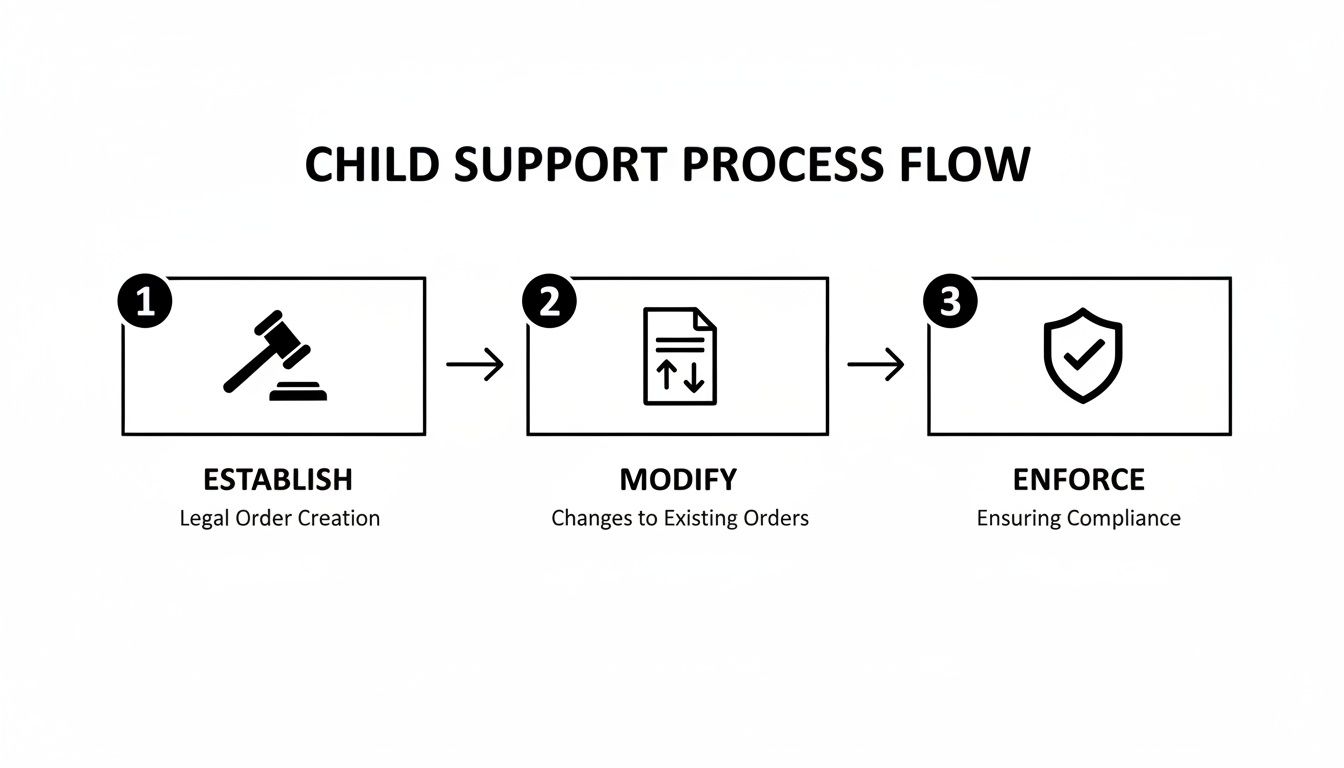
Whether you're starting from scratch (establishment), changing an old order (modification), or making sure payments are made (enforcement), each step requires its own unique legal strategy.
Texas Standard Child Support Guideline Percentages
Once the court has the paying parent’s net monthly resources figured out (up to the cap), it applies a standard percentage. This percentage is based on the number of children the support order is for.
Here is the basic breakdown according to the Texas Family Code:
| Number of Children | Percentage of Net Resources |
|---|---|
| 1 | 20% |
| 2 | 25% |
| 3 | 30% |
| 4 | 35% |
| 5 or more | 40% |
It's important to know these percentages can be adjusted if the paying parent is already legally obligated to support other children from a different relationship.
Because these calculations can get surprisingly complicated, especially with other factors at play, it's smart to see how a dedicated child support lawyer in The Woodlands can make sure the final number is correct and fair.
Establishing, Modifying, and Enforcing Support Orders

A child support order isn't static. Think of it less as a final number and more as a living document that has to keep up with the realities of your family's life. A skilled Montgomery County child support lawyer works within three main phases: getting the first order in place, changing it when life throws a curveball, and stepping in when payments stop coming.
Each phase requires a different game plan. The goal is always the same: to make sure your child has the consistent financial support they're entitled to under Texas law. This isn't about punishing anyone; it's about providing for the child.
Establishing the First Child Support Order
The starting point is Establishment. This is the formal legal process of getting an official, court-enforceable child support order. It all kicks off when a parent files a lawsuit, typically called a Suit Affecting the Parent-Child Relationship (SAPCR), with the Montgomery County District Clerk in Conroe.
Filing this suit gets the ball rolling. It asks the court to officially name the child's legal parents, create a custody schedule, and order one parent to pay child support. Without this court order, any agreement you have is just a handshake deal with no legal teeth.
Modifying an Existing Order for Life's Changes
Life rarely stays the same, and Texas law gets that. The second key action is Modification. You can change a child support order, but you must prove there's been a material and substantial change in circumstances since the last order was made.
Under Chapter 156 of the Texas Family Code, this significant change is the legal key to getting a modification. A small dip or rise in income usually isn't enough. The change has to be big.
Here are a few examples that often lead to a modification in Montgomery County courts:
- The paying parent involuntarily loses their job.
- The paying parent gets a major promotion or a much higher-paying job.
- The cost of the child’s health insurance goes way up or down.
- A child is diagnosed with a medical condition that needs expensive care.
- The custody schedule changes, and the child now lives with the other parent most of the time.
An attorney's job here is to collect the proof—termination letters, pay stubs, medical bills—and build a strong argument for why the old support amount is no longer fair.
Enforcing the Order When Payments Stop
Finally, we have Enforcement. When a parent stops paying child support, you have powerful legal options. This is a legal problem that needs a legal solution.
Your child support attorney can file a Motion for Enforcement, which is a formal request asking a judge to step in. This action compels the non-paying parent to pay back everything they owe, which is known as "arrears."
Real-World Scenario: Enforcement in Action
Imagine a mother in Conroe whose ex-husband's child support payments became unpredictable after he started a new business. Soon, they stopped altogether. Her lawyer filed an enforcement action. At the hearing, the judge found the father in contempt of court. The judge ordered him to pay all back support and signed a wage withholding order to have funds taken directly from his bank account, ensuring the children got their money on time.
Enforcement actions can bring serious consequences, including wage garnishment, liens on property, and even jail time for non-compliance.
What to Do Next: A Quick Checklist
If you're dealing with any of these issues, getting organized is your best first step.
- Locate Your Current Order: Find the most recent child support order signed by a judge and have a copy ready.
- Document the Change: For a modification, collect proof like a job offer letter, termination notice, or a doctor's diagnosis.
- Track Missed Payments: For an enforcement, create a simple log of all missed or partial payments, with dates and amounts owed.
- Schedule a Consultation: Speak with a local attorney to get clear, effective advice.
Disclaimer: This information is for educational purposes only and does not constitute legal advice. Every family's situation is different, and you should consult with a qualified attorney about your specific case.
To get personalized guidance on your rights and legal options, it's best to schedule a meeting with a lawyer.
Your Step-by-Step Guide to the Montgomery County Court Process
Walking into a child support case can feel incredibly stressful, but knowing the road ahead can make all the difference. While every family’s situation is unique, the court process here in Montgomery County generally follows a clear path. Think of it as a roadmap—understanding it helps you and your attorney prepare for each turn.
The whole thing kicks off when one parent files an initial petition, usually called a Suit Affecting the Parent-Child Relationship (SAPCR). This happens at the Montgomery County District Clerk's office in Conroe. This document officially asks the court to step in and make decisions on custody, visitation, and child support, setting the legal wheels in motion.
The Initial Stages of a Case
Once the petition is filed, the next move is service of process. This is the formal, legal way of notifying the other parent about the lawsuit. You can't just hand them the papers yourself; it has to be done by a constable or a private process server to count. It’s a crucial step that ensures everyone is properly brought into the case.
After both parents are officially on board, the focus shifts to finding a solution. The judges in Montgomery County much prefer that parents work things out themselves rather than leaving it all to a final trial. For this reason, most cases are ordered to mandatory mediation. This is a private meeting where a neutral third-party mediator helps you and the other parent hash out your disagreements and try to find a middle ground.
Attorney General vs. Private Attorney
A common question we get is about using the Texas Office of the Attorney General (OAG) for child support. The OAG offers low-cost services for establishing and enforcing support, which is a great help for some. But it's important to know who they work for: the OAG represents the state’s interest in making sure a child is supported, not you or the other parent.
When you hire a private child support attorney in Montgomery County, you get someone whose only job is to advocate for you. We work to protect your rights and fight for your child's best interests, offering advice that’s specifically tailored to your finances and your family. This is absolutely critical when your case involves complex income sources, significant assets, or a tough custody battle.
Real-World Scenario: A Temporary Orders Hearing
We recently represented a father from The Woodlands who needed a child support order in place while his divorce was ongoing. His attorney requested a temporary orders hearing with a Montgomery County judge. In court, his lawyer presented recent pay stubs and a detailed breakdown of the kids' expenses. The judge used that evidence to set a temporary support amount and handle health insurance, bringing much-needed financial stability while the larger case continued.
From Filing to Final Order
A child support case involves a mountain of paperwork. To keep everything straight—from financial affidavits to discovery requests—an experienced attorney will use a solid document management workflow. Staying organized is the secret to being prepared for mediation and any court hearings.
How long will it take? A case can wrap up in a few months or stretch out for more than a year, depending entirely on how much the parents disagree. If you reach a deal in mediation, your lawyer will draft a Final Order for everyone to sign, which the judge then approves. If you can’t agree, the case gets set for a final trial, and the judge will make the decisions for you. Getting familiar with the general flow of divorce court proceedings in Montgomery County can give you a better sense of the overall court environment.
What to Do Next: A Quick Checklist
The best way to prepare for the court process is to be organized and proactive from the start.
- File and Serve: Work with your lawyer to file the initial petition correctly and make sure the other parent is served properly.
- Attend Mediation: Take mediation seriously. It's your best opportunity to have a direct say in the outcome, so go prepared to negotiate.
- Prepare for Hearings: If a hearing is scheduled, gather every financial document your attorney asks for. Be ready to answer questions directly and honestly.
- Communicate with Your Lawyer: Keep your attorney in the loop. Even small updates can be important.
Disclaimer: This article provides general information and is not a substitute for legal advice. The specifics of your case require a personalized consultation with a qualified attorney.
The court system has its own language and rhythm. Having a local attorney who knows the ins and outs of the Montgomery County courts can make the experience far less intimidating. To get clear, straightforward guidance on your specific situation, we invite you to schedule a consultation with our office.
How to Work With Your Montgomery County Child Support Attorney

Choosing a legal partner is one of the most critical decisions you'll make in your child support case. The best attorney-client relationships are built on trust, transparent communication, and a clear, shared vision for the outcome. The real key is finding someone who not only knows Texas law inside and out but truly understands the unique dynamics of the Montgomery County courts.
Your work together begins the moment you walk in for a consultation. Don't think of it as a sales pitch—it's a strategy session. This is your opportunity to interview the attorney just as much as they're assessing your case. Come prepared with your documents, a list of questions, and a solid idea of what you want to accomplish.
Finding the Right Fit for Your Case
When you start looking for help, it’s useful to see how people actually find attorneys in the real world. Your goal is to find a lawyer with deep roots in our local family law community. You want an attorney who lives and breathes Montgomery County family law, with specific, hands-on experience in child support establishment, modification, and enforcement.
A lawyer who is a familiar face in the Conroe courthouse will have priceless insights into how specific judges operate and what they expect to see. That local knowledge is a powerful advantage you just can't get from a textbook. Ultimately, a good fit means finding someone whose communication style clicks with yours and who genuinely makes you feel heard.
Understanding Attorney Fees
Let's be direct: legal fees are a major concern for almost everyone. It’s crucial to have a frank conversation about costs right from the start. Most family law attorneys in The Woodlands area use one of two common fee structures.
- Retainer Fee: This works like a deposit. You pay an upfront sum to the firm, and the attorney bills their time against that balance. If the retainer runs low, you’ll be asked to replenish it.
- Hourly Billing: This is exactly what it sounds like. The attorney tracks every minute spent on your case—from drafting court documents to making phone calls—and bills you at an agreed-upon hourly rate.
Your attorney should give you a detailed fee agreement that spells out their rates and billing practices in plain English. Never be afraid to ask for clarification on any charge you don't understand.
Real-World Scenario: The Power of Preparation
A mom from Creekside Park in The Woodlands was getting ready to file for child support. Before her first meeting, she gathered two years of tax returns, pay stubs for both parents, and a detailed spreadsheet of her child's monthly expenses like daycare and sports. By coming in so prepared, her attorney could immediately run guideline support calculations, spot a potential fight over the other parent's bonus income, and start building a case strategy from day one. That organization saved her significant time and money in legal fees.
What to Do Next: A Quick Checklist
A strong attorney-client relationship is a partnership—you are an active player on the team. To build a productive working relationship, keep these points in mind.
- Be Honest and Open: Your attorney can only help you if they have all the facts—the good, the bad, and the ugly. Holding back information is one of the fastest ways to hurt your own case.
- Stay Organized: Keep all your documents together in one spot. When your attorney asks for a document or information, get it to them as quickly as you can.
- Communicate Effectively: If you have a question, ask. If something changes in your life (a new job, a move), tell your attorney immediately.
- Trust Their Guidance: You hired an expert for a reason. Listen to their advice and trust their legal strategy, even when the process feels frustratingly slow.
Disclaimer: This article provides general information and does not constitute legal advice. You should consult with a qualified attorney for advice regarding your individual situation.
Your attorney is your advocate and your guide through a complex system. By working together as a team, you put yourself in the best position to secure an outcome that truly protects your child’s best interests. To discuss your options for a custody or support case, you can also learn more about our child custody representation in Montgomery County.
We invite you to schedule a consultation with our office to discuss the specifics of your situation.
Frequently Asked Questions About Child Support in Texas
When it comes to child support, you’re bound to have questions. Getting straightforward answers can make all the difference. Here are some of the most common questions from parents in Montgomery County.
Can We Agree to a Different Child Support Amount?
Yes, but there's a crucial detail. While you and the other parent can agree to an amount that differs from the state guidelines, that agreement must be approved by a judge and written into a formal court order.
A judge’s main concern is whether the agreement is in the child’s best interest. The Texas Family Code is clear: the right to support belongs to the child, not the parents. So, even if you both agree to waive support entirely, a judge will almost certainly reject it.
What If the Other Parent Is Hiding Income?
This is a tough but common situation, especially if the other parent is self-employed or works for cash. If you suspect they are misrepresenting their income, we have legal tools to get to the truth through a process called discovery.
Through discovery, your attorney can legally demand financial records like bank statements, business records, and loan applications, which often reveal the real story. In complex cases, we might bring in a forensic accountant to trace hidden assets. The goal is to make sure the support calculation is based on their actual ability to pay.
Real-World Scenario: Uncovering Hidden Income
I worked with a mother in Conroe who was certain her ex-husband, a contractor, was making far more than he claimed. We filed a motion to compel him to produce two years of all business and personal bank records. The statements showed substantial cash deposits that never appeared on his income reports. The judge ultimately calculated child support based on this much higher, true income, finally securing the proper support for their kids.
How Does Health Insurance Affect the Calculation?
The cost of health and dental insurance is a significant factor. Texas law requires the court to order one or both parents to provide insurance. The parent who pays the child's monthly premium receives a direct credit for that expense.
The amount you pay for the child's portion of the premium is subtracted from your gross income before the final child support percentage is applied. This lowers your net resources, which reduces the final support payment.
When Does Child Support End in Texas?
For most families, the duty to pay child support lasts until the child turns 18 or graduates from high school, whichever happens last. If your child's 18th birthday falls during their senior year, support continues until graduation.
The major exception is disability. If a child is physically or mentally disabled and unable to support themselves, a court can order support to continue indefinitely.
What to Do Next: A Quick Checklist
If you're facing a child support issue, taking these steps can help you prepare.
- Gather Your Documents: Collect tax returns, pay stubs, and a list of your child's major expenses (health insurance, daycare).
- Find Your Current Order: If you have an existing case, locate the most recent court order.
- Track Key Events: Note any significant changes like a job loss or change in custody.
- Schedule a Consultation: Talk to an experienced attorney to understand your rights and options.
Disclaimer: This article provides general information and does not constitute legal advice. Child support laws are complex, and you should consult with a qualified attorney about your individual situation.
Dealing with a child support case in The Woodlands or Montgomery County can be challenging, but you don't have to do it alone. To get personalized guidance and protect your child's future, schedule a consultation with our experienced team today.