
When you're facing a divorce or custody battle, the time between filing the papers and getting a final ruling can feel like a chaotic freefall. This is precisely where a temporary custody hearing in Montgomery County comes in.
Think of it as the court's first-aid kit for your family. It isn't about deciding the case forever, but about stopping the chaos and creating a stable, predictable environment for your children right now. The judge's decisions in this hearing result in legally binding Temporary Orders, which are the rules everyone lives by until the case is finalized.
Understanding The Purpose Of A Temporary Custody Hearing
For families in The Woodlands, Conroe, and across Montgomery County, the uncertainty of a separation is the hardest part for children. A temporary custody hearing is the court’s method for stepping in quickly to provide structure. The goal isn’t to pick a winner; it's to put a safe, predictable routine in place that serves your child's immediate needs.
The entire hearing, from start to finish, centers on a single guiding principle: the best interest of the child. This isn’t just a feel-good phrase; it's the legal standard defined in Section 153.002 of the Texas Family Code that gives a judge the framework for making decisions. A judge will evaluate many factors to determine what this "best interest" looks like in your specific situation.
Primary Goals of a Temporary Orders Hearing
| Objective | What This Means for Your Family |
|---|---|
| Establish Immediate Safety | The judge's first priority is ensuring the child isn't in physical or emotional danger. They will act decisively to remove a child from a harmful situation. |
| Create Stability and Routine | Courts want to minimize disruption. This often means keeping the child in their current school, with their current doctors, and in a stable home. |
| Set a Possession Schedule | The judge will define a clear, enforceable schedule detailing when the child will be with each parent. This ends the day-to-day arguments over parenting time. |
| Ensure Financial Support | The court will order temporary child support and determine who is responsible for health insurance to make sure the child's financial needs are met. |
Ultimately, a Montgomery County judge is trying to create a "new normal" for your child that is as calm and consistent as possible under the circumstances.
Real-World Scenario: A Spring Family Finds Stability
Imagine a couple in Spring, Texas, decides to divorce. The mother has always been the one doing school runs and taking the kids to the pediatrician, while the father works a demanding job. The mother’s attorney quickly files for a temporary hearing. The judge, focused on minimizing disruption for the children, issues temporary orders allowing them to stay in the family home with their mom during the school week and establishing a clear weekend schedule with their dad. This provides instant stability while the bigger divorce issues are sorted out.
The Role of a Temporary Restraining Order (TRO)
Many temporary custody proceedings actually kick off with a Temporary Restraining Order (TRO). A TRO is an immediate, short-term court order that essentially freezes the family situation in place.
Its purpose is to prevent one parent from making sudden, game-changing moves—like taking the child and moving to another state, canceling the child's health insurance, or emptying the joint bank account needed to pay the mortgage. It preserves the status quo so the judge can make informed decisions at the hearing.
Navigating this process without help is challenging. Data from one legal aid group showed over 12,500 people sought help with urgent filings, a stark reminder of how many are trying to navigate these critical hearings alone. You can see the challenges they faced in this report on how unrepresented parents handle emergency petitions. For families here in Montgomery County, this highlights how crucial it is to be ready to make a strong, clear case for the orders that will protect your child's well-being.
What to do next: Your Immediate Action Plan
- Assess the Urgency: Do you need a TRO? If you genuinely fear the other parent might take drastic action that could harm your child or your finances, you need to tell your attorney immediately.
- Become a Record-Keeper: Start a simple journal or calendar. Log every communication with the other parent. Track who handles drop-offs, who pays for what, and any incidents—good or bad—that are relevant to parenting.
- Start Your Document Hunt: Begin gathering the paperwork you'll need. This includes your child's report cards, medical records, and your pay stubs or other proof of income. The more organized you are, the better.
- Get Expert Guidance: Don't go it alone. You need to speak with a family law attorney who knows the Montgomery County courthouse, the judges, and the local rules.
Disclaimer: This article provides general information for educational purposes only and does not constitute legal advice. You should consult with an attorney about your individual situation.
Navigating a temporary custody hearing is one of the most important first steps in your family law case. If you have questions about protecting your child's best interests in Montgomery County, we can help you understand your options.
How To File For Your Hearing in Montgomery County
Getting a temporary custody hearing on the books in Montgomery County isn't as simple as calling the courthouse to schedule an appointment. The entire process has to start with a formal lawsuit.
This lawsuit is known as a Suit Affecting the Parent-Child Relationship, or "SAPCR" in legal shorthand. Think of it as the official case file that will cover everything related to your child's custody, visitation, and support.
The first document you'll need is the Original Petition in a Suit Affecting the Parent-Child Relationship. This petition formally opens your case. It tells the court who everyone is—you, the other parent, and the child—and explains why a Montgomery County judge has the authority to make decisions for your family. But the petition alone doesn't get you a hearing. You also need to file a Motion for Temporary Orders. This is your specific request for the judge to set a hearing date and create some ground rules while the case is ongoing.
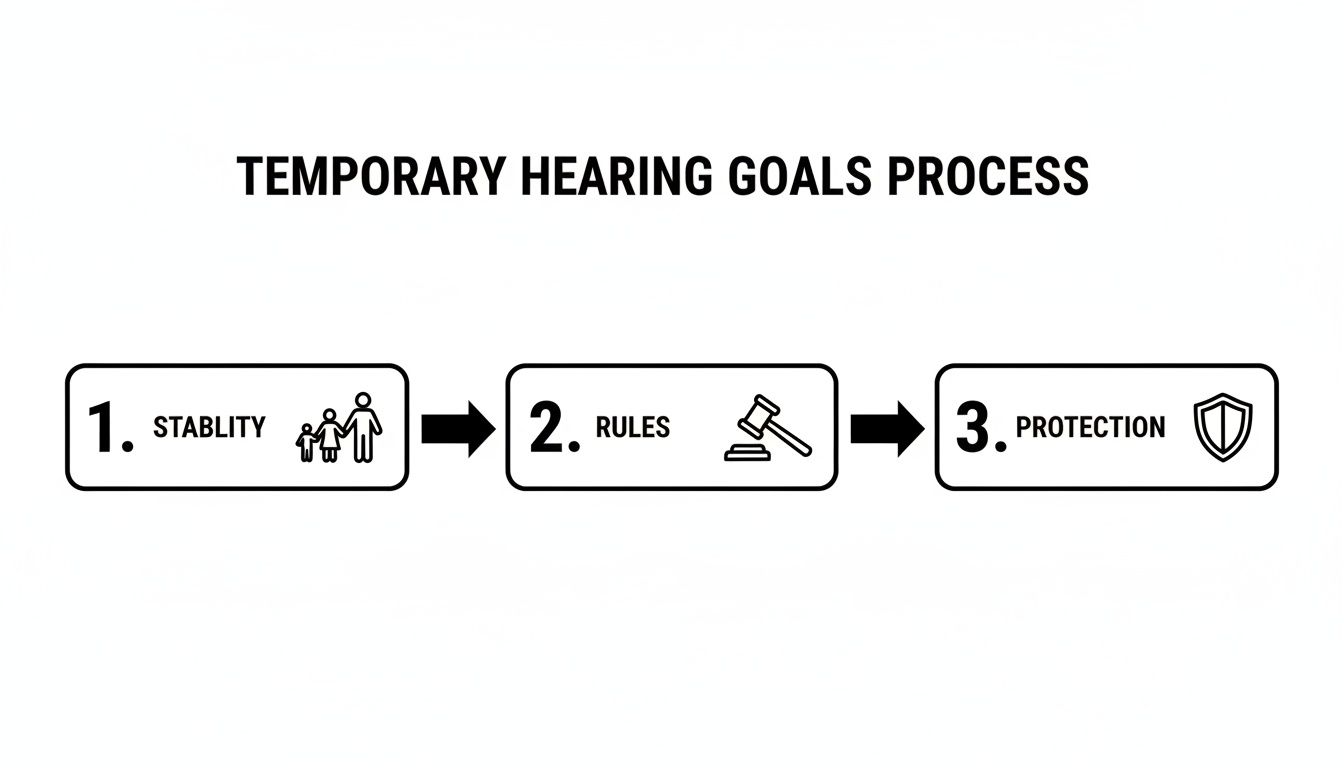
As you can see, the court's priority is always the child. They work to establish stability, set clear rules, and ensure the child's protection above all else.
Local Filing and Service Rules
Once your petition and motion are drafted, they get filed at the Montgomery County District Clerk's Office in Conroe. After filing, the next step is absolutely crucial: service.
Under the Texas Family Code, the other parent has to be formally notified that they've been sued. This isn't a text message or an email. It means a sheriff, constable, or private process server must physically hand them a copy of the lawsuit. This is what gives them legal notice and the chance to appear in court. You or your lawyer must also actively schedule a hearing date on the judge's docket with the court administrator.
Real-World Scenario: A Conroe Mom Takes Action
Take Sarah, a client from Conroe. Her husband had just moved out and was completely unpredictable about seeing the kids. One week he'd show up constantly, the next he was a ghost, and the chaos was wrecking their school and extracurricular schedules. We immediately drafted a petition seeking clear orders to maintain the kids' routine and lock in a predictable possession schedule. After filing, we had a constable serve her husband that same day. That official step is what triggered the court to set a date for their temporary custody hearing in Montgomery County, finally putting them on a path toward stability.
If you're going through a divorce, the process is very similar. You can find more details in our guide to temporary orders hearings in a Montgomery County divorce.
What to do next: Filing Checklist
- Gather the full legal names and exact dates of birth for yourself, the other parent, and your children.
- Write down the child’s current home address and school information.
- Make a list of any immediate worries you have about your child’s safety or well-being.
- Collect recent pay stubs and financial documents to help calculate temporary child support.
Disclaimer: This article provides general information for educational purposes only and does not constitute legal advice. You should consult with an attorney about your individual situation.
Navigating the filing process is the first critical step toward securing your child’s stability. If you are facing a custody issue in The Woodlands or anywhere in Montgomery County, schedule a consultation to understand your rights and options.
Building Your Case with the Right Evidence

The evidence you bring to a temporary custody hearing is the absolute backbone of your case. Montgomery County judges have packed dockets and very little time. This means they need to see clear, convincing proof that what you're asking for is truly in your child’s best interest.
It’s not enough to just say you're the better parent—you have to show it with objective, undeniable facts. Your goal is to paint a picture for the judge, one that clearly demonstrates how your proposed plan provides the stability and support your child needs right now.
Tying Your Proof to the "Best Interest" Standard
Every piece of evidence must connect directly back to the “best interest of the child” standard outlined in the Texas Family Code. This is the only lens the judge will use. They’ll evaluate factors like the child’s emotional and physical needs, the stability of each home, and which parent is better at putting the child’s needs ahead of their own.
Strong evidence answers the judge's unspoken questions: Who has historically been the primary caregiver? Who makes sure the child gets to school on time with homework done? Who handles doctor's appointments? Think of your evidence like puzzle pieces. Each one—a text message, a report card, a photo—helps form a complete picture of your child's life and proves you are best equipped to maintain a stable environment.
What Kind of Evidence Actually Works in Court?
In a fast-moving temporary hearing, some evidence carries more weight than others. From my experience, Montgomery County judges respond best to proof that is objective, organized, and easy to digest quickly.
- Communication Records: Text messages, emails, and messages from co-parenting apps can be your most powerful tool. A clear pattern of hostile messages or repeated refusals to cooperate from the other parent speaks volumes.
- A Detailed Calendar: A simple calendar documenting every missed visitation, late exchange, or broken promise is often more compelling than hours of testimony. It provides a visual timeline that shows a pattern of unreliability.
- School and Medical Records: Has your child’s academic performance suddenly dropped? Are they missing school? Records like recent report cards or attendance logs can provide concrete proof that the current situation is negatively impacting your child.
- Photos and Videos: A picture is still worth a thousand words. Photos of your child’s clean, well-stocked room can stand in stark contrast to evidence of a chaotic living situation at the other parent's home.
Real-World Scenario: Proving Danger with Facts
A father in The Woodlands was deeply concerned about his ex-wife's new boyfriend, who had a history of angry outbursts. Instead of just telling the judge he was worried, we came prepared. We presented a series of erratic, late-night text messages from the ex-wife, along with a public social media post from the boyfriend that contained threatening language. This tangible evidence immediately highlighted the unstable and potentially dangerous environment, which was crucial for securing an order to protect the child.
What to do next: Evidence Checklist
- Organize Your Texts & Emails: Screenshot and save any significant communications. Organize them by date or topic (e.g., "Missed Visits," "Medical Decisions") in a digital folder or binder.
- Start a Parenting Journal: Get a simple notebook and document daily events related to your child. Note who handles school pickups, meals, homework, and bedtime. Be factual, not emotional.
- Gather Key Documents: Collect recent report cards, doctors’ notes, and pay stubs.
- Identify Potential Witnesses: Make a list of credible, neutral third parties. Think teachers, coaches, or daycare providers who have firsthand knowledge of your child’s well-being and your involvement.
Disclaimer: This article provides general information for educational purposes only and does not constitute legal advice. You should consult with an attorney about your individual situation.
Gathering the right evidence is a critical step. In urgent situations, you may need faster court intervention like an emergency custody order in The Woodlands. To prepare for a temporary custody hearing in Montgomery County, schedule a consultation to build your strongest case.
Navigating the Montgomery County Courtroom

Walking into one of the courthouses in Conroe for a custody hearing is nerve-wracking. The good news is that knowing what to expect—and how to conduct yourself—can dramatically lower your stress and help you present the best possible case for your child.
Your demeanor speaks volumes before you ever say a word. Treat it like the most important job interview of your life. Dress professionally, silence your phone completely, and show respect to everyone. Always address the judge as “Your Honor.” Stand when you speak to the judge, and never interrupt—not the judge, the other attorney, or even the other parent. It's about showing the judge you are the calm, reasonable parent.
What To Expect in a Contested Hearing
When you and the other parent can't agree on temporary orders, you're heading for a contested hearing. Think of it as a mini-trial, but with a ticking clock. Most Montgomery County judges will only give each side 20-30 minutes to present their entire case. This means every second counts. Your attorney will guide you with direct questions, and your job is to deliver clear, factual answers. Stay on point and trust your lawyer to tell the story.
For highly complex cases, especially those with financial disputes, presenting the facts is everything. While more common in final trials, understanding how experts can untangle complicated information is key. For example, topics like Forensic Accountants and Family Law show just how deep these investigations can go to uncover the truth.
The Difference Between Agreed and Contested Hearings
An agreed hearing is the complete opposite—and the goal you should aim for. If you and the other parent manage to work out a deal beforehand and sign off on Agreed Temporary Orders, the hearing is just a formality. It’s a simple "prove-up" where you present your agreement to the judge for a signature. It’s faster, cheaper, and far less stressful for everyone.
Real-World Scenario: How Calm Demeanor Won the Day
We once represented Mark, a father from The Woodlands whose ex had made a string of serious accusations. He was understandably terrified. We prepared him to stay calm and focus only on the facts: his child's daily routine, his involvement in school, and the stable home he provided. In court, he answered every question calmly and directly. His composure and fact-based testimony cut through the drama and made a powerful impression on the judge, who saw him as the stabilizing force.
Mark's story highlights a critical truth: judges want to see stability. They are tasked with making a quick decision based on limited information. Data from another jurisdiction shows that when a clear need for protection is demonstrated, courts are prepared to act decisively, with 92% of petitions seeking protection having temporary orders granted after an initial review. This just underscores how vital it is to present a clear, compelling case.
What to do next: Final Courtroom Checklist
- Practice Your Testimony: Role-play with your attorney. You don't want to sound like a robot, but you need your key facts down cold.
- Finalize Your Outfit: Choose a conservative, professional outfit days in advance. Think business attire, not weekend wear.
- Review Your Evidence: Know your evidence binder inside and out. Be ready to calmly explain any text, email, or photo you've submitted.
- Arrange Childcare: This is non-negotiable. Children should never be brought to a custody hearing. Arrange for them to be cared for off-site for the entire day.
Disclaimer: This article is for informational purposes only and does not constitute legal advice. Every family's situation is unique, and you should consult with a lawyer to discuss your specific circumstances.
Making your case in front of a judge is a skill. As an experienced custody attorney in Montgomery County, TX, we guide clients through this intimidating process. To prepare for your day in court, schedule a consultation with our team.
The Hearing Is Over. What Now?
As you walk out of the courtroom, the judge’s spoken words aren't the final step. To have any legal weight, those rulings must be put into a formal, written document. This is your Temporary Order—a legally binding court order that turns the judge's decisions into clear, enforceable rules.
Typically, one of the attorneys will be tasked with drafting it. Before a judge signs off, both you and the other parent get to review the draft. You and your attorney need to pour over every line. A simple typo in a pickup time or a miscalculation in the child support amount can create a world of conflict. Once that order is signed, it's in full effect.
Looking Ahead: The Next Phase of Your Case
Your signed Temporary Orders aren’t the finish line; they're the starting blocks for the next phase. These orders will dictate your rights and responsibilities until a final agreement or trial resolves everything, which can take months or even longer. From here, the process usually unfolds in a few key stages:
Mediation: Most Montgomery County judges will order you and the other parent to mediation before they'll even consider a final trial. Think of it as a structured negotiation, guided by a neutral third-party mediator, to see if you can settle the remaining issues yourselves.
Discovery: This is the formal process of exchanging information. It’s where both sides get the facts and evidence out on the table. This often involves sending written questions (Interrogatories), requesting specific documents, and conducting depositions (sworn testimony taken outside of court).
Final Trial Prep: If you can't reach a full agreement in mediation, all efforts turn toward preparing for the final trial. This is a much deeper, more detailed version of what you just went through for the temporary hearing.
Montgomery County's court system handles a high volume of cases, including hundreds of mediations and 274 custody evaluation referrals in a recent year, as noted in their annual report. You can see more data on Montgomery County court operations in their latest annual report. This volume means staying organized and following protocol is key to moving your case forward smoothly.
Under the Texas Family Code, a judge has the power to enforce their orders through contempt proceedings. A parent who willfully disobeys can face fines or even jail time.
What to do next: Post-Hearing Checklist
- Get a Certified Copy: As soon as the judge signs the order, get a certified copy from the Montgomery County District Clerk’s office. This is your official proof.
- Put It on the Calendar: Immediately calendar every possession date, holiday, and child support payment.
- Plan Your Next Moves: Sit down with your lawyer to map out a strategy for mediation and the discovery process.
- Keep Your Files in Order: The work of gathering documents doesn't stop. Continue organizing financial records, communications, and other evidence you'll need for the final resolution.
Disclaimer: This information is for educational purposes and is not a substitute for legal advice. Family law is complex, and you should consult with an attorney about your specific situation.
The time after a temporary hearing is about two things: strict compliance with the current orders and smart preparation for what’s next. If you need help navigating your custody case in The Woodlands or Montgomery County, schedule a consultation to build a clear path forward.
Common Questions After Your Temporary Custody Hearing
The hearing might be over, but you’re likely left with a flood of questions. That's completely normal. The judge’s ruling, known as a temporary order, sets the ground rules for your family while the case is ongoing. Let's break down what these orders mean for you and your child in Montgomery County.
How Long Do Temporary Orders Last in Texas?
It's a common misconception that "temporary" means a few weeks. In reality, these orders are the law of your case until the judge signs a new, different order, or your entire case is finalized with a Final Order.
Think of it this way: temporary orders create a stable, predictable routine for your child during a time of major upheaval. They will govern everything from who has the child on which days to child support payments until your case is completely resolved, which can often take many months.
Can I Change the Temporary Orders?
It's possible, but Montgomery County judges don't change these orders on a whim. To get a modification, you have to file a formal request and prove to the court that a “material and substantial change” has occurred in the life of the child or one of the parents since the last order was signed, as required by the Texas Family Code.
This is a high bar to clear. A simple disagreement over pickup times won't cut it. You need to show something significant has happened—for example, a parent has developed a substance abuse problem, lost their job and can no longer pay support, or a living situation has become unsafe for the child.
Real-World Scenario: A Change in Circumstances
Imagine a Conroe mother, Maria, agrees to a temporary order that includes a specific possession schedule. Six months later, the father is arrested for a DWI with the child in the car. This event is a clear material and substantial change in circumstances that directly impacts the child's safety, giving Maria a strong basis to file a modification and ask the court to change the temporary orders immediately.
What if the Other Parent Violates the Orders?
If the other parent isn't following the judge's ruling—maybe they're consistently late for exchanges or have stopped paying temporary child support—your first instinct might be to retaliate. Do not do this. Withholding visitation because child support wasn't paid, for instance, can land you in hot water with the very same judge.
The correct move is to use the court system. You'll file a Motion for Enforcement. This document lays out exactly how the other parent has violated the order and asks the judge to step in. A judge has a wide range of tools to compel compliance, as laid out in the Texas Family Code. They can order make-up visitation, award attorney's fees, issue fines, and in serious cases, even order jail time.
What to do next: Post-Hearing Action Plan
- Read and Understand the Order: If any part of the order is confusing, ask your lawyer to explain it. You can't follow rules you don't understand, and "I didn't know" is not a defense in court.
- Become a Record-Keeping Machine: Get a calendar and document every time the other parent violates the order with dates, times, and specific details. This documentation is your best evidence.
- Compliance is Key: Follow the order perfectly, even the parts you hate. When you strictly follow the rules, it highlights the other parent's violations and shows the judge that you respect the court's authority.
- Strategize with Your Attorney: If violations are happening, talk to your lawyer. Filing an enforcement action costs time and money, so you'll want to discuss whether it's the right strategic move for your case.
Disclaimer: This article provides general information and is not a substitute for legal advice. Family law is complex, and you should consult with an experienced attorney to discuss your specific situation.
Navigating a temporary custody hearing in Montgomery County is a critical first step, but understanding what comes next is just as important. For strategic guidance tailored to your family's unique circumstances in The Woodlands or Montgomery County, schedule a consultation.