
When a court says your time with your child must be supervised, it can feel like a devastating blow. This situation is incredibly stressful for any parent. The first thing to understand is that from a judge's perspective in Montgomery County, this isn't about punishment. It's about protection.
Every decision a family court judge in Conroe makes is guided by one core principle: the “best interest of the child,” a standard found throughout the Texas Family Code. When there are serious, credible concerns about a child's safety with one parent, standard visitation isn't an option. That's when supervised visitation becomes a necessary tool.
Think of it as a temporary safeguard. It allows a parent and child to maintain their crucial bond, but with a neutral third party present to ensure the visit is safe, positive, and free from conflict. This supervisor is an objective observer, there to make sure everything goes smoothly while the underlying issues are addressed.
What Triggers a Supervised Visitation Order?
A judge in Montgomery County won't order supervision lightly. It takes compelling evidence that allowing a parent to be alone with their child could lead to physical or emotional harm, as defined by the Texas Family Code. These aren't minor disagreements; they are serious allegations that force the court to act cautiously.
The reasons can vary widely, but they all point to a significant risk that the court cannot ignore.
Common Triggers for Supervised Visitation in Montgomery County
To give you a clearer picture, here are some common reasons a Montgomery County judge might order supervised visitation. The court looks for patterns of behavior or specific events that raise red flags about a parent's ability to provide a safe environment.
| Reason | What It Means for the Court | Example |
|---|---|---|
| Family Violence or Abuse | A documented history or credible allegation of abuse is the most direct threat to a child's well-being. | A parent has a protective order against them or there are police reports detailing domestic disputes. |
| Substance Abuse | Active drug or alcohol addiction can severely impair a parent's judgment and ability to care for a child. | A recent DUI, failed drug tests, or witness testimony about a parent's substance use. |
| Serious Mental Health Issues | An unmanaged mental health condition could make a parent's behavior unpredictable or unsafe. | A parent has been recently hospitalized for a psychiatric issue or is not complying with treatment. |
| Risk of Abduction | If a parent has threatened to take the child and not return, the court will take immediate preventative action. | A parent has no ties to the community, has threatened to flee the state or country, and has taken the child before. |
| Long-Term Estrangement | After a long absence, reintroducing a parent requires a slow, managed approach to avoid traumatizing the child. | A parent has been incarcerated or absent for years and is trying to re-establish a relationship. |
Ultimately, any situation that puts a child's physical or emotional health in question can be grounds for supervision. The court's primary job is to protect the child.
A Real-World Scenario
Imagine a father in The Woodlands who was recently charged with a DUI. The mother, deeply worried about their young child's safety during visits, files a motion with the Montgomery County court asking for his time to be supervised. Presented with the evidence of the charge, the judge sees a potential risk. The court orders that the father's visits must take place at a professional supervision facility in the area. This order might stay in place until he completes an alcohol awareness program and can prove a consistent period of sobriety. This approach protects the child from immediate risk while giving the father a clear path to earning back his unsupervised time.
When standard possession orders just aren't enough to keep a child safe, Texas courts will turn to solutions like supervised visitation. It often comes up in cases involving evidence of family violence, substance abuse, or mental health crises that impact a parent's judgment. For parents trying to navigate these high-stakes situations, understanding the basics of child custody law is the critical first step.
Visits often start short, maybe just one to two hours per week. The child's age and developmental stage are always key factors in how these plans are structured. For more insight on how courts approach these restrictions, you can read a detailed analysis of visitation restrictions.
What to Do Next Checklist
If you're facing a potential supervised visitation case, either as the parent requesting it or the one who might be supervised, it's time to get organized.
- Gather Your Evidence: Start collecting documents, texts, photos, or official reports that support your concerns or demonstrate your own fitness.
- Understand the Legal Standard: Familiarize yourself with the "best interest of the child" standard from the Texas Family Code. This is how the judge will view everything.
- Research Local Providers: Look into supervised visitation centers and professional supervisors in The Woodlands and the greater Montgomery County area.
Disclaimer: This article provides general information and is not legal advice. The law is complex and changes, and you should consult with an attorney for advice regarding your individual situation.
If supervised visitation is on the table, being proactive is crucial. An experienced family law attorney can walk you through your rights and help create a strategy focused on protecting your child. Schedule a consultation to get clear advice for your circumstances.
Navigating the Montgomery County Court Process
Thinking about going to court over your child’s safety is one of the toughest things a parent can face. Understanding how the legal system works here in Montgomery County can bring a little more predictability to a very stressful time.
The process officially kicks off when one parent files a Motion to Modify the Parent-Child Relationship. This document is filed with the court in Conroe and asks a judge to change the current custody order to require supervised visits. But it’s not as simple as just asking. The entire case will hinge on the quality of the evidence you can provide.
Presenting a Compelling Case
A Montgomery County judge won’t restrict a parent’s time with their child lightly. To get an order for supervised visitation, you have to show that unsupervised possession would endanger the child's physical or emotional well-being, which is the legal standard set by the Texas Family Code. This isn't about airing personal grievances; it's about proving a real risk.
So, what kind of proof does a judge find persuasive? In our experience, it comes down to credible, objective evidence.
- Official Reports: This is the gold standard. Think police reports documenting family violence, CPS investigation findings, or criminal records for drug offenses.
- Digital Communication: Text messages, emails, or social media posts containing threats, admissions of substance abuse, or clear signs of instability can be powerful.
- Witness Testimony: Statements from people who have seen the concerning behavior firsthand, such as a teacher, therapist, or relative, can be powerful.
- Medical or Psychological Records: This could include proof of a parent's untreated substance abuse, a diagnosis of a severe mental health condition, or records showing a failure to comply with treatment.
Your job, with your attorney, is to weave this evidence into a clear narrative that demonstrates why supervised visitation in The Woodlands is necessary. Without strong proof, a judge is unlikely to take such a drastic step.
This flowchart breaks down the court's safety-first approach, from the initial concern to the final order.
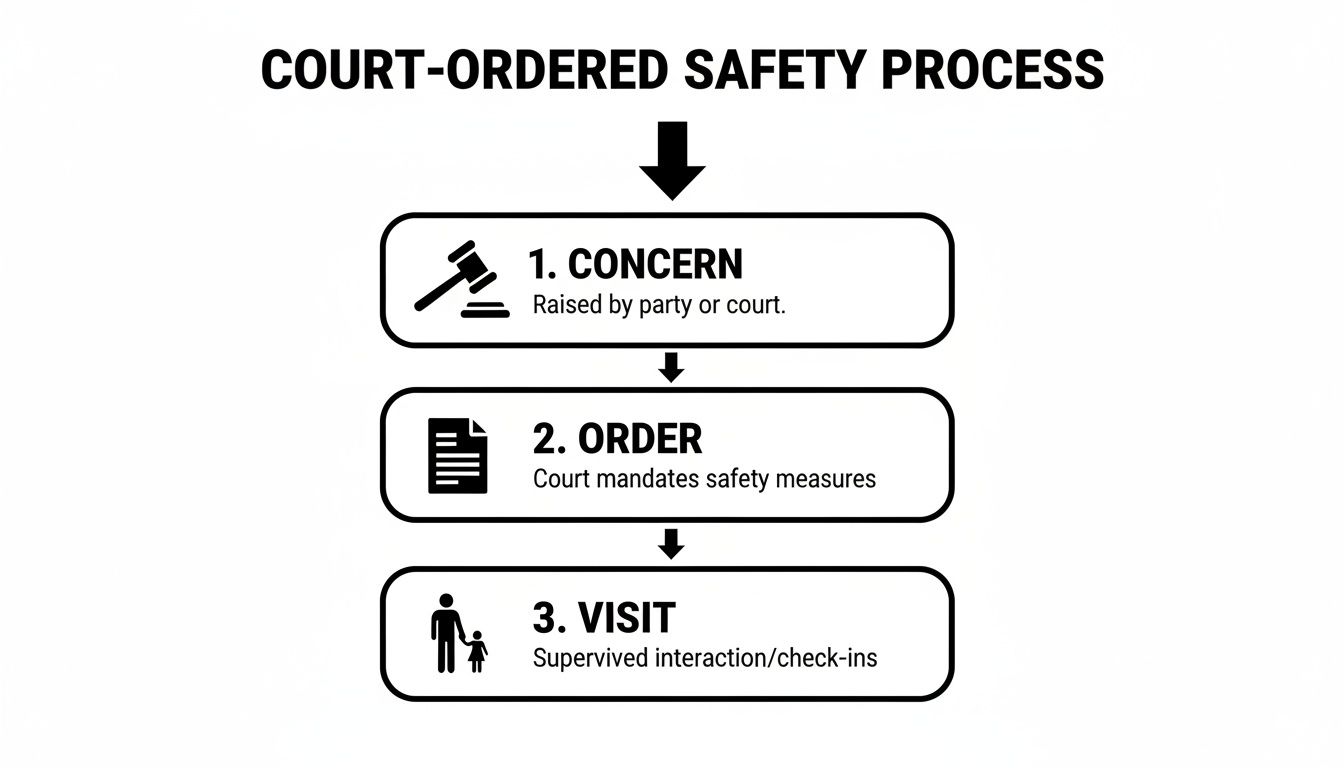
As you can see, the path is straightforward: a proven concern leads directly to a court-ordered safety measure designed to protect the child.
What Happens at the Court Hearing
After the motion is filed, the court sets a hearing date. At the hearing, both parents and their lawyers appear before the judge to argue their side. The parent asking for supervision will present their evidence and call witnesses to establish the risk. The other parent will have a chance to defend themselves.
The judge’s role is to listen to both arguments, examine the evidence, and make a decision based on one factor: what is necessary to keep the child safe. If they find that a genuine risk exists, they will sign an order mandating supervised visitation and outlining the specific rules.
A Real-World Scenario
A mother in the Village of Creekside Park grew concerned after her ex-husband relapsed on prescription painkillers. She filed a motion in Conroe, providing the court with his recent arrest record for prescription fraud and text messages where he admitted to using again. At the hearing, her lawyer laid out the evidence. The judge ordered all the father's visits to be supervised at a professional facility and stated the supervision would remain in place until the father could provide six consecutive months of clean drug tests and show proof of consistent therapy.
These custody issues are often just one piece of a larger puzzle. For clients who are also navigating the end of a marriage, it’s crucial to have a team that understands the whole picture. You can learn more by reading about our divorce lawyer services in The Woodlands.
What to Do Next Checklist
If you have a supervised visitation hearing on the calendar, getting organized is your most important task.
- File the Right Paperwork: Work with an attorney to file a formal Motion to Modify that clearly explains why supervision is necessary for your child's safety.
- Organize Your Evidence: Create a timeline and organize all your documents, photos, and witness information to present a clear case.
- Prepare for Testimony: Practice with your attorney so you can answer questions calmly and stick to the facts. The focus should always be on your child’s well-being.
Disclaimer: This article provides general information and is not legal advice. The law is complex and changes, and you should consult with an attorney for advice regarding your individual situation.
The court process is designed to be thorough, but it can feel overwhelming. An attorney with deep experience in Montgomery County family courts can guide you through every step.
Choosing the Right Visitation Supervisor

Once a Montgomery County judge has ordered supervised visitation in The Woodlands, the next practical decision is: who will actually do the supervising? This isn't just a logistical detail. The person you choose is responsible for your child’s safety and will be writing reports that can heavily influence the judge's future decisions.
You essentially have three paths to choose from. Each comes with its own set of benefits, drawbacks, and costs. Let's break down what these options look like so you can figure out what makes the most sense for your situation.
Professional Supervision Centers
Think of these as the gold standard for high-conflict or high-risk cases. Professional supervision centers are facilities built for this purpose. They are neutral ground, staffed by trained professionals who know how to monitor parent-child interactions and de-escalate tense situations.
Courts often lean toward this option when there are serious allegations like abuse or intense conflict. Why? Because the supervisors are true third parties. Their reports are seen as objective and factual, which gives them a lot of credibility in the courtroom. While they provide the highest level of security, they are also the most expensive route.
Private Professional Monitors
A private professional monitor offers a middle ground. Instead of going to a facility, you hire a qualified individual to oversee the visits. These are often people with relevant backgrounds, like off-duty police officers, therapists, or social workers.
This approach brings more flexibility. If the court order permits, you might have visits in a more relaxed setting, like a park in the Village of Alden Bridge or a local community center. This can feel much more natural for a child. It’s still a professional service you have to pay for, but it can create a more comfortable environment. You must ensure the court approves the person and they know the reporting requirements.
Using a Family Friend or Relative
In cases where the risk is considered low, the court might allow a trusted family member or a mutual friend to act as the supervisor. On the surface, this seems like a great, low-cost solution.
But this path is filled with potential problems. The court is unlikely to view a friend or relative as a truly neutral party. Their reports may be seen as biased and carry little weight. It also puts that person in an incredibly difficult position. While it can work in very low-conflict situations, it's an option to approach with extreme caution.
Comparing Visitation Provider Options
Making this choice can feel overwhelming. This table breaks down the key differences between the three main types of supervisors.
| Provider Type | Typical Cost | Pros | Cons |
|---|---|---|---|
| Professional Center | $$$ | Highly structured, neutral, and credible; detailed court reports. | Most expensive; can feel clinical or unnatural. |
| Private Professional | $$ | More flexible locations; professional and objective. | Costs can add up; requires finding and vetting a qualified individual. |
| Friend or Relative | $ (Free) | No cost; familiar person for the child. | Perceived as biased by the court; reports lack credibility; can damage relationships. |
The right choice depends on the specific facts of your case, the language in your court order, and your budget.
A Real-World Scenario
A mother living in Panther Creek is ordered to have supervised visits with her son. The father suggests using his own sister to supervise to keep costs down. The mother, however, is concerned his sister can't be objective. Her attorney argues in court that given the history of conflict, the only way to ensure the child is safe and the reports are neutral is to use a professional from a Montgomery County center. The judge agrees, deciding that objective oversight is more important than saving money in this case.
What to Do Next Checklist
- Review Your Court Order: It may state exactly what type of supervisor you must use. Always start here.
- Research Local Providers: Compile a list of professional centers and private monitors in The Woodlands and Conroe. Call them to ask about fees, intake, and availability.
- Discuss with Your Attorney: Talk through the pros and cons of each option with your lawyer. They can help you understand which choice best serves your legal strategy.
Disclaimer: This article provides general information and is not legal advice. The law is complex and changes, and you should consult with an attorney for advice regarding your individual situation.
Choosing the right supervisor is a critical step. If you need help weighing your options or making the case for a supervisor who will protect your child, schedule a consultation to discuss the specifics of your case.
Preparing for a Successful Supervised Visit

When a judge orders supervised visitation, it's crucial to see every visit as an opportunity. This is your time to show up for your child, create positive moments, and build a stronger bond. How you handle these visits speaks volumes, not just to your child, but directly to the court.
Think of the supervisor as the court's eyes and ears. Their notes can end up right in front of the judge in Montgomery County. Consistent, positive, and child-focused behavior is the most powerful evidence you can build to prove you’re a stable and loving parent.
Let’s walk through some practical advice for both parents on how to make these moments count.
For the Visiting Parent: Making Your Case Through Action
As the parent whose time is supervised, you’re under a microscope. Your objective is simple: show the court that you are safe, engaged, and put your child’s needs first.
- Be on Time, Every Time. Punctuality shows you respect the process, the supervisor, and most importantly, your child.
- Come Prepared. Bring simple, age-appropriate activities—like coloring books, a puzzle, or a favorite story—to show you’ve been thinking about your child.
- Make it All About Your Child. This is your protected time together. Do not talk about the court case, complain about the other parent, or ask your child probing questions. The visit must be a conflict-free zone for them.
Most importantly, follow the supervisor’s rules without complaint. Proving you can respect authority is a huge step toward convincing a judge you’re ready for more independence.
For the Custodial Parent: Setting the Stage for Success
Your role is just as critical. Your attitude and actions can either escalate tension or help your child feel secure, which is what the court wants to see. The purpose of supervised visitation in The Woodlands isn't to punish anyone; it's to build a safe bridge for the parent-child relationship to grow. When you cooperate, you show the court you support that goal.
- Prep Your Child Calmly. Let them know about the visit in a neutral, positive way. Something simple like, "You get to see Mom/Dad today, and [Supervisor's Name] will be there too," is perfect.
- Keep Exchanges Brief and Neutral. Drop-offs should be all business. A quick, polite hello and goodbye is all that's necessary. This is not the time to rehash old arguments.
- Use Proper Communication Channels. If you have an issue to discuss, use your lawyers or a court-approved co-parenting app. The visit exchange is a communication-free zone.
A Real-World Scenario
I once worked with a father in the Village of Sterling Ridge whose access to his daughter was supervised because of past substance abuse issues. For a full year, he attended every two-hour visit without fail. He always arrived early, brought a small toy, and spent the entire visit on the floor with his daughter, completely absorbed in her world. He never brought up the legal case. As a result, the supervisor's reports were filled with positive notes. When we filed a motion to lift the supervision, those glowing reports were our primary evidence, and the judge transitioned him back to standard possession.
Your behavior is your best advocate. For more on the data behind these outcomes, you can read a comprehensive analysis of supervised visitation statistics.
What to Do Next Checklist
- Create a "Visit Bag." If you're the visiting parent, get a bag ready with simple, approved toys or activities.
- Establish a Drop-Off Routine. If you're the custodial parent, create a calm and predictable routine to reduce your child's anxiety.
- Document Everything. Both parents should keep a simple calendar or journal to note that visits happened as scheduled. This creates a personal record of compliance.
Disclaimer: This article provides general information and is not legal advice. The law is complex and changes, and you should consult with an attorney for advice regarding your individual situation.
Preparing for these visits with intention can make all the difference. If you need help building a strategy to work toward unsupervised time, schedule a consultation to get advice tailored to your situation.
Modifying or Ending a Supervision Order
The first thing to understand about a supervised visitation order is that it's rarely meant to be permanent. I often tell my clients in Montgomery County to view it as a temporary safeguard, not a final punishment. If you've put in the work, you have a path to change or end the supervision requirement.
In Texas, the key to unlocking unsupervised time is proving a “material and substantial change in circumstances.” That’s the specific legal phrase from the Texas Family Code. It means you must show that whatever risk led to the supervision is no longer a factor and that standard possession is now in the child's best interest.
Proving a Material and Substantial Change
To successfully modify a supervised visitation in The Woodlands order, you can't just tell a judge you've changed. You need tangible proof that directly answers the court's original worries.
This often includes things like:
- Completion Certificates: Proof you’ve finished any court-ordered programs, like anger management, parenting skills, or substance abuse treatment.
- Clean Drug and Alcohol Tests: If substance use was the issue, a long, consistent history of negative test results is powerful evidence.
- Positive Supervisor Reports: A track record of positive reports highlighting good parenting and consistent attendance is perhaps the most powerful evidence you can have.
- Therapy Records: A letter from your therapist confirming your progress and mental stability can be incredibly persuasive.
Your actions over the months of supervision become the building blocks for your legal argument. You're showing the judge your progress, not just telling them about it.
A Real-World Scenario
Imagine a mother in Montgomery County whose untreated mental health condition led to a judge ordering supervised visits. For the next 18 months, she never missed a visit. She went to therapy every week and stuck to her medication plan. When she was ready to go back to court, her attorney presented a letter from her psychiatrist confirming her stability, a perfect attendance log, and 18 months of glowing supervisor reports. Faced with that much proof, the judge felt confident the original risk was gone and signed a new order granting her standard, unsupervised possession.
The Legal Process to Modify an Order
The formal process starts when you file a Petition to Modify the Parent-Child Relationship. This document, filed in the same Montgomery County court, lays out the “material and substantial change” and asks the judge to remove the supervision.
After the petition is filed, the other parent is served and can respond. The case could then head to a hearing where you'll present your evidence. In some cases, this can be worked out more collaboratively and affordably through methods like divorce mediation, where parents try to reach an agreement without a court battle.
What to Do Next Checklist
If you feel you’re ready to end supervised visitation, here’s a practical checklist to get started.
- Gather Your Proof: Collect every certificate, letter, and test result. Organize it all so it tells a clear story of your progress.
- Request Supervisor Reports: Formally request copies of every single visitation report and review them carefully.
- Consult an Attorney: Before you file, sit down with a family law attorney. They can review your evidence and tell you if you have a strong case for modification.
Disclaimer: This article provides general information and is not legal advice. The law is complex and changes, and you should consult with an attorney for advice regarding your individual situation.
Getting your unsupervised time back is an achievable goal, but it demands dedication and the right legal strategy. If you’re ready to take that next step, a consultation can give you a clear roadmap.
Your Next Steps and Final Thoughts
Going through supervised visitation is one of the most stressful experiences a parent can face. It's easy to feel overwhelmed. But I want to shift your focus to what you can control: your own actions and your commitment to your child's well-being.
Remember, every step you take creates a record. Whether you’re the parent asking for supervision or the one being supervised, the court is looking for a consistent pattern of behavior. Your goal is to build a clear, positive record that shows you are a stable, reliable parent focused on your child's best interests.
A Real-World Scenario
I once worked with a dad in The Woodlands devastated by an order for supervised visitation in The Woodlands. He was stuck on the unfairness of it all. We shifted his focus to a strategy of "proactive compliance." He started treating every visit like a job interview. He documented his arrival times, took a co-parenting class before the judge even suggested it, and jotted down notes about the positive things he and his daughter did. When we went back to court, we presented a mountain of evidence showing his commitment. It completely changed the case.
Disclaimer: This article provides general information and is not legal advice. The law is complex and changes, and you should consult with an attorney for advice regarding your individual situation.
What to Do Next Checklist
Let’s break this down into a few manageable steps to help you get organized and move forward in Montgomery County.
- Start Your Evidence File: Get a binder or digital folder and start collecting everything: court orders, texts, emails, and certificates for any classes you've completed.
- Find the Right Supervisor: Research approved visitation centers and monitors in The Woodlands and Conroe. Call a few to understand their rules, fees, and intake processes.
- Make Your Visits Count: Before each visit, think about simple, fun things you can do. The goal is to create a low-stress, positive memory for your child.
- Know the Legal Framework: Familiarize yourself with the basics of the Texas Family Code regarding parental rights and modifying orders. This will help you have more productive conversations with your attorney.
If you’re facing a child custody battle in The Woodlands, Conroe, or anywhere in Montgomery County, the actions you take today are critical. Schedule a consultation to get the specific guidance you need for your situation.
Frequently Asked Questions About Supervised Visitation
When you're facing supervised visitation, a million questions can run through your mind. Let's tackle some of the most common ones we hear from parents in The Woodlands and across Montgomery County.
Who Pays for Supervised Visitation in Texas?
This is often the first and biggest question. In most Montgomery County cases, the court orders the parent whose visitation is supervised to cover all the costs. This includes the supervisor's hourly rate and any administrative fees at a professional center.
However, judges have some flexibility. The Texas Family Code allows a judge to split the costs based on each parent’s ability to pay, especially if there is a large income disparity. The final decision is always spelled out in the court order.
What Does a Visitation Supervisor Report to the Court?
A supervisor acts as the neutral eyes and ears of the court. Their job is to create a factual, objective record of what happened during the visit, not share personal opinions.
A typical report will include:
- Who was there and the exact arrival and departure times.
- Observations on how the parent and child interacted, including moods and engagement.
- Any red-flag conversations, like a parent discussing the court case or bad-mouthing the other parent.
- Any time rules were broken or conflicts arose.
These reports are serious business and can heavily influence a judge's future decisions.
Can I Choose Who Supervises the Visits?
Sometimes, but the court order is king. If the order says visits must take place at a professional facility, then you must use one of their staff supervisors.
If the order is more flexible and allows for a private professional or a mutually agreed-upon individual, both parents must agree. A judge will almost never approve a close friend or family member of one parent due to the high potential for bias, especially in a high-conflict case.
A Real-World Scenario: A Canceled Visit
Imagine a father has a supervised visit scheduled at a facility in The Woodlands. The day before, he gets the flu and has to cancel. He immediately lets the supervisor and the child's mother know through the court-ordered communication app, even attaching a doctor's note. Because he followed the facility's cancellation policy and was transparent, the supervisor noted the cancellation was due to a documented illness. This was seen as responsible behavior, not a violation of the court order.
What Happens if I Have to Cancel a Scheduled Supervised Visit?
Life happens. An occasional cancellation for a real emergency or illness is generally understood. The key is communication and documentation. You must follow the provider's cancellation policy, which usually requires at least 24 hours' notice. If you don't give proper notice, you can expect to be billed for the missed visit. Worse, a pattern of frequent cancellations or no-shows gets documented and can be used against you in court.
What to Do Next Checklist
- Read the Rules: The moment a supervisor is chosen, ask for a copy of their policies. Read the cancellation and payment sections carefully.
- Use a Calendar: Track every single visit on a calendar with reminders so nothing gets missed by accident.
- Document Everything: If you have to cancel, create a paper trail. Save the email or text you sent to the supervisor and the other parent.
Disclaimer: This article provides general information and is not legal advice. The law is complex and changes, and you should consult with an attorney for advice regarding your individual situation.
Navigating the rules of supervised visitation in The Woodlands can feel like walking a tightrope. One small misstep can have significant consequences. We help parents develop clear strategies to protect their rights and present their best case to the court. If you're facing a challenging custody situation, schedule a consultation with our team to get advice that's tailored to you.