
When a relationship ends, the most urgent question for any parent in The Woodlands is, "When will I see my children?" For families across Montgomery County, the Texas court system provides a default answer: the Standard Possession Order (SPO).
Think of the SPO as the starting playbook for nearly every custody case that comes before a judge in Conroe. It’s a structured, predictable visitation schedule designed to ensure children have consistent, meaningful time with both parents. It's built to minimize conflict by setting clear expectations from the start.
What a Standard Possession Order Means for The Woodlands Families
A Standard Possession Order is not a punishment. It's the Texas legislature's attempt to create a fair, reliable framework for co-parenting. The law, specifically the Texas Family Code, presumes that the SPO is in the best interest of the child. This is the single most important standard in all Texas family law cases.
Because of this legal presumption, a judge in Montgomery County will almost always start with the SPO. A parent would need to provide compelling reasons why this schedule would be unsafe or inappropriate for the children to convince a judge to order something different.
The Key Roles: Conservatorship Explained
To grasp how a possession order works, you need to understand the language the court uses. In Texas, we don't use "custody" in final orders. Instead, parents are named "conservators."
Primary Conservator: This is the parent who has the exclusive right to decide where the child lives (often called the "custodial" parent). They establish the child's primary residence, which is usually restricted to a specific area, like Montgomery County and its surrounding counties.
Possessory Conservator: This is the parent who has visitation rights (often called the "non-custodial" parent). They have the right to have the child according to the schedule laid out in the court order, which is typically the SPO.
Think of it like this: the primary conservator manages the child's home base, but the possessory conservator has guaranteed, scheduled time with the child. The SPO is the calendar that makes sure both parents stay deeply involved in their child's life.
Standard Possession Order At a Glance
| Component | What It Means for Parents in The Woodlands |
|---|---|
| Weekend Possession | The possessory parent typically gets the kids on the first, third, and fifth weekends of a month. |
| Holiday Schedule | Major holidays like Thanksgiving and Christmas/Winter Break are split or rotated between parents each year. |
| Summer Possession | The possessory parent usually gets an extended period of possession, typically 30 days, during the summer. |
| Geographic Distance | The schedule can vary depending on whether the parents live under or over 100 miles apart. |
| Child's Age | For children under the age of three, a different, more customized schedule is often put in place, as outlined in the Texas Family Code. |
This table is just a snapshot. The actual order will have much more detail, but this covers the main components that families in The Woodlands can expect. The local courts in Conroe frequently rely on these orders to create stability.
Without a solid legal strategy, you risk losing valuable time with your children. It's essential to understand not just the rules, but how they are applied right here in Montgomery County. You can explore more about child custody arrangements in Texas to see how these trends impact families.
Real-World Scenario: The Fifth Weekend
Let's say Sarah lives in the Village of Alden Bridge, and her ex-husband, Tom, lives nearby in Spring. Their standard possession order gives Tom the first, third, and fifth weekends. This month happens to have five Fridays. Tom correctly plans to have their son for that fifth weekend. However, he tells Sarah he'll pick their son up after school on Thursday and just keep him through the weekend. Sarah checks their order and gently reminds him that his Thursday possession is a separate period that ends Friday morning at school, and the fifth weekend possession begins when school lets out Friday afternoon. They are not one continuous period of possession.
What to do next
- Learn the Lingo: Get comfortable with terms like conservator, possession, and SPO. Understanding the language makes court documents less intimidating.
- Review Your Child’s Life: Think realistically about your child's school and activity schedules in The Woodlands. How would a standard schedule fit in?
- Get a Calendar: Pull up a calendar and map out a month under an SPO. Visualizing the schedule helps make it real.
- Know You Have Options: While the SPO is the default, parents can agree to a custom schedule, and a judge can order one if it’s proven to be in the child's best interest.
Disclaimer: The information provided in this article is for informational purposes only and does not constitute legal advice. Family law matters are complex. You should consult with a qualified attorney for advice regarding your individual circumstances.
Navigating a standard possession order in The Woodlands requires a clear understanding of Texas law and how it's applied locally. If you're facing a custody battle, our experienced attorneys can help. Schedule a consultation to start protecting your time with your children.
Your Guide to the Texas Standard Possession Schedule
When you’re a parent in The Woodlands facing a new custody situation, one question towers above the rest: "When will I actually get to see my kids?" The Texas Standard Possession Order (SPO) is the state's answer. Think of it as the default parenting schedule used by judges right here in Montgomery County.
Its main purpose is to create a predictable and consistent routine for your children. While the legal language can seem intimidating, breaking it down removes the guesswork and helps you build a stable new normal. The Texas Family Code provides a clear blueprint based on one key factor: how far apart the parents live.
This roadmap shows the typical path a family takes, moving from the initial confusion of a separation toward the stability that a Standard Possession Order can provide.
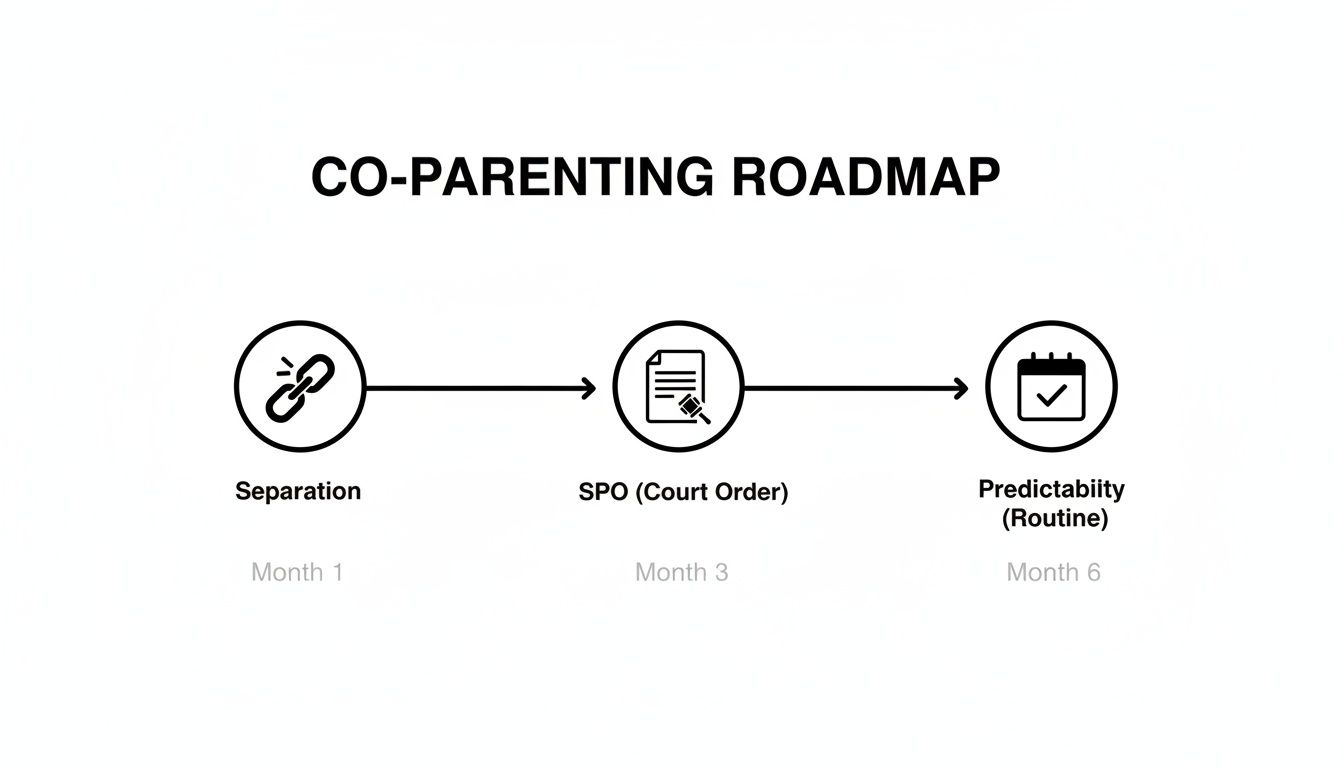
As you can see, the court order is a crucial tool. It’s designed to transform a potentially chaotic time into a structured, manageable co-parenting plan.
The Schedule When Parents Live 50 Miles Apart or Less
This is the most common scenario for families in The Woodlands, Conroe, and the surrounding areas. If you and your child's other parent live 50 miles apart or less, the non-primary parent (or "possessory conservator") has a very clear schedule.
- Weekend Possession: This parent has the children on the first, third, and fifth weekends of any given month. A weekend officially starts when school lets out on Friday and ends when school begins again on Monday morning.
- Thursday Visits: During the school year, the possessory conservator also gets the child every Thursday. This visit typically begins at school dismissal and ends Friday morning when the child is returned to school, making it an overnight stay.
- No Thursday Overnight? The parents can agree, or the court can order, that the Thursday visit will end that same evening instead of being an overnight. If you live in Panther Creek and your ex-spouse is near Market Street, this schedule is quite manageable.
This setup ensures the child has frequent, consistent contact with both parents, which is vital for maintaining strong relationships.
The Schedule When Parents Live Over 100 Miles Apart
Life gets more complicated when parents live farther apart—say, one parent is in The Woodlands and the other moves to Austin. The standard possession order adjusts to make travel practical. In this situation, the weekly Thursday visit is usually eliminated.
Instead of getting the first, third, and fifth weekends, the possessory conservator can choose to have possession on one weekend per month. To balance the lost time, this parent receives a more generous possession schedule during holidays and summer. The driving principle is to support frequent contact, just with modified logistics.
How Holidays and Summer Work
Holidays and summer vacation are divided to give both parents a chance to build memories. To keep things fair, the schedule typically alternates from one year to the next.
Major Holidays:
- Thanksgiving: The possessory conservator has the children for the entire Thanksgiving break in even-numbered years (e.g., 2024, 2026). The primary parent gets them in odd-numbered years.
- Christmas/Winter Break: This long break is usually split. In even-numbered years, the possessory conservator gets the first half of the vacation, from school dismissal until noon on December 28th. They get the second half in odd-numbered years.
Summer Break:
The possessory conservator gets a solid block of time for summer possession. For parents living 100 miles apart or less, this is usually a 30-day period. If you live over 100 miles apart, that time is extended to 42 days. The parent must provide written notice, typically by April 1st, to select their preferred dates.
Real-World Scenario
Let's imagine a father, David, lives in Conroe, and his ex-wife lives in Magnolia. It is an even-numbered year, so David has possession for Thanksgiving. The following weekend is the first weekend of December, which would normally be his possession weekend. He assumes he gets the children for that weekend too. However, the Texas Family Code is clear: the parent who does not have possession for Thanksgiving gets the children for the Christmas holiday. The possession periods are distinct, and one does not "roll over" into the next. David's ex-wife correctly has possession for that first weekend in December before the Christmas break begins.
What to do next
- Get a Calendar: Buy a large wall calendar and use two different colored highlighters to map out the possession days for each parent for the entire year. This simple visual aid prevents confusion.
- Review Your Order's Specifics: Your final order may have small but important modifications. Read the exact language in your decree about holiday exchange times and summer notification deadlines.
- Document Communication: Keep all scheduling conversations in writing, whether through email or a co-parenting app. This creates a clear record.
Disclaimer: This information is for educational purposes and is not a substitute for legal advice. The Texas Family Code contains the full statutes, and you should always consult with an attorney to understand your specific rights and obligations.
Understanding these details is the first step in making a standard possession order in The Woodlands work for your family. If you need help applying this schedule to your unique situation, Schedule a consultation with The Law Office of Bryan Fagan today.
When a Standard Order May Not Fit Your Family
While the Standard Possession Order (SPO) is the go-to schedule for most families in The Woodlands, it's not a one-size-fits-all solution. Texas law recognizes that every family is different. A Montgomery County judge has the duty to create a custom possession order when a parent provides solid proof that the standard schedule isn't in a child's best interest.
The Texas Family Code gives judges the flexibility to design schedules that fit a family's unique circumstances. The court’s mission is to protect a child’s well-being, and the "best interest of the child" standard always takes precedence over the default SPO. If the standard schedule would be impractical or harmful, a judge will craft a different plan.
Children Under Three Years Old
One of the most common reasons to move away from the SPO involves very young children. The Texas Family Code specifically allows for a customized schedule for any child under the age of three. For infants and toddlers, a standard schedule with longer stretches of separation often isn't appropriate.
In these cases, a Montgomery County judge will frequently put a "step-up" possession plan in place. This is a phased schedule that gradually increases the non-primary parent's time as the child grows.
- Phase 1 (e.g., 0-18 months): Might start with several short visits each week, without overnights.
- Phase 2 (e.g., 18-36 months): Could introduce one overnight visit on a weekend.
- Phase 3 (At age 3): The court order automatically transitions to a full Standard Possession Order.
This graduated approach helps nurture the parent-child bond while maintaining stability for the young child.
Significant Health or Safety Concerns
A judge will not hesitate to restrict a parent's access if there are legitimate safety risks. The court's responsibility to shield a child from harm is its highest priority.
Under the Texas Family Code, credible evidence of family violence, child abuse, or neglect creates a legal presumption that unsupervised possession by the offending parent is not in the child’s best interest.
This means a documented history of substance abuse, domestic violence, or serious instability can lead a judge to deny a standard possession order in The Woodlands. The court might instead order alternatives such as:
- Supervised Visitation: Requiring the parent’s time with the child to be monitored by a neutral third party.
- No Overnight Stays: Limiting possession to daytime hours only.
- Monitored Exchanges: Ordering parents to hand off the child at a designated facility to avoid conflict.
Real-World Scenario
Maria lives in Sterling Ridge and has a son with severe asthma that requires breathing treatments every morning and evening. Her ex-husband, who lives in an apartment in Houston, is a heavy smoker. Maria is concerned that overnight visits in his home would endanger her son's health. She can present medical records and testimony to the court to argue that the standard order is not in her son's best interest. A judge might agree and order that all of the father's possession be restricted to daytime hours in a smoke-free environment.
What to Do Next
- Document Everything: If you believe the SPO is wrong for your child, start documenting the reasons why. Keep a detailed log of incidents, medical appointments, or scheduling conflicts.
- Gather Your Evidence: Collect police reports, medical records, school communications, or witness statements that support your position.
- Consult an Attorney: Proving that an SPO is not in your child's best interest requires clear evidence. An attorney can help you build a compelling case for a custom order.
Parents can often work out custom schedules through mediation. You can learn more about the divorce mediation process in The Woodlands as a way to find common ground.
Disclaimer: This article is for informational purposes only and does not constitute legal advice. You should consult with a qualified attorney for advice on your specific situation.
If you are concerned that a Standard Possession Order may not work for your family, our team can help you understand your options. Schedule a consultation with The Law Office of Bryan Fagan to discuss your case.
How to Establish, Modify, or Enforce Your Order
A court order is the legal blueprint for your co-parenting relationship, defining your rights and responsibilities in an enforceable way. For families here in The Woodlands, knowing how to establish, change, or enforce a Standard Possession Order (SPO) is essential for creating stability for your children.
Each of these actions—establishing, modifying, and enforcing—is a distinct legal process. They each have their own rules and requirements, and they all run through the Montgomery County courthouse in Conroe.
Whether you’re just starting out or dealing with a co-parent who won’t follow the rules, the legal system has a specific path for you.
Establishing Your First Order
Your first possession order is created as part of a larger family law case, like a divorce or a Suit Affecting the Parent-Child Relationship (SAPCR). This formal case settles all the big-picture issues at once, including conservatorship and child support.
The court will either approve an agreement you've worked out with the other parent or a judge will make the decision. In almost every situation, the court begins with the legal presumption that a standard possession order is in the child's best interest, as stated in the Texas Family Code.
Modifying an Existing Order
Life happens. Jobs change, families move, and kids grow up. The Texas Family Code allows parents to ask the court to modify a possession schedule, but not just because you don't like it.
To convince a Montgomery County judge to modify your order, you must prove two things:
- There has been a material and substantial change in circumstances since the last order was signed.
- The change you're asking for is in the best interest of the child.
A "material and substantial change" is a high legal bar. It needs to be a truly significant shift in the life of the child or one of the parents, like a relocation, a major work schedule change, or a child's demanding new activity schedule.
Enforcing a Violated Order
It is incredibly frustrating when the other parent doesn't follow the possession order. The law provides a powerful tool: a Motion for Enforcement. This is a formal legal action to hold the other parent accountable for violating a direct court order.
An enforcement action is a serious proceeding. You have to list every specific violation with dates and times (e.g., the other parent refused to turn over the child, was consistently late, or blocked phone calls). If the judge agrees the order was violated, they can order make-up time, fines, and even jail time for contempt of court.
Real-World Scenario
A father in The Woodlands has a standard possession order, but his ex-wife is consistently 30-45 minutes late bringing their daughter back on Sunday evenings, causing stress and late bedtimes on school nights. He has documented a dozen late returns over six months via text messages and a journal. The schedule itself isn't the problem; her failure to follow it is. His correct legal path is not a modification, but an enforcement action to compel her to follow the existing order's exchange times.
What to do next
- Review Your Current Order: Pull out your order and read the exact wording of the possession schedule. You can't enforce something that isn't explicitly written down.
- Document Everything: This is non-negotiable. Keep a detailed calendar or journal of every single violation. Note the date, time, and exactly what happened. Save every relevant text and email.
- Communicate in Writing: When a conflict arises, address it with the other parent through email or a co-parenting app. This creates a clear paper trail for the court.
Disclaimer: This information is for educational purposes only and not a substitute for legal advice. Consult a qualified attorney about your specific case.
If you're facing challenges with your possession order, our team can help you understand your legal options. Schedule a consultation with The Law Office of Bryan Fagan to build a strategy that protects your rights.