
Life changes. A dream job appears, family pulls you closer, or you just need a fresh start. Moving feels like the next logical step. But for a parent in The Woodlands with a Texas custody order, that simple move can trigger a complex legal fight: a relocation custody case.
A judge in Conroe isn't just looking at a map. They are weighing your child's entire future and their relationship with both parents. The court's only guide is the "best interest of the child," a standard from the Texas Family Code that puts your child's stability above everything else.
This guide explains the process in plain English, using practical examples relevant to families in The Woodlands and Montgomery County.
What is a Relocation Custody Case?

Your custody order almost certainly contains a geographic restriction. This is a boundary line drawn by the court, dictating where the child’s primary home must be.
For most families in our area, this boundary is often Montgomery County and sometimes the counties touching it (like Harris, Walker, or San Jacinto). If you want to move with your child outside this designated area, you can't just pack the U-Haul. You need the court's permission or the other parent's formal agreement.
Why Geographic Restrictions Matter
Judges in Conroe use these boundaries to ensure your child maintains a strong, consistent relationship with both parents. A long-distance move can make frequent, meaningful contact nearly impossible.
This gives you two paths forward:
- Get the other parent to agree to the move in a new, written order signed by a judge.
- File a "Petition to Modify the Parent-Child Relationship" asking the court to lift the restriction.
The burden of proof is entirely on the parent who wants to move. The legal standard isn't about what's best for you; it's about what's best for your child.
Real-World Scenario: A Job Offer in Austin
Imagine a mom lives in the Village of Alden Bridge in The Woodlands. She gets a great job offer in Austin. Her current custody order restricts the child’s residence to Montgomery County. She believes the better pay and career path will create a better life for her child.
The problem? The child's father lives in nearby Conroe and is very involved. He coaches Little League and never misses his weekends. A move to Austin would make that level of hands-on parenting impossible.
To make the move happen, the mom must file a modification case. She would have to convince a Montgomery County judge that the benefits for the child in Austin—like better schools or unique opportunities—outweigh the definite harm of reducing the child's daily relationship with their father. It’s a very high bar to clear.
What to Do Next: A Quick Checklist
- Review Your Current Order: Find the geographic restriction clause. Know the exact boundaries. Is it just Montgomery County, or are others included?
- Consult a Local Attorney: Before mentioning the move to anyone, talk to a lawyer who knows the Montgomery County courts. They can assess your odds and help build a strategy.
- Document Your "Why": If you want to move, list every benefit for the child. If you oppose the move, document your deep involvement and how the move would hurt the child.
- Research the New Location: The moving parent must present a detailed plan: schools, housing, activities, and a proposed new possession schedule for the other parent.
Disclaimer: This article is for informational purposes only and does not constitute legal advice. You should consult with a qualified attorney for advice regarding your individual situation.
What 'Best Interest of the Child' Means in Montgomery County
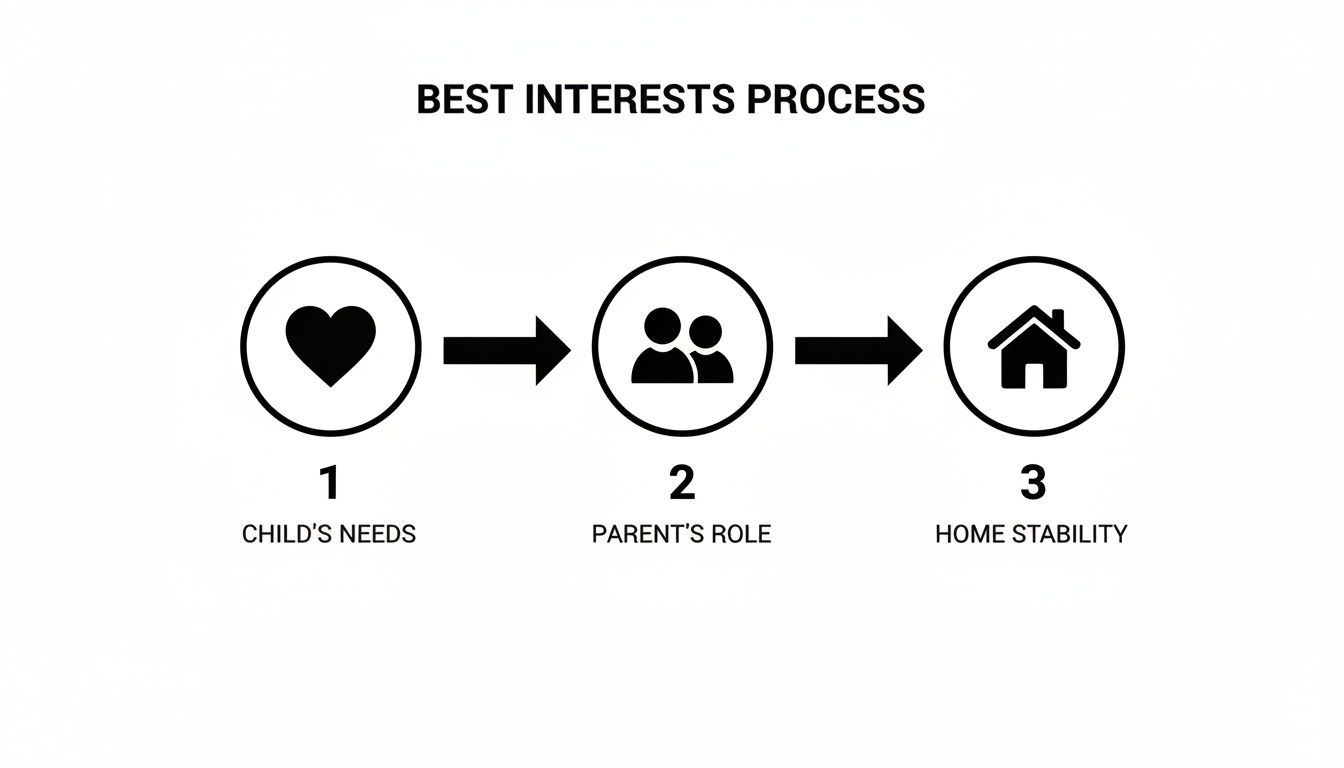
You will hear the phrase “best interest of the child” constantly in a custody case. It sounds vague, but it’s a specific legal standard in Texas. A Montgomery County judge will use a set of factors, established by Texas law, to decide what's truly best for your child.
The Holley Factors: The Judge's Roadmap
This legal framework is built around a series of questions known as the “Holley Factors.” A judge in a Conroe courtroom will measure the facts of your case against these principles.
The most critical questions the court will ask are:
- What are the child's needs—emotionally, physically, and developmentally? How will a move affect their stability?
- What are the parenting abilities of each person? The judge looks at who has been the primary caregiver and each parent's capacity to provide a safe home.
- How stable is the proposed new home? A parent wanting to move needs a solid plan, not just a wish. This means real answers about the new school, community, and support system.
- Is there any history of acts or omissions that suggest an unhealthy parent-child relationship? Past neglect, abuse, or instability will be weighed heavily.
At its core, the court is trying to figure out how a child will handle a massive change. For parents, supporting children through life's transitions is not just good parenting—it’s central to what a judge wants to see. A deeper dive into how these rules are applied can be found by learning more about a geographic restriction in a custody order in Montgomery County.
What to Do Next: A Quick Checklist
- Analyze Your Strengths: Look at your situation through the lens of the Holley Factors. Where is your argument strong, and where is it weak?
- Gather Child-Focused Evidence: Collect report cards, notes from teachers in Conroe ISD or Magnolia ISD, and statements from coaches that show how rooted your child is.
- Document the Other Parent's Role: Keep a simple log of the other parent's involvement. Is it consistent? Is it sporadic? Regular participation is powerful evidence for the parent opposing a move.
- Focus on Stability: No matter which side you’re on, frame your entire argument around your child’s need for stability and continuity.
Disclaimer: This information is for educational purposes only and is not a substitute for legal advice. The outcome of any legal matter depends on the specific facts and circumstances. You should consult with an experienced family law attorney for advice tailored to your individual situation.
The Legal Steps: How to File or Fight a Relocation Case
When one parent wants to move away with a child, a formal legal process begins. You can't just pack up and go. Whether you're hoping to start fresh or trying to keep your child close, knowing the rules is crucial.
For the Parent Who Wants to Move
If you're asking to relocate, the burden of proof is on you. You must file a Petition to Modify the Parent-Child Relationship.
In this petition, you must convince the judge of two things:
- There has been a “material and substantial change” in circumstances since the last custody order.
- Changing the order to allow the move is in the “best interest of the child.”
Wanting a change of scenery or moving for a new partner usually isn't enough. You need to show how the move directly benefits your child, like a life-changing job, a specialized school, or necessary medical care. You can learn more about custody modification in The Woodlands, Texas, in our detailed guide.
For the Parent Opposing the Move
If you want to prevent the move, your first step is to file a formal Answer to the other parent's petition. This tells the court you are fighting the request.
Your job is to show the judge why uprooting your child is not in their best interest. The best way to do this is to demonstrate your deep, consistent involvement in your child's life here in The Woodlands area. A judge will weigh the move's potential benefits against the harm of disrupting the child's stable home, school, and relationship with you.
What to Do Next: A Quick Checklist
- If You're Moving: Gather proof of how the move benefits your child—job offer letter, school information, details on your support system in the new city.
- If You're Opposing: Immediately start documenting your involvement. Keep a journal of visits, save school emails, and show your active role.
- File the Correct Paperwork: File the Petition to Modify or the Answer with the Montgomery County District Clerk’s office right away.
- Don't Take Matters Into Your Own Hands: Never move the child without a court order or a signed agreement from the other parent. "Self-help" can do serious damage to your case.
Disclaimer: This article is for informational purposes only and does not constitute legal advice. You should consult with a qualified attorney for advice regarding your individual situation.
Why Texas Courts Often Deny Relocation Requests
Frankly, winning a contested relocation case in The Woodlands is an uphill battle. The Texas family court system is designed to keep a child's life stable. Judges in Montgomery County are naturally skeptical of any move that disrupts a working co-parenting relationship.
The law assumes that frequent, meaningful contact with both parents is best for a child. A long-distance move directly challenges that core principle. The burden falls on the moving parent to prove the move is so overwhelmingly positive that it justifies upending the child's world.
A judge will put your reasons for moving under a microscope. If the move seems to benefit you more than your child, your request is on shaky ground. Moves for a new partner, a vague "fresh start," or a slightly better job often aren't enough. The court needs to see a clear, undeniable advantage for the child. You can discover more about how Texas courts handle these cases to get a better sense of the odds.
Real-World Scenario: A Parent’s Convenience vs. a Child’s Stability
Imagine a parent in the Village of Panther Creek wants to move out of state for a new relationship. The other parent, who lives nearby in Spring, is completely involved—attending school events, coaching sports, and never missing their scheduled time.
From a judge's view, the moving parent is asking to sever the child's daily connection to a dedicated parent for a new romance. A judge will likely see this as prioritizing the parent’s happiness over the child's stability and bond with their other parent. In this scenario, the request is almost guaranteed to be denied.
What to Do Next: A Quick Checklist
- Honestly Assess Your Motive: Is this move truly for your child's benefit, or is it more about your own? Be honest with yourself before spending time and money on a fight you may not win.
- Evaluate the "Loss" to the Child: List everything your child would lose by moving—time with their other parent, grandparents, friends, school, and community. A judge will make this same list.
- Consult an Attorney First: Get a realistic opinion on your chances from a family lawyer who knows the Montgomery County judges.
- Consider Alternatives: Can you achieve your goals without moving so far? Showing a judge you explored local options first demonstrates your primary goal isn't to interfere with the other parent's relationship.
Disclaimer: This information is for educational purposes and is not a substitute for legal advice. Every case is unique, and you should consult with a qualified attorney about your specific situation.
The True Costs of a Relocation Battle in Montgomery County

A court fight over moving a child is a massive undertaking. The costs go far beyond legal fees. Before you draw a line in the sand, you need to understand what you’re signing up for. A relocation custody case in The Woodlands can be one of the most expensive and exhausting chapters of your life.
The Financial Drain
Let's talk numbers. Litigating a relocation case in Texas has become very expensive. For a contested case in Montgomery County, legal bills can climb to between $20,000 and $40,000, and sometimes higher. You can discover more insights about the rising costs of Texas relocation cases on bryanfagan.com.
Where does that money go?
- Attorney Fees: A contested case is a marathon of preparation, depositions, and court time, all billed by the hour.
- Court Costs: Filing fees, motions, and hearings add up.
- Mandatory Mediation: Before trial, you must attend mediation, and mediators charge hundreds of dollars per hour.
- Expert Witnesses: A child psychologist or custody evaluator can provide crucial testimony, but their reports and time can cost thousands.
The Emotional Toll
The emotional cost is even higher. A long legal fight creates a hostile environment that is incredibly stressful for you and damaging for children caught in the middle. It can shatter your co-parenting relationship, making it nearly impossible to cooperate long after the judge has ruled.
What to Do Next: A Quick Checklist
- Create a Realistic Budget: What can you truly afford to spend on this fight without risking your family's stability?
- Consider the Emotional Impact: How will a bitter fight affect your child and your ability to co-parent for the next 10 or 15 years?
- Explore Every Settlement Option: Exhaust every avenue for a negotiated agreement before committing to a court battle.
- Get a Professional Cost-Benefit Analysis: Talk to an experienced child custody lawyer in The Woodlands who can give you a blunt assessment of your case and its potential costs versus rewards.
Disclaimer: This is not legal advice and is for informational purposes only. You should consult a qualified attorney for advice regarding your specific situation.
Frequently Asked Questions About Relocation Cases in The Woodlands
When you're facing a potential move, questions race through your mind. Here are plain-English answers to some of the most common ones we hear from parents in The Woodlands and Montgomery County.
Can I move to a nearby city like Conroe without asking?
The answer is in your custody order's geographic restriction. Most orders limit the child's residence to Montgomery County and sometimes surrounding counties. A move from The Woodlands to Conroe is within Montgomery County, so it would likely be fine. But a move to a different county like Harris might require permission. You must read the specific wording in your decree before packing.
What if my ex moves with our child without telling me?
If your ex takes your child and moves outside the approved area without a court order or your written permission, it is a serious violation. Your first step is to file an enforcement action with the court. A judge can order the immediate return of your child and may penalize the other parent, ordering them to pay your attorney’s fees or even imposing fines.
How long does a relocation case take in Montgomery County?
If you and the other parent agree, a modified order can be signed in a few weeks. If the case is contested, it can easily take six months to a year, or even longer. The process involves filing petitions, gathering evidence, attending mandatory mediation, and finally, a trial. This lengthy timeline is why we always encourage trying to reach a settlement first.
Do I really have to prove a 'material and substantial change'?
Yes. This is a non-negotiable legal requirement from the Texas Family Code. Before a judge will even consider changing your custody order (including lifting a geographic restriction), you must first prove that there has been a material and substantial change in circumstances since the last order was signed. Only after you clear that hurdle will the court consider if the move is in the child's best interest. You can find useful tips in this essential checklist for relocating to another state.
What to Do Next: A Quick Checklist
- Read Your Order: Find and understand the exact wording of the geographic restriction.
- Document Everything: Keep detailed records of communications and the reasons for or against the move.
- Don't Jump the Gun: Never violate a court order by moving without permission.
- Talk to a Lawyer: Get legal advice from someone who understands your specific situation before making any moves.
Disclaimer: This article provides general information and does not constitute legal advice. You should consult with a qualified attorney for guidance on your individual situation.
Navigating the complexities of a relocation case requires a clear strategy. If you're facing this challenge in The Woodlands or Montgomery County, understanding your rights and options is the first step. To discuss the specifics of your case and get the clarity you deserve, we invite you to schedule a consultation.