
When you're facing a property division the woodlands divorce, the first and most important rule to understand is this: Texas is a community property state.
In plain English, from the moment you got married, Texas law views you and your spouse as a single financial unit. Almost everything earned or acquired by either of you during the marriage belongs to this "community estate." It’s a shared pot that must be divided.
This guide will walk you through how property division works in The Woodlands and Montgomery County, using practical examples and clear language to help you understand your rights.
Community vs. Separate Property: The First Hurdle in a Woodlands Divorce
When you go through a divorce in Montgomery County, the judge starts with a simple assumption: everything you and your spouse own is community property. Your first job is to help the court figure out what, if anything, doesn't belong in that shared pot.
This is where we draw a bright line between two types of property. It's the most critical distinction in dividing your assets.
The Two Buckets: Community and Separate
Sorting your assets and debts into these two categories is the foundational work of any Texas divorce.
Community Property: This is the default. It’s the house in Creekside Park bought after your wedding, the salaries you both earned, the 401(k) contributions made over the years, and even the debt taken on together. It doesn’t matter whose name is on the title. If it was acquired during the marriage, the law presumes it’s community property.
Separate Property: This is the exception. To be considered separate, an asset must be proven to belong to only one spouse. The Texas Family Code is very specific, defining separate property as assets owned before the marriage, a direct inheritance left to just one spouse, or a gift given to just one spouse.
For example, if you owned a rental property in Conroe before you married, that property is yours alone. But be careful: if you used money from a joint checking account to pay the mortgage or make renovations during the marriage, the community estate may have a claim for reimbursement. It gets complicated fast.
The "Just and Right" Standard (It’s Not Always 50/50)
Many people hear "community property" and assume everything gets chopped down the middle. That's a huge misconception.
While a 50/50 split is a common starting point, Texas law actually requires a “just and right” division. This gives a Montgomery County judge significant discretion to divide the community estate in a way they believe is fair, which might be a 55/45 or even a 60/40 split.
Why? Because Texas Family Code Section 7.001 directs judges to consider many factors, including:
- The spouses' earning potential and education
- Who will have primary custody of the children
- Fault in the breakup of the marriage (like adultery)
- The size and nature of the estate
You can learn more about how Texas law dictates a fair distribution of assets and the factors judges consider.
Real-World Scenario: Untangling Assets
Sarah and Tom are divorcing in The Woodlands. The family home, purchased during their marriage, is community property. However, a $50,000 inheritance Tom received from his father and kept in a separate account is his separate property. Sarah's car, though titled in her name, was bought with her salary earned while married, making the car community property and subject to this "just and right" division.
What to Do Next
Feeling overwhelmed is normal. Start with these practical steps to get organized:
- Make a Master List: Open a spreadsheet and list everything you own and owe, from real estate and vehicles to credit cards and retirement accounts.
- Find "Before" Documents: Locate statements, deeds, and titles for any significant assets you owned before your wedding. This is your proof of separate property.
- Trace Gifts & Inheritances: Find any wills, trust documents, or letters that show an asset was a gift or inheritance intended solely for you.
- Talk to an Expert: An attorney can review your list and help you categorize your estate, giving you a realistic picture of what to expect. You can also check out our guide on Texas community property for more examples.
Disclaimer: This article provides general information and does not constitute legal advice. The law is complex, and you should consult with an attorney for guidance regarding your individual situation.
Getting Your Ducks in a Row: How to Inventory and Value Your Marital Estate
After you understand the difference between separate and community property, it’s time to create a complete financial picture of your marriage. This is where the rubber meets the road in a property division the woodlands divorce. It involves building a detailed inventory of everything you and your spouse own and owe.
This process is more than just making a list. You are conducting a financial audit of your shared life, assigning a realistic value to each item. You must account for everything—the family home in Sterling Ridge, the cars, stock options, retirement accounts, and credit card balances. Every piece helps complete the final puzzle.
Kicking Off the Inventory Process
To get started, you and your attorney will draft a Sworn Inventory and Appraisement. This isn't a casual spreadsheet; it's a formal document filed with the Montgomery County court. It lists all assets and debts, their estimated values, and your claim as to whether they are community or separate property.
Honesty and accuracy are critical. Hiding assets or providing lowball values is a fast way to lose credibility with the judge and can lead to serious legal penalties. The entire process is built on transparency.
Key Legal Rules for Classifying Property
As you build your inventory, your attorney will mention two important legal concepts from the Texas Family Code: "inception of title" and "tracing."
Inception of Title Rule: This rule looks at when an asset was first acquired to determine if it's separate or community property. For instance, if you signed a contract to buy a townhome before marriage, it is your separate property, even if you both made mortgage payments on it during the marriage. The community estate, however, might have a right to be reimbursed for those payments.
Tracing: This is the detective work. It’s the method used to prove an asset is separate property by following it from its origin (like an inheritance) to its current form. This requires a clean paper trail of bank statements and other financial records.
This chart helps visualize the basic decision-making process for classifying property in a Texas divorce.
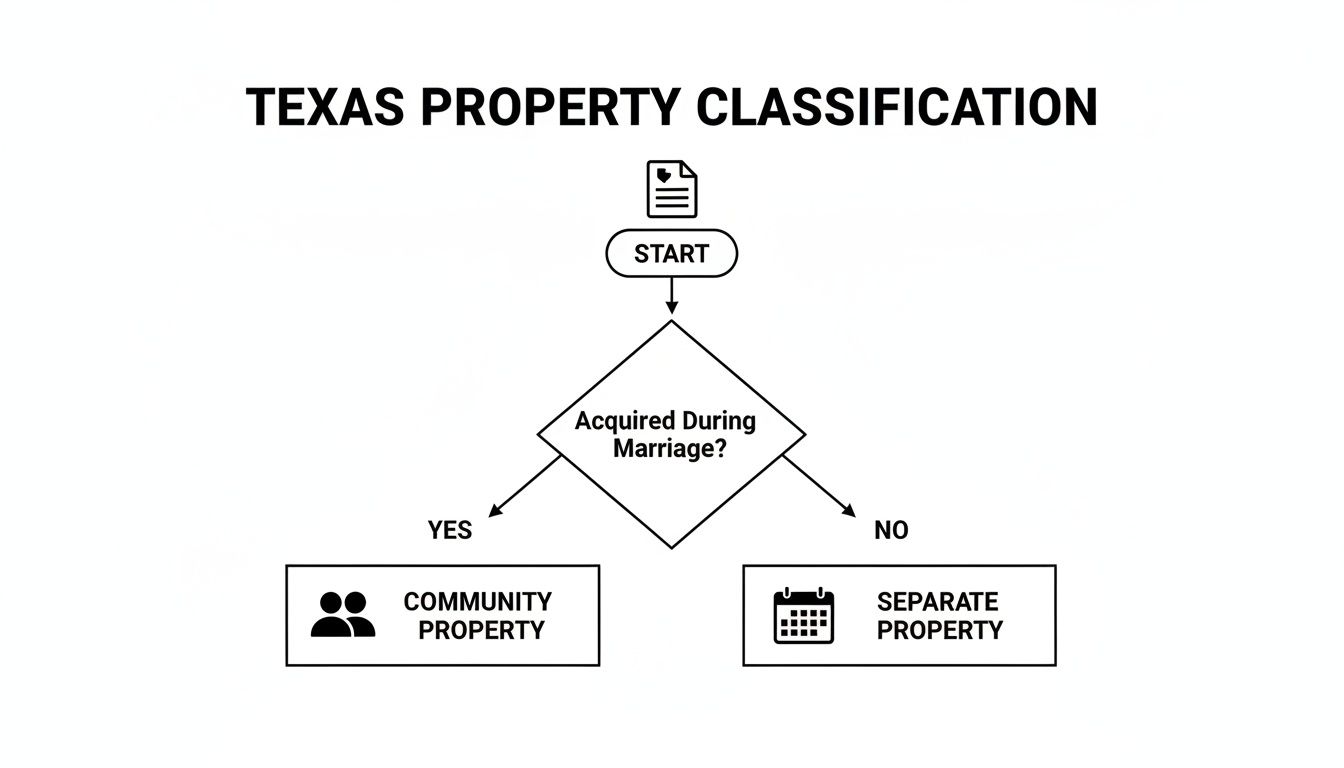
The takeaway? Texas law presumes everything is community property. The burden is on you to prove otherwise with clear and convincing evidence.
What Commingling Looks Like in the Real World
Let's walk through a common scenario. Imagine Mark inherits $100,000 from his grandmother. That money is his separate property. But instead of putting it into a new, separate account, he deposits it into the joint checking account he shares with his wife, Sarah. Over the next few years, they use funds from that account for groceries, vacations, and home repairs.
This is a classic case of commingling. By mixing his separate inheritance with community funds to the point they can no longer be individually identified, Mark has likely transformed his separate property into community property.
Community Property vs. Separate Property Examples
| Asset or Debt Type | Typically Community Property If… | Typically Separate Property If… |
|---|---|---|
| House | Purchased during the marriage with joint funds. | Owned by one spouse before the marriage. |
| Retirement Account | Contributions and growth that occurred during the marriage. | The portion of the account that existed before the marriage date. |
| Inheritance | Inherited funds were deposited into a joint account and used for shared expenses. | Kept in a separate account and never mixed with marital funds. |
| Car | Purchased and paid for with income earned during the marriage. | Received as a gift specifically to one spouse from a third party. |
| Credit Card Debt | Incurred during the marriage for family expenses (groceries, utilities, etc.). | Incurred by one spouse before the marriage. |
This table provides a simplified look, but as the commingling example shows, the lines can blur quickly without careful financial management. You can see additional details about how property is divided in Texas divorces to better understand the importance of accurate records.
What to Do Next
- Gather Your Financials: Pull together at least five years of bank statements, tax returns, credit card statements, and investment account information.
- Create a Master List: Open a simple spreadsheet and list every known asset and debt. Just get it all down on paper.
- Flag Separate Property: Note any assets you owned before marriage or received as a personal gift or inheritance. Then, look for documents to prove it.
- Talk to an Expert: Discuss your list with a family law attorney who can spot potential valuation problems or tracing challenges early on.
Disclaimer: This article provides general information and does not constitute legal advice. The law is complex, and you should consult with an attorney for guidance regarding your individual situation.
The “Just and Right” Standard in Montgomery County Courts
One of the biggest misconceptions about Texas divorce is that property is always split 50/50. While a 50/50 division is possible, it is not required. The law directs judges in Montgomery County to seek a “just and right” division.
This standard gives the court significant flexibility. It allows a judge to move beyond simple math and consider the unique circumstances of your marriage and divorce. For anyone navigating a property division the woodlands divorce, understanding how a judge defines "just and right" is key to anticipating the final outcome.
Factors That Influence the Division
So, what does a judge look at to determine what’s fair? Based on legal precedent, they weigh a series of factors that can justify an unequal division.
Some of the most powerful factors include:
- Fault in the Breakup: If the divorce was caused by one spouse's actions—like adultery, cruelty, or abandonment—the judge can award a larger share of the community estate to the innocent spouse.
- Differences in Earning Capacity: A major gap between what you and your spouse can earn in the future is a huge consideration. A judge may award more assets to the lower-earning spouse to help ensure their financial stability.
- Health and Age: The court considers each person's physical and mental health. A spouse with chronic health problems or who is nearing retirement may receive a larger share to cover future needs.
- Needs of the Children: The court always prioritizes stability for the children. This often means the parent who has the children most of the time is awarded the family home to keep their lives as undisrupted as possible.
These aren't the only factors, but they often sway the outcome of cases right here in Montgomery County. You can uncover more about how Texas courts handle property division and the principles judges follow.
Real-World Scenario: Stability for the Kids in Alden Bridge
Imagine a couple, David and Maria, from The Woodlands. They have two kids and live in the Alden Bridge village. Maria paused her career to be a stay-at-home mom while David became a high-earning executive. The judge decides the kids will live primarily with Maria.
To keep things stable for the children, the judge awards Maria the family home. Since the home is a large part of their net worth, this creates an imbalance. To make the entire division "just and right," the judge offsets this by awarding David a larger portion of his 401(k) and other investments. It is a practical solution that puts the kids first while still working toward a fair financial outcome.
What to Do Next
If you believe a 50/50 split would be unfair, you must build a case to show the judge why.
- Document Everything: Gather evidence. This could be texts proving adultery, medical records detailing a health condition, or pay stubs showing a large income gap.
- Focus on the Children's Needs: Clearly explain why keeping the family home is critical for your children's stability.
- Calculate Future Needs: Create a realistic post-divorce budget. This is a powerful tool to demonstrate your financial reality to the court.
- Consult an Attorney: An experienced family lawyer can weave these facts into a compelling narrative for the judge to advocate for a division that is truly just and right for you.
Disclaimer: This article provides general information and does not constitute legal advice. The law is complex, and you should consult with an attorney for guidance regarding your individual situation.
Navigating High-Asset and Complex Property Division

While the basic rules apply in every Texas divorce, cases in The Woodlands often involve complex finances. When dealing with a family-owned business, a professional practice, or intricate executive compensation, a simple inventory is not enough. A successful property division the woodlands divorce requires a much deeper financial investigation.
These situations are less about listing what you own and more about dissecting it. You must untangle the marital share of a company, value intangible assets like a business's reputation, and divide future income streams like stock options.
Valuing a Business or Professional Practice
Placing a value on a business is one of the trickiest parts of a high-asset divorce. A proper business valuation involves analyzing financial records, assets, liabilities, and market position.
A common point of conflict is “goodwill”—the intangible value a business has due to its name, customer base, and reputation. Texas law distinguishes between personal goodwill (tied to the owner's skills) and enterprise goodwill (tied to the business itself). Only enterprise goodwill is typically a community asset that can be divided.
Dealing with Retirement Funds and QDROs
For many couples, retirement accounts are a massive asset. The portion of a 401(k), pension, or IRA earned during the marriage is community property. You can't just split it like a checking account; these require a special court order.
That order is a Qualified Domestic Relations Order (QDRO). This is a separate, technical legal document that tells the retirement plan administrator how to split the account and pay the non-employee spouse their share. A mistake in the QDRO can be a disastrous and costly error. You can learn more by exploring our detailed guide on navigating a high-asset divorce in The Woodlands.
Real-World Scenario: Uncovering Hidden Value
A couple in The Woodlands is divorcing. The husband started a contracting business during the marriage. He claims it is barely profitable, showing financials with minimal income. The wife is certain its value is much higher.
Her attorney hires a forensic accountant. The accountant finds the husband used the business account like a personal piggy bank, paying for luxuries and underreporting cash jobs. With this expert report, the wife's attorney proves the business is worth nearly three times what was claimed, securing her a just and right share.
Executive Compensation Packages
For many executives in Montgomery County, their compensation is more than a salary. It's often a mix of bonuses, restricted stock units (RSUs), and stock options. Characterizing these is difficult because their value is tied to future performance or vesting schedules that extend past the divorce date. An experienced attorney can identify the community property portion of these complex awards.
What to Do Next
If your marriage involves complex assets, be proactive.
- Don’t Accept Values at Face Value: Be skeptical of any valuation your spouse provides, especially for a business they run. Always insist on an independent appraisal.
- Gather Key Business Documents: Collect tax returns, profit and loss statements, balance sheets, and any shareholder agreements.
- Identify All Retirement Plans: List every 401(k), IRA, pension, or other retirement plan held by you or your spouse.
- Hire the Right Experts: Retain a forensic accountant or a certified business appraiser. Their expertise is often key to uncovering the true value of your marital estate.
Disclaimer: This article provides general information and does not constitute legal advice. The law is complex, and you should consult with an attorney for guidance regarding your individual situation.
From Negotiation and Mediation to the Courtroom
Once you have a complete inventory of your marital estate, the question becomes: how do you divide it? While many people imagine tense courtroom battles, most property division The Woodlands divorce cases are resolved long before a judge makes a final ruling.
The process usually unfolds in stages, starting with negotiation and often moving to mediation before litigation is even considered.
It begins with a phase called discovery. This is the formal process where you and your spouse exchange all financial information—inventories, bank statements, tax returns, and appraisals. This transparency ensures everyone is working from the same set of facts, which is the only way to have a productive conversation.
The Power of Settling Out of Court
The vast majority of divorces are settled through negotiation or mediation. When you resolve your property division outside of court, you keep control over the outcome, maintain your privacy, and save significant money and stress.
Informal Negotiation: This is usually the first stop. Your attorneys communicate directly to try to reach an agreement. It’s a flexible, low-conflict way to work through disagreements.
Mediation: If direct talks stall, mediation is the next step. You, your spouse, and your lawyers meet with a neutral third-party mediator. The mediator’s job is to help you find common ground. They have no power to force a decision. We strongly encourage this path, and you can learn more in our guide to divorce mediation in The Woodlands, Texas.
When you resolve your case in mediation, you and your spouse write the final chapter. You control the outcome, not a judge who has only known you for a few hours. This allows for creative and personalized solutions.
Real-World Scenario: A Mediation Success Story
We worked with a couple from Conroe where both spouses were adamant about keeping the family home. In a courtroom, a judge would have been forced to pick a winner and a loser.
Instead, in mediation, they crafted a better solution. The wife kept the house for two years until their youngest child graduated high school. After that, they agreed to sell it and split the proceeds. This kind of creative, win-win outcome is almost impossible in a formal trial.
When Settlement Fails: The Path to Trial
If you’ve exhausted every settlement option, your case will be set for a final trial at the Montgomery County courthouse. This is the last resort.
At trial, both sides present evidence, call expert witnesses, and make legal arguments. The judge will then make a final, binding decision on how to divide your property based on the “just and right” standard from the Texas Family Code. Litigation is by far the most expensive, time-consuming, and emotionally draining path.
What to Do Next
- Be an Open Book in Discovery. Don't hide documents. Withholding information only breeds distrust and makes a fair settlement harder to reach.
- Go to Mediation Ready to Compromise. The goal isn't to "win" on every point; it's to reach a fair agreement that allows you both to move forward.
- Know Your Non-Negotiables. Before you start, decide what is most important to you. Knowing your priorities makes negotiation much clearer.
- Trust Your Attorney's Guidance. A seasoned lawyer can tell you if a settlement offer is reasonable and assess your chances at trial.
Disclaimer: This article provides general information and does not constitute legal advice. The law is complex, and you should consult with an attorney for guidance regarding your individual situation.
Your Practical Checklist for Property Division

It’s easy to feel overwhelmed by paperwork when facing a property division The Woodlands divorce. The number of things to track can feel endless. But you can get a handle on it.
The key is to break the process into smaller, concrete tasks. This simple checklist helps you focus on what you can control right now and gives you a solid foundation as you move forward.
What to Do Next
Your first goal is to get a clear financial snapshot of your marriage. Getting organized is a necessary part of the process, as the court will need a full accounting of your marital estate.
- Start Digging for Documents: Gather the last 2-3 years of key financial records: bank statements, tax returns, pay stubs, deeds, mortgage statements, car titles, and credit card bills.
- List Everything: Open a spreadsheet and start a master list. On one side, list all assets (house, cars, retirement accounts). On the other, list all debts (mortgages, car loans, credit cards).
- Pinpoint Separate Property: Note anything you owned before marriage or received as a personal gift or inheritance during the marriage. Then, find the paperwork to prove it, as required by the Texas Family Code.
- Freeze Major Financial Moves: Don’t sell major assets, empty joint bank accounts, or take on new debt without talking to your attorney first. Panic-driven decisions can complicate your case.
- Talk to a Professional: Schedule a consultation with a family law attorney in The Woodlands to get advice specific to you.
Real-World Scenario: How Preparation Pays Off
Consider Sarah, divorcing after living in her Creekside Park home for over a decade. Before meeting with an attorney, she felt lost but followed this checklist. She arrived with two years of bank statements and the original closing papers for her house.
Because Sarah came prepared, her lawyer quickly spotted something important: the $50,000 down payment came directly from an inheritance she had received. This allowed the attorney to immediately start "tracing" those funds to prove her separate property claim, which ultimately protected a huge chunk of her home's equity. Her preparation saved significant time and money.
Taking these steps gives you a powerful head start. You will walk into your first legal consultation ready to have a strategic conversation, armed with the documents needed to build your case.
Disclaimer: This article provides general information and does not constitute legal advice. The law is complex, and you should consult with an attorney for guidance regarding your individual situation.
If you're ready to get personalized guidance for your specific circumstances in Montgomery County, schedule a consultation to discuss your case.
Your Pressing Questions About Property Division, Answered
When you're facing a divorce in The Woodlands, your mind is likely racing with practical, what-if questions. These are the real-world concerns that can keep you up at night. Here are answers to a few key questions that almost always come up.
Who Gets to Stay in Our Home During the Divorce?
This is often the first and most emotional question. Since the house is typically community property, you both legally have a right to be there. But living together during a divorce is rarely practical.
A Montgomery County court can grant one spouse exclusive use of the home while the divorce is pending. This is often done with a Temporary Restraining Order (TRO), especially when children are involved and the court wants to keep their lives as stable as possible.
How Are Credit Card Debts and Loans Divided?
It's not just about what you own; it's also about what you owe. Debts incurred during the marriage are treated just like assets. It doesn't matter whose name is on the credit card or loan.
If the money was used for a community purpose—like groceries, a family car, or a vacation—that debt belongs to the community. A judge will divide it in a "just and right" manner. The main exception is debt one of you brought into the marriage, which usually remains that person's separate responsibility.
Real-World Scenario: The Retirement Account Question
Mark and Lisa from The Woodlands are divorcing after 20 years. Mark has a 401(k) he’s contributed to for his entire career. Lisa worries she has no claim to it because it's in Mark's name. However, under Texas law, the portion of the 401(k) that grew from contributions and market gains during their 20-year marriage is community property. The court will divide that marital portion in a just and right manner.
Is My Spouse's 401(k) or Pension Considered Community Property?
Yes, absolutely. Any growth in a retirement account, 401(k), or pension that occurred during the marriage is community property. The scenario with Mark and Lisa is something we see all the time.
It doesn't matter that only one spouse's name is on the account. The Texas Family Code is very clear. We use a special court order, called a QDRO, to divide these funds correctly without triggering early withdrawal penalties or taxes.
What Can I Do if I Suspect My Spouse Is Hiding Assets?
If you suspect the financial picture isn't complete, listen to your gut. Hiding assets is a serious issue, and there are legal tools to address it.
An attorney can launch the formal discovery process, which legally requires your spouse to produce financial records. If things seem more complex, we can bring in a forensic accountant. These experts are like financial detectives, trained to trace money, scrutinize business records, and uncover hidden assets, ensuring the final division is truly fair.
What to Do Next
- List Your Pressing Questions: Jot down every question you have about your home, accounts, and debts.
- Gather Relevant Documents: Start pulling together statements for your mortgage, retirement accounts, and credit cards.
- Avoid Making Assumptions: The rules for dividing property are complex. Don't assume an asset or debt is "yours" or "theirs."
- Consult with a Local Attorney: The best way to get reliable answers is to talk to a lawyer who knows the Montgomery County courts.
Disclaimer: This article provides general information and does not constitute legal advice. The law is complex, and you should consult with an attorney for guidance regarding your individual situation.
Navigating a divorce is tough, but getting clear answers can give you a solid footing. The attorneys at The Law Office of Bryan Fagan have the local knowledge and experience to guide you through every detail of property division in The Woodlands. To get answers for your specific situation, schedule a consultation with our team.