
When you're facing a divorce in The Woodlands and military service is part of the picture, you’re dealing with a mix of Texas family law and complex federal rules. It’s an emotionally tough time that also comes with logistical challenges civilian couples don't face.
Laws like the Servicemembers Civil Relief Act (SCRA) are designed to protect those on active duty, but they can create a web of rules that feel overwhelming. My goal is to untangle that web and give both service members and their spouses a clear map for handling these issues in the Montgomery County court system.
Your Guide to Military Divorce in The Woodlands

Divorce is always hard. But for families here in The Woodlands, from Alden Bridge to Creekside Park, adding military service means your case isn't just a local family law matter anymore. It's now a federal one, too. You have to understand how federal laws interact with Texas's community property rules, and that requires specific attention to detail.
This guide is designed to walk you through the process, empowering you with the knowledge you need to protect your rights and your future. Let's break down how the biggest military-specific issues play out in a Texas divorce.
Key Aspects We Will Cover
We'll focus on the areas where military service most directly impacts the divorce process:
- Jurisdiction and Timing: How the SCRA protects active-duty personnel from being blindsided by a divorce while deployed and how it affects the case timeline.
- Dividing Military Benefits: How military retirement pay is divided under the Uniformed Services Former Spouses' Protection Act (USFSPA) and Texas community property law.
- Child Custody During Deployment: How to build solid, enforceable custody plans that account for military life and provide stability for your children.
According to the Texas Family Code, anything you and your spouse acquire during the marriage is generally considered community property—and that includes the portion of military retirement benefits earned during those years. This makes dividing the retirement a critical part of nearly every military divorce.
A Real-World Scenario
Think about a couple living in the Sterling Ridge village of The Woodlands. He's an active-duty Army officer, and she's a civilian. After 15 years of marriage, they decide to divorce. A common misconception is the "10/10 Rule," but even if they don't meet that federal threshold, Texas law still grants her a share of the retirement benefits earned during their marriage.
Their final divorce decree must contain very specific language to make sure that division is enforceable by the Defense Finance and Accounting Service (DFAS). One wrong word can cause huge problems, which is why getting experienced legal guidance is so important.
What to do next
If you're at the beginning of this process, here are the first few steps to take:
- Gather Your Documents: Start collecting key paperwork like Leave and Earning Statements (LES), military orders, and records of retirement points.
- Confirm Your Residency: Before you can file in Montgomery County, you must have lived in Texas for at least 180 days and in the county for at least 90 days.
- Know Your Rights: Get a basic understanding of the SCRA. Whether you're the service member or the spouse, you need to know how it can impact your case.
- Pause on Big Decisions: Don't move children out of state, sell major assets, or make other big life changes without speaking to an attorney first.
Disclaimer: This article is for informational purposes only and does not constitute legal advice. Family law matters are complex, and you should consult with a qualified attorney to discuss your specific situation.
Successfully navigating a military divorce requires a lawyer who is fluent in both Texas family law and federal military regulations. For clear, strategic guidance tailored to your family's needs in The Woodlands, schedule a consultation to discuss your case.
Filing for Military Divorce in Montgomery County
Taking that first step toward divorce is never easy. It’s often the hardest part, but having a clear roadmap can make the journey feel less overwhelming. For anyone facing a military divorce here in The Woodlands, that road begins at the Montgomery County Courthouse in Conroe. Before you file the first paper, you have to meet specific legal requirements to prove Texas is the right place for your case.
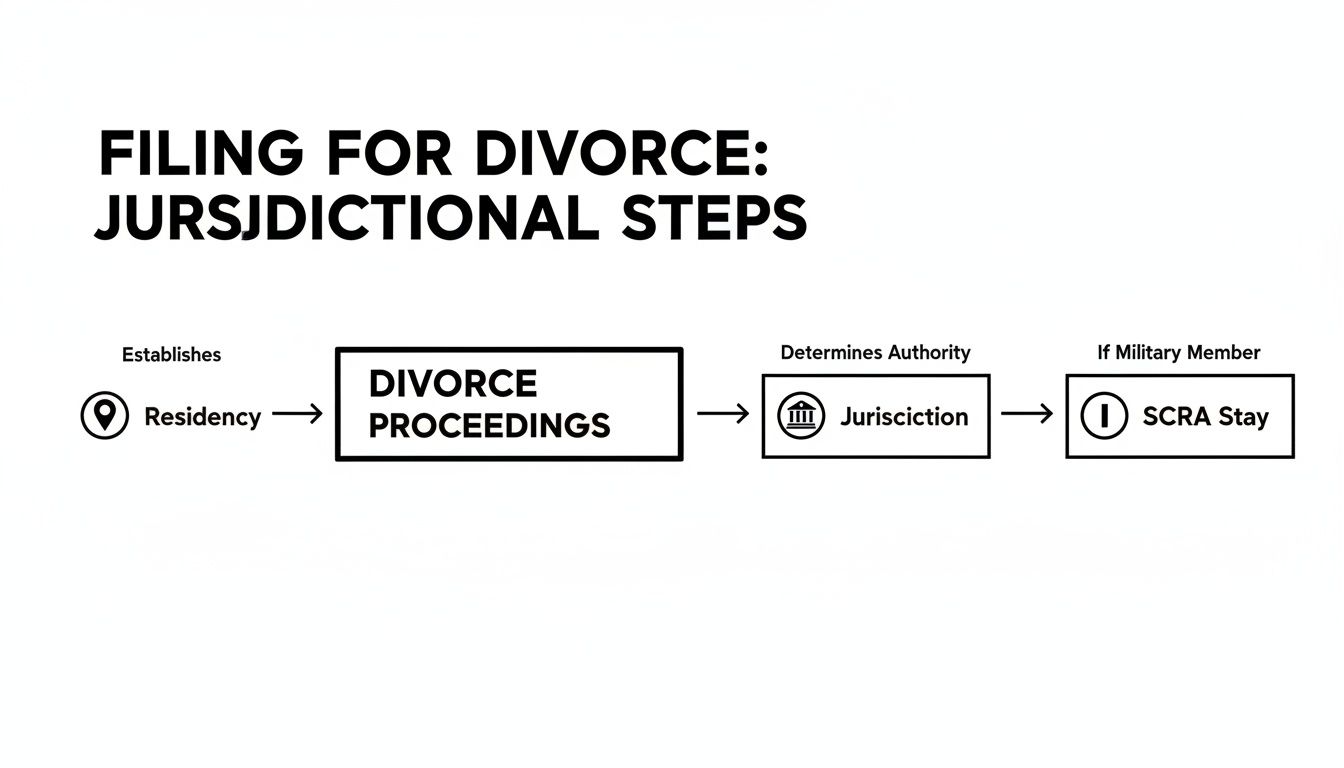
This initial phase is all about establishing jurisdiction—the legal term for a court’s power to hear your case. Getting this part right from the start is absolutely critical.
Meeting the Texas Residency Requirements
Before a Montgomery County judge can oversee your divorce, either you or your spouse must have established residency here. The Texas Family Code makes this straightforward with a clear, two-part test. You must have lived:
- In the state of Texas for at least the last 180 days, and
- In Montgomery County specifically for at least the last 90 days before filing your petition.
This can be tricky for military families. What if you live in The Woodlands, but your spouse is stationed at Fort Cavazos or even overseas? Fortunately, Texas law allows a service member to file for divorce in the county they consider their legal residence or "home of record," even if they are physically stationed somewhere else. This provides much-needed stability for military personnel who call Montgomery County home.
The Role of the Servicemembers Civil Relief Act (SCRA)
Once you establish jurisdiction and file the divorce papers, a major federal law called the Servicemembers Civil Relief Act (SCRA) comes into play. It's a common myth that this law can stop a divorce. It can't. Its real purpose is to protect active-duty service members from being put at a disadvantage in legal proceedings while they’re focused on serving the country.
The main job of the SCRA in a divorce is to prevent a default judgment. It ensures a service member who can't respond to a lawsuit because of military duties—like being deployed—isn't unfairly penalized for their absence.
Under the SCRA, an active-duty service member can ask the court for a temporary "stay," which is a fancy word for pausing the divorce. A judge can postpone the case for the entire duration of their active duty plus an extra 60 days. It’s a crucial factor for anyone in The Woodlands to keep in mind when thinking about how long their divorce might take. You can find more detail on these protections in this overview of military divorce proceedings in Texas.
The First Legal Step: The Original Petition for Divorce
The official start of your divorce is the filing of an Original Petition for Divorce. This document is filed with the Montgomery County District Clerk. It gives the court the basic who, what, and where of your marriage, children, and property. It also states the legal grounds for the divorce, which in Texas is almost always "insupportability"—what most people call a no-fault divorce.
While filing the petition is a key first move, it's just one piece of the puzzle. Our general guide to divorce in The Woodlands can give you a broader context.
Real-World Scenario: The Stay Request
Imagine a couple living in the Village of Panther Creek. The wife files for divorce in Conroe. Her husband, a Marine, is deployed overseas. He gets notice of the lawsuit but can't possibly hire an attorney from his location. Through his commanding officer, he can petition the Montgomery County court for an SCRA stay. A judge will almost certainly grant it, pausing the divorce until he returns and has a fair chance to participate.
Key Initial Considerations for a Military Divorce in The Woodlands
| Consideration | What It Means for Your Case |
|---|---|
| Residency (Jurisdiction) | You must confirm that either you or your spouse meets the 180-day state and 90-day county residency requirements to file in Montgomery County. |
| Spouse's Military Status | Is your spouse active duty? If so, the SCRA will likely affect the case's timeline and how legal notices are handled. |
| The Original Petition | This is the official document that starts the divorce. It must be drafted carefully and filed correctly with the District Clerk. |
| Grounds for Divorce | Texas is a no-fault state, so "insupportability" is the most common and least contentious reason to state in your petition. |
| Temporary Orders | While the divorce is pending, you may need the court to issue temporary orders for child custody, support, and use of property. |
What To Do Next
- Confirm Your Residency: Double-check that you meet the 180-day state and 90-day county residency rules.
- Gather Initial Documents: Start collecting papers like your marriage certificate, social security cards, and the full names and birthdates of your children.
- Consult an Attorney: Discuss the facts of your situation, especially your spouse's military status and how the SCRA might impact timing.
- Prepare the Petition: Work with your lawyer to draft the Original Petition for Divorce, ensuring every detail is accurate.
Disclaimer: This article is for informational purposes only and does not constitute legal advice. Family law matters are complex, and you should consult with a qualified attorney to discuss your specific situation.
Filing the first documents is just the beginning. The next steps involve navigating the complicated rules surrounding military benefits. To learn how to protect your financial future, schedule a consultation to discuss your case in detail.
Dividing Military Retirement and Assets in Texas
For military families here in The Woodlands, the most challenging part of a divorce is often untangling the finances. While Texas has straightforward community property laws, federal military regulations add another layer of complexity. For many, military retirement is the single largest asset, and how it’s divided will shape your financial future for decades.
It all starts with a federal law called the Uniformed Services Former Spouses' Protection Act (USFSPA). This act doesn't automatically give a former spouse a piece of the retirement. Instead, it allows Texas courts to treat military retired pay earned during the marriage as community property, just like a house or a 401(k).
Before any assets can be divided, however, you have to navigate the initial steps of jurisdiction and timing. This flowchart breaks down that initial path.
The Myth of the 10/10 Rule
One of the most common myths is the "10/10 Rule." People often believe that if the marriage didn't last for 10 years that overlapped with 10 years of military service, the non-military spouse gets nothing from the retirement. That is absolutely false.
A Montgomery County judge can award a former spouse a portion of the military retirement no matter how long you were married. The 10/10 Rule is purely about how you get paid, not if you get paid.
- If you meet the 10/10 Rule: The Defense Finance and Accounting Service (DFAS) will pay the former spouse their share directly.
- If you do NOT meet the 10/10 Rule: The court can still award the same share. The military retiree is just responsible for paying their ex-spouse each month.
Your right to a share of the pension is based on Texas community property law, plain and simple.
How a Military Pension is Divided
Think of a military pension like a traditional 401(k). Any money contributed to a 401(k) from the day you say "I do" to the day the divorce is final is community property. A judge will split that value fairly.
A military pension is treated the same way. The value of the retirement benefits earned during the marriage belongs to both of you.
According to the Texas Family Code, a judge will calculate the community property portion of the military retirement and divide it in a "just and right" manner. This usually means a 50/50 split of the marital share. You need a very specific, expertly worded court order to make it happen.
Just like a 401(k) needs a special order called a QDRO to be divided correctly, a military pension requires its own unique, ironclad order. This is where having an attorney who understands military divorce in The Woodlands becomes critical.
How the Frozen Benefit Rule Affects You
A 2017 federal law, known as the "Frozen Benefit Rule," changed the math for good. Now, the non-military spouse's share is calculated based on the service member’s rank and years of service at the time of the divorce—not when they actually retire.
This means a former spouse doesn't benefit from any promotions the service member earns after the divorce. This makes the language in the divorce decree more crucial than ever. A single mistake can cost you tens of thousands of dollars. The stakes get even higher when significant assets are involved, which we cover in our guide to high-asset divorce in The Woodlands.
Real-World Scenario: A Drafting Error's High Cost
I once saw a case where a couple divorced in Montgomery County after 15 years. The wife was awarded 50% of the marital share of her husband's retirement. Unfortunately, their lawyer used a generic order. Years later, when the husband retired, DFAS rejected it because it was missing federally-required language. The wife had to hire a new attorney and spend thousands more to fix the error.
What to Do Next
- Gather Retirement Documents: Collect Leave and Earning Statements (LES) and any retirement point statements you can find.
- Calculate the Marital Share: You need an attorney to run the numbers and determine the exact slice of the retirement that Texas law considers community property.
- Address the Survivor Benefit Plan (SBP): This is a critical, time-sensitive decision. Will the former spouse be the SBP beneficiary? This must be written into the decree and filed with DFAS within one year of the divorce.
- Draft a Specific Order: Make sure your attorney drafts a Military Retirement Benefits Order that is compliant with all federal regulations. There is no room for error.
Disclaimer: This article is for informational purposes only and does not constitute legal advice. Family law matters are complex, and you should consult with a qualified attorney to discuss your specific situation.
Securing your share of military retirement demands a deep understanding of state and federal law. To protect your financial future, schedule a consultation to get expert guidance tailored to your specific case.
Military Child Custody: Deployments and Relocations in Texas
Navigating a military divorce in The Woodlands means planning for the realities of service—and nothing impacts family life more than deployment or a Permanent Change of Station (PCS). For military parents, the biggest worry is almost always the same: How do I protect my relationship with my children when my career takes me thousands of miles away?
Fortunately, Texas law and our local Montgomery County courts recognize these challenges. The focus is on creating a solid, predictable parenting plan that can weather military life, ensuring your bond with your children remains strong.
Protecting a Deployed Parent’s Rights
One of the most common fears from service members is, "Will I lose my kids if I'm deployed?" The answer in Texas is a firm no. The Texas Family Code, specifically in Chapter 153, provides a legal firewall for our military parents.
A judge in Montgomery County cannot use your military service—including deployments—as the sole reason to take away your parental rights. This protection is huge. The law instead pushes for temporary, practical solutions that keep you involved and preserve your rights until you come home.
Deployment is a leading cause of stress in military marriages. You can read more about the profound impact of deployment on military families. For co-parents navigating this on top of a divorce, having a clear, court-ordered plan is essential.
Crafting a Deployment-Specific Possession Order
A standard Texas possession schedule doesn't work for a military family. You need a highly detailed, deployment-specific section built right into your divorce decree that kicks in automatically when you get orders.
A strong military possession order should always include:
- Designating a Temporary Caregiver: The deploying parent has the right to name a trusted person—often a grandparent or stepparent—to exercise their visitation time.
- A Detailed Communication Plan: Don't just say "regular contact." Specify what that means, like scheduled video calls every Sunday and Wednesday.
- "Make-Up" Possession Time: A good plan will award the service member a block of uninterrupted time with their children immediately upon returning from deployment.
- Travel and Leave Rules: The order should require both parents to share detailed travel itineraries, especially when it coincides with post-deployment leave.
Think of a well-drafted military possession order as your instruction manual for co-parenting during a deployment. It takes the guesswork out of a stressful situation and ensures you have a voice, even from afar.
Trying to hammer out these details can be tough. Using a structured negotiation process like mediation can make a world of difference. You can learn more about divorce mediation in The Woodlands and how it can help you build a workable plan.
Real-World Scenario
An Air Force member living in Creekside Park gets orders for a one-year tour. Their co-parent lives in nearby Alden Bridge. Their divorce decree has a solid deployment plan. It designates the paternal grandparents in Conroe to have the kids on the service member's weekends. It also guarantees the deployed parent three video calls a week and two straight weeks of time with the kids the moment they get back. This plan gives everyone stability and peace of mind.
What To Do Next
- Outline Your Ideal Communication: Write down a realistic communication schedule for a deployment (video, phone, text frequency).
- Identify Your Potential Designee: Think about who you would trust to exercise your visitation time and talk to them beforehand.
- Review Your Leave Time: Consider how you’d like to use your mid-tour or post-deployment leave. Your parenting plan needs to be flexible.
- Discuss Relocation Clauses: Ask your attorney about including geographic restrictions or specific notification requirements in your final orders to manage a future PCS move.
Disclaimer: This article is for informational purposes only and does not constitute legal advice. Family law matters are complex, and you should consult with a qualified attorney to discuss your specific situation.
Building a custody plan that stands up to the pressures of military life takes real foresight and legal skill. To make sure your parental rights are protected, schedule a consultation to create a strategy for your family's needs.
The Unique Pressures of Military Marriages
Before we dive into the legal specifics of a military divorce in The Woodlands, TX, it’s important to talk about the human side. Texas is a no-fault state, meaning you don’t need to prove someone was “wrong” to end a marriage. But the relentless, unique pressures of military life are almost always the real story behind the breakdown.
Life in the armed forces creates a pressure cooker of stress that civilian couples in Montgomery County rarely face. The constant uncertainty, moves, and emotional weight of service can grind down even the most committed partnership. These are life-altering events, repeated year after year.
The Cycle of Deployment and Relocation
Frequent moves, or Permanent Change of Station (PCS), are a fact of military life. Being uprooted every few years from a community like Creekside Park to a new assignment across the world is disruptive. It often forces the non-military spouse to reset their career and friendships, which can breed resentment and isolation.
Then there’s deployment. The emotional whiplash of preparing for a loved one to leave, holding everything together during a long separation, and navigating reintegration puts enormous strain on a relationship. The person who comes home isn't always the same one who left, and the spouse who stayed behind has found their own rhythm.
The hard truth is that military marriages come with a higher risk of divorce. This isn't about the people involved; it's a testament to the extraordinary circumstances they face. Acknowledging this is the first step toward a more compassionate legal outcome.
Financial and Emotional Strains
Money is another major source of friction. While a military paycheck is steady, a non-military spouse often sees their earning potential stifled by the constant moves. This can create financial dependency and an unhealthy power dynamic. When combined with the emotional toll of service, you have a perfect storm for marital conflict.
The numbers back this up. A deployment to a combat zone can increase the risk of divorce by 25% within the first year of a service member's return. You can discover more insights about military marriage trends to see the full picture.
Real-World Scenario
Think about a couple who spent 12 years bouncing between bases before getting stationed near The Woodlands. He deployed three times, and each homecoming felt more distant. With every PCS move, she put her career on the back burner. When they divorced, there wasn't one big fight to blame. It was the cumulative weight of military life that had worn them down.
What to do next
If this story sounds familiar, here are a few practical first steps:
- Acknowledge the Stress: Recognize that the pressures you faced were real and valid. This is about understanding the context of your divorce.
- Find Your Support System: Whether it's counseling, a support group, or trusted friends, you need an outlet to process everything.
- Document Career Sacrifices: If you're the non-military spouse, gather evidence of career opportunities you gave up to support the service member's career.
- Find a Legal Team That "Gets It": Your attorney needs to know more than just the law. They need to understand the human story behind your military divorce.
Disclaimer: This article is for informational purposes only and does not constitute legal advice. Family law matters are complex, and you should consult with a qualified attorney to discuss your specific situation.
When your lawyer understands the real-world context of your marriage, they are better equipped to fight for a resolution that reflects your family’s unique journey. To talk through your situation with an experienced team, we invite you to schedule a consultation.
Taking Control: Your Next Steps in a Military Divorce
Knowing what to do first can feel like the hardest part of a military divorce. It’s easy to get overwhelmed by the legal jargon and unknowns. But you can take control, and it starts by taking a few smart, deliberate actions right now. This is your game plan for moving forward in The Woodlands, TX.

Why Acting Without a Plan Is Risky
I’ve seen this happen too many times. A couple in Montgomery County decides to split. Before any papers are filed, one spouse packs up the kids, moves to another state, and empties a joint savings account.
It seems logical at the moment, but it’s a disaster in the making. Suddenly, the case becomes a nasty, expensive fight over which state has jurisdiction and what happened to the missing money. It’s a mess that could have been avoided with a simple phone call to an attorney.
The single most important rule is to avoid making major decisions unilaterally. Don't move the children across state lines, sell off major assets, or clean out bank accounts without understanding the legal fallout. One wrong move can tie up your case for months.
What To Do Next
Use this checklist to get organized and start protecting your rights from day one.
- Gather Your Financial Intel: Start collecting essential documents. You'll need several years of Leave and Earning Statements (LES), retirement point statements, and recent tax returns.
- Document Your Family's Routine: Write down what a normal week looks like. Who handles school drop-offs? Who takes the kids to the doctor? This simple record is powerful when establishing temporary custody orders.
- Get Familiar with Your Rights: Start learning the basics of the Servicemembers Civil Relief Act (SCRA) and the Uniformed Services Former Spouses’ Protection Act (USFSPA). Understanding how these federal laws affect your case will give you a major head start.
Taking action early is especially important. You can find more details on these military family statistics that show just how critical it is to have a strategy in place to protect assets and parental rights from the very beginning.
Real-World Scenario
Imagine a Navy sailor and his wife live in The Woodlands. They decide to divorce. Before calling a lawyer, the wife moves with their two children to Florida to be near her parents. This single action immediately creates a complex legal battle over whether Texas or Florida has jurisdiction over the children, delaying the entire divorce and adding thousands in legal fees.
Disclaimer: This article provides general information and does not constitute legal advice. You should consult with a qualified attorney to discuss your specific situation.
This checklist is a powerful starting point, but it isn't a substitute for a legal strategy tailored to your family. The single best next step you can take is to talk with an attorney who understands the unique challenges of a military divorce in Montgomery County.
If you’re ready to protect your rights and build a clear plan for your family’s future, we encourage you to schedule a consultation.
Your Top Questions About Military Divorce in The Woodlands, Answered
When you're facing a military divorce in Montgomery County, it feels like you're following two different sets of rules. You’ve got Texas family law and another layer of federal regulations with acronyms like SCRA and USFSPA. It’s a lot to take in.
Let’s clear up some of the most common questions we hear from both service members and their spouses right here in The Woodlands.
Can I File for Divorce in The Woodlands if My Spouse Is Deployed?
Yes. As long as you meet the Texas residency requirements—living in the state for 180 days and in Montgomery County for the last 90 days—you can file for divorce.
However, the Servicemembers Civil Relief Act (SCRA) is a major factor. This federal law protects active-duty personnel from being at a disadvantage in a lawsuit. Your deployed spouse can request a temporary "stay," which pauses the divorce proceedings. A judge will almost certainly grant this if military duties prevent them from participating. It doesn't stop the divorce, but it will delay it.
Am I Entitled to My Spouse's Retirement if We Were Married for Less Than 10 Years?
Yes, you are likely entitled to a portion. This is the single biggest myth we have to bust. The "10/10 Rule" has nothing to do with if you get a share of the retirement—only with how you get paid.
If you meet the 10/10 Rule (married for 10 years overlapping with 10 years of service), the Defense Finance and Accounting Service (DFAS) can pay you directly. If you don't, the court can still award you your share, but your ex-spouse will be responsible for paying you. Under the Texas Family Code, military retirement earned during the marriage is community property and is on the table for division.
Real-World Scenario
We recently handled a case for a couple in The Woodlands who divorced after an eight-year marriage. The civilian spouse worried she'd get nothing from the retirement because they didn't meet the 10/10 Rule. The Montgomery County court awarded her the community property share she was entitled to. Now, their divorce decree requires the retired service member to pay her that portion directly every month.
What Happens to Our Custody Order if I Get PCS Orders Out of Texas?
If you have a Montgomery County custody order, you can't just pack up the kids and move when you get Permanent Change of Station (PCS) orders. Doing so without the court's permission or the other parent's written agreement can have serious legal consequences.
You'll need to go back to court and file a modification lawsuit. This asks the judge to lift the geographic restriction and create a new long-distance possession schedule. As long as one parent still lives in Texas, the Texas courts will almost always keep jurisdiction over the children.
What to do next
Feeling overwhelmed is normal. Here’s a simple checklist to get you started:
- Check Your Residency: Confirm you meet the 180-day state and 90-day Montgomery County residency requirements.
- Gather Your Intel: Locate key documents, especially recent Leave and Earning Statements (LES) and any retirement point statements.
- Hold Your Position: Don't make any sudden moves. Avoid relocating the children or selling assets until you've spoken with an attorney.
- Call for Backup: This isn't a DIY mission. Consult with a local attorney who is fluent in both Montgomery County court procedures and federal military law.
Disclaimer: This article is for informational purposes only and does not constitute legal advice. Family law matters are complex, and you should consult with a qualified attorney to discuss your specific situation.
Successfully navigating the intersection of Texas and military law demands specific, hands-on experience. If you need straightforward guidance on your rights and a clear path forward for a military divorce in The Woodlands, schedule a consultation.