
When a court in Montgomery County finalizes a child custody order, one of the most important clauses you’ll find is the geographic restriction. This isn’t a punishment. It's a standard tool judges use to make sure both parents can stay deeply involved in their child’s life, whether that’s for school plays in Conroe or soccer games in The Woodlands.
In plain English, a geographic restriction is a boundary line in your custody order that defines where your child’s primary home can be. Think of it as a "home base" for your child, designed to keep them close enough for both parents to maintain a strong, active presence.

This legal provision is very common in Texas family law. It directly supports the state's policy, found in the Texas Family Code, of ensuring children have frequent and continuing contact with both parents. By preventing one parent from moving hundreds of miles away on a whim, the court makes it practical for the other parent to use their possession time and be part of the day-to-day parenting.
What Does a Typical Restriction Look Like?
Here in Montgomery County, a standard geographic restriction usually limits the child’s residence to Montgomery County and any county that touches it (contiguous counties). This creates a fairly generous zone that includes:
- Harris County (to the south)
- Walker County (to the north)
- San Jacinto County (to the northeast)
- Liberty County (to the east)
- Waller County (to the west)
- Grimes County (to the northwest)
If you’re the parent who has the right to determine the child’s residence, you can move freely within this entire area—from The Woodlands to Magnolia or even to parts of northwest Harris County—without going back to court. A move to Austin or Dallas, however, would be a different story and would require modifying the order first.
Real-World Scenario
Let's say John is the primary parent for his daughter, Mia, and their order has a standard Montgomery County restriction. John lives in The Woodlands, while Mia’s mother lives in nearby Spring (Harris County). If John gets a great job offer in Willis, he can move without asking for permission. Because Willis is still in Montgomery County, the move doesn't stop Mia's mom from easily making it to her school events or picking her up for the weekend.
Why Are These Restrictions So Common?
Judges in our local Montgomery County family courts start with the belief that keeping parents in close proximity is almost always in the child’s best interest. This isn’t just a personal preference; it’s a principle grounded in the Texas Family Code, which heavily favors stability and strong relationships with both parents.
A restriction helps preserve the life your child already knows—their school, their friends, their doctor, and their extracurricular activities. It sets clear ground rules that promote a more cooperative co-parenting relationship by removing the fear that one parent might suddenly relocate and disrupt everything.
What to Do Next Checklist
- Read Your Order: Find the exact language that defines the restricted area.
- Map It Out: Understand the boundaries. Can you move to Conroe? Spring? Know your limits.
- Plan Ahead: If you think a move might be in your future, start thinking about how it impacts your child and the other parent.
- Communicate: Always start by talking to the other parent about any potential changes.
Disclaimer: This article provides general information and is not legal advice. The law is complex and changes often. For advice specific to your situation, you should consult with a qualified family law attorney.
If you are facing a custody issue involving a geographic restriction in Montgomery County, our team is here to help you understand your rights and options. We can help you navigate the complexities of your order and plan the best path forward for your family. Schedule a consultation with our office to discuss your case.
The Legal Standard for Child Custody Restrictions in Texas
In any Montgomery County custody case, every single decision a judge makes comes down to one powerful, guiding principle: the best interest of the child. This isn’t just a nice phrase; it's the legal standard established in the Texas Family Code, and it's what a judge must use when deciding whether to put a geographic restriction in place.
When a judge in Conroe is asked to limit where a parent can live with their child, their goal isn't to punish anyone or restrict a parent’s freedom. The court’s entire focus is on what will create the most stable, supportive, and predictable life for the child. The only question that truly matters is, "What living arrangement will best support this child’s physical and emotional well-being?"
What "Best Interest" Really Means in Court
To figure that out, Texas judges use a list of factors to see the whole picture. These are famously known as the “Holley Factors,” named after a landmark Texas Supreme Court case, and they provide the framework for the judge’s decision.
While every family's situation is different, a Montgomery County judge will carefully consider things like:
- The child's specific needs, both emotional and physical. Does the child rely on local doctors, therapists, or support systems in The Woodlands?
- Each parent’s ability to provide for the child, looking at who has historically been the main caregiver.
- The stability and safety of the homes each parent is offering.
- The child’s own wishes, if they are 12 or older. A judge can talk with them privately, but their preference isn't the final word.
- Any past actions by a parent that might point to an unhealthy or unstable environment for the child.
From a judge’s perspective, a geographic restriction is a practical tool. It helps ensure the child can grow up with stability and have frequent, meaningful contact with both parents—something the courts almost always find is in a child's best interest. You can explore more about these legal standards at TexasLawHelp.org.
Real-World Scenario
Maria and Tom are divorcing in Montgomery County. Maria is the primary parent and wants to move to Houston with their 8-year-old son, Leo, for a great job opportunity. Tom objects. He points out that Leo loves his school in Magnolia, has all his friends there, and plays on a local soccer team that Tom coaches. A judge would use the Holley Factors to weigh Maria’s career advancement against the stability of Leo's current life, his community ties, and his close, active relationship with his dad.
What to Do Next Checklist
If a geographic restriction is on the table in your case, start thinking like a judge and focusing on that "best interest" standard.
- Document Your Child's Life: Start a simple log of school schedules, extracurriculars, doctor visits, and time spent with friends and relatives in your community.
- Outline Your Parenting History: Be ready to show how you've been involved in the day-to-day work of parenting, from homework help to attending school events.
- Gather Proof of Stability: Collect documents that prove your stable home, your job, and your deep ties to The Woodlands or the greater Montgomery County area.
- Talk to a Family Law Attorney: An attorney who knows the local judges can help you understand how the specific facts of your case fit into this legal framework.
Disclaimer: This article provides general information and is not legal advice. The law is complex and changes often. For advice specific to your situation, you should consult with a qualified family law attorney.
Understanding the legal standard is the first step. If you're concerned about a geographic restriction custody order in Montgomery County, our experienced team can help you build a case that focuses on what truly matters—your child's best interest. Schedule a consultation today to discuss your specific circumstances.
How to Modify or Lift a Geographic Restriction
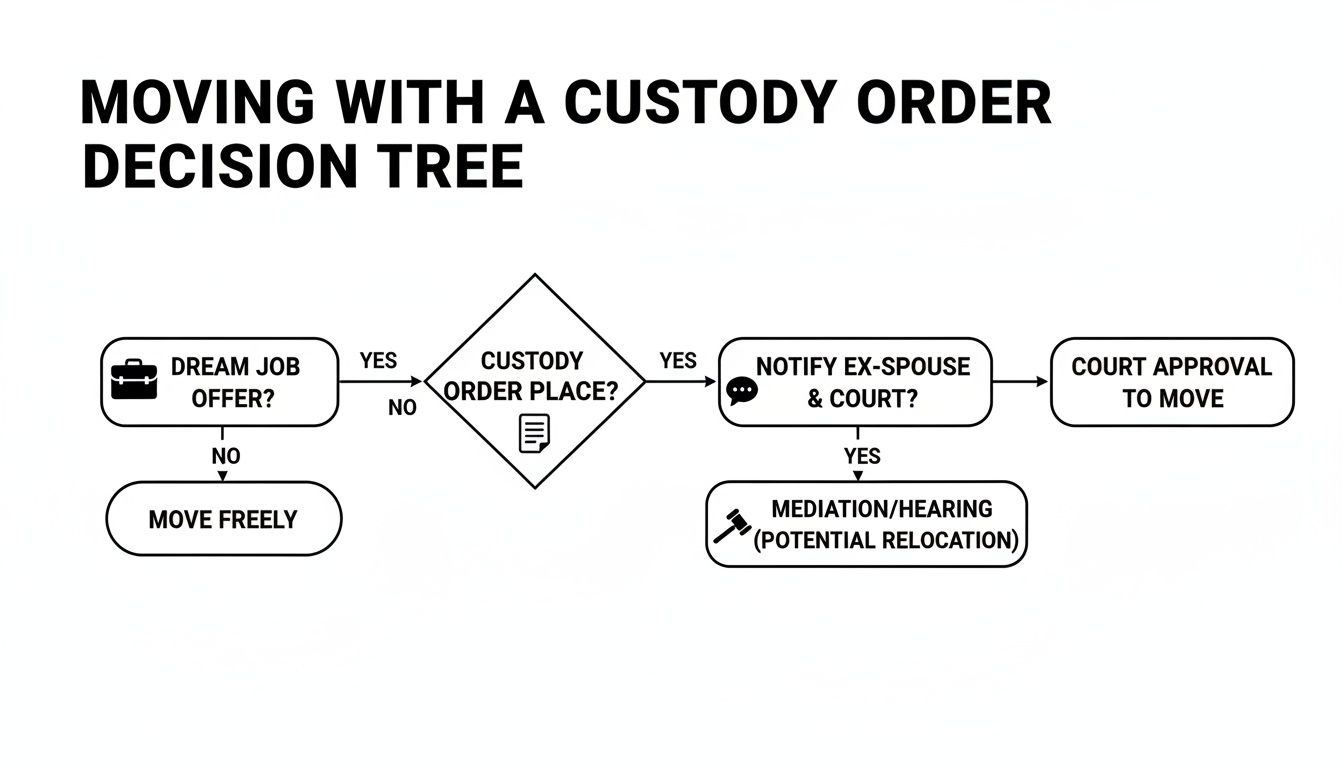
Life throws curveballs. A fantastic job offer, a new marriage, or the need to be closer to aging parents can all require a major move. But if you’re the primary parent and your custody order has a geographic restriction, you can't just pack the moving truck. You must get the court’s permission first by modifying your order.
Do not try to bypass the legal process. A Montgomery County judge can, and often will, force you to bring the child back immediately. On top of that, you could be ordered to pay the other parent's attorney fees or, in a worst-case scenario, lose your right to decide where your child lives. The number one rule is non-negotiable: you must file a modification suit before you move.
The Formal Legal Process for Relocation
Asking a court to let you move is a formal lawsuit, officially called a Petition to Modify the Parent-Child Relationship. You’ll file this petition in the same Montgomery County court that handled your original custody case. You're asking the judge to agree that a "material and substantial change" has happened since the last order was signed, and that lifting the restriction is now in your child's best interest, as required by the Texas Family Code.
The burden of proof is entirely on you, the parent who wants to relocate. It's not enough to show that the move is great for you; you have to prove it's what's best for your child.
What if the Other Parent Agrees to the Move?
The easiest path is reaching an agreement with the other parent. If you can sit down, explain your reasons, and they consent to the move, you can finalize it with an Agreed Order to Modify.
A simple verbal "okay," however, isn't legally binding. To make it stick, the agreement must be put in writing, signed by both parents and the judge, and filed with the court. Without that signed order, the other parent could change their mind, leaving you in violation of the original restriction. If you're aiming for a cooperative path, you may want to learn more about divorce mediation in The Woodlands, which can help you create a solid, binding agreement.
Real-World Scenario
Picture this: Sarah is the primary parent of two kids in The Woodlands. Their custody order restricts the children’s residence to Montgomery and contiguous counties. Sarah gets a fantastic job offer in Austin—a major career step. The problem? Austin is outside the approved zone, and the kids' father, Mark, is a very active dad in nearby Spring. Sarah cannot just pack up and move. That would violate the order. To make the move legally, she must either get Mark's written agreement or file a Petition to Modify and convince a judge the move is in the children's best interest.
What to Do Next Checklist
- Review Your Current Order: Know the exact boundaries of your geographic restriction.
- Discuss Your Plans: Talk to the other parent. See if an agreement is possible.
- File a Petition to Modify: If you can't agree, you must file a lawsuit to formally ask the court for permission.
- Gather Your Evidence: Start collecting documents that show why the move is in your child’s best interest (e.g., better schools, safer neighborhood, a detailed visitation plan for the other parent).
Disclaimer: This article provides general information and is not legal advice. The law is complex and changes often. For advice specific to your situation, you should consult with a qualified family law attorney.
Whether you are seeking to move or need to respond to a relocation request, the stakes are high. Our attorneys understand the local courts and can help you build the strongest possible case. Schedule a consultation to discuss your specific circumstances and protect your family's future.
Enforcing Your Custody Order if a Parent Moves
What happens when you have a valid Montgomery County custody order with a geographic restriction, but the other parent ignores it and moves away with your child? It’s a gut-wrenching situation, but one you must act on immediately. This isn’t just breaking a rule; it’s a direct violation of a court order, and Texas law gives you a direct remedy: filing a Motion for Enforcement.

An enforcement action is a formal case you file with the same court that handled your original custody suit. The goal is simple: to ask the judge to force the other parent to follow the order and, most importantly, bring your child back. In these cases, time is not on your side. Acting quickly is the single best thing you can do to protect your relationship with your child and get them home.
The Consequences of Violating a Geographic Restriction
A Montgomery County judge will not be pleased with a parent who single-handedly disregards a court order. The Texas Family Code grants judges wide-ranging power to enforce their orders, and the consequences can be serious.
A parent who ignores the restriction could face:
- Contempt of Court: A serious finding that can lead to jail time or probation.
- Fines: The court has the authority to levy significant financial penalties.
- Paying Your Attorney's Fees: The judge can—and often will—order the violating parent to reimburse you for all the legal fees you had to spend.
- Loss of Custody Rights: For severe violations, a judge can take away the other parent's right to decide where the child lives and give that exclusive right to you.
Real-World Scenario
A father in Conroe gets a tip that his child’s mother packed up and moved with their son to Waco to live with a new boyfriend, a clear violation of their Montgomery County order. He immediately contacts his attorney. Together, they gather proof: screenshots of the mother's social media posts showing off her "new life" in Waco, a copy of the new apartment lease she signed, and enrollment papers from the child's new school. Armed with this concrete evidence, their Motion for Enforcement becomes incredibly powerful.
What to Do Next Checklist
If you discover the other parent has moved with your child in violation of the custody order, you need to be strategic. Follow these steps immediately:
- Do Not Take Matters into Your Own Hands: It’s tempting to drive over and demand your child back, but this can backfire. Avoid heated arguments. Let the court system do the heavy lifting.
- Document Everything: Start a file. Gather any texts, emails, social media posts, or information about a new school or address that proves the move.
- File a Motion for Enforcement Immediately: Don't wait. The longer you delay, the more settled the child becomes in the new location. Contact a family law attorney to get the paperwork filed in the Montgomery County court right away.
- Request the Return of the Child: Your attorney will ask the judge for a temporary order demanding the immediate return of your child to Montgomery County while the case proceeds. For parents navigating these complexities, a general moving to a new state legal checklist can provide a broader view of interstate relocation issues.
Disclaimer: This article provides general information and is not legal advice. The law is complex and changes often. For advice specific to your situation, you should consult with a qualified family law attorney.
If you believe the other parent has violated your custody order, your child’s stability is on the line. Our firm understands the urgency of these situations and can help you take decisive action. Schedule a consultation to discuss enforcing your geographic restriction custody montgomery county order.
Your Next Steps: A Practical Guide for Parents
When a geographic restriction comes into play, it can feel like your world is shrinking. Whether you're the parent hoping to move or the one who just found out your child has been moved without your consent, knowing what to do next is crucial.
Let’s break down the immediate steps you should take.
If You Need to Move Out of the Restricted Area
A career opportunity, a new relationship, or the need to be closer to family might mean you have to relocate. If that new home is outside your geographic restriction custody montgomery county order, it's vital to handle it the right way.
What to do next:
- Read Your Order Carefully: Your first step is to pull out your final decree and find the exact language of the restriction. Know your exact boundaries.
- Talk to the Other Parent: Before running to the courthouse, try talking it out. The simplest path is reaching an agreement with the other parent.
- File a Petition to Modify: If you can’t agree, you must file a lawsuit, called a Petition to Modify the Parent-Child Relationship, asking the judge to lift the restriction. You must do this before you move.
- Build Your Case: You’ll need to convince the judge the move is in your child’s best interest. Gather evidence now: information about the new home and neighborhood, school ratings, and a detailed proposal for a long-distance possession schedule. A general moving to a new state legal checklist can also give you a broader sense of the legal details involved.
If the Other Parent Moved Without Permission
That sinking feeling you get when you discover the other parent has taken your child and moved out of the area is a true emergency. It's a direct violation of a court order, and you need to act quickly and correctly.
What to do next:
- Don't Act on Your Own: As tempting as it might be to confront them, this can backfire. Let the court system do the heavy lifting.
- Document Everything: Screenshot social media posts, save text messages, and gather any information you can find about the new address. This is crucial evidence.
- File for Enforcement Immediately: This is not a "wait and see" situation. Your attorney will need to file a Motion for Enforcement right away. The Texas Family Code provides powerful tools for judges to order the immediate return of the child.
- Hire a Local Montgomery County Attorney: You need a lawyer who knows the local judges and court procedures. You can find more details about working with a Woodlands divorce lawyer and see how local experience is a significant advantage.
Disclaimer: This article provides general information and is not legal advice. The law is complex and changes often. For advice specific to your situation, you should consult with a qualified family law attorney.
Whether you're trying to move or trying to bring your child back home, navigating a geographic restriction is high-stakes. If you're facing a relocation issue in The Woodlands, Conroe, or anywhere in Montgomery County, schedule a consultation with our team. We can help you protect your rights and your child's best interests.
Frequently Asked Questions About Geographic Restrictions
When I sit down with parents from The Woodlands and across Montgomery County, the same worries about geographic restrictions almost always surface. It’s a stressful topic, so let's walk through some of the most common questions I hear every day.
Can a Jury Decide My Relocation Case?
No. While you can have a jury weigh in on some major custody decisions, the Texas Family Code is very clear that the judge—and only the judge—gets to decide the specific terms of your parenting plan.
That includes where the children live. When it comes to lifting a geographic restriction, the final decision rests solely with a Montgomery County judge. It's their call, not a jury's.
What if My Order Has No Geographic Restriction at All?
Many parents assume that if their order is silent on where they can live, they can move anywhere. This is a risky assumption. While it’s technically true that the parent who establishes the child's residence can move without getting the court's permission first, it's not the end of the story.
The other parent has every right to go back to court and ask a judge to put a stop to it. They can file a new suit, arguing the move isn't in the child's best interest and harms their relationship, and ask the judge to impose a restriction.
Real-World Scenario
A mother in Conroe has an order with no location boundaries and lands a fantastic new job in Dallas. If she just packs up and moves, the father can immediately file a motion asking a judge to order the child to remain in Montgomery County. His argument will be all about the child's stability and protecting his time with them.
How Does a 50/50 Possession Schedule Change Things?
A true 50/50 possession schedule makes getting permission to move significantly harder. The entire point of a 50/50 plan is to give both parents nearly equal time and involvement.
A long-distance move completely shatters that arrangement. Judges are very protective of these schedules because they represent a high level of co-parenting. They will be incredibly hesitant to approve a move that makes a balanced 50/50 plan physically impossible to maintain.
Does the Restriction Automatically End When My Child Turns 18?
Yes. All parts of a custody order, including any rules about where you can live, expire when the child turns 18 or graduates from high school, whichever happens last. At that point, the court's involvement in that aspect of your life comes to a complete end.
What to Do Next Checklist
- Read Your Order: The answers to most questions start with the exact text of your current custody order.
- Understand 50/50 Impacts: If you have a 50/50 schedule, recognize that any move will be an uphill battle.
- Know the Age Limit: Remember that all these rules end when your child becomes an adult.
- Get Legal Advice: Never assume. An order's silence on an issue doesn't mean you have total freedom.
Disclaimer: This article provides general information and is not legal advice. The law is complex and changes often. For advice specific to your situation, you should consult with a qualified family law attorney.
Navigating a geographic restriction requires a clear understanding of your rights and obligations. If you have more questions or need help with a custody issue in The Woodlands area, we are ready to provide guidance. Schedule a consultation with us today to discuss your case.